
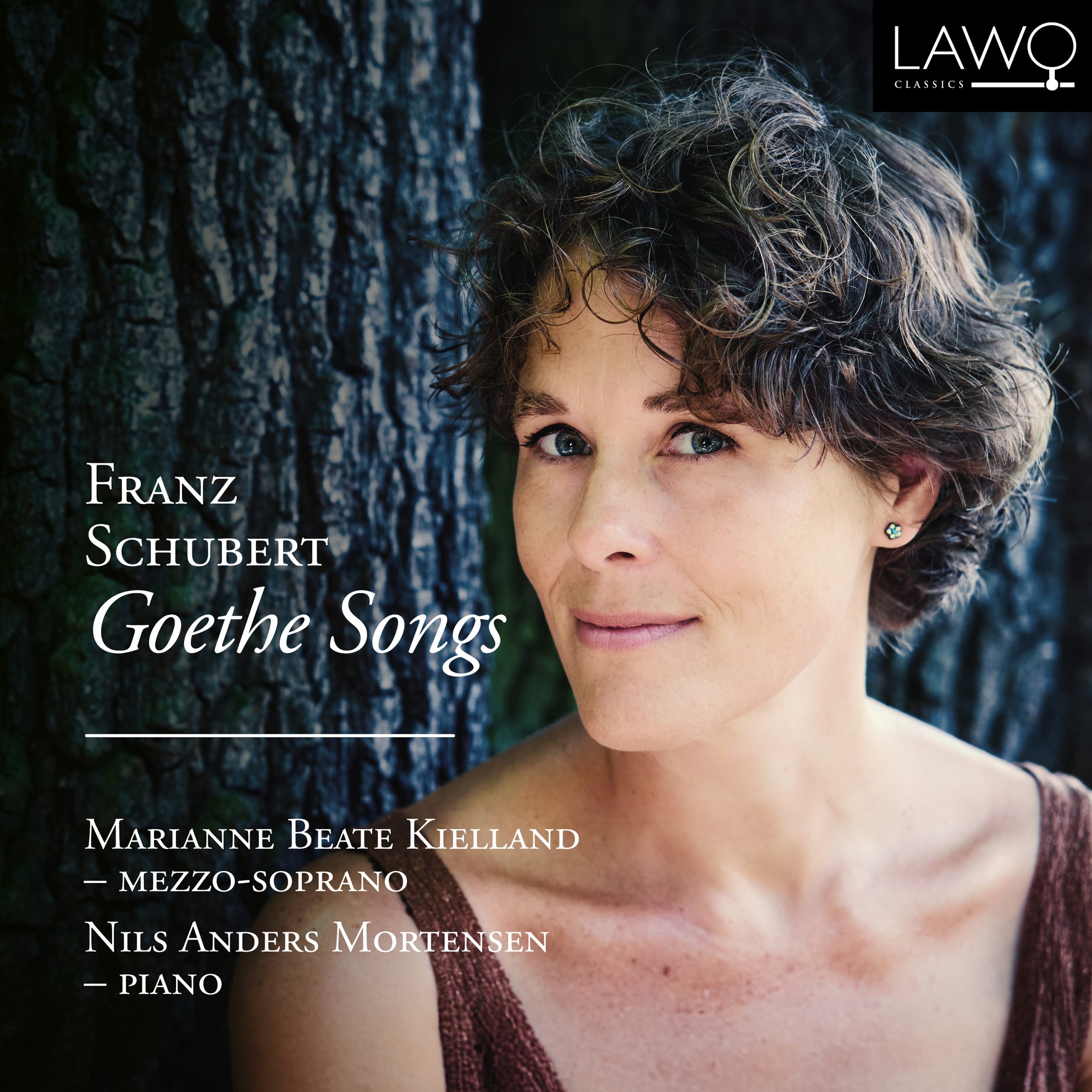
Goethe Songs
Marianne Beate Kielland (Mezzo-soprano) | Nils Anders Mortensen (Piano)
Stream & download
Tracks
Franz Schubert (1797–1828)
4 Gesänge aus 'Wilhelm Meister', D. 877
Mignons Gesang, D. 321
Credits
- Performer
- Marianne Beate Kielland (Mezzo-soprano) | Nils Anders Mortensen (Piano)
- Composer
- Franz Schubert
- Producer
- Vegard Landaas
- Engineer
- Thomas Wolden
- Editing
- Vegard Landaas
- Mastering
- Thomas Wolden
- Liner notes
- Marianne Beate Kielland
- English translation
- Jim Skurdall
- Executive producer
- Vegard Landaas
- Booklet editor
- Torgeir M. Landaas
- PR
- Camilla Momkvist-Skau
- Accounting
- Torgeir M. Landaas
- Artist photo
- Marianne Beate Kielland by David Dawson | Nils Anders Mortensen by Sebastian Ludvigsen
- Design
- Anna-Julia Granberg | Blunderbuss
- Recording location
- Sofienberg Church, Oslo
- Recording country
- Norway
- Recording year
- 2022
- Recording dates
- 07.06.2022 | 08.06.2022 | 09.06.2022 | 10.06.2022
- Original source
- DXD (352.8 kHz, 24 bit)
- Discs / tracks
- 1 disc | 16 tracks
- Produced with support from
- Arts and Culture Norway | The Audio and Visual Fund
- Release year
- 2024
- Label
- LAWO Classics
- Duration
- 59:08
- EAN
- 7090020183275
- ISRC
- NOEHX2431010/160
Booklet text
Schubert and I
by Marianne Beate Kielland
Throughout my long life as a recording artist "Schubert" has been a regularly recurring theme. But to the question of whether I should record an album of Schubert songs, my answer has been no. His songs are for me so masculine. My ears ring with the sound of fantastic tenors when I think of his lieder. And I have heard fabulous baritones do memorable versions of Schubert's more robust songs. Nor is a slightly desperate version of Gretchen am Spinnrad performed by a fine soprano something to be sneezed at. Yet I have not managed to see myself as the most natural interpreter of Schubert. And when I HAVE performed some of his lieder, I have recognised that this repertoire places greater demands on the performer than does the music of other composers: clarity, diction, intimacy, rhythm, lyrical expression, perfect intonation … indeed, it has been good training.
Then came the day when the topic of "Schubert" seemed even more urgent. Should we record an album of his songs? I remained hesitant, but wondered whether there might be among his roughly 600 songs a few texts more feminine than masculine? I am not an adherent of feigning the emotions of a man when I sing, so it would be out of the question for me to perform Die schöne Müllerin, for example, or Winterreise. But if one searches a little, one finds that Schubert did in fact set to music texts that tend to be more feminine than masculine: Goethe's Mignon-figure is an androgynous child with a complex existential and emotional state of mind, without the texts being either feminine or masculine. And Suleika — here the feminine comes to the fore, and indeed these two poems were written by a woman, Marianne von Willemer. She saw herself as Suleika and wrote them in the context of her correspondence with Goethe. He included them in his collection of poetry West-östlicher Divan, and the poems of Marianne von Willemer perhaps became known in this way.
In any case, the common denominator for the texts on this album is author Johann Wolfgang von Goethe. Goethe was a good deal older than Schubert, and the two reportedly never met. But like so many, many others at the time, Schubert was deeply fascinated by Goethe's texts, and he set to music more poems by him than by any other poet.
I decided that if I were to record an album of Schubert songs, it would include only texts by Goethe. For while the poems of Goethe reveal profound depth and intricate poetic language, a number of them are, in my eyes, "gender-neutral". They often tell a story without reference to a male or female voice.
So here we have a Schubert recording — with texts by Goethe. The choice of songs is not necessarily the most obvious. I have omitted "Gretchen am Spinnrade" (its strong feminine message notwithstanding!) and "Erlkönig" because there are in my opinion already so many marvelous interpretations of these songs. Nor have I included "Heidenröslein".
At the core of the collection for me are the five songs to Mignon. They illustrate the intense emotional life of the androgynous, abused child. Here Schubert's compositions are emotionally intense, and I have tried to recreate what I feel is there from his hand. The remaining selections include a variety of songs, a number of them serious, quiet, motionless, somewhat disturbing … for many of Goethe's texts invite us into such a world.
I have chosen to begin with the remarkable and melancholy story of the King of Thule in an attempt to set the mood for the songs that follow. And I end the album with the less familiar "Grenzen der Menschheit", about the relationship between the human and the divine. The poem concludes that humanity must know its place and not compete with the gods as to who is superior. Humankind must keep its feet on the ground — where it belongs. And I can say in the same breath that I also know my place among the world's great interpreters of Schubert throughout history. With this release I have tried to find my view of the greatest song composer of them all, and possibly show a slightly different side of him — one marked by uncertainty, melancholy and restlessness. For they also must have been present in Schubert's life. Kindly lend a friendly ear.
— Marianne Beate Kielland
Booklet translation: Jim Skurdall