
Stream & download
Tracks
Olav Berg (*1949)
Therese Birkelund Ulvo (*1982)
Ragnar Söderlind (*1945)
Horns in Landscapes
Marcus Paus (*1979)
Concerto for Timpani and Orchestra
Credits
- Conductor
- Edward Gardner | Andrew Litton | James MacMillan
- Performer
- Bergen Philharmonic Orchestra
- Symphony orchestra
- Bergen Philharmonic Orchestra
- Composer
- Olav Berg | Therese Birkelund Ulvo | Ragnar Söderlind | Marcus Paus
- Producer
- Gunnar Herleif Nilsen
- Engineer
- Gunnar Herleif Nilsen | Håkon Gunnby
- Mastering
- Thomas Wolden
- English translation
- Jim Skurdall
- Executive producer
- Vegard Landaas
- Booklet editor
- Hege Wolleng
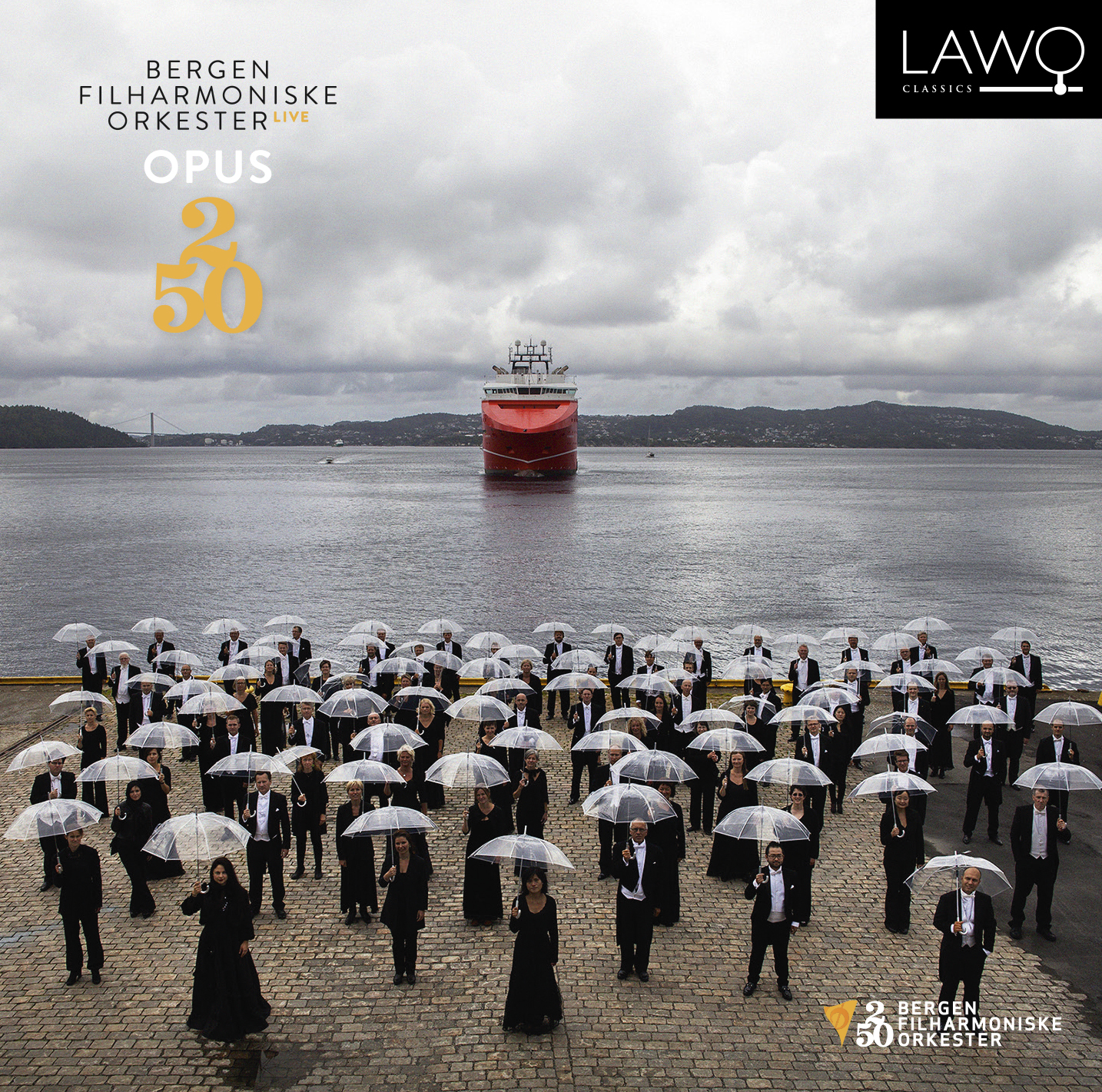
- Cover photo
- Oddleiv Apneseth
- Design
- Anette L’orange | Blunderbuss
- Recording location
- Grieghallen, Bergen
- Recording country
- Norway
- Recording year
- 2015
- Recording dates
- 15.01.2015 | 15.02.2015 | 19.02.2015 | 20.02.2015 | 26.03.2015 | 27.03.2015
- Original source
- 96 kHz, 24 bit
- Discs / tracks
- 1 disc | 8 tracks
- Produced with support from
- Arts and Culture Norway
- Release year
- 2015
- Label
- LAWO Classics
- Duration
- 72:56
- EAN
- 7090020181011
- ISRC
- NOEHX1513010/80
Booklet text
In celebration of its 250th anniversary, Bergen Philharmonic Orchestra has undertaken an unprecedented project of commissioning and premiering more than 20 new compositions. Contemporary music has always been central to the orchestra's tradition, which included performing the works of Haydn, Mozart and Beethoven while the ink was still fresh.
OPUS 250 is the name of this project dedicated not only to the composers represented, but also to the musicians of the orchestra, and particularly its own soloists. In fact, the four works presented on this CD are the result of initiatives taken by the soloists themselves to inspire and collaborate with Norwegian composers with whom they particularly identify.
The greater OPUS 250 endeavor also encompasses new works by esteemed Norwegian composers such as Ørjan Matre, Knut Vaage, Ketil Hvoslef, Henrik Hellstenius, Asbjørn Schaathun, Lasse Thoresen and Olav Anton Thommessen. They are joined by stellar international counterparts, including Peter Eötvös, Michel van der Aa, James MacMillan, Sebastian Fagerlund, Alissa Firsova, Lera Auerbach, Per Nørgård and Einojuhani Rautavaara.
The OPUS 250 project is an exemplification of Bergen Philharmonic Orchestra's commitment to the preservation of its tradition, while investing in the future of symphonic music.
OLAV BERG — VIOLA CONCERTO, JANUARY 2015
A dreamt concerto — One night a few years ago I heard an orchestral work with a soloist in a dream. When I awoke, the dream was still there. Dreams are often imprecise and incomplete, so I did not know which solo instrument it had been. However, the atmosphere was such that it had to be the viola: this wistful, melancholic alto singer — the blackbird of instruments. And there was something dream-like about the music, which was interrupted by aggressive moments in the orchestra. I needed a soloist, so I contacted a trusted friend and asked for advice. "Ilze Klava is one of the best violists I have heard," he said. And that turned out to be the truth!
Olav Berg spoke on the occasion of the premiere performance of his one-movement viola concerto, written in 2012. His musical creed is that listeners should listen with an open mind and follow their imagination. "It is only then that he or she will avoid passivity and become a co-creator," says Berg. And he has been successful in his communication with the audience. He enjoys great respect as a representative of moderate expression in contemporary music.
Berg is from Kvelde in Vestfold, but as a teenager he moved to Horten, where he played trumpet in the military band. Compositions for woodwind have a prominent place on his opus list. His double concerto for flute and bassoon will be performed by Dag Jensen (previously of Bergen Philharmonic Orchestra) and his wife Andrea Lieberknecht in Munich in February 2016. In 2000 the BFO commissioned a double bass concerto, which was dedicated to the soloist, Janne Johansson.
Berg studied theory and composition with Antonio Bibalo in Larvik and with Lennox Berkeley in London, and went on to teach theory himself at the conservatory in Stavanger for a year. Since then he has been a full-time composer. "Poseidon," an orchestral work, is his most frequently performed composition. It was first performed in 1983 by Oslo Philharmonic Orchestra, and represented Norway the following year at the International Rostrum for Composers in Paris. "Four Poems" (1993) shows an interesting development in Berg's musical expression. His neoromantic, expressionistic style from the 1980s became more concentrated, so that the material was cut down to the bone, and he was more concerned with sounds/harmonies/tone qualities than melodies.
He is now working on a piece for clarinet and bassoon which will have its first performance in London with clarinettist Matthew Hunt and solo bassoonist Amy Harman from the Philharmonia Orchestra.
THERESE BIRKELUND ULVO — SHADOWS AND SHIELDS, FEBRUARY 2015
Close dialogue — Therese Birkelund Ulvo, a composer from Bergen, often stresses this point: "I work first and foremost with people, not with instruments or paper." Her composition process often involves close conversation with the performer. Shaping her scores through exchanges with other musicians, and making sure to inspire active listening from the audience are very important principles for her. Her music is also inspired by other media such as film, text, and sound art, and lies in a place between the acoustic and the electronic. She had her first musical experience in the band at Skjold school, where she played together with Christian Stene. When he decided to continue his clarinet studies, Therese left her cornet behind and chose to create her own music. She received degrees from the Norwegian Academy of Music and Guildhall School of Music and Drama, where she studied with Lasse Thoresen and Diana Burrell, among others. She also has a close relationship to traditional Norwegian music.
Hild Borchgrevinck writes in the music journal Ballade: "Her music often stems from different forms of friction, noise and the overtones of instruments. The forms can seem open. Sometimes on the brink of improvisation. It is simultaneously very narrative. Openness gives both performers and audience great freedom to shape the music. On one level she is giving up control, yet on the other hand she achieves a closeness and direct contact with the listener."
Therese Ulvo was INTRO-composer in 2010-12, wrote the music for the performance "Heilage Sunniva" for Bergen International Festival in 2013, and assumed artistic leadership of Hardanger Music Festival last year together with singer and actress Tora Augestad, who is also from Bergen. When Bergen Philharmonic Orchestra, supported by the Arts Council Norway, commissioned new pieces in connection with its 250th anniversary, Christian Stene's first thought was that his old bandmate from Skjold school should take part. In the clarinet concerto of one movement, the composer's and performer's worlds collide. The soloist must adjust to an unfamiliar musical language, and the composer compromises by accommodating to his taste for order and system.
RAGNAR SÖDERLIND — HORNS IN LANDSCAPES, MARCH 2015
The role of the horn — Composer Ragnar Söderlind, who, like Bergen Philharmonic Orchestra, has an anniversary this year, was thrilled to get the commission to write a piece for his old instrument. Especially for six of them. With Peter Christian Asbjørnsen, Danish folk music and "Gurrelieder" as inspiration, he began exploring the horn's historical role in life and music.
Since the 1960s, Söderlind has been one of our most productive composers. He began composing in the music program at Hartvig Nissen High School in Oslo, and his "Jølsterslått" was performed by Oslo Philharmonic Orchestra when he was in his first year at the Music Conservatory of Oslo. He studied with Conrad Baden, Trygve Lindeman and Finn Mortensen there, and Joonas Kokkonen at the Sibelius Academy in Helsinki. In 1976, he took his diploma in orchestral conducting under Arvid Fladmoe.
His list of works is impressively long, comprising nearly one hundred compositions. Söderlind has written nine symphonies, seven operas, four ballets, six instrumental concerti, as well as chamber music and songs. Although he has expanded his harmonic language in recent years in the direction of free tonality and polytonality, he has never broken with what he considers the western musical tradition. Söderlind has taught for many years, and in 2001 became a professor in composition at the Norwegian Academy of Music. He has been vice-chairman of the Norwegian Composer's Union, and he was awarded the Lindeman Prize in 1996. This evening's piece is dedicated to Bergen Philharmonic Orchestra, its horn section, and chief conductor Edward Gardner. The commission is supported by Arts Council Norway.
As a teacher of composition, I often wondered at how little students had reflected on the horn's history, and on its use outside of music. The students needed a lot of background information to help them understand that the horn in fact has its origin in the animal kingdom. We have since recreated this primitive instrument using more sustainable materials, increased its size, added valves and thus given it a wide tonal range, but all this is part of its more recent history. The horn was used as a means of communication; to call and attract livestock, to scare away wild animals, and, not least, for hunting purposes. However, its round and warm tone can also create the most delicate atmospheres — of which Carl Michael Bellman reminds us in one of his Epistles.
When I received the commission from Bergen Philharmonic Orchestra to write a piece for six horns and orchestra, I began to reminisce about the experiences I had had at the music conservatory. I borrowed the title for the first movement from one of Asbjørnsen and Moe's fairy-tales, Fra fjellet og seteren (From the mountain and farm), however, the music does not tell that story. In this movement, we hear horn calls and signals taken from throughout Norway. When the summer farm is left vacant in the autumn, netherworldly beings take it over. With the dance, "Storhurven," they make their entrance and do not stop until the church bells ring. The soloists perform as pairs at a distance from the orchestra.
The second movement is composed around the Danish folk song "I skovens dybe, stille ro" (In the forest's deep, quiet stillness). Here, the horn shows its atmospheric character. The phrase "hvor sangerhære bor, der er idyllisk fred" (where armies of singers live, there is idyllic peace), can be seen in a different light. In this movement, four horns are placed in front of the orchestra and two behind. In the finale, they are all at the front. This is a variation on the hymn to the patron saint of hunting, Saint Hubert, who has been celebrated for hundreds of years in the Ardennes in Belgium. After an introduction, the hymn is presented. It is played without the use of valves, just like the hunting horns of old. The hunt begins relatively slowly and moves through different landscapes and moods, before increasing speed and becoming wild, verging on grotesque. Suddenly Hubert sees the shining crucifix in the great Hart's antlers. He cannot shoot Christ …
MARCUS PAUS — TIMPANI CONCERTO, FEBRUARY 2015
Utilization of resources — Marcus Nicolay Paus says that the thought behind his composition for timpani and orchestra has been to utilize the solo instruments' resources to the fullest and to explore the possibility of new timbres and expressivity. He wishes to celebrate Bergen Philharmonic Orchestra's anniversary with a concerto in which the orchestra is not simply an "accompaniment" and solo instruments also act as a "motor" for the orchestra.
The composer is the son of Norwegian musical artist Ole Paus and vocalist/journalist Anne-Karine Strøm. As a teenager he played electric guitar — an experience which is evident in some of his compositions. He studied at the Norwegian Academy of Music until 2002, then moved to New York to attend the Manhattan School of Music for three years. He is currently based in Berlin.
As a composer, Paus is defined by his preference for clear tonality and melody. He has expressed that he is not against modernism, but rather a supporter of diversity. He therefore uses a wide range of both time-honoured principles of composition and modern techniques. Many of his works are influenced by Norwegian folk music and non-western traditions.
In Paus's opinion, music should mirror all of human existence and experience. It should not only control and challenge, but also inspire joy, comfort and engage. He believes in the humanity of music, and that music is even more timeless than most contemporary composers like to admit. He believes there is a need for euphony and for melodies directed towards each individual.
Paus's opus list includes chamber music, choir pieces, orchestral music, operas, and music for theater, film and television. He has collaborated with a number of Norwegian musicians, and, taking inspiration from the visual arts, he has written four string quartets based on paintings by Edvard Munch, Halfdan Egedius, and Christopher Rådlund. Paus has also set poems by several Norwegian and non-Norwegian poets. Other collaborators include the ensemble Frikar and actress Minken Fosheim.
Paus has been artistic director for Oslo's Opera Festival. Ole Paus wrote libretti for two of his son's operas, "The Witches" and "Askeladden" (Pål's version), in addition to the text for his Requiem for bass-baritone and piano, first performed in 2014. August of the same year saw the international release of "Hate Songs," with lyrics by Dorothy Parker, performed by mezzo-soprano Tora Augestad and the Finnish chamber orchestra led by Jukka-Pekka Saraste.
— Hans H. Rowe
BERGEN PHILHARMONIC ORCHESTRA
One of the world's oldest orchestras, Bergen Philharmonic Orchestra dates back to 1765 and celebrated its 250th anniversary in 2015. Edvard Grieg had a close relationship with the orchestra, and served as its artistic director during the years 1880–1882. Andrew Litton led the orchestra from 2003 to October 2015; Edward Gardner, the acclaimed outgoing Music Director of English National Opera, was appointed Chief Conductor for a three-year tenure starting in October 2015. The orchestra's recording of the complete orchestral music of Edvard Grieg conducted by Ole Kristian Ruud remains a reference point in a competitive field, and its discography spans Chandos, BIS, Hyperion and Aurora, among others.
— Notes: Hans H. Rowe · English translation: James Lassen