
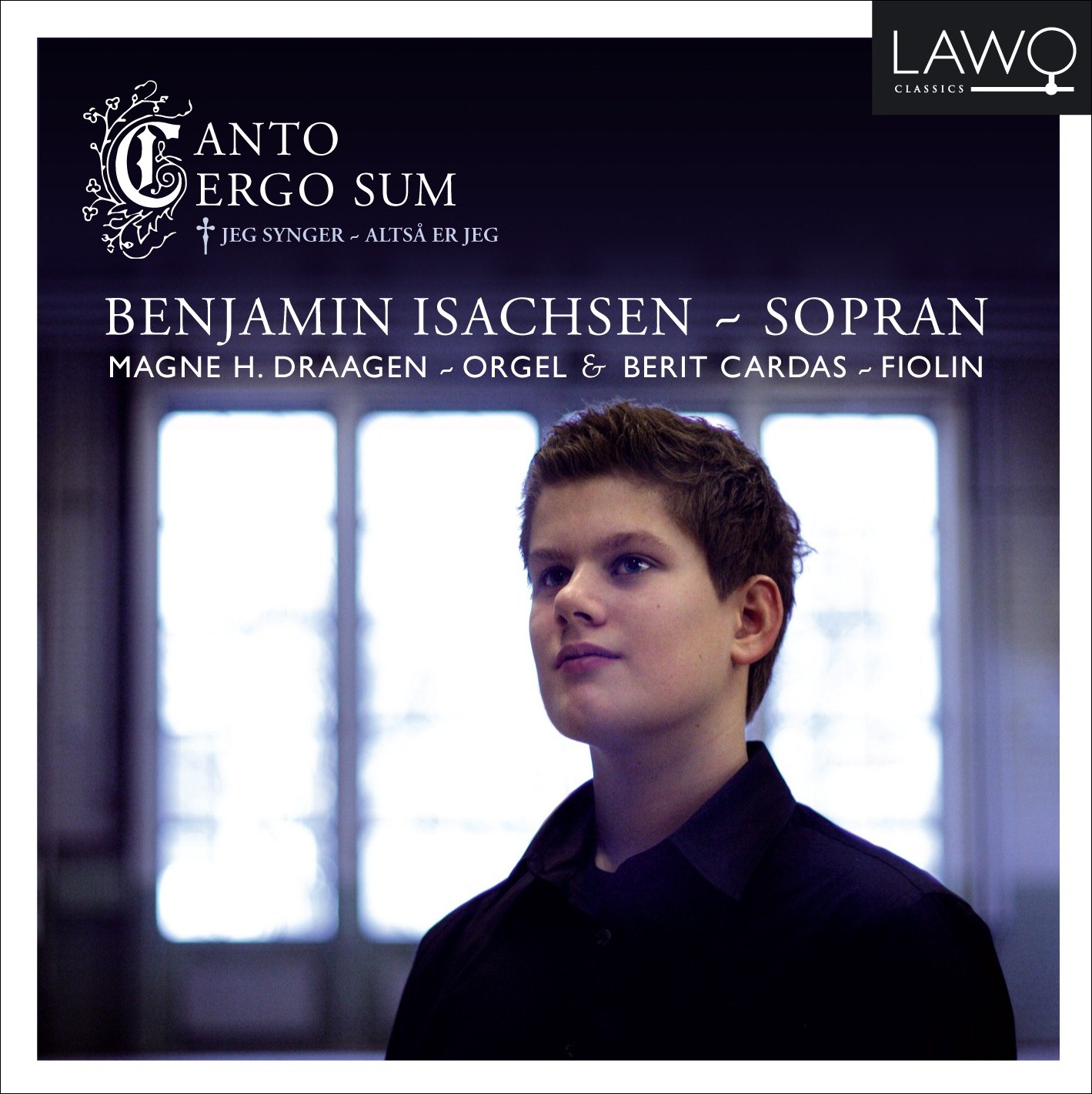
Canto Ergo Sum
Benjamin Isachsen (Soprano) | Magne H. Draagen (Organ) | Berit Cardas (Violin)
CLASSICAL BOY SOPRANO WITH SOLO RECORDING
When the time came for Benjamin Isachsen to find a title for this CD, he suddenly lit on the idea of putting a slightly new twist on Descartes’ famous maxim on doubting, thinking, and being. You see, singing for Benjamin is about being alive, being free, fully realizing himself. He sings, therefore he is. “When I sing,” Benjamin says, “I feel an inner calm, as though I am floating, floating in full control.”
The CD presents a broad repertoire within the classical music genre with reference both to musical periods and to language and tradition. Descartes proceeded from doubt to thought and concluded that he existed. Good art which survives does not create itself. Art is born out of a disruption we may call doubt. The musical works presented here originate perhaps from a different kind of doubt and inner struggle than that with which Descartes was so absorbed. Yet, the sustainability of the songs suggests that they are capable of encompassing doubt and disruption in a way that can also fortify us and give us life. These pieces leave us with the feeling of being alive.
Listen
Tracks
Georg Friedrich Händel (1685–1759)
Messiah, HWV 56, Part II
Magne H. Draagen (organ) | Benjamin Isachsen | Berit Cardas
Johann Sebastian Bach (1685–1750)
Gabriel Fauré (1845–1924)
Requiem, Op. 48
Magne H. Draagen (organ) | Benjamin Isachsen
Trond H.F. Kverno (*1945)
Jeremia
Magne H. Draagen (organ) | Benjamin Isachsen
Joseph Haydn (1732–1809)
Mass No. 7 in B-Flat Major, Hob.XXII:7, "Missa brevis Sancti Joannis de Deo", "Kleine Orgelsolomesse" (Little Organ Mass)
Magne H. Draagen (organ) | Benjamin Isachsen
Franz Schubert (1797–1828)
Ellens Gesang III (Ave Maria!), Op. 52, No. 6, D. 839
Magne H. Draagen (organ) | Benjamin Isachsen
Kjell Mørk Karlsen (*1947)
Geoffrey Burgon (1941–2010)
Felix Mendelssohn (1809–1847)
Hear my prayer, MWV B49
Magne H. Draagen (organ) | Benjamin Isachsen
Johann Sebastian Bach (1685–1750)
Anna Magdalena Notenbuch (Clavier-Buchlein III)
Magne H. Draagen (organ) | Benjamin Isachsen
Traditional
Sigfrid Karg-Elert (1877–1933)
Reviews
A brilliant boy soprano: Benjamin Isachsen makes a beautiful debut with this CD.…
Show more Show less
A brilliant boy soprano: Benjamin Isachsen makes a beautiful debut with this CD. Through a wide range of music, we are treated to a brilliantly clear boy soprano voice. The voice has many dimensions to it, and there is a vulnerability in it, as if both Isachsen himself and everyone around him know that it is temporary.Show original
Strålende guttesopran Det er en vakker cd Benjamin Isachsen debuterer med. Gjennom et bredt spekter av musikk får vi presentert en strålende klar guttesopran-stemme. Stemmen har mange dimensjoner i seg, og det er en sårbarhet i den, som om både Isachsen selv og alle rundt ham vet at den er midlertidig.
 Bergens Tidende
Norwegian
Something as rare as a Norwegian boy soprano.…
Show more Show less
Something as rare as a Norwegian boy soprano. A sparklingly pure boy soprano. The recording demonstrates, first and foremost, just how vulnerable this vibrato-free child’s voice really is. It therefore also serves as an embodiment of the CD’s existential title, which perfectly captures what this recording is really about. You’d be hard-pressed to find purer intonation.Show original
Noe så sjeldent som en norsk guttesopran. En tindrende ren guttesopran. Innspillingen viser først og fremst hvor sårbar den vibratoløse barnestemmen egentlig er. Derfor blir den også et utrykk for den eksistensielle tittelen på cd-en, som er et meget godt utrykk for hva denne innspillingen egentlig handler om. Renere intonering skal man lete lenge etter.
 Adresseavisen
Norwegian
The boy with the youthful voice. There is no doubt that this is a musician whose performance is underpinned by a solid musical instinct.…
Show more Show less
The boy with the youthful voice. There is no doubt that this is a musician whose performance is underpinned by a solid musical instinct. In Schubert’s ‘Ave Maria’, for example, he shines in the high notes, and it sounds as beautiful as only a boy soprano can make it sound.Show original
Gutten med den unge stemmen. Det er ingen tvil om at dette er en musiker som har en solid musikalsk nerve i fremføringen. I for eksempel Schuberts «Ave Maria» glitrer han i høyden, og det låter så bra som bare guttesopran kan gjøre.
 VG
Norwegian
Now that he is about to retire as a boy soprano, someone has had the brilliant idea of releasing a CD on which he performs many of the best-known songs and arias for this voice type.…
Show more Show less
Now that he is about to retire as a boy soprano, someone has had the brilliant idea of releasing a CD on which he performs many of the best-known songs and arias for this voice type. And it has turned out to be a splendid testament. Benjamin impresses with his rich, full, clear tones. His intonation is flawless and he phrases like a mature musician, with beautiful lines. The highlights are Mendelssohn’s ‘Dove’ and Gabriel Fauré’s marvellous ‘Pie Jesu’, from the ‘Requiem’. It sounds so beautiful that it sends shivers down your spine.Show original
Nå som han er i ferd med å gå av med pensjon som guttesopran, har noen fått den glimrende ideen å utgi en CD, der han framfører mange av de mest kjente sanger og arier for denne stemmetypen. Og det er blitt et flott testament. Benjamin imponerer med store, runde, klare toner. Hans intonasjon er prikkfri og han fraserer som en moden musiker, med flotte linjer. Toppen er Mendelssohns «Dove» og Gabriel Faurés vidunderlige «Pie Jesu», fra «Requiem». Det er så velklingende at man fryser på ryggen.
 Dagsavisen
Norwegian
Credits
- Performer
- Benjamin Isachsen (Soprano) | Magne H. Draagen (Organ) | Berit Cardas (Violin)
- Composer
- Georg Friedrich Händel | Johann Sebastian Bach | Gabriel Fauré | Trond H.F. Kverno | Joseph Haydn | Franz Schubert | Kjell Mørk Karlsen | Geoffrey Burgon | Felix Mendelssohn | Sigfrid Karg-Elert
- Arranger
- Magne H. Draagen | Martin Neary | Kåre Nordstoga
- Lyricist
- J.H. Till | Eivind Skeie | Åse-Marie Nesse | Laurentius L. Laurinus | Paul Gerhardt
- Producer
- Vegard Landaas
- Engineer
- Thomas Wolden
- Editing
- Vegard Landaas
- Mastering
- Thomas Wolden
- Liner notes
- Elisabeth Thorsen | Benjamin Isachsen
- English translation
- Jim Skurdall
- Executive producer
- Vegard Landaas
- Booklet editor
- Vegard Landaas
- Cover photo
- Anna-Julia Granberg
- Artist photo
- Benjamin Isachsen by Lars O. Flydal | Benjamin Isachsen by Gunnar Klingvall
- Design
- Anna-Julia Granberg | Blunderbuss
- Recording location
- Ullern Church, Oslo
- Recording country
- Norway
- Recording year
- 2008
- Recording dates
- 19.06.2008 | 20.06.2008 | 24.08.2008
- Original source
- 96 kHz, 24 bit
- Discs / tracks
- 1 disc | 13 tracks
- Release year
- 2009
- Label
- LAWO Classics
- Duration
- 53:47
- EAN
- 7090020180045
- ISRC
- NOEHX0902010/130
Booklet text
Canto Ergo Sum
When the time came for Benjamin to find a title for this CD, he suddenly lit on the idea of putting a slightly new twist on Descartes' famous maxim on doubting, thinking, and being. For Benjamin, singing is about being alive, being free, fully realizing himself. He sings, therefore he is. "When I sing," Benjamin says, "I feel an inner calm, as though I am floating, floating in full control."
The CD presents a broad repertoire within the classical genre, drawing on different musical periods, languages and traditions. Descartes proceeded from doubt to thought and concluded that he existed. Good art which survives does not create itself. Art is born out of a disruption we may call doubt. The musical works presented here originate perhaps from a different kind of doubt and inner struggle than that with which Descartes was so absorbed. Yet, the sustainability of the songs suggests that they are capable of encompassing doubt and disruption in a way that can also fortify us and give us life. These pieces leave us with the feeling of being alive.
As a member of the Oslo Cathedral Boys' Choir over a period of ten years, Benjamin has acquired a rich musical vocabulary which has challenged and enriched his thinking, faith, and emotions. Of the repertoire he says: "These are the songs that have meant the most to me in the course of my development. Here you find everything I have loved to sing. It is music of such high quality that I feel I am a part of something greater than myself when I sing it."
One wonders quite naturally what it is about this musical tradition which continues to appeal to new generations. Why do new voices perpetuate it? Is it perhaps the transcendent character of the selected works, the experience that these melodies and texts put us in contact with something which is greater than, yet, at the same time, part of ourselves? Do we derive comfort from the melodies, or find courage in the words? Are our lives encompassed by hope as by the starry heavens? Is there contact with the past and the future, with heaven and earth, all at the same time? Do the songs contain the doubt within us and bear testimony that doubt can be transformed into song? No one knows entirely what it is, only that it exists. And we know that these selected works have life-giving power in themselves.
As a small boy Benjamin said that he "wanted to sing to make others happy." And precisely that is what he hopes to achieve with this recording: To share with others the joy which singing and music have brought to him.
— Notes: Elisabeth Thorsen & Benjamin Isachsen · English translation: Jim Skurdall