
Listen
Tracks
Ketil Hvoslef (*1939)
Fartein Valen (1887–1952)
Klaus Egge (1906–1979)
Credits
- Performer
- Ricardo Odriozola (Violin) | John Ehde (Cello) | Einar Røttingen (Piano)
- Piano trio
- Valen Trio
- Composer
- Ketil Hvoslef | Fartein Valen | Klaus Egge
- Producer
- Vegard Landaas
- Engineer
- Thomas Wolden
- Editing
- Vegard Landaas
- Mastering
- Thomas Wolden
- Piano tuner
- Thron Irby
- Liner notes
- Arvid O. Vollsnes
- English translation
- Jim Skurdall
- Executive producer
- Vegard Landaas
- Booklet editor
- Hege Wolleng
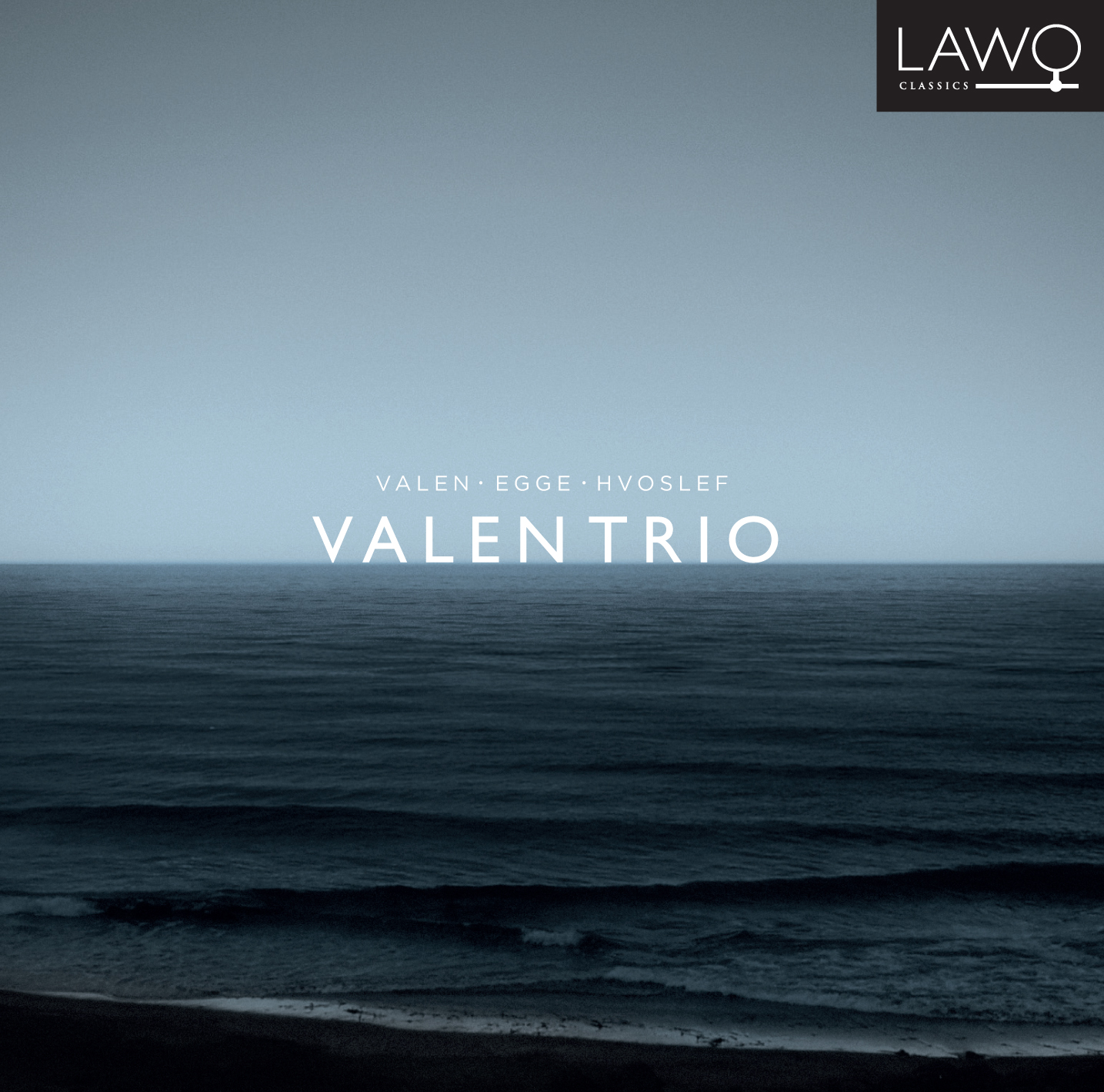
- Cover photo
- Blunderbuss / Anette l'Orange (cover), Anna-Julia Granberg, Blunderbuss (artist)
- Artist photo
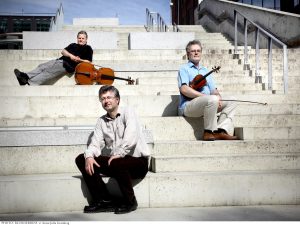
- Valen Trio by Anna-Julia Granberg
- Design
- Anette L’orange | Blunderbuss
- Recording location
- Sofienberg Church, Oslo
- Recording country
- Norway
- Recording year
- 2011
- Recording dates
- 20.06.2011 | 21.06.2011 | 22.06.2011 | 23.06.2011
- Original source
- 96 kHz, 24 bit
- Discs / tracks
- 1 disc | 9 tracks
- Produced with support from
- Arts and Culture Norway | Grieg Academy | University of Bergen
- Release year
- 2013
- Label
- LAWO Classics
- Duration
- 1:08:05
- EAN
- 7090020180380
- ISRC
- NOEHX1207010/90
Booklet text
A Trio of Trios — Valen, Egge, Hvoslef
Three trios have been selected for this recording from three generations of Norwegian composers. They trace an interesting line, both historically and musically, through the past one hundred years.
All three works bear the simple title "Trio". There is nothing descriptive or expressive, and no familiar program in this title. Each challenged the listener of its period, in particular because each composer wanted to break new ground and use new compositional means to dissociate the music from its prevailing features, above all, tonality. The pieces are still so interesting and distinctive that they challenge our habits and the usual manner in which we experience music.
Piano trio – the description encompasses so many aspects. One of them is sound. The violin and cello enable a string sound with a wide register, while the piano provides us with great range and varied dynamics. Together, the instruments can achieve remarkable diversity of expression through melodic, harmonic, and timbral treatment, and, not least, the entire breadth of articulation, phrasing, and expression. The trio can sound large and powerful, or intimate. Other times it can span from the percussive over plastic melodies and lines to crystal-clear flageolets.
Yet equally diverse have been the intentions of the trio. We remember the divertimenti of Haydn and Mozart, and Beethoven's doubleness. In the 1800s, piano trios with or without voice were extremely popular in homes and as public entertainment. A trio could replace an entire orchestra at a café, restaurant, or spa. And there were a great many arrangements of folk music, operas and symphonies, and dances and songs published for piano trio.
The piano trios of Mendelssohn, Schumann, Brahms, Dvořák, and Tchaikovsky were repeatedly performed in the concert halls. In Norway, Edvard Grieg's melodic and harmonic gem was not performed as it is today. The opposite fate awaited the trios of Christian Sinding, on the other hand; they were performed internationally during his lifetime, but today, unfortunately, are seldom played. Yet they can be rediscovered, along with the Trios of Catharinus Elling, Gerhard Schjelderup, and Sigurd Lie.
Fartein Valen (1887–1952): Trio for Violin, Cello, and Piano
Moderato — Scherzo. Allegro — Largo — Finale. Allegro molto
It was not so many years ago that certain musicians tended to steer clear of Valen's atonal music. It was regarded as interesting and distinctive, but also as difficult to play. For Valen, his trio was a transitional work from his late Romantic tonal compositional style to atonal expression. Plans for a trio began in Berlin in 1912 following his studies there at the Academy of Music. He supported himself during these years as private tutor, pianist, and vocal coach for singers rehearsing new repertoires. The sketches and preliminary work on the trio, more than 1,200 pages, have been preserved. From 1917–1924 Valen stayed at the family farm in Valevåg and used the work on the trio to explore what he called "the new counterpoint"— modern music based on traditional counterpoint (Bach) combined with a more modern tonality (that of Max Reger, for example), which would eventually lead to atonal counterpoint.
Valen wrote the following to Tove Mohr in a letter from Valevåg dated 24 August 1920:
With each passing day I become ever more certain that it is the only path for me, yet it seems an endless task. Progress on the trio is exceedingly slow, but I haven't lost courage. I received Schoenberg's orchestra pieces and was so excited I didn't sleep the next night. He has come an infinitely long way, so much further than our foolish efforts here at Valevaag. He has complete mastery of counterpoint; my only consolation is that nothing he does is unintelligible to me—so my studies have born fruit. I can assure you that I look forward to each new day; it seems like I have just begun to speak my own language.
The Trio turned into a strong, self-contained work. It was accepted by the publisher Norsk Musikforlag in 1927, but three years passed before it was printed, and yet another six months before it was premiered by three young musicians—violinist Gunnar Knudsen, cellist Sverre Krøvel, and pianist Melvin Simonsen, all of whom would come to have an influence on Norwegian musical life.
Valen was a celebrity in 1931, and his music remained one of the central themes of the modernism debate in Norway. Critic Ulrik Mørk, reviewing the premiere of Valen's Trio in the 20 May 1931 issue of Nationen, wrote: "Never has a man of the revolution looked more peaceful and modest than Fartein Valen, and yet as composer he is an ardent revolutionary." The University's venerable Great Hall was filled to capacity, not least because of the high expectations generated by an article in Aftenposten by composer David Monrad Johansen when the score was published. Claiming that Valen had broken new ground, Johansen wrote in part: "And what is particularly captivating is the ardent passion which has no connection with the tangible world but seems rather to derive its impressions and sustenance entirely from the realm of the spirit, whose knights still inhabit this earth. The perspective of the infinite is not alone an existing value, but equally an inexhaustible source of inspiration for the highest forms of art." And in Bergen, Harald Sæverud had written: "From the first to the last measure, the Trio is a brilliant work that ought to earn both fame and fortune for its creator. But our home audiences are hardly mature enough to judge the unique phenomenon of Fartein Valen." The audience in the Great Hall was, nonetheless, filled with enthusiasm.
Klaus Egge (1906–79): Trio Op. 14
Allegro con impeto — Adagio — Scherzo. Presto — Finale. Sostenuto – Allegro appassionato
One generation after his death, Klaus Egge has had the misfortune of being better known as writer, critic, and organizational leader than composer. He was a towering figure in the musical landscape, remembered for having created and developed propitious conditions for musicians and composers, especially as head of the Norwegian Society of Composers for an entire generation. But now some of his music is also beginning to be resurrected.
Valen's European modernism gave rise to other forms of radical music in Norway, including a variant of Norwegian national modernism. Harald Sæverud was among those who shaped it on the basis of trends other than Valen's ideals, closer to Hindemith than to Schönberg. In the 1930s there was an upswing in musical "heimstaddiktning" intimately connected with a composer's birthplace or home. And with roots in Telemark, Gudbrandsdalen, Hardanger, and Nordfjord there were some composers who adopted musical elements from broader European trends, especially from the catch-all imprecisely labeled neoclassicism.
At the time Valen's Trio was premiered, Klaus Egge was one of his pupils. Egge travelled from Porsgrunn to Oslo to receive instruction. Valen based his teaching on J. S. Bach's chorales, inventions, and Wohltemperiertes Klavier. It enabled the pupils to learn all the fundamental elements of music and see the apparent "set pattern" governing their relationships to one another. And then it was a matter of facing the challenges at hand and determining what devices to use. When Egge had completed his large piano sonata (Draumkvæde, 1934), he set off for Oslo and Berlin, in order to "discover Telemark". The journey of discovery entailed discarding the styles and attitudes of Romanticism and abstracting and synthesizing basic elements from Norwegian folk music that could serve as the building blocks and glue of his own music. In that period, his music was to be masculine, insistent, and animated, with Central European sound and counterpoint. From the works Fantasi i halling, Fantasi i gangar, and Fantasi i springar to Symphony No. 1 and Piano Concerto No. 2 (1944), these are the dominant elements, together with certain "Norwegian" building blocks, such as recognizable rhythmic forms from folk dance, the many open fifths, and ornaments and melodic phrases familiar from fiddle music. Egge binds it all together with a distinctive tonality, which often can be categorized as built on synthetic scales, and a rather free use of dissonances.
Egge wrote first for a different instrumentation, Wind Quintet (Opus 13), before he composed his Trio, Opus 14. In the manuscript, Egge included the following in the form of a little poem:
This work was written
Jan. – July 1940.
The tension and anxiety
enveloping us runs as
an undertone through all the movements.
Oslo 10—8—1940
The premiere of the Trio took place in the University Aula in Oslo on 8 February 1941, before the call for a concert boycott had come from the resistance movement. The Norwegian Society of Composers had arranged a concert it called "Utstilling" ("Exhibition"), with three piano trios. Alongside Egge's, the trios of Karl Andersen and Aage Myklegaard were performed by prominent musicians—pianist Amalie Christie, cellist and composer Karl Andersen, and violinist Oscar Holst.
Ketil Hvoslef (b. 1939): Trio (2010)
It is difficult to decide whether Hvoslef is a modern musical dramatist who occasionally slips into chamber music attire, or whether he is a classical chamber musician who borrows scenery, costumes, and effects. There have been productions of more than twenty of his musical dramas, and an even greater number of his chamber works. And all are, in a sense, untraditional, both in relationship to his own activities as a composer, and to the music of his time. There is something unique about Hvoslef's entire output. The works are difficult to categorize, but we detect his fingerprints on everything he has composed. In particular, there is something very special about his tonal world and his relationship to musical time. Whether he is entertaining us and the musicians or expressing anguish of the spirit, the experience is genuine. It is a musician speaking. It has been said of Hvoslef that he is so conscious of how he expresses himself musically that he chooses devices in part based on what is suitable for the occasion, and in part from the given musical framework, and what he himself calls "necessity in the material's musical development". He also has an eye to the premises and expectations of the musicians and audience. Yet, being as particular as he is, he does not resort to easy solutions, hackneyed phrases, or cheap points.
To have chosen such a short and almost minimalistic title as Trio is also characteristic of him. And the spareness is also evident in the music. There is a kind of "ecological" recirculation both in the motifs and the use of time. It is neither overloaded nor over-explanatory, and the music has ample space to live and develop as music. There is a twenty-minute development of repetitions that create recognition.
Much has been written about Hvoslef's original and vivid tonal imagination, and it is absolutely vital, also for Trio. It may not have the same multiple layers as others of his works, but here the rhythmic drive of the group as a whole often is deliberately set up against longer solo passages for each instrument. It becomes the performers' concertizing music.
Hvoslef wrote Trio during the summer of 2010. He tells of listening to Valen Trio perform in Bergen in January 2010 and of being filled with enthusiasm for the musicians, both as individuals and as a group, during their performance of Tchaikovsky's Trio in A Minor. He then decided to write a trio for them, and shared his enjoyment of the work and the performance with both musicians and audience at the successful premiere in Bergen on 14 May 2011 during the Avgarde concert series for New Music.
— Notes: Arvid O. Vollsnes · English translation: Jim Skurdall
Biographies
Ketil Hvoslef
Ketil Hvoslef (b. 1939) became a composer almost by chance. As a young man he had planned to become a painter and studied at the Bergen Academy of Art, where he met Inger Bergitte Flatebø, who was to become his wife. Hvoslef soon realised he had to make a living, and went on to take his organ exam.
Well into his eighties, Ketil Hvoslef continues to write music at a furious pace. He has written for many thinkable and unthinkable ensembles, often relishing the challenge of working with potentially hopeless» instrumental combinations. He is Norway’s most prolific composer of con certos, with 20 to date. He has written three operas, numerous works for orchestra, and a wealth of chamber music. Hvoslef’s vo cal music is of particular interest in that it includes, for the most part, nonsense texts. Aware of the main pitfall of the Bel Canto tradition, where the beauty of tone in the vowels often results in the unintelligibility of the text, Hvoslef usually constructs his own meaningless words in order to under line the character of the music. He has also composed an impressive collection of works for solo instruments and a fair amount of incidental music.
Hvoslef’s style is characterized by an economy of means, the accumulation of latent energy, rhythmical ingenuity and, often, an element of humour. He has repeatedly said that he wishes for his listeners to lean for ward on the edge of their chairs rather than sit back. There is, in Hvoslef’s music, always a sense of anticipation, a feeling that it is on its way to somewhere unknown, which in turn makes the experience of each moment all the more intense. There is always transparency in the music, allowing it to breathe and making it possible for the listener to follow what is happening in it.
Klaus Egge
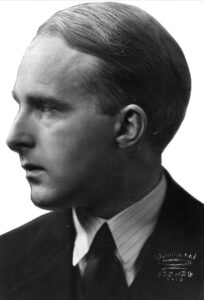
Klaus Egge (1906–1979) was one of Norway's leading twentieth-century composers, celebrated for a musical language that evolved from folk-inspired roots to a highly personal, at times twelve-tone, idiom. Born in Gransherad in Telemark, he trained as a teacher before studying at the Norwegian Academy of Music in Oslo, graduating in 1929, and later took private composition lessons from Fartein Valen and studied in Berlin under Walther Gmeindl. Egge worked as a schoolteacher in Porsgrunn and Oslo while building his career as a composer and music critic. His catalogue includes five symphonies, three piano concertos and concertos for violin and cello, alongside chamber and choral works.
His music passed through three broad phases: an early period drawing on Norwegian folk material, a middle period built on a universal tonal language using what he termed a "metamorphic" technique of thematic transformation, and a late period exploring twelve-tone writing, exemplified by the "Preludio metamorfico" movement of his 1966 Cello Concerto. In recognition of his contribution to Norwegian musical life, Egge received the Arts Council Norway Honorary Award in 1972 and was made a Commander of the Order of St Olav in 1977. He died in Oslo in 1979.
Valen Trio
Valen Trio consists of Einar Røttingen (piano), Ricardo Odriozola (violin) and John Ehde (cello). Founded in 2009, the trio took its name after the Norwegian composer Fartein Valen. In addition to performing trios from the standard repertoire, Valen Trio actively commissions new trios and explores repertoire from the 19th and 20th centuries that deserve to be better known.
Valen Trio's first CD release on LAWO with trios by Fartein Valen, Klaus Egge and Ketil Hvoslef received great critical acclaim — Gramophone wrote: 'The players' ensemble and intonation are flawless and their understanding of each other and the repertoire highly impressive.' Fanfare wrote: 'They play Valen's rhythmic, energetic music with love and great attention to detail and with the stylistic knowledge that comes from a serious study of the composer and knowledge of the culture in which he worked.' In 2013 Valen Trio did the first performance of Knut Vaage's In Movement at the Bergen International Festival, and in 2015 they toured Norway and Denmark with trios by Martinu, Dvořák and Grieg.