
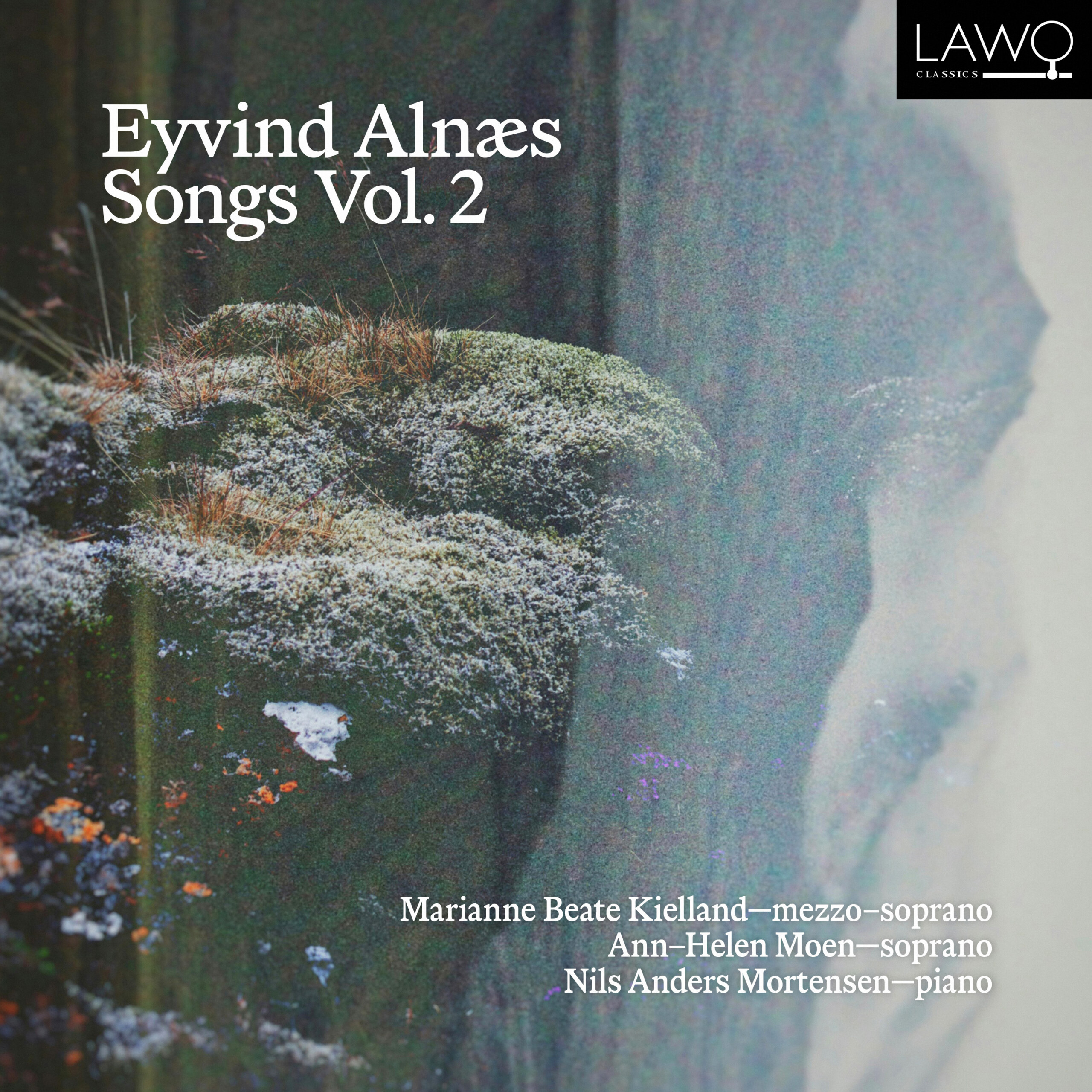
Eyvind Alnæs Songs, Vol. 2
Marianne Beate Kielland (Mezzo-soprano) | Ann-Helen Moen (Soprano) | Nils Anders Mortensen (Piano)
Eyvind Alnæs, Norway’s great song composer
Around 1900, Norway had three leading composers of art songs: Edvard Grieg, Agathe Backer Grøndahl and Eyvind Alnæs. On the second volume of a three-part series, mezzo-soprano Marianne Beate Kielland, soprano Ann-Helen Moen and pianist Nils Anders Mortensen bring us 30 of Alnæs’ songs.
Alnæs (1872-1932) ranked alongside Grieg and Backer Grøndahl as Norway’s foremost composer of romances around 1900. His songs were recorded by singers of the stature of Kirsten Flagstad and Feodor Chaliapin. The songs are beautiful and exquisite, and are colored by the composer’s rare melodic talent. The piano parts in his songs make considerable demands on the accompanist. He wrote in a late-Romantic style, and was also an organist: from 1916 to 1932 he served as organist and cathedral cantor at Vår Frelsers Kirke in Oslo.
The album brings together songs set to poems by some of Norway’s best-known writers, including Herman Wildenvey, Olaf Bull, Vilhelm Krag, A. O. Vinje, Henrik Wergeland, Knut Hamsun and Olav Aukrust. The programme moves from the tenderness of “Moderen synger” and “Liden Kirsten” to the nature poems of Vinje, giving two singers and one pianist a wide range of moods and colours.
Listen
Tracks
Eyvind Alnæs (1872–1932)
4 Digte av Herman Wildenvey Op.30
Text: Herman WildenveyAnn-Helen Moen (soprano) | Nils Anders Mortensen (piano)
3 Digte av Olaf Bull Op.31
Marianne Beate Kielland (mezzo-soprano) | Nils Anders Mortensen (piano)
Sange for en dyp stemme Op.19
Marianne Beate Kielland (mezzo-soprano) | Nils Anders Mortensen (piano)
Fire Sange Op.12
Ann-Helen Moen (soprano) | Nils Anders Mortensen (piano)
Fem Dikte av Vilhelm Krag Op.2
Text: Vilhelm KragMarianne Beate Kielland (mezzo-soprano) | Nils Anders Mortensen (piano)
6 Sange Op.22
Marianne Beate Kielland (mezzo-soprano) | Nils Anders Mortensen (piano)
Tre Sange Op.45
Marianne Beate Kielland (mezzo-soprano) | Nils Anders Mortensen (piano)
Credits
- Performer
- Marianne Beate Kielland (Mezzo-soprano) | Ann-Helen Moen (Soprano) | Nils Anders Mortensen (Piano)
- Composer
- Eyvind Alnæs
- Producer
- Vegard Landaas
- Engineer
- Thomas Wolden
- Editing
- Vegard Landaas
- Mastering
- Thomas Wolden
- English translation
- Marie Haukeland | Verboo Language Services
- Executive producer
- Vegard Landaas
- Booklet editor
- Alison Bullock Aarsten
- PR
- Camilla Momkvist-Skau
- Accounting
- Torgeir M. Landaas
- Design
- Anette L’orange | Blunderbuss
- Recording location
- Sofienberg Church, Oslo
- Recording country
- Norway
- Recording year
- 2025
- Recording dates
- 06.01.2025 | 07.01.2025 | 08.01.2025 | 09.01.2025 | 10.01.2025 | 16.06.2025 | 17.06.2025
- Original source
- DXD (352.8 kHz, 24 bit)
- Series
- Eyvind Alnæs Songs, Vol. 1-3
- Discs / tracks
- 1 disc | 30 tracks
- Produced with support from
- Arts and Culture Norway | Fund for Performing Artists | The Norwegian Society of Soloists | The Lindeman Foundation
- Release year
- 2026
- Label
- LAWO Classics
- Duration
- 1:07:51
- EAN
- 7090020184456
- ISRC
- NOEHX2638
Booklet text
Eyvind Alnæs… whenever I say or read his name, I think of beautiful melodies, grace and elegance. He had the lyrical gift of creating truly beautiful music; melodies that captivate you, move you, and enhance the message of the text. If I were to compare Eyvind Alnæs to one of the greatest composers in the song repertoire, it would be Robert Schumann, who also had the ability to capture the listener with the beauty of the music. Is this not a wonderful quality to possess as a composer?
Eyvind Alnæs was indeed a beloved composer in his time. It is moving to read this excerpt from the obituary by Torolf Voss in Aftenposten, 27 December 1932: “Eyvind Alnæs is dead – such was the painfully sorrowful message that spread quickly through the city around midday on Christmas Eve. A message of mourning that not only seemed unbearably painful to us here at at home, but that will also be received with profound sorrow across the Nordic musical world, and far beyond, wherever Alnæs's lovely romances and lyrical works have taken root. (...) Alnæs undoubtedly produced his greatest art as a composer of romances; here, he usually hit the mark perfectly. He created over one hundred romances, and through them left a rich legacy of lyrical works that future generations will surely listen to with the same rapture as his contemporaries.”
It is also the romances that truly made Alnæs’s music famous, and I firmly believe that the most beloved of them have remained in singers' concert repertoire from the time they were composed up to the present day.
Alnæs was born in Fredrikstad in 1872 and, following Edvard Grieg and Agathe Backer Grøndahl, became one of the leading Norwegian romance composers around 1900. Like Grieg a few years before him, he went to Leipzig at the age of 20 to study with Carl Reinecke, after initial studies in Oslo with Peter Lindeman, among others, at the Music and Organ School in Kristiania. Grieg observed Alnæs’s talent and endorsed his scholarship application with the following words: “Mr. Alnæs has shown me some of the songs he has composed, which display such evident talent. (...) I therefore strongly recommend him for any public support by which this aim may be advanced.”
After three years in Leipzig, followed by two years in Berlin, he returned to Norway, where he began his main work as an organist and choir conductor. He first worked at Bragernes in Drammen, but Agathe Backer Grøndahl is said to have remarked that he was far too talented to live in Drammen! Fortunately, a few years later, he secured a position as organist at Uranienborg Church in Oslo. His crowning achievement was his appointment as organist at Oslo Cathedral (The Church of Our Saviour), where he also founded what is now the Oslo Cathedral Choir. He remained at the Cathedral until his death on Christmas Eve in 1932.
After his studies in Berlin, Eyvind Alnæs was thoroughly trained in the Romantic tradition. Apart from 88 romances, his list of works includes around 20 piano pieces, a suite for violin and piano, symphonic variations, two symphonies, a piano concerto, and several organ works, including the harmonisation of the entire Norwegian chorale book. However, he did not achieve truly great success with his instrumental music, which can be explained by his admiration for the style and idiom of the late Romantic period. Perhaps this, combined with Alnæs’s great lyrical talent, was not quite the ideal match? He was, however, considerably more talented as a composer of choral works. Several works for male choir, especially his Christmas Motet, have been beloved choral works for male, female and mixed choirs at many Christmas concerts over the past hundred years.
But let us return to the romances. They made Alnæs one of the most frequently performed composers of his time, and his new works were well received by performers, audiences and critics alike. The piano accompaniments in his songs reveal that Alnæs himself was a brilliant pianist and a sought-after accompanist, being written with imagination, beauty, and expressiveness. They provide strong support for the often beautiful melodies of the songs, and this is only one of the elements that contribute to the remarkable completeness of so many of his romances. The influence of the German Lied tradition is clearly evident, yet his songs often display a natural and playful text declamation, and occasionally a subtle hint of influence from folk music. As a result, the relationship between text, melody and piano writing is often very successful. Personally, I consider many of Alnæs’s romances to be among the very best works in this genre by Norwegian composers.
With valuable help from Kirsti Wilhelmsen’s master’s thesis ‘Eyvind Alnæs as a Composer of Romances’ (University of Oslo, 1968), we have identified 88 songs to be released across three albums.
This second volume
opens with Opus 30, which includes the gem Ved Syrintid (‘When the lilacs
bloom’). As on volume 1, this is followed by a wide range of songs spanning
from Opus 2 to his final Opus 45, in which Alnæs for the first (and only) time
shows a hint of more advanced tonal language. In Steinbrytervise (‘The miners’
song’) from Opus 19, Alnæs moves towards the style of Norwegian folk
songs in his interpretation of Henrik Wergeland’s powerful poem. In Den dag
kjem aldri, at eg deg gløymer (‘The day that I forget you will never come’),
he demonstrates with his touching setting of Vinje’s well-known poem that he
also masters the strophic lied form. Opus 22 contains songs in which Alnæs
draws on Norwegian folk music, particularly in Attergløyma (‘The
Spinster’) and So skal gjenta hava det (‘How a girl ought to have it’),
but in this opus, we also find Tungalda (‘The great wave’) – a rare
attempt by Alnæs to write a song on a large and expansive scale, spanning over
two octaves. The album concludes with Kulokk (‘Cow call’), found in
manuscript form, where Alnæs moves closest to folk music. I am not sure whether
he was inspired by an actual folk song here, or whether the song is simply
written in a folk music style.
This album contains opuses in which Alnæs continues to set texts by Norwegian
poets of his own time: Olaf Bull, Nils Collett Vogt, Vilhelm Krag, Anders
Hovden, and even Knut Hamsun and Sigbjørn Obstfelder. One collection combines
the new and the old: Opus 22, with texts by Anders Hovden and Aasmund Olavsson
Vinje, while Opus 12 draws on the poets Aasmund Olavsson Vinje and Ivar Aasen.
He also has one opus devoted solely to texts by Herman Wildenvey (Opus 30).
As with album I in this series (LWC1423), there is no song cycle as such on this album. None of the opuses feature a consistent theme or narrative development, but the songs are well grouped together, and form a coherent whole.
I hope you will continue to enjoy Alnæs’s romances. Happy listening!
Marianne Beate Kielland
This text takes inspiration from articles in Cappelens musikkleksikon, Norsk biografisk leksikon (nbl.snl.no) and Store norske leksikon (snl.no).
Biographies
Marianne Beate Kielland
Marianne Beate Kielland studied at The Norwegian Academy of Music in Oslo with Ingrid Bjoner and Svein Bjørkøy and earned a master’s degree in contemporary music in 2000. She has also studied with Oren Brown and Barbara Bonney. After completing her professional training she sang with the Hanover State Opera during the 2001/02 season before moving to Harstad and later to Svolvær, Norway. She quickly established a solid professional reputation and is now regarded as one of Europe’s foremost singers, working frequently with leading orchestras and on opera stages in Norway and throughout the world. Kielland regularly performs on the concert stages of Europe, Asia and America under such conductors as René Jacobs, Fabio Biondi, Jordi Savall, Rinaldo Alessandrini, Masaaki Suzuki, Herbert Blomstedt, Jukka Pekka Saraste and Andrew Manze.
In 2012 her CD recording Veslemøy Synsk (on which she collaborated with Nils Anders Mortensen) was nominated for a Grammy award in the category Best Classical Solo Vocal Album. Thanks to this and over 70 other recordings, as well as her many performances on concert and opera stages, she has established herself as a distinguished interpreter of repertoire from the baroque period to the present day. Kielland was Artistic Director of the Oslo Chamber Music Festival from 2022 to 2025, and is Professor at the Norwegian Academy of Music.

Ann-Helen Moen
Norwegian soprano Ann–Helen Moen is a versatile singer, known for her musical interpretations of a broad repertoire ranging from the early baroque to the great Romantic composers and contemporary music. She performs both in concert halls and on the opera stage, and her career has taken her to venues in cities as far afield as Tokyo and New York.
She is especially renowned for her Mozart interpretations, both operatic roles and lieder. Together with Liv Glaser on fortepiano she has recorded Mozart’s Lieder for SIMAX Classics. She performs regularly with all the Norwegian and Danish orchestras, and collaborates with pianists such as Christian Ihle Hadland and Håvard Gimse. Conductors she has sung with include Ed Gardner, Masaaki Suzuki, William Christie, Harry Christophers, Sir Andrew Davis, Eivind Gullberg Jensen, Kristjan Järvi, Andrew Litton and Susanna Mälkki.
Moen studied with Susanna Eken at the Opera Academy in Copenhagen. Upon completing her studies, she was engaged as a soloist at the Graz Opera in Austria for three years. In 2021 she was appointed Associate Professor at the Norwegian Academy of Music in Oslo.
Nils Anders Mortensen
Nils Anders Mortensen is a Norwegian pianist renowned for his versatility and expressive playing. Born in Flekkefjord in 1971, he began playing the piano at three, won the Norwegian Young Pianist Competition in 1986, and studied at the Norwegian Academy of Music, the École Normale in Paris and the Hochschule für Musik und Theater in Hannover.
In 1996 Concerts Norway named him "Debutant of the Year", leading to an extensive national tour. He has since performed in the United States, Germany, Russia, Hungary and the Baltic states, and appeared as soloist with the Norwegian Radio Orchestra at the Bergen International Festival in 1998.
Based in Alta since 1998, Mortensen moves freely between classical and contemporary music, jazz, folk and crossover. He has worked closely with mezzo-soprano Marianne Beate Kielland, violinist Arvid Engegård and double bassist Knut Erik Sundquist on several acclaimed recordings; Veslemøy synsk, with Kielland, was nominated for a Grammy Award. His solo discography includes Grieg, Brahms, Debussy and Bach, and his 2023 album J.S. Bach: Partitas Nos. 1, 5 & 6 won critical acclaim.
He received the Robert Levin Memorial Prize in 2004 and the Nordlys Prize in 2013.