
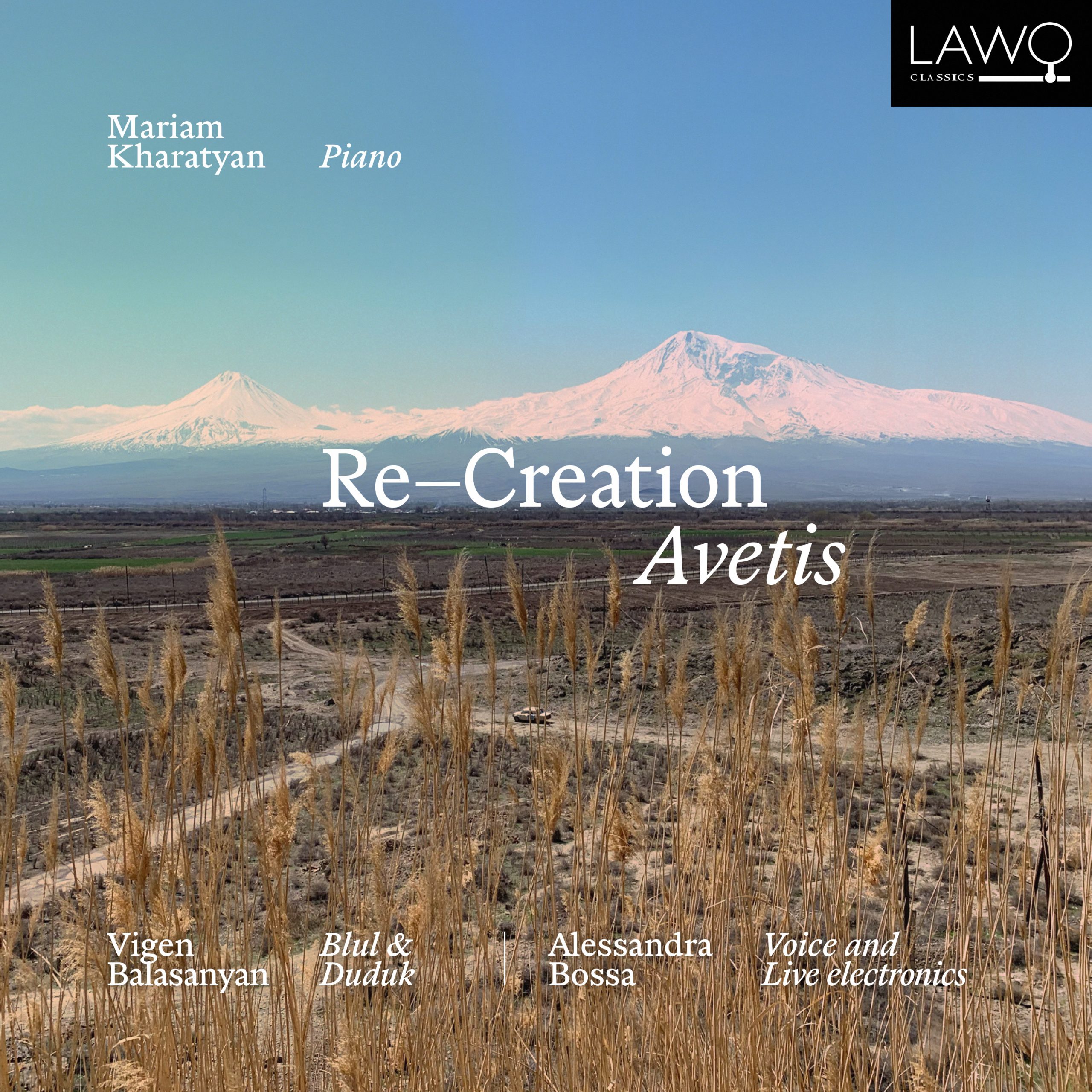
RE-CREATION
Mariam Kharatyan (Piano) | Vigen Balasanyan (Duduk | Blul) | Alessandra Bossa (Vocals | Electronics)
RE‑CREATION
RE‑CREATION, an innovative new album bringing together Armenian musical heritage, contemporary composition, and exploratory sound worlds. Pianist Mariam Kharatyan, blul and duduk performer Vigen Balasanyan, and vocalist/electronic artist Alessandra Bossa join forces in a project that reimagines tradition through modern artistic expression.
At the heart of RE‑CREATION lies a dialogue between past and present. The album draws inspiration from Armenian folk and spiritual music, modal language, and improvisational practices, while opening these traditions to new sonic possibilities through extended techniques, live electronics, and cross‑disciplinary collaboration. The result is a musical landscape where ancient timbres meet contemporary textures, and where cultural memory becomes a catalyst for new creation.
Pianist Mariam Kharatyan, known for her deep engagement with Armenian repertoire and her work at the intersection of classical, folk, and contemporary music, leads the project with a distinctive artistic vision. She is joined by Vigen Balasanyan, whose mastery of the blul and duduk brings an authentic and expressive voice to the album, and by Alessandra Bossa, whose vocal palette and electronic artistry expand the ensemble’s sound into immersive, atmospheric dimensions.
Listen
Tracks
Komitas, Traditional
Anania Shirakatsi, Traditional
Grigor Narekatsi, Traditional
Nerses Shnorhali, Traditional
Komitas, Traditional
Anania Shirakatsi, Traditional
Grigor Narekatsi, Traditional
Nerses Shnorhali, Traditional
Komitas, Traditional
Credits
- Performer
- Mariam Kharatyan (Piano) | Alessandra Bossa (Vocals | Electronics) | Vigen Balasanyan (Duduk | Blul)
- Producer
- Mariam Kharatyan
- Engineer
- Roald Rasberg
- Editing
- Roald Rasberg
- Mastering
- Roald Rasberg | Thomas Wolden
- Piano tuner
- Åse Gundersen Tveit
- Liner notes
- Mariam Kharatyan
- Executive producer
- Vegard Landaas
- Booklet editor
- Alison Bullock Aarsten
- PR
- Camilla Momkvist-Skau
- Accounting
- Torgeir M. Landaas
- Cover photo
- Mariam Kharatyan
- Artist photo
- Mariam Kharatyan by Roger Svalsrød | Mariam Kharatyan by Sara Ghazarayan | Vigen Balasanyan by Mariam Gevorgyan
- Design
- Anette L’orange | Blunderbuss
- Recording location
- University of Agder, Kristiansand
- Recording country
- Norway
- Recording year
- 2024
- Recording dates
- 27.09.2024 | 28.09.2024
- Discs / tracks
- 1 disc | 18 tracks
- Produced with support from
- Faculty of fine arts and createme (creative use of technologies in music education) at the university of agder in kristiansand, norway
- Release year
- 2026
- Label
- LAWO Classics
- Duration
- 1:17:49
- EAN
- 7090020184753
- ISRC
- NOEHX2636010-180
Booklet text
RE-CREATION
Reinterpreting Armenian Folk and Medieval Sacred Music through
Improvisations and Live Electronics
The Re-Creation album takes its departure from an innovative, experimental, and deeply personal approach to reinterpreting — or rather, embodying — Armenian folk and spiritual music. I chose the Armenian title Avetis — Awakening/Revelation/Good News — because it speaks to the essence of Re-Creation. Avetis carries rebirth and transformation. It reflects a dialogue between the past and the present, where these melodies live again, shaped by our collective listening, intuition, and creative presence.
Together with Vigen Balasanyan and Alessandra Bossa, we present our explorations captured in trio and duo settings, where Armenian folk and spiritual melodies evolve within contrasting musical mediums and aesthetics. The three sound worlds — the piano played by me, the Armenian folk instruments duduk and blul played by Vigen Balasanyan, and the live electronics, sampling/remixing, and voice by Alessandra Bossa — converge in a live, co-creative interplay, giving rise to a new music that stands at the crossroads of tradition and innovation, evoking and intertwining the past and the present.
The artistic idea behind the Re-Creation project stemmed from my own transformation and metamorphosis as a musician and artist, particularly over the last decade. I grew up surrounded by contrasting musical traditions, among which the most formative were Armenian folk music — an inseparable part of my identity — and classical music, which I studied professionally from the age of six.
Parallel to my formal classical piano education, I have always improvised and played by ear since childhood. Yet, as a result of Werktreue (a concept that originated in the 19th century, indicating that performers should be “true to the work” rather than creating their own interpretations), my passion for improvisation was largely suppressed, leaving room for the complex classical repertoire and the strict demands of the institutions where I studied. During my doctoral artistic research project Armenian Fingerprints: Interpreting the piano music of Komitas and Aram Khachaturian in light of Armenian folk music (2015–2020), I explored in depth the interplay between classical and folk music and its impact on my piano playing, as well as searching for new interpretational possibilities in the works of Komitas and Aram Khachaturian. (Kharatyan, 2019).
However, a more profound emancipation from the influence of the classical tradition of Werktreue was still unfolding. In my project Armenian Crossroads: Embodying the Piano Music of Hovhaness at the Crossroads of Contemporary and Folk (2022–2024), I presented my explorations of Alan Hovhaness’ Lousadzak / Coming of Light (1944) piano concerto with strings, where improvisation played a vital role — expressed through my improvised cadenza in the concerto, solo improvisations, and collective improvisations with the string ensemble inspired by the concerto, as well as by Armenian folk and medieval melodies incorporating live electronics.
Here, in Re-Creation, Avetis, I continued to embrace improvisation and my inner musical understanding of Armenian folk and spiritual music more freely, allowing my piano playing to respond organically to folk aesthetics — bridging tradition and personal expression in a way I had not fully achieved before.
ECHOING FOLK WISDOM
Folk music embodies the accumulated wisdom of the people, reflecting human emotion and the expression of the heart, as well as the historical and cultural journey of a nation. Passed down orally, thousands of folk songs naturally undergo change — mobility and transformation are essential elements of the tradition. This process gave rise to various versions of songs, shaped by place, dialect, and landscape. Every individual left a trace in the living body of folk song — yet authorship never mattered for a peasant.
In collective dance songs, melodies often emerged spontaneously — created in the moment of performance. In Articles and Studies (ed. Terlemezian; 1941), Komitas describes how Aman Telo was created by dancing peasants in 1905, in Shirak, around the Haritch Church, during a folk festivity. He collected several variations of the original, as well as 34 new songs that evolved as the dancing and singing continued.
In this album, we present two versions of three spiritual and six folk songs that I have carefully selected. My approach was to stay aligned with the spirit of the folk musician’s tradition — the motility and vitality of music as a living, transforming organism, evolving and metamorphosing with each performer, bearing the individual traces of that person as a core principle. Each version of the songs evolves differently during improvisations, revealing the endless musical opportunities.
Minimalism, simplicity and transparency were essential elements in my improvisations. My intention was to restrain the vast possibilities of classical virtuosic technique on piano and instead give the sound freedom and space to unfold.
Anchored in one of the core characteristics of Armenian folk music — monody — I have remained faithful to monophonic thinking in my improvisations. I combined this with parallel layers of evolving soundscapes that unfold individually yet form an organic unity with the folk instruments and live electronics, all stemming from the melodic motives. Beyond monody, another key aspect of Armenian music is the conjunction of two tetrachords (c–d–e–f and f–g–a–b), unlike European music, which forms an octave from consecutive tetrachords (c–d–e–f and g–a–b–c). In Articles and Studies (1941), Komitas writes that Armenian church and folk music are like «brother and sister» and both are based on a system of tetrachords, in which the last note of one becomes the first of the next — unlike the European octave system.
The long drone tones — the dam tradition — widely used in Armenian folk music, have also been important. The microtonal influence of the folk instruments on my piano playing, and the urge to recreate subtle dissonances that evoke slightly imperfect tuning, were central. I often used dissonant seconds to evoke microtonality and the raw, untempered sonority of folk music.
AVETIS
Armenian folk and spiritual songs are the anchor of this album, taking the listener on a journey of rethinking, translating, recreating and reinterpreting traditional music through improvisations and live sampling/remixing. The album begins with the trio setting, where improvisations evolve further beyond the initial material.
The medium of live electronics opens a new dimension, where sound creation moves toward abstraction and fragmentation of original melodic lines. Some songs are over a thousand years old, and through the lens of the modern piano and live electronics, coupled with the archaic sound of folk instruments, they reveal the timeless essence of this music.
The trio versions capture our co-creative interplay in its fullest form. The duo versions of the same melodies, following the trio, appear as reminiscences of the story already told. In all three spiritual medieval songs my source has been the original monodic versions from Voskeporik, Hay Yergi Goharner (“Gems of Armenian Song”), European notation, published 1982.
The minimalistic, solemn, and serene expression of the folk instruments and piano — without the three-dimensional sound cloud of electronics — brings the monophonic essence of Armenian music to the forefront in duo versions. Trio and duo versions opened new dimensions in my piano playing — articulation, touch, dynamics, pedalling, timing. Improvisations in both unfold differently, yet remain anchored through mutual listening and response.
The album was recorded as complete takes of each song, with minor adjustments of electronics and vocal responses afterwards. It is also presented in Atmos technology, enhancing perception of fluid, breathing, and moving soundscapes. Using Dolby Atmos immersive audio recording opens the most immersive listening experience and places the listener in the centre of the music spatially.
ACROSS THE CENTURIES - KOMITAS, SHIRAKATSI, NAREKATSI, SHNORHALI
Komitas Vardapet (born Soghomon Soghomonyan, 1869–1935) was an Armenian ethnomusicologist, composer, conductor and performer, the founder of the Armenian national school of music during turbulent times. From early years, alongside his spiritual studies in Gevorgyan Seminary (1881–1893), he passionately collected and arranged thousands of Armenian peasant and folk tunes, sacred music, and instrumental and vocal dance melodies.
Komitas shared his research across Europe and published collections of Armenian solo and choral works and Peasant Songs in Paris (1907) and Leipzig (1912), shaping the musical and cultural landscape of Armenia.
His creative path was tragically interrupted during the Armenian Genocide in 1915. Miraculously spared, he spent the rest of his life from 1916 in psychiatric hospitals in Constantinople and Paris, carrying the deep trauma inflicted by the horrors he endured.
The album opens with Komitas’ Oror (Lullaby), which he collected from the region of Akn, and it was first published as ethnographic material in Armenian notation in 1895 in Ejmiatsin (Vagharshapat). The genre of lullabies - known also as nana, ruri, hayrur - the oror in Armenian folk music present one of the most vital and ancient forms. It stands out for its improvisational character and for the depth and complexity of its musical elements.
The next three tracks of the album are based on melodies drawn from the treasures of Armenia’s medieval spiritual music. Armenia was the first nation to officially adopt Christianity as a state religion in 301 AD. Armenian spiritual and religious music began to develop from that date, and from the 5th century onwards became a central force in shaping national identity, in parallel and sometimes intertwined with folk music traditions. With the invention of the Armenian alphabet ca. 405 AD by Mesrop Mashtots (ca. 361-440), alongside the translation of the Bible, and thousands of other texts into Armenian language, the first spiritual songs were composed in Armenian. Various spiritual genres emerged within the liturgy— psalms, hymns, sharakanner, avetisner, and tagher among others. The religious music of medieval Armenia was written in neumatic notation, called khaz, placed above the lyrics to indicate duration, pitch, ornamentation, melodic direction and other nuances. As religious music grew more elaborate—encompassing countless prayers and genres—the khaz notation system also became increasingly complex. Over time, around the 16th century the ability to fully read and interpret the detailed meanings of the complex khaz signs in singing was unfortunately lost.
However, many tagher, sharakanner continued to be transmitted orally through church liturgy and religious rituals. Komitas devoted years to researching the mysteries of khaz. He transcribed numerous tagher and sacred songs using the new Armenian notation system - Limonjian notation, created in the early 19th century by Hampartsum Limonjian (1768–1839).
Vasn Meroy Prkutean (For Our Salvation) by Anania Shirakatsi (ca. 610–685), written in the 7th century, is a sharakan, one of the oldest religious forms in Armenian church liturgy - prayer for the salvation of souls — a dialogue with Jesus, the Son of God, incarnated from the Virgin, and a plea for mercy upon us.
By the 10th century, a new wave of reform in religious music had emerged, bringing revitalization to the liturgy and to spiritual music genres that continued to evolve through the centuries.
Havun, Havun (Bird, Bird) by Grigor Narekatsi (ca. 950–1003/1011), written in the 10th century, stands as one of the most glorious examples of Armenian tagher — full of mysticism and symbolism, and the spiritual allegory of resurrection, transformation and divine longing. Although Havun, Havun embodies the resurrection of Christ, it also expresses a dialogue between the human and the divine, blurring the line between the humble and the cosmic.
Nor Tsaghik (New Flower) by Nerses Shnorhali (1102–1173), written in the 12th century, is among the most important and unique examples of tagher. It is both joyful and contemplative, highlighting the Avetis — good news of the Resurrection of Jesus in every verse.
The next four songs are lyrical love songs — Matniqy Matovs Cher (The Ring Misfit My Finger), Tun Ari (Come Home), Qeler, Tsoler (He Walked Shining), and Chinar es (You Are a Plane Tree) — collected and arranged by Komitas. My initial sources of scores for all Komitas songs included in this album are the original arrangements for voice and piano by Komitas, the complete collection published in 1960.
Kanche Krunk (Call, Crane) is a pilgrim song collected by Komitas. Throughout centuries of turbulence, Armenians endured hardship, often forced to leave their homeland. Pilgrim songs, called also Antuniner, reflect a nation’s history, social realities and personal emotions. The crane symbolizes the messenger with whom the pilgrim confides.
______________________________________________
Biographies
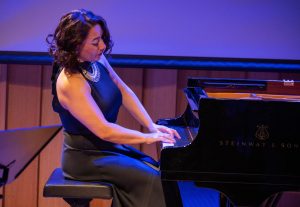
Mariam Kharatyan
Mariam Kharatyan is an Armenian-Norwegian pianist, an internationally acclaimed soloist and chamber musician praised for her expressive, intuitively free playing and interpretative depth. Her work bridges tradition and innovation at the crossroads of classical, folk and improvised music.
She holds two master’s degrees, from the Komitas State Conservatory in Yerevan and the University of Agder in Kristiansand, where she is Associate Professor in the Department of Classical Music and Music Education. In 2020 she defended her PhD artistic research project Armenian Fingerprints, on interpreting the piano music of Komitas and Khachaturian in light of Armenian folk music.
In 2019 she released two albums, Aram Khachaturian: Chamber Music and Komitas – Shoror, the latter with Vigen Balasanyan on duduk and blul. She has performed Khachaturian’s Piano Concerto with the Kristiansand Symphony Orchestra under Eivind Gullberg Jensen and with the Niederrheinische Sinfoniker, with whom she returned in 2025 for Brahms’s Piano Concerto No. 2.
Kharatyan has been artist-in-residence at Troldhaugen, Edvard Grieg’s home in Bergen, and has performed at major festivals and venues across Europe, the USA and Armenia.
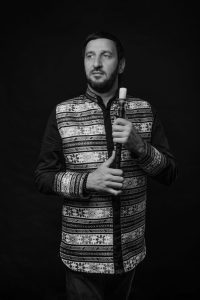
Vigen Balasanyan
Vigen Balasanyan is an Armenian folk musician, performing internationally on several Armenian traditional folk instruments such as duduk, blul, shvi, pku, zurna, as well as on saxophone and clarinet. His versatile musical profile features Armenian folk, jazz and popular music in a broad repertoire, playing as a solo artist and in ensembles, including the Gusanakan State Ensemble of Folk instruments in Armenia.
In 2019 Vigen Balasanyan featured on the album Komitas – Shoror, published by SIMAX Classics / Grappa musikkforlag in the framework of pianist Mariam Kharatyan’s artistic research PhD project Armenian Fingerprints. Prior to the recording of Komitas – Shoror, in 2018 they performed together in Kristiansand Cathedral.
In 2024 Balasanyan performed together with Mariam Kharatyan and Alessandra Bossa as part of Fragment Festival in Kristiansand. Balasanyan has for many years collaborated with numerous folk, jazz and pop music bands and has toured the USA, France, China, Vietnam, Lithuania, Poland, Greece, Cyprus, Uzbekistan, Qatar and Lebanon.
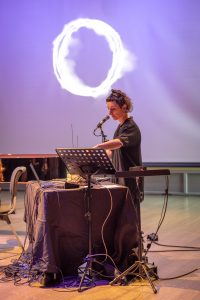
Alessandra Bossa
Guided by intuition, exploration, and curiosity, with her roots in classical and contemporary traditions, Alessandra Bossa has embraced the possibilities of electronic music and performance art. Unfolding her unique sonic world through improvisation, creative use of devices and processing of live signals, Alessandra bridges avant-garde, jazz and remixing.
Bossa has garnered recognition with her performances at festivals such as Casa da Musica di Porto, Punkt Festival in Norway, Cully Jazz Festival, London Jazz Festival at the Barbican, Stockholm Jazz Festival, Bergamo Jazz, Katowice Jazz Festival, Gas Festival Göteborg and Winter Jazz Festival of Copenhagen.
With her project O-Jana', together with singer Ludovica Manzo, she released Inland Images (2018 - Folderol Records) and Animal Mother (2023 - Folderol Records). Bossa is currently involved in several electroacoustic projects and works with the Centre for Excellence in Education - CreaTeME (Creative use of Technologies in Music Education) in Kristiansand, Norway. She teaches Live Electronics and is pursuing her PhD at the University of Agder in Kristiansand.