
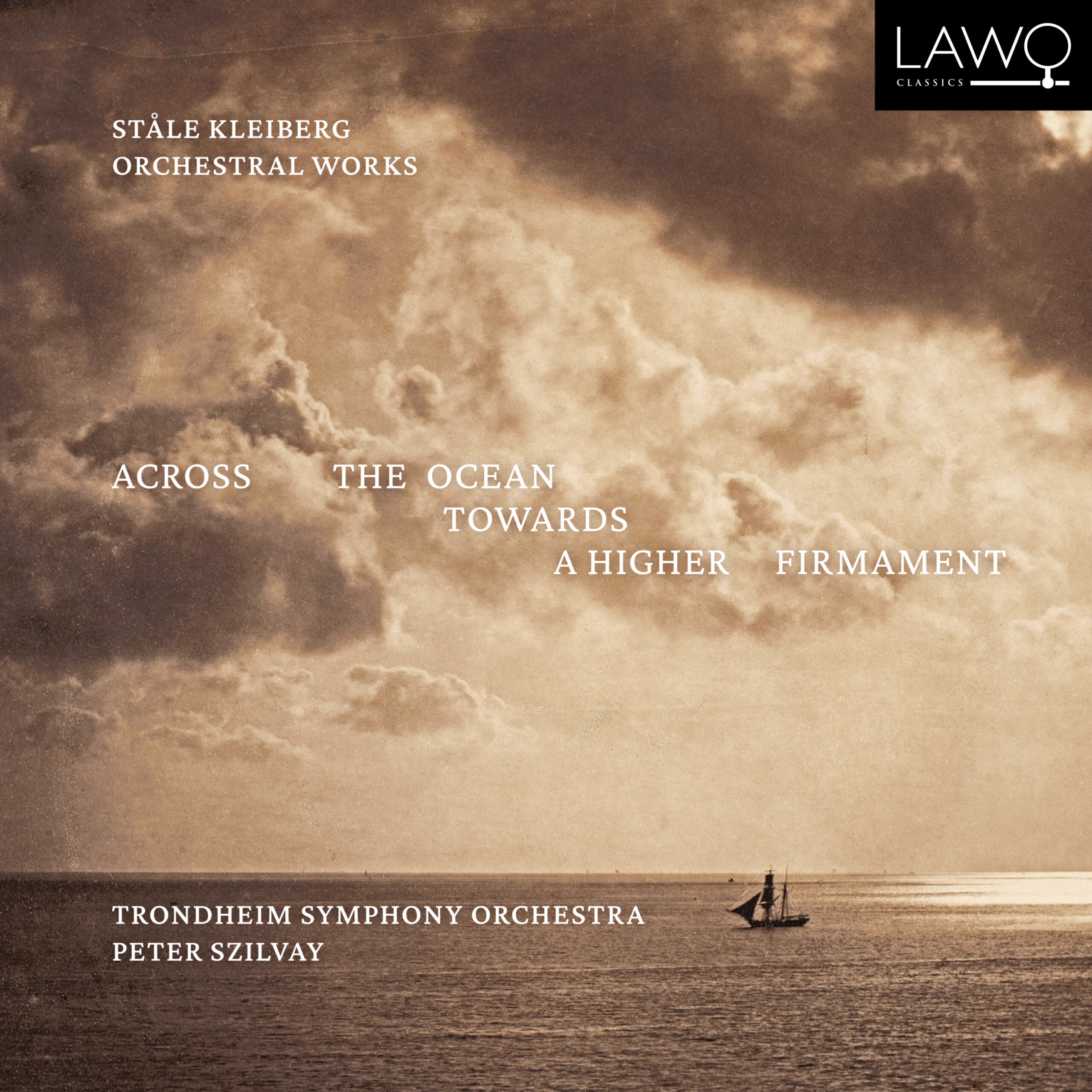
Across the Ocean towards a Higher Firmament – Orchestral Works by Ståle Kleiberg
Peter Szilvay (Conductor) | Trondheim Symphony Orchestra (Symphony orchestra)
ACROSS THE OCEAN TOWARDS A HIGHER FIRMAMENT
A moving orchestral portrait of Ståle Kleiberg (b. 1958), one of Norway's most performed living composers, recorded with the Trondheim Symphony Orchestra under conductor Peter Szilvay.
At the album's heart is Symphony No. 3, "Across the Ocean towards a Higher Firmament", commissioned by the orchestra and premiered under Szilvay in April 2025. Written in 2025, a year dedicated to commemorating Norwegian migration and identity (leading up to Norway's National Jubilee in 2030), the symphony takes as its subject the great wave of Norwegian emigration to North America in the 19th and 20th centuries — moving across three movements from yearning through drama to a hymn-like close.
The album opens with Lamento – Cissi Klein in memoriam (2001), a tender tribute to a young Jewish girl from Trondheim killed during the Second World War, part of a trilogy by Kleiberg on Nazi persecution alongside his Requiem and the cello concerto Dopo. It is followed by The Town and its People (2022), completing a journey from the intimate to the epic.
A major Norwegian composer with a considerable international reputation, Kleiberg is known for a distinctive, warmly expressive musical language. His large-scale works, including the Requiem – for the Victims of Nazi Persecution and David and Bathsheba, have earned wide acclaim. He is professor emeritus of music at NTNU in Trondheim.
Listen
Tracks
Ståle Kleiberg (*1958)
Across the Ocean towards a Higher Firmament (Symphony no 3)
Credits
- Conductor
- Peter Szilvay
- Symphony orchestra
- Trondheim Symphony Orchestra
- Composer
- Ståle Kleiberg
- Producer
- Vegard Landaas
- Engineer
- Thomas Wolden
- Editing
- Vegard Landaas
- Mastering
- Thomas Wolden
- Liner notes
- Jim Samson
- Executive producer
- Vegard Landaas
- Booklet editor
- Alison Bullock Aarsten
- PR
- Camilla Momkvist-Skau
- Accounting
- Torgeir M. Landaas
- Artist photo
- Trondheim Symphony Orchestra by Marthe A. Vannebo | Peter Szilvay by Lars Igesund | Ståle Kleiberg by Ole Wuttudal
- Design
- Anette L’orange | Blunderbuss
- Recording location
- Olavshallen Concert Hall, Trondheim
- Recording country
- Norway
- Recording year
- 2025
- Recording dates
- 25.08.2025 | 26.08.2025 | 27.08.2025 | 28.08.2025
- Original source
- DXD (352.8 kHz, 24 bit)
- Discs / tracks
- 1 disc | 5 tracks
- Produced with support from
- Arts and Culture Norway | The Audio and Visual Fund
- Release year
- 2026
- Label
- LAWO Classics
- Duration
- 56:46
- EAN
- 7090020184630
- ISRC
- NOEHX2646010-50
Booklet text
Across the
Ocean, towards a Higher Firmament
Orchestral
Works by Ståle Kleiberg
All three works of Ståle Kleiberg recorded here offer musical commentaries on either a specific event from Norwegian history or a singular Norwegian setting. But they share one other important feature. In their different ways, they each build upon, and integrate, a popular song that Kleiberg associates closely with the event or the setting. Leaving aside obvious analogies with the role of plainchant and chorale in Renaissance and Baroque music, there are more specific precedents in Norwegian music history for the deployment of an existing song as an integrative component of instrumental works. The String Quartet No 1 by Edvard Grieg is a notable case in point.
Lamento: Cissi Klein in memoriam
This is one of a trilogy of works composed by Kleiberg in response to Nazi atrocities (the other two are the Cello Concerto Dopo and the Requiem for the Victims of Nazi Persecution). It was composed in 2000-2001, and premiered by the Trondheim Symphony Orchestra in 2001. Trondheim – location of the world’s northernmost synagogue – was by no means exempt from Nazi persecution, and lost several Jews to Auschwitz. Among them was 13-year-old Cissi Klein, who was taken from her classroom in 1942, interned along with other Jewish women and children in the flat belonging to her family, and shortly after sent to the gas chambers at Auschwitz. Kleiberg represents this tragedy (which is in turn emblematic of the much wider tragedy) through a single-movement dramatic form based on Mordechai Gebirtig’s well-known Yiddish song S’Brent. At the outset a free version of the song on solo violin is brought into direct confrontation with two very different musical elements that recur later in the work: savagely modernist string sonorities redolent of Polish expressionism (notably Penderecki) and ‘sleigh-bell’ music that is later transmuted into the evocatively innocent, deliberately mechanistic sounds of the six musical boxes (operated by three cellists and three double-bassists) which bring the piece to its strikingly original conclusion. Throughout the work the Yiddish song remains a background presence, its individual melodic motives isolated, transformed, and worked contrapuntally in a series of symphonic meditations that build steadily towards two climaxes of shattering intensity. The first of these climaxes gives way to a dream-like parenthesis in which the Yiddish song emerges to the foreground in soft woodwind colours, before the procession begins again, and we are drawn inexorably towards the second climax. Yet even at this, the highest peak of the work’s intensity, the emotional world inhabited by this music is highly complex, allowing the playful to engage with the tragic, and in the process reminding us that one of the potencies of music is its unique capacity to switch between affects. The whispered coda, in which wisps of the Yiddish melody gradually surrender to the tinkling sonorities of the musical boxes, is an ending but not a closure, for as the boxes are stopped one by one, the simple ‘nursery rhyme’ tune breaks off with its last note unheard.
The Town and Its People
The title of this work pays tribute to a homonymous book by Kleiberg’s great grandfather, the author Theodor Dahl. The book consists of depictions of everyday life in Stavanger, incorporating portraits of people and events passed on by word of mouth from one generation to the next, stories that have shaped the identity of the city’s inhabitants. Like Dahl’s book, Kleiberg’s orchestral work is a homage to the city, and to the many generations of people who have lived there.
The work was commissioned by the Stavanger Symphony Orchestra for the 900th anniversary of the city, and although its subject matter is local, the theme is universal. The music takes its point of departure in an old song closely associated with the city of Stavanger, Rygjafylket’s Mountains and Deep Fjords (Rygjafylki is Old Norse for Ryfylke) [The Land of the Rygers]. This song, whose text begins by describing, and paying tribute to, the surroundings of the city, is certainly familiar to Stavanger residents, not least because it often rings out from the carillon of the medieval cathedral, the oldest such carillon in Norway, and the largest. In Kleiberg’s piece, fragments of the melody are revealed little by little until, towards the end, it is presented in its entirety. This approach, somewhat reminiscent of Sibelius, neatly reverses Classical compositional praxes, where a theme is more usually presented in toto at the outset and is only later subject to fragmentation and development. The Kleiberg approach is arguably closer to experiential realities – typically, we make sense of the complexities and confusions of life only in retrospect – and it gives some measure of just how stylized (in a positive way), and how ‘distanced’ (in an Aristotelian sense), is the music of Viennese Classicism and its immediate inheritance.
Since the song melody infiltrates the musical discourse at all levels, albeit spawning related melodies that take on their own life, the thematic substance of this work is marked by an unusually high degree of integration. At the same time, the song fragments are assigned contrasted characters as the work unfolds. Already intimated in the thickly dissonant harmonies of the opening, and clarified further by an episode on pitched percussion and a fugato section on woodwinds, the incipient melody is at times assertive and patriotic in tone, no doubt expressive of the pride taken in Stavanger by its residents – the siddiser, as they are known. At other times it is tender and whimsical, suggestive rather of a deeper, warmer affection for the city. But as it coalesces into a self-contained ‘chorale’ in the later stages of the work, the melody takes on a more dispassionate, even serene, quality. True affirmation, the music seems to suggest, is not about the grandiose. These various transformations are symptomatic of music’s emblematic value, and of its singular capacity to reinforce our sense of identity (one reason, incidentally, that music has always been useful to those who wield power). Kleiberg clearly relishes this emblematic quality. He is himself a son of Stavanger, after all. But his major achievement in The Town and its People is to ground these various transformations – these changing musical evocations of Stavanger – in a single unfolding narrative. He demonstrates throughout an unerring control of the pacing of that narrative, and of the rise and fall of its intensity curve.
Across the Ocean towards a Higher Firmament (Symphony No 3)
2025 marked the bicentenary of the Atlantic crossing of the shallop Restauration,
with fifty-two people on board. They were Quakers and other dissenters, all
leaving their homeland in search of religious freedom and prosperity. The
fifty-four-foot sailing vessel reached New York three months later, by which
time a baby had been born on board. Thus, there were fifty-three Norwegians who
landed in New York on 9 October 1825. They were the first Norwegian emigrants
to reach North America, and many more were to follow. Between 1825 and 1920
some 800,000 Norwegian men and women emigrated. Aside from Ireland, Norway
supplied North America with more immigrants than any other European country, relative
to its population size. Kleiberg reminds us, in a note in the score, that today,
as modern Norway plays host to people emigrating for similar reasons, it may be
useful to keep in mind this historical perspective.
Across the Ocean towards a Higher Firmament (Symphony No 3), composed in 2003–24 and premiered in 2025, is a work in three movements. Each movement is inspired by an image of nature, respectively moorland, ocean and sky, or rather firmament, since the Norwegian word ‘Himmel’ means both heaven and sky. Hence the underlying narrative, as suggested by the title: from the moorlands – across the ocean – towards a higher firmament. However intangible the association, images of landscape do seem to resonate widely in Nordic music more generally, and in this respect Kleiberg’s symphony sits squarely within a singular tradition. The work has a pre-history.
The first movement, ‘Espressivo e rubato – Andante’, recalls Schönberg’s observation about Sibelius and Shostakovich: “I feel they have the breath of symphonists”. Schönberg was not specific about this, but he surely meant, among other things, a capacity to pace the musical discourse over a lengthy timespan, to wait for effects, and to grade climactic moments so that they are kept to scale. In this first movement, we are always made aware that there is more to come. The music ebbs and flows, and there are distinctive, well-marked stages in its onward progression. A solo flute quasi-cadenza introduces one such stage, marked by wind and later brass choirs, while another is the allegretto section that initiates a steady accrual of tension. But we know that we have not yet reached what Sergey Rachmaninov liked to call “le point”, that moment of maximum intensity in a work towards which the music strives. That the orchestral colouring is muted is perhaps redolent of the moorland inspiration for this movement.
The second movement, ‘Tranquillo – Drammatico – Misterioso’, adds a splash of colour, as we are taken seaward. This setting is established at the outset by a rocking rhythm in winds, harp and pitched percussion, accompanying an expressive solo flute melody. For one listener at least, there are even tentative echoes of La Mer in some of the brass chording that follows, and it is hard not to assign visual imagery to some of those swirling figurations on winds and strings. But a new theme with a sharply defined rhythmic profile intimates that there may also be storms afoot, and this leads to the ‘Drammatico’ section and a major climactic peroration. Then a lull – ‘Misterioso’ – and a moment of stasis in which pitched percussion, which seem so often to have a stilling effect in Kleiberg’s music, accompany s series of melodic arcs on trumpet, underpinned by a rotating ostinato pattern, before a destination of some sort finally comes into view.
At the outset of the third movement – ‘Maestoso – Quasi corale’ – Kleiberg prepares the ground for a melody that will unfold in its entirety towards the very end of the work, in an unmistakable echo of The Town and its People. The movement establishes an assertive, yet also anticipatory, tone at the outset, and this is soon reinforced by treading rhythms, initially propelled by the timpani, that build steadily towards a climax, before dissolving again in pitched percussion figuration. As in the analogous moment in Berg’s Violin Concerto, the resolution to a ‘corale’ demands the most careful handling of what Wagner once described as the quintessential art of musical composition, “the art of transition”.
It turns out that this ‘corale’ is the so-called ‘Quaker hymn’, How Can I Keep from Singing. The folk singer, author and civil rights activist Pete Seeger often sang this song, and it was later taken up by other folk revivalists. Kleiberg reminds us in a note on the work that Seeger was accused of un-American activities during the McCarthy era and convicted of this in 1961. He goes on to suggest that the last verse of the song, added by Doris Plenn around 1950, has by no means lost its relevance:
When tyrants tremble, sick
with fear,
and hear their death-knell ringing,
when friends rejoice both far and near,
how can I keep from singing?
In prison cell and dungeon
vile,
our thoughts to them go winging.
When friends by shame are undefiled,
how can I keep from singing?
Biographies
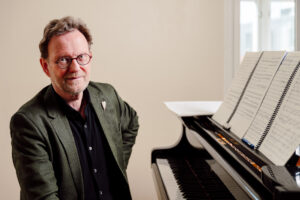
Ståle Kleiberg
Ståle Kleiberg is a major Norwegian composer with a considerable international reputation. His music is widely performed, and he receives commissions from well-established orchestras, ensembles and performers. Many recordings of his music have been released to outstanding international reviews, with several receiving Grammy nominations.
Kleiberg’s music is characterized by a distinctive form of extended tonality and by meticulous attention to coloristic details. This is especially evident in his orchestral works, including his three symphonies. The most recent, Across the Ocean towards a Higher Firmament, was commissioned by the Trondheim Symphony Orchestra and premiered in 2025. A television production of the work was broadcast by NRK the same year. The work will be released in 2026 on an album featuring three of Kleiberg’s orchestral works. His orchestral output also includes several concertos, five of which have been released on two albums, including the Grammy-nominated Treble & Bass: Concertos by Ståle Kleiberg.
Kleiberg’s works in the genres of oratorio and opera constitute an important part of his output. Mass for Modern Man is his most recent work in the genre. It had its Norwegian premiere in Trondheim’s Nidaros Cathedral in 2015, followed by its German premiere later that year at Münchner Dom. The work was commissioned by the Münchner Dommusik. The opera David and Bathsheba was highly acclaimed after its première in Nidaros Cathedral in 2008 and has subsequently been performed in several countries. 2L’s recording of the work was nominated for a Grammy in the category Best Opera Recording. Requiem – for the victims of Nazi persecution is one of Kleiberg’s most frequently performed works. Following its premiere in Nidaros Cathedral, it was performed in Washington National Cathedral on 11 September 2004 and recorded on CD with the Washington National Cathedral Choir and Orchestra. It has also been broadcast nationally in the US and has received numerous international performances. Kleiberg’s Requiem is his principal work dealing with this subject matter, alongside the orchestral work Lamento: Cissi Klein in memoriam and the cello concerto Dopo.
Kleiberg’s innovative approach, formal command and technical mastery are particularly apparent in his chamber music. A selection of six chamber works was featured on the 2015 album Mezzotints – Chamber Music by Ståle Kleiberg followed by the album Do You Believe in Heather? in 2019.
Ståle Kleiberg is Professor emeritus of Music at the Norwegian University of Science and Technology (NTNU).
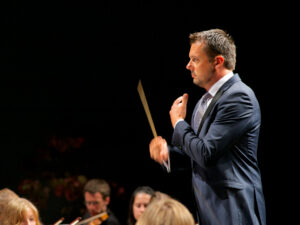
Peter Szilvay
Peter Szilvay began his career as a viola player. He spent three years playing in the Oslo Philharmonic, where he met Mariss Jansons, for whom he served as an assistant conductor for three years. His years as a musician were soon replaced by a steady stream of requests to conduct. This was followed by a position as assistant conductor at Stavanger Symphony Orchestra before Szilvay took on conducting engagements in his own right.
Early in his career, he made an impressive contribution to contemporary music, performing more than 150 new works with leading ensembles at home and abroad. However, his interest in classical and romantic music has grown steadily. Szilvay is passionate about working with singers, and conducting opera is high on hispriority list.
Szilvay has conducted orchestras and opera in Norway and abroad, including the Oslo Philharmonic, Bergen Philharmonic, St. Petersburg Philharmonic Orchestra, the Gothenburg Symphony Orchestra, Orchestra Philharmonique de Radio France and the Royal Danish Orchestra. Szilvay has conducted opera productions at the Norwegian Opera & Ballet (Oslo) and Opera Sør in Kristiansand, as well as in Würzburg, Germany.
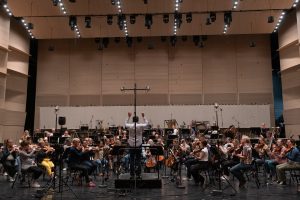
Trondheim Symphony Orchestra
The Trondheim Symphony Orchestra (TSO) is a powerhouse of the central Norwegian cultural landscape, providing a broad range of music of the highest artistic quality and contributing to the promotion and development of general interest in music locally, nationally and internationally.
Trondheim Symphony Orchestra & Opera (TSO) is one of Norway’s largest cultural institutions with a history stretching back to 1909. After the establish ment of the Trondheim Chamber Orchestrain 1947, the professional orchestra began to take shape. TSO was taken over by the state and NRK in 1962, and gradually became one of the country’s leading orchestras. In addition to classical symphony concerts, TSO performs a wide range of music including opera, contemporary music, early music and popular concerts. Its educations activities include talent development, as well as projects for children and youths. TSO is based in the Olavshallen Concert Hall in Trondheim, where most of its concerts are held throughout the season. In addition, it performs on tour in and around central Norway, as well as nationwide and international tours and assignments. TSO collaborates with TrondheimSolistene and the Trondheim Vocal Ensemble, as well as the Trondheim Symphony Opera Choir (TSO-koret), which is naturally an integral part of its opera productions.