
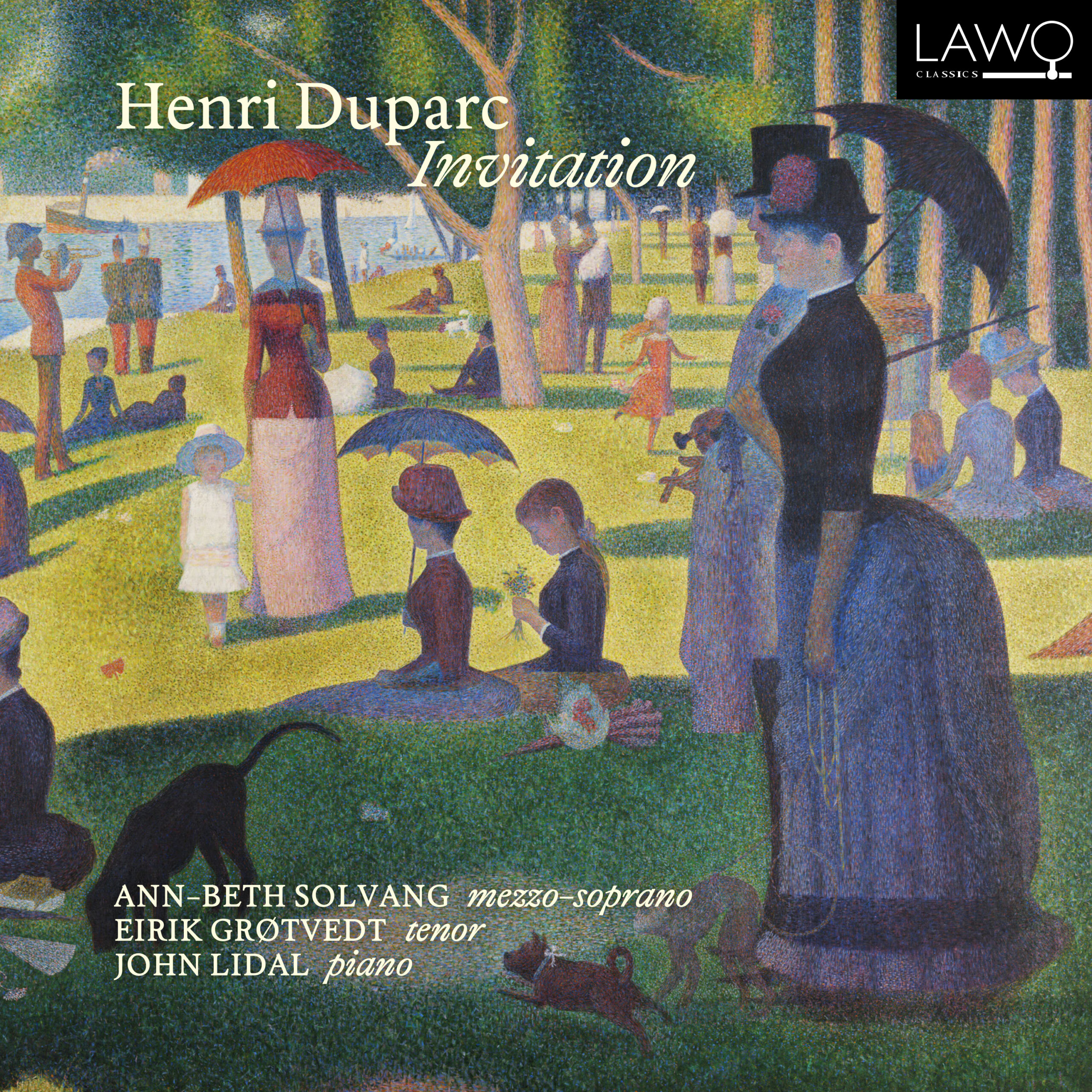
Henri Duparc – Invitation
Ann-Beth Solvang (Mezzo-soprano) | Eirik Grøtvedt (Tenor) | John Lidal (Piano)
HENRI DUPARC: INVITATION
Henri Duparc (1848–1933) wrote only seventeen songs, yet they rank among the finest in French art song. Debussy and Ravel called them works of genius and perfection. Around 1885, illness brought an end to Duparc's composing career. His Baudelaire setting of L'invitation au voyage is often called the quintessential French mélodie. It ranks alongside treasures such as Phidylé, Chanson triste, Soupir and La vie antérieure. Invitation gathers all seventeen songs on one album. The two singers share the songs and unite in La fuite, Duparc's only duet.
Mezzo-soprano Ann-Beth Solvang is currently a highly praised member of the soloist ensemble at the Badisches Staatstheater Karlsruhe, Germany. She has built an international opera career, comprising an exceptionally vast repertoire. Tenor Eirik Grøtvedt is one of Norway's most promising young voices, already with notable accomplishments to his credit. His artistic base is at the Norwegian Opera & Ballet. John Lidal is an in-demand Norwegian pianist, coach and accompanist currently on the roster of the Norwegian Opera & Ballet. All three artists are recipients of important Norwegian awards, including the Equinor and the Tom Wilhelmsen Foundation Award.
Listen
Tracks
Henri Duparc
Credits
- Performer
- Ann-Beth Solvang (Mezzo-soprano) | Eirik Grøtvedt (Tenor) | John Lidal (Piano)
- Composer
- Henri Duparc
- Producer
- Vegard Landaas
- Engineer
- Thomas Wolden
- Editing
- Vegard Landaas
- Mastering
- Thomas Wolden
- Liner notes
- Richard Stokes
- Executive producer
- Vegard Landaas
- Booklet editor
- Alison Bullock Aarsten
- PR
- Camilla Momkvist-Skau
- Accounting
- Torgeir M. Landaas
- Artist photo
- Ann-Beth Solvang by Stephan Walzl | Eirik Grøtvedt by Calm Vidal Photography | John Lidal by Péter Madai
- Design
- Anette L’orange | Blunderbuss
- Recording location
- Rainbow Studio, Oslo
- Recording country
- Norway
- Recording year
- 2025
- Recording dates
- 11.08.2025 | 12.08.2025 | 13.08.2025
- Original source
- DXD (352.8 kHz, 24 bit)
- Discs / tracks
- 1 disc | 17 tracks
- Release year
- 2026
- Label
- LAWO Classics
- Duration
- 1:01:31
- EAN
- 7090020184555
- ISRC
- NOEHX2626
Booklet text
Duparc - Complete songs
Henri Duparc’s output is slight: no more than seventeen songs survive, but on them rests his reputation as one of the greatest composers in the history of the mélodie. He composed them between the ages of 20 and 37, after which he lived for another 48 years without publishing – and hardly writing – another note. Unlike Fauré, three years his senior, who by the age of 20 had already produced a fair corpus of juvenile songs, Duparc's first mélodies, from ‘Chanson triste’ on, reveal his fully developed genius.
L'invitation au voyage, perhaps his best-known song, was composed during the Siege of Paris in 1870. It was later orchestrated by Duparc, but this version lacks the bright quality of the piano accompaniment, which exploits to perfection the sonorities of the instrument, especially in the vibrant oscillation of the open fifths and the way they contrast with the utter stillness of the refrain. There is something maniacal about Duparc’s expression of this nostalgia, akin to Wolf's treatment of Mignon’s vision of her homeland in ‘Kennst du das Land’. Baudelaire’s middle stanza, which describes a Dutch interior of gleaming furniture, rich ceilings, deep mirrors and scents of flowers and amber, was clearly too domestic for Duparc’s visionary setting, and was therefore omitted. Sérénade florentine was composed in 1880. It’s a tiny song, half lullaby, half barcarolle. Duparc would have known Fauré’s ‘Sérénade toscane’, and there’s a lyrical immediacy and simplicity about this little song of 33 bars that reminds us of early Fauré.
The poet of Testament (1883) is Armand Silvestre, whose minor verse inspired some of the finest songs in the repertoire by Chausson, Massenet, Fauré and Lalo. As W.H. Auden put it in the Introduction to The Poet's Tongue, “We do not want to read ‘great’ poetry all the time, and a good anthology should contain poems for every mood.” Silvestre’s elegantly crafted verse clearly struck a chord with Duparc, just as Mayrhofer’s did with Schubert. Duparc and Silvestre were friends, and the composer expressed disappointment at the critics’ luke-warm reception of his work. The song is bound together by a drooping phrase in the accompaniment which tolls throughout like a bell. The quotation of the spear-motif from Parsifal (four ascending notes, first in the right hand, and then in the left) in the postlude, reminds us that 1883 was the year of Wagner's death – Duparc is clearly paying homage to the composer he revered.
As soon as he heard Phidylé (1883), Massenet declared that the French Mélodie now possessed a masterpiece comparable to Schubert’s ‘Gretchen am Spinnrade’. Duparc uses only 4 of Leconte de Lisle’s 10 verses – the first three and the last. The sultry calm of the opening bars reminds us unmistakably of the opening of Chausson’s ‘Le colibri’ which had been composed a year earlier – small wonder that the song was dedicated to Chausson. After a page of nature description (soft grass beneath fresh poplars, banks of mossy springs, flowering meadows, dark copses) the poet/lover gazes on Phidylé: his pulse quickens, and flowing quavers speak of tenderness and erotic desire. ‘Repose, ô Phidylé!’ The music gradually gains momentum, undergoes remarkable modulations and reaches a passionate climax in the final verse, but not before another ‘Repose, ô Phidylé’, this time a third higher. The surging postlude allows the accompanist to sing wordlessly of those passions that the singer has voiced.
Extase from 1878 was composed according to Pierre de Bréville in the style of Tristan und Isolde, as a retort to the anti-Wagner lobby in Paris. Duparc’s miniature Liebestod is beautifully managed, and the limited range, which hovers between pp and mp, seems to increase rather than diminish the intensity of the song. La vague et la cloche sets a poem by François Coppée. Sketched at the piano in 1871, it was almost immediately orchestrated by Duparc for a large Wagnerian orchestra, and given the secondary title ‘mélodie dramatique’. Vincent D’Indy, to whom the song is dedicated, made a piano transcription of it in 1894. Marked assez vite et tumultueux, this is a huge song in E minor. With its touches of Liszt and Wagner (prelude of Das Rheingold and the storm from Die Walküre), it drew from Duparc the comment, made to Vincent D'Indy in 1892: “C’est déclamatoire, descriptiv, sans personnalité et sans émotion.” Indeed, the singer is instructed to sing simplement et sans nuances.
Chanson triste sets a poem by Jean Lahor and dates from1868, when Duparc was 20 years old. The vocal line is cruelly taxing and demands an impeccable sostenuto (Duparc also provided, uncustomarily, an alternative vocal line of reduced range). The rippling arpeggios of the accompaniment recall Fauré, and they intensify the melancholy of the song as they progress from the tonic E flat major, through G flat, A major, D major, D minor and back again to E flat. Written in the same key as Schubert’s ‘Erlkönig’ (G minor), Le galop is marked Allegro non troppo ma con fuoco, and this is indeed Duparc’s most fiery song. After the second verse there’s a whole stanza of energico recitative, before a new idea in E major leads to a fff climax. The postlude dies away to a ppp close. A song of extremes. Au pays où se fait la guerre, composed at the time of the Franco-Prussian war, was written for mezzo-soprano with the title of ‘Absence’. Duparc later re-worked and orchestrated it before it was eventually published in the 1911 Nouvelle édition complète of the songs. Duparc also intended to include it in his opera Roussalka after Pushkin, of which it is the only surviving fragment. “Je l’ai détruit pour des raisons d'art” (“I destroyed it for artistic reasons”), Duparc confided to Jammes in 1921. Sérénade sets a poem by Gabriel Marc. The rising arpeggios – all in 6/8 time for all 4 strophes – recall many a romance from Gounod to early Fauré. The accompaniment can almost be played by the left hand alone. La fuite (1871), to a poem by Théophile Gautier, takes the form of a duet between Kadidja and Ahmed. The girl suggests to her lover that they should elope together, and when he proves faint-hearted, she assures him that her eyelashes will shade him from the sun and, if there's no water along the route, they will drink the tears of her joy. There’s also a setting of this poem by Bizet.
Lamento (1883) was dedicated to Fauré. The Gautier poem comes from La Comédie de la Mort (1832), a collection as vital to the mélodie as Heine’s Buch der Lieder is to the Lied. The poem had already been set, complete, by Berlioz in the Nuits d'été; Duparc, however, cuts the poem and thereby diminishes it, despite the supple, elegant and sinuous melodic line with its step-wise movement. Elégie dates from 1874, and sets the same poem that Berlioz had tackled in 1829. Thomas Moore’s poem is dedicated “to the shade of the unfortunate Robert Emmet”, the Irish nationalist who was executed by the British in 1803 for his part in an uprising. Whereas Berlioz wrote a song of vehement outburst, into which he poured all his frustration and pain over the Harriet Smithson romance, Duparc’s setting is one of throbbing grief. The oppressive and Tristanesque chromaticism is reminiscent of Wagner. An ostinato motif of a falling minor second dominates the song, which is arguably more effective than Berlioz’s blustering. There are two melancholy stanzas, the first of quavers, and the second (marked un peu plus animé, mais très peu) of semiquavers. Melancholy the song might be, but it ends on a major third of hope. Le manoir de Rosemonde (1879) is a good example of Duparc’s mature declamatory style. The song is dominated by the rhythmic opening and that ascending bass figure which ushers in the voice. Durchkomponiert in the manner of Schubert’s ‘Erlkönig’, it recalls the composer’s own ‘La vague et la cloche’ and Lénore. In More than Singing, Lotte Lehmann wrote that “something akin to madness rages through this song”, and gives a compelling description of her interpretation of the final page: “With the forte chord [after ‘monde’], it is as if you see before you the commanding figure of death . . . your end, your surrender, and the realization in dying that everything has been senseless and futile. You never reached your goal. You must die without ever again seeing Rosamonde.” The briefest of postludes suggests that Duparc was familiar with ‘Ich hab im Traum geweinet’ from Schumann’s Dichterliebe.
Romance de Mignon (1869) sets a free translation by Victor Wilder of the first two verses from Goethe’s well-known poem, ‘Kennst du das Land’, from Wilhelm Meisters Lehrjahre. It’s an attractive and melodic song but by 1894, when Duparc published his Recueil de Mélodies, he had already heard Hugo Wolf’s masterful setting, and decided to omit his version from the collection, along with ‘Le galop’ and ‘Sérénade’. Duparc describes the background to Soupir (1868) in a letter to Jean Cras: “J'ai attendu trois ans mon mariage [...]. C’est pendant ce temps d’épreuve que j’ai écrit la petite mélodie que vous connaissez, Soupir” (“I waited three years to be married [. . .] It was during this testing time that I wrote the little mélodie that you know as ‘Soupir’”). The critic A. Michel interprets the song as an expression of a sort of mother fixation, but the extreme chromaticism of the accompaniment seems rather to convey the anguish of an unrequited lover. Whatever – the song has much in common with ‘Chanson triste’: the same appoggiatura motif, the same intensification of chromatic harmony in stanzas two and three, and the same expression of a hope that might never be fulfilled.
La vie antérieure, Duparc’s final song, was composed in 1884. “Mieux vaut n’avoir fait qu’une chose comme celle-là, plutôt qu’une œuvre nombreuse et imparfaite” (“Better to have created but one work like that than a large and imperfect œuvre”), said Massenet, referring to this masterpiece. It seems extraordinary that after this great song such flaming genius should compose no more for almost half a century, but that was Duparc’s fate. He suffered from a debilitating hyper-aesthesia, exacerbated no doubt by his excessive sensibility. He was neither insane nor crippled, but lived with his family, reading and discussing music and painting, until blindness and paralysis finally prevented him from leading a normal life.
Liner notes – Richard Stokes
Biographies

Ann-Beth Solvang
The Norwegian mezzo-soprano Ann-Beth Solvang studied at the Rogaland Conservatory of Music in Stavanger and at the Academy of Opera in Oslo. She was awarded the Shell Award in 2007. Following two years in the opera studio at the Hamburg State Opera, she joined the company as a principal artist in 2008, performing a wide range of mezzo-soprano roles. In the 2011/12 season she began her freelance career, appearing regularly at leading European opera houses and festivals, including the Innsbruck Festival of Early Music, Théâtre du Châtelet, Opéra Bastille, Theater an der Wien, the Bavarian State Opera and the Norwegian Opera & Ballet. Several of these productions have been released on CD and DVD.
From 2018 to 2024, Solvang was a member of the ensemble at the Oldenburg State Theatre, where she performed central roles across a broad operatic repertoire. In 2022 she was awarded the Erna-Schlüter Prize. Since joining the soloist ensemble of the Badische Staatstheater Karlsruhe in 2024, her repertoire has expanded to include soprano roles such as Marschallin, Lidoine, Sieglinde and Santuzza. In 2025, she sang the title role in the German premiere of Lemoyne’s Phèdre, receiving critical acclaim. An active concert singer, her repertoire includes works by Elgar, Mahler, Richard Strauss, Berlioz and Wagner. Ann-Beth Solvang was awarded the prestigious Wilhelmsen Award in 2026.

Eirik Grøtvedt
The Norwegian tenor Eirik Grøtvedt studied at the Norwegian Academy of Music in Oslo. In 2019 he joined the Young Artist Programme at the Norwegian Opera & Ballet, where he subsequently became a member of the soloist ensemble. Grøtvedt has established himself as a versatile operatic singer, with a repertoire spanning Mozart, Italian bel canto, French opera and contemporary works. He has appeared in leading roles such as Tamino, Don Ottavio and Ferrando, alongside more characterful parts and contributions to several contemporary opera premieres. His concert work includes major sacred and symphonic repertoire by composers such as Bach, Händel, Haydn and Beethoven. In recent seasons, he has undertaken notable engagements both in Norway and internationally.
Highlights include performances with the Bergen Philharmonic Orchestra, participation on a recording of Der Fliegende Holländer released by DECCA, and his debut with the London Philharmonic Orchestra in Alban Berg’s Wozzeck in 2026. At the Norwegian Opera & Ballet, he continues to appear in major productions, including Verdi’s Requiem and Wagner’s Der Ring des Nibelungen. Grøtvedt also maintains a strong commitment to the song repertoire. His achievements have been recognised with the Norwegian Soloist Prize in 2023 and the Equinor Award in 2025.

John Lidal
John Lidal is a prominent Scandinavian pianist, recognised for his versatility and extensive experience as an accomp–anist and chamber musician. A highly sought after collaborator, he has worked with artists of international stature throughout Europe and the United States, and regularly coaches leading singers performing at major opera houses and festivals. Lidal completed his studies at the Trondheim Conservatory of Music, and subsequently graduated with honours from the Guildhall School of Music & Drama in London, the Norwegian Academy of Music in Oslo and the Manhattan School of Music in New York. In 1999 he was awarded first prize in two international piano competitions in London. From 2001 to 2011, Lidal served on the faculty of the Manhattan School of Music.
He is currently engaged as pianist and coach at the Norwegian Opera & Ballet in Oslo, alongside an active freelance career. He is also frequently invited to give masterclasses at leading institutions, including the Conservatoire National Supérieur de Musique et de Danse de Paris, the Staatsoper Unter den Linden Opera Studio in Berlin, and the Manhattan School of Music. John Lidal was awarded the prestigious Wilhelmsen Award in 2018. He is the founder and Artistic Director of the LidalNorth International Opera Work shops, and maintains private coaching studios in Berlin, London, New York, Oslo and Paris.