
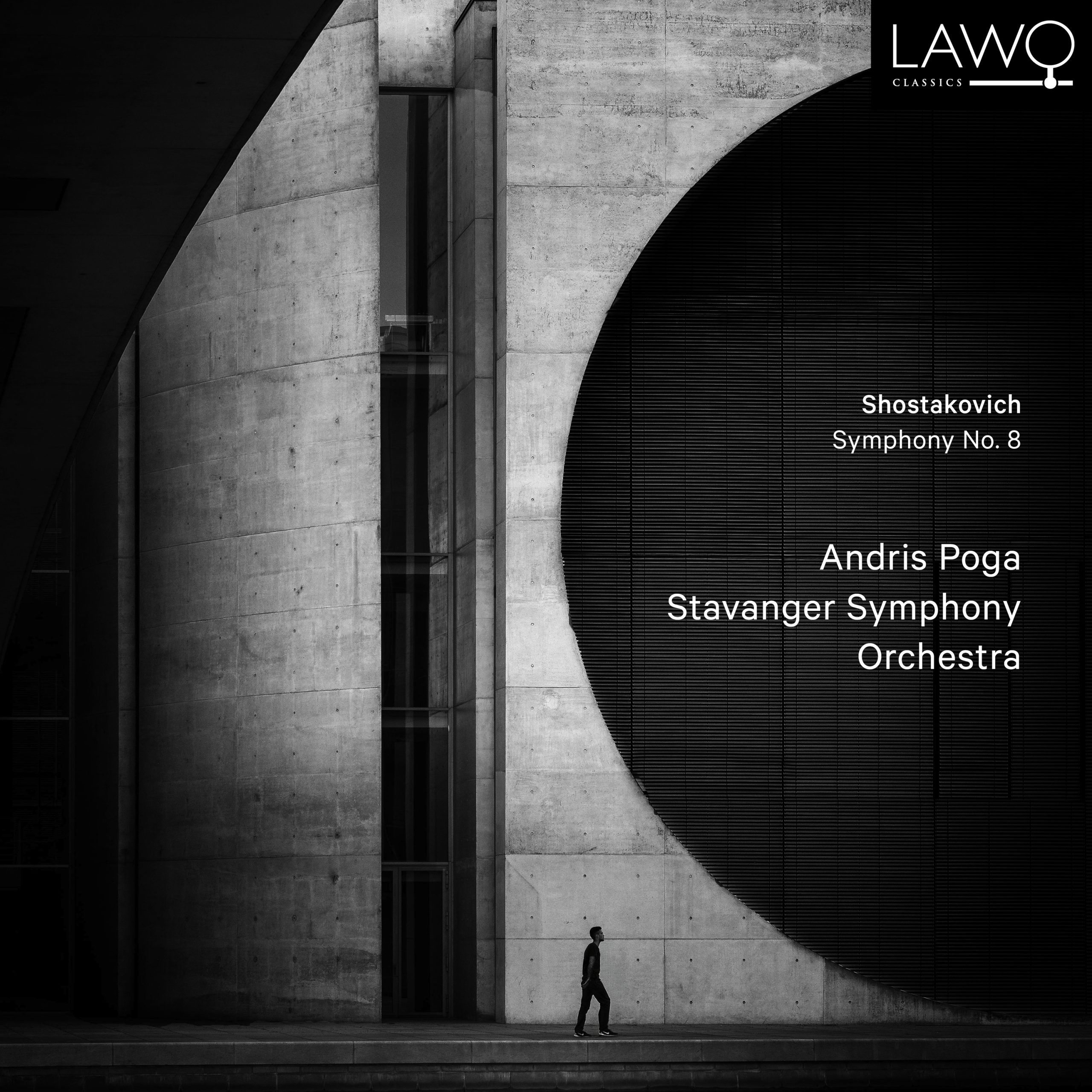
Shostakovich Symphony No. 8, Op. 65
Stavanger Symphony Orchestra (Symphony orchestra) | Andris Poga (Conductor)
DMITRI SHOSTAKOVICH'S SYMPHONY NO. 8 — STAVANGER SYMPHONY ORCHESTRA & ANDRIS POGA
Dmitri Shostakovich's Symphony No. 8 in C minor, Op. 65, performed by the Stavanger Symphony Orchestra under conductor Andris Poga, brings one of the twentieth century's most harrowing symphonic statements to vivid life.
Composed in 1943 at the height of the Second World War and written in the wake of the Battle of Stalingrad, the Eighth Symphony is one of Shostakovich's darkest and most personal works. Its five movements move from grinding tragedy toward an ambiguous, unresolved close rather than a conventional heroic finale — a structure that defied wartime expectations for triumphant symphonic writing and remains one of the composer's most uncompromising scores. Where many contemporaries called for celebratory music, Shostakovich instead confronted the era's devastation directly, producing a work of stark introspection and unflinching honesty.
The recording was made during Poga's tenure as the orchestra's Chief Conductor, a post he held from 2021 to 2026, and continues their exploration of Shostakovich's symphonic output — a body of work that has become a defining thread in the orchestra's recent recording history.
Listen
Tracks
Dmitri Shostakovich (1906–1975)
Symphony No. 8, Op. 65 (1943)
Credits
- Conductor
- Andris Poga
- Performer
- Stavanger Symphony Orchestra
- Symphony orchestra
- Stavanger Symphony Orchestra
- Ensemble members
Stavanger Symphony Orchestra on this recording
- Emily Davis (Violin 1)
- Dunja Bontek (Violin 1)
- Victoria Lewis (Violin 1)
- Una Maja Vagner (Violin 1)
- Nora Myrset Asheim (Violin 1)
- Aleksander Zetterstrøm (Violin 1)
- Bjarte Mo (Violin 1)
- Naho Nayuki (Violin 1)
- Zeljko Djerdj (Violin 1)
- Ida Celine Dirdal (Violin 1)
- Jian Ren (Violin 1)
- Eirik Stangenes (Violin 1)
- Erling Skaufel (Violin 1)
- Francesco Ugolini (Violin 1)
- Mara Haugen (Violin 1)
- Harald Grimsrud (Violin 2)
- Benedicte Kyllingstad (Violin 2)
- Sigrun Egeland-Eriksen (Violin 2)
- Carole Marie Harris (Violin 2)
- Maren L. Nygård (Violin 2)
- Malgorzata Chwastek (Violin 2)
- Chao-Kai Lin (Violin 2)
- Sondre Sandberg (Violin 2)
- Hans Björkroth (Violin 2)
- Gjertrud Økland (Violin 2)
- Åsne F. James (Violin 2)
- Hedvig Selstad (Violin 2)
- Magnhild S. Torvanger (Violin 2)
- Davis Sliecans (Viola)
- James Herstatt (Viola)
- Yauheniya Mazynskaya (Viola)
- Ingerid Waleson (Viola)
- Terje Wiedswang (Viola)
- Wouter Raubenheimer (Viola)
- Stephanie Blanchard (Viola)
- Øystein Torp (Viola)
- Elisabet S. Sijpkens (Viola)
- Agnes Pavelich (Viola)
- Emma Hagenström (Viola)
- Marcus Michelin (Cello)
- Ilmari Hopkins (Cello)
- Liv Opdal (Cello)
- Tonje Bekken (Cello)
- Katarina Svendsen (Cello)
- Jaakko Pulakka (Cello)
- Aslihan Gençgönül (Cello)
- Bodhild E. Vossgård (Cello)
- Hjalmar Kvam (Cello)
- Igor Eliseev (Double bass)
- Ivan Zavgorodniy (Double bass)
- Markus Weinhold (Double bass)
- Jacek Wozny (Double bass)
- Askild Sømme (Double bass)
- Bjørn F. Nilssen (Double bass)
- Charlotte Henry (Double bass)
- Kristin Hammerseth (Flute)
- Marie Haugejorden Schau (Flute)
- Kristin Hjellset (Flute)
- Karin Venaas (Flute)
- Yurie Aramaki (Oboe)
- Stacey Dixon (Oboe)
- Vicente Montalt Ros (Oboe)
- Ben Aldren (Clarinet)
- Alzbeta Baldova (Clarinet)
- Nino Felbab (Clarinet)
- Benedict van Leuven (Clarinet)
- Johannes Herjö (Bassoon)
- Dmitry Arseniev (Bassoon)
- Francisco Soutinho Ventura (Bassoon)
- Steven James (Horn)
- Barkin Sönmezer (Horn)
- Andrea Wensberg (Horn)
- Andraz Znidarsic (Horn)
- Frank Braafhart (Trumpet)
- Odin Hagen (Trumpet)
- Frank Roger Eikeland (Trumpet)
- David Friedrich (Trombone)
- Ebbe Sivertsen (Trombone)
- Ingrid Utne (Trombone)
- Øyvind Grong (Tuba)
- Odd Børge Sagland (Timpani)
- Mark Sijpkens (Percussion)
- Bastien Ricquebourg (Percussion)
- Odd Kyrre Alsvik (Percussion)
- Tormod Berven Skjerve (Percussion)
- Akane Tominaga (Percussion)
- Composer
- Dmitri Shostakovich
- Producer
- Vegard Landaas
- Engineer
- Thomas Wolden
- Editing
- Vegard Landaas
- Mastering
- Thomas Wolden
- Liner notes
- Andrew Mellor
- Executive producer
- Vegard Landaas
- Booklet editor
- Torgeir M. Landaas
- PR
- Camilla Momkvist-Skau
- Accounting
- Torgeir M. Landaas
- Cover photo
- Bastian
- Artist photo
- Andris Poga by Janis Porietis | Stavanger Symphony Orchestra by Mari Hult
- Design
- Anna-Julia Granberg | Blunderbuss
- Recording location
- Stavanger Concert Hall, Fartein Valen, Stavanger
- Recording country
- Norway
- Recording year
- 2025
- Recording dates
- 26.05.2025 | 27.05.2025 | 28.05.2025 | 30.05.2025
- Original source
- DXD (352.8 kHz, 24 bit)
- Discs / tracks
- 1 disc | 5 tracks
- Release year
- 2026
- Label
- LAWO Classics
- Duration
- 1:04:22
- EAN
- 7090020184463
- ISRC
- NOEHX2639010-050
Booklet text
Dmitri Shostakovich’s life and music are defined by his complicated relationship with the Soviet authorities who kept a watchful eye over his every creative move. Composers under Stalin were supposed to write music that chimed with the dictator’s view of the world. For an artist like Shostakovich who naturally opposed Stalin’s oppression and killing, that made for a living hell.
At least, that’s what we tend to think in the third decade of the twenty-first century – with the benefit of perspective and living (mostly) in liberal democracies. One notably high-profile conductor with the same nationality as Andris Poga, who is no stranger to Shostakovich’s symphonies, recently posited the notion that the composer believed wholeheartedly in the Soviet project and was proud to be a Soviet Russian artist – even if he’d become grossly disappointed by the way things turned out and was no friend of Stalin’s.
Shostakovich’s Symphony No 7 certainly bears that theory out. It is the first of the composer’s trilogy of symphonies written during the Second World War. The Seventh had a galvanizing effect at the time (particularly on Shostakovich’s fellow citizens of a city enduring a siege by German troops, Leningrad) while its success abroad secured Shostakovich’s status as a figure of hope at a time of global conflict. The meaning of so much music by the composer is elusive, obfuscated and apparently contradictory. But the Seventh was as unequivocal as his music gets: it was concerned with nothing less than the unity and survival of his fellow citizens and was considered a noble gesture in its contribution to the fight against Nazism.
Shostakovich’s next symphony would prove very different. The composer headed to the Soviet Composer’s Union’s retreat to write the piece in the summer of 1943, months after the Russian victory at Stalingrad had been declared, on 2 February 1943. Did that victory stir-up uneasy feelings in Shostakovich, whose ill-feelings towards Stalin can’t be denied, no matter what his commitment to the wider Soviet ideology? Stalingrad had undeniably strengthened the hand of the dictator, who had already liquidated millions of Shostakovich’s fellow citizens as punishment for dissent.
As awkward as it may be to admit – although Shostakovich seemed happy enough to admit it himself – the horror and chaos of war had its positive side for the composer. It distracted Stalin from internal affairs and loosened his paranoid grip on domestic creativity. It also allowed Shostakovich to write deeply painful music which he could plausibly justify as a depiction of Soviet hardship in the face of German savagery. That is precisely how the composer explained the near irrepressible gloom of his Symphony No 8 – a five movement, hour-long journey through musical suffering towards an inconclusive ending.
This is how the symphony survived initial censorship, when Soviet cultural apparatchiks were presented with a dark piece when they’d been expecting (and needing) a work glorifying the military victory. But there was more to it than that. Shostakovich admitted the cathartic opportunity of the war and of the ongoing siege of Leningrad: that it allowed open expressions of grief and pain that were unacceptable in Soviet countries during peacetime.
As the composer comments in Testimony, the memoir he co-curated with Solomon Volkov: ‘the sorrow [in wartime] became a common one. We could talk about it, we could cry openly, cry for our lost ones. People stopped fearing tears. Before the war…everyone had someone to cry over, but you had to cry silently, under the blanket.’
The ‘before the war’ refers to the many Soviet citizens killed by their own government in the years running up to the war – an estimated 1.5 million in 1937-39 alone. It was to this death toll that Shostakovich was referring in Testimony, when he commented that ‘I had to write a Requiem for all those who died, who had suffered. I had to describe the horrible extermination machine and express protest against it. The Seventh and Eighth Symphonies are my Requiems.’
Thus it becomes easy to view the Eighth Symphony as a classic example of Shostakovich hiding his own truth behind a more obvious but yet misleading narrative, as in the Symphony No 5. Publicly, the Eighth was an act of remembrance for the heroes of Stalingrad; privately – or rather, honestly – it was a lament for those lost on Stalin’s orders.
The symphony was finished in September 1943, apparently in the space of just two months – though that was really just the time it took for the composer to commit to paper the complete form of a work that had been taking shape inside his head for many months already. It was first performed in Moscow on 4 November by the USSR State Symphony Orchestra under Yevgeny Mravinsky, its dedicatee.
Shostakovich was careful to make all the right noises before the premiere so as to condition the responses of the censors as far as possible. It shows just how deaf those censors could be to nuance that the irony in the composer’s tone wasn’t detected. The symphony, claimed Shostakovich, ‘reflects my elevated creative mood, influenced by the joyful news of the Red Army’s victories’ – a bold description for a symphony that appears to depict suffering on a cosmic scale. He continued: ‘the symphony contains tragic and dramatic inner conflicts. But on the whole it is optimistic and life-asserting…the philosophical conception […] can be summed up in these words: life is beautiful. All that is dark and evil rots away, and beauty triumphs.’
The state-controlled press appear to have accepted that explanation – or at least, the alternative narrative that the symphony was a testament to Soviet suffering. It was only later on, at a Composer’s Union event in 1944, that the symphony was criticized by Shostakovich’s colleagues. Four years later in 1948, the regime finally smelled the coffee. The Central Committee of the Communist Party attacked the symphony for its ‘pessimism, unhealthy individualism, extreme subjectivism and willful complexity’. Minister of Culture, Andrei Zhdanov, decreed that it was ‘not a musical work at all’ and likened it to ‘a musical gas chamber, the sort the Gestapo use.’ It would not be heard again until after Stalin’s death.
There is a grain of truth in Zhadov’s latter point, as crudely as it was put. There are moments in the Eighth that are chillingly dehumanizing. Even now, some point to its repetition, mundanity and chaos – all of which, Shostakovich would doubtless respond, are intentional reflections of life under Stalin.
Few would deny now, however, that the Eighth is one of the most ambitious and complex of Shostakovich’s fifteen symphonies and one whose philosophical and emotional challenges are pertinent and necessary as the world enters a new phase of state-sponsored aggression. The symphony is arranged over five movements, with the first as long as the three that follow next. Shostakovich described that opening movement as ‘a long adagio, with a dramatically tense climax.’ In reality it’s a grueling movement in which lyricism is deprived of the necessary oxygen to even exist, that oscillates between sadistic brutality and desolate resignation.
Two rapid, scherzo-like movements follow: a bristling march punctuated by shrieking woodwinds and volcanic drums that winds up on a traumatized cor anglais; and a grotesque image of industrial slaughter in which maniacal trumpets and a machine-like snare drum play off one another. The conductor Mark Wigglesworth has noted that the movement contains thirty-nine crescendos and only two diminuendos.
Many consider the music of the fourth movement among the most terror-inducing the composer wrote, the music apparently paralyzed by the looping bass line and, by implication, the heavy constriction of totalitarianism, conflict and a lack of choice. The tragedy of the final movement is only increased by fleeting visions of apparent hope instigated by the woodwinds, which prove illusory. The music gropes its way towards a faintly reassuring but also somehow menacing C major. If that key is supposed to offer consolation, its orchestration on sparse strings and flute suggests that any sense of peace is achieved only by death.
The symphony’s journey from C minor to C major echoes that of Beethoven’s Fifth, though lacking any sense of that work’s victory. Its five-movement structure, opening with an Adagio, and its various shrieks of pain also align it with Mahler’s Tenth, a work Shostakovich knew well. But as with Beethoven’s victory, Mahler’s coming-to-terms also proves elusive. A faint reference to Tchaikovsky at his most fatalistic in the final movement also signals that Shostakovich knew the game was up. The Leningrad Symphony depicts a Shostakovich who believed in the prevailing strength of the human spirit. Its successor suggests that in the face of so much human tragedy, he had lost faith even in that.
Andrew Mellor © 2026
Andrew Mellor is a journalist and critic based in Copenhagen and author of The Northern Silence: Journeys in Nordic Music and Culture (Yale University Press, 2022)
Biographies
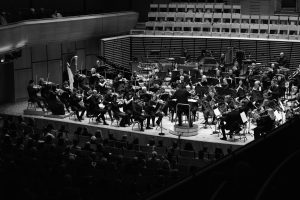
Stavanger Symphony Orchestra
Stavanger Symphony Orchestra is located on Norway's southwest coast, the Stavanger Symphony Orchestra (SSO) performs in Stavanger Concert Hall, regarded as one of the finest acoustic venues in Europe. Andris Poga has been the orchestra's Chief Conductor since the 2021–22 season. Recent guest conductors have included Karina Canellakis, Pablo Heras-Casado, James Gaffigan, Dalia Stasevska, Fabien Gabel, Jan Willem de Vriend, and Andrew Manze.
The orchestra has released a substantial catalogue under SSO Recordings, in addition to acclaimed albums of Scandinavian music for BIS and baroque repertoire with Fabio Biondi for Naïve. SSO has toured in Japan, the United States, Germany, Finland and the Netherlands. Early music has been a key artistic pillar for the orchestra. Frans Brüggen served as Artistic Director for Early Music from 1990–1997, followed by Philippe Herreweghe (2000–2004) and Fabio Biondi (2006–2016).
The orchestra was nominated for a Spellemann Award in 2018 and for a Grammy Award in 2020, for Gisle Kverndokk's Symphonic Dances.
Founded in 1938, the orchestra today consists of 85 musicians representing 24 nationalities.
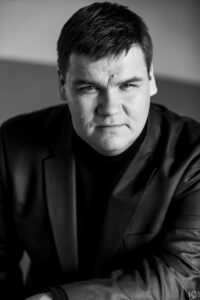
Andris Poga
Andris Poga was the Chief Conductor of the Stavanger Symphony Orchestra for the period from 2021 to 2026. He was the Music Director of the Latvian National Symphony Orchestra from 2013 till 2021 and continues to collaborate with the LNSO as its Artistic Advisor.
Highlights of recent years have included concerts with the leading orchestras of Germany, France, Italy, Japan and Scandinavia. After the first successful collaborations he has become a regular guest at the NDR Elbphilharmonie Orchester Hamburg, WDR Sinfonieorchester Cologne, Deutsches Symphonie-Orchester Berlin, NHK Symphony Orchestra Tokyo and many others. He has also conducted the Tonhalle-Orchester Zürich, Gewandhaus-orchester, Accademia Nazionale di Santa Cecilia, Royal Philharmonic Orchestra, Hong Kong Philharmo-nic, Sydney Symphony and Dallas Symphony.
In 2010, Andris Poga was the First Prize winner of the Evgeny Svetlanov International Conducting Competition, which thrust him into the international scene. He became an assistant to Paavo Järvi at the Orchestre de Paris and he also served as the assistant conductor for the Boston Symphony Orchestra.
Poga graduated from the conducting department of the Jāzeps Vītols Latvian Academy of Music. He studied philosophy at the University of Latvia and conducting at the Vienna University of Music and Performing Arts.