
Personal Best
Trio Accanto (Chamber ensemble) | Eivind Buene (Vocals)
PERSONAL BEST
With Personal Best, Norwegian composer Eivind Buene presents a new work written for Trio Accanto that blurs the boundaries between composition, performance, and reflection.
The title suggests competition and measurement, but Personal Best turns the idea inward. Rather than striving for virtuosity in the conventional sense, the work investigates what it means to perform at one’s limits—artistically, physically, and mentally. The instrumental writing moves between sharply etched gestures and moments of suspended clarity, creating a constantly shifting terrain in which sound, text, and presence interact. The result is a work that feels at once rigorously constructed and strikingly immediate.
The album also includes Serious Songs, Buene’s adaptations of Johannes Brahms’ Four Serious Songs. Here Buene himself appears as singer, his performance bringing back imperfection and vulnerability to art music and blurring the boundaries between real life and the art of interpretation.
Trio Accanto, one of Europe’s leading ensembles for contemporary music, brings its characteristic precision and openness to Buene’s multifaceted score. The ensemble consists of Nicolas Hodges (piano), Marcus Weiss (saxophone) and Christian Dierstein (percussion).
Personal Best continues Buene’s long‑standing engagement with music as a performative and social practice. Rather than presenting a fixed statement, the piece invites listeners into a process—one that is searching, self‑aware, and acutely attuned to the conditions of contemporary music-making.
This release offers a compelling portrait of a composer unafraid to place himself inside the work, and of an ensemble uniquely equipped to navigate its demands with intelligence and intensity.
Listen
Tracks
Eivind Buene (*1973)
Personal Best
Serious Songs
Text: Eivind BueneTrio Accanto | Eivind Buene | Nicolas Hodges
Serious Songs
Text: Eivind BueneTrio Accanto | Eivind Buene | Nicolas Hodges
Serious Songs
Text: Eivind BueneTrio Accanto | Eivind Buene | Nicolas Hodges
Serious Songs
Text: Eivind BueneTrio Accanto | Eivind Buene | Nicolas Hodges
Credits
- Performer
- Nicolas Hodges (Piano | Vocals) | Marcus Weiss (Saxophone | Vocals) | Christian Dierstein (Percussion | Vocals) | Eivind Buene (Vocals)
- Chamber ensemble
- Trio Accanto
- Composer
- Eivind Buene
- Lyricist
- Eivind Buene
- Producer
- Michal Acker | Manuel Braun
- Engineer
- Manuel Braun | Roland Schneider | Daniel Miska
- Editing
- Manuel Braun
- Mastering
- Thomas Wolden
- Piano tuner
- XXX
- Liner notes
- Martina Seeber
- Executive producer
- Eivind Buene
- Booklet editor
- Torgeir M. Landaas
- PR
- Camilla Momkvist-Skau
- Accounting
- Torgeir M. Landaas
- Artist photo
- Trio Accanto by Nicolas Hodges
- Design
- Anette L’orange | Blunderbuss
- Recording location
- SWR Experimental Studio, Freiburg
- Recording country
- Germany
- Recording year
- 2024
- Recording dates
- 19.02.2024 | 20.02.2024 | 21.02.2024 | 22.02.2024 | 23.02.2024
- Original source
- 48 kHz, 24 bit
- Discs / tracks
- 1 disc | 13 tracks
- Produced with support from
- Arts and Culture Norway
- Release year
- 2026
- Label
- LAWO Classics
- Duration
- 45:50
- EAN
- 7090020183947
- ISRC
- NOEHX2544010-130
Booklet text
A nest can be a refuge, especially the one made for you by someone else. When Eivind Buene sings Brahms, as he already did with Schubert, the musical setting feels familiar. Anyone acquainted with classical music has likely been here before, perhaps even often enough that the nest—admittedly existentially unsettling—which Brahms constructed near the end of his life with the Four Serious Songs, may have become a kind of home, a part of one's own biography, one's own identity. Is this a new retro comfort? Or kitsch, if kitsch means relying on the tried-and-true emotional registers without taking risks?
It's been not too long, yet still three-quarters of a century, since New Music declared a "zero hour" to escape the horror of both personal and collective pasts. This impulse, originating mainly in Germany, was so absolute—and perhaps so fascinating in its absoluteness—that it swept even the northernmost edges of Europe along with it. Concepts like "homeland" and "tradition" became as heavily burdened as melodies, tonal structures, or surrendering control over one's emotions. The inherited nest was contaminated, down to the last intricately woven twig. Much time has passed since then. The collective trauma has lost some of its grip over generations, and New Music itself has aged. It now has a past and a history. Lives have been lived in this time.
Trio Accanto was founded in 1994 by a pianist, a saxophonist, and a percussionist who commissioned new works for this unusual instrumentation in contemporary music. Since then, the trio has premiered around 40 compositions. When pianist Yukiko Sugawara stepped down, she was succeeded by Nicolas Hodges; starting in 2025, Stefan Wirth has taken over his role. Despite these personnel changes, Accanto has forged its own identity, shaped as much by its members as by its shared repertoire. In Personal Best, Eivind Buene invites saxophonist Marcus Weiss, percussionist Christian Dierstein, and Nicolas Hodges to reflect on their individual histories—musically and verbally. As they put vinyl records on during this six-part trio portrait from 2021, their voices play from conversations with the composer, one after another. Having previously guided the computer assistant Siri through orchestral history in A Posthuman Guide to the Orchestra (2018), Buene now has the trio's members speak for themselves: about early dreams of composing, boarding schools, the practice of practice, the courage to make mistakes, and their own bodies.
These three original-sound collages, in which Eivind Buene transforms key moments from each performer's story, is woven into the live music, electronically transformed with live electronics from the Experimentalstudio in Freiburg. In Christian's Collage, meditative bell sounds gradually blend with piano. Marcus' Collage is dominated by an expansive saxophone solo, featuring the fragile multiphonics he masters so well, while Nic's Collage resonates with the raw anger of the postwar avant-garde.
The passage of individual and collective time is not just central to this Trio—it's a thematic core. For instance, the live use of turntables serves both as playback device and theatrical prop. The vinyl record alone signifies a journey into the past. Eivind Buene refers to this as "telescopic listening." The focus shifts from the present into the recent or even more distant past.
In Personal Best, we witness a trio that has written more history than it is likely to write in the future. This isn't a judgment, just a matter of arithmetic. It can look back on decades of musical and performer history. When Eivind Buene began to look not only forward toward a radically new future in his work, but also back, he was still in his mid-thirties: "From 2009 to 2012, I was composing, but mostly engaged in developing new and different ideas. I read a lot of critical theory and art theory, which became very important to me. Theorists like Hal Foster inspired me, especially his book Return of the Real. During that time, I became increasingly interested in media archaeology. I opened myself up to the past, but with a critical eye and particular attention to outdated technologies—including the orchestra, a Fender Rhodes, the Minimoog synthesizer from the late 1960s, or the vinyl record." (Interview with Torsten Möller, SWR, 2020)
This form of musical archaeology has nothing to do with academic research. These artistic inquiries, both self-directed and outward-looking, have more the character of personal affirmations in which social conditions may also be reflected. They explore the relationships between performers, works, and historical moments, and bring them to the concert stage. There, the performers do not merely act as conveyors of an artistic message, they become performers of themselves. Reality TV in the 1990s may have provided trashy models for this, but parallels also exist in the autobiographical novels of Karl Ove Knausgård or documentary theatre. Eivind Buene is not alone in his approach within the music world. Composers such as Georges Aperghis (Situations, une convivialité musicale, 2013; Lauf des Lebens, 2020) or Lars Petter Hagen (The Neue Vokalsolisten Notebook, 2011) have developed concepts in which musicians are more than highly skilled yet replaceable interpreters. These works make individuals—with their bodies, instruments, voices, thoughts, and shared histories—the subject of the art. This is a reality-based art, far from timeless, as it draws no clear line between the score and the actual human being interpreting it. Eivind Buene himself calls it embodied history.
In his adaptations of Four Serious Songs by Johannes Brahms, it is the composer himself who continues the Romantic song tradition using his own voice and body. As in Schubert Lounge (2012), where he accompanied himself on a Fender Rhodes, Buene also takes the stage as a singer in Serious Songs. In doing so, he weaves his own story—and that of the 20th century—into the songs. He sings like a pop musician or singer-songwriter, playing with the aura of authentic self-taught expression and the microphone that paved the way for pop vocalism. The piano accompaniment is left to Nicolas Hodges.
As an arranger, Buene sometimes stays close to the original structure, but often keeps only a loose connection. It is primarily the pop aesthetic that drives the divergence from the original. In covering the Four Serious Songs, the stark contrasts Brahms composed disappear. Not coincidentally, the word "composing" (Komponieren) means "putting together." The Serious Songs, sung in English, follow a much smoother flow—seemingly born of improvisation—gliding past many of the abrupt mood shifts of the original.
Just as Personal Best partly blurs, and partly only appears to blur, the distinction between interpreter and private individual (after all, the Trio itself is a form of staging), and just as the pop singing in Serious Songs suggests maximum authenticity: both examples reveal how Eivind Buene plays with the "fourth wall" that separates art from everyday life on stage. He does so not ironically or with deconstructive coldness, but likely out of a desire to overcome alienation. The path that led to Serious Songs began with reflections on chamber music—music that, before the invention of the phonograph, could only be heard when someone played it: sometimes on the big stage, but more often at home or in intimate settings. When Buene's Schubert and now Brahms arrangements bypass the authority of the professional song interpreter, he brings back imperfection and vulnerability to art music—paired, however, with pop's commercially successful and proven promises of authenticity. He walks a fine line between kitsch and experiment. His adaptations satisfy longing—and question it openly on stage. How new does a nest need to be? And what experiments can it withstand? Both Serious Songs and Personal Best could be fruitfully accompanied by Adorno's sharpest aphorisms. After all, Adorno also left many questions unanswered when he ended his essay Vers une musique informelle with the sentence: "The aim of every artistic utopia today is to make things in ignorance of what they are."
— Notes: Martina Seeber
Biographies
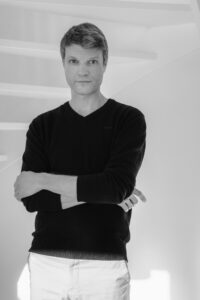
Eivind Buene
Eivind Buene studied at the Norwegian Academy of Music from 1992 to 1998, and the following two years he was composer in residence with the Oslo Sinfonietta. He is living and working in Oslo and is currently professor of composition at the Norwegian Academy of Music. Buene has collaborated with a wide array of international ensembles, orchestras and festivals, with commissions from among others Ensemble Intercontemporain, Donaueschinger Musiktage, Klangforum Wien, Ensemble Musikfabrik and Berliner Philharmoniker. He has an extensive discography, including Possible Cities/Essential Landscapes, that was awarded a Norwegian Grammy.
Apart from writing music for soloists, ensembles and orchestras, Buene has also engaged in collaborations with improvising musicians, in the cross-section between classical notation and improvisation. In the project Schubert Lounge he regularly performs his renderings of Schubert songs re imagined as singer/songwriter performances, with Buene as a singer with a Fender Rhodes and different ensembles. In addition to music, Buene has written critique and essays, and he made his literary debut with the novel Enmannsorkester in 2010. He has published five novels and two collections of essays, and is also exploring hybrid forms between music and text in large–scale orchestral works such as Blue Mountain, for two actors and orchestra (2014), A Posthuman Guide to the Orchestra (2018) and I dag og i morgen (2023).
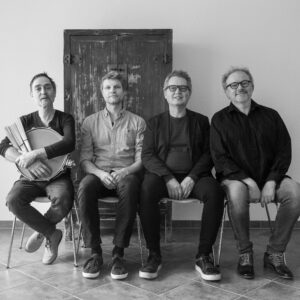
Trio Accanto
Trio Accanto was formed in 1994 by three internationally prominent soloists united by a distinctive approach to chamber music, and has been praised for its “mastery” and “world class interpretations”. The line-up of saxophone, piano and percussion is common in jazz but was a rarity in classical music, leading to the description “a jazz trio that does not play jazz”, until Trio Accanto changed that, inspiring more than one hundred composers to write new works.
Major figures such as Georges Aperghis, Aldo Clementi, Michael Finnissy, Beat Furrer, Georg Friedrich Haas, Toshio Hosokawa, Helmut Lachenmann, Wolfgang Rihm, Rebecca Saunders, Salvatore Sciarrino and Christian Wolff have contributed to the repertoire, along with many younger composers from around the world.
The trio has appeared at festivals in Donaueschingen, Witten, Darmstadt, Huddersfield, Basel and Stuttgart, as well as the Munich Biennale, Maerzmusik in Berlin, the Salzburg Festival and Wien Modern, and further afield in Madrid, Chicago and Japan.
Its recordings include Funambules (2016), Songs and Poems (2018), Other stories (2020), a disc of music by Christian Wolff (2021) and, most recently, Out into the open (2026), with music by Furrer, Pauset, Mochizuki and Saunders. In 2022 the trio also recorded Evan Johnson’s Plan and section of the same reservoir.