
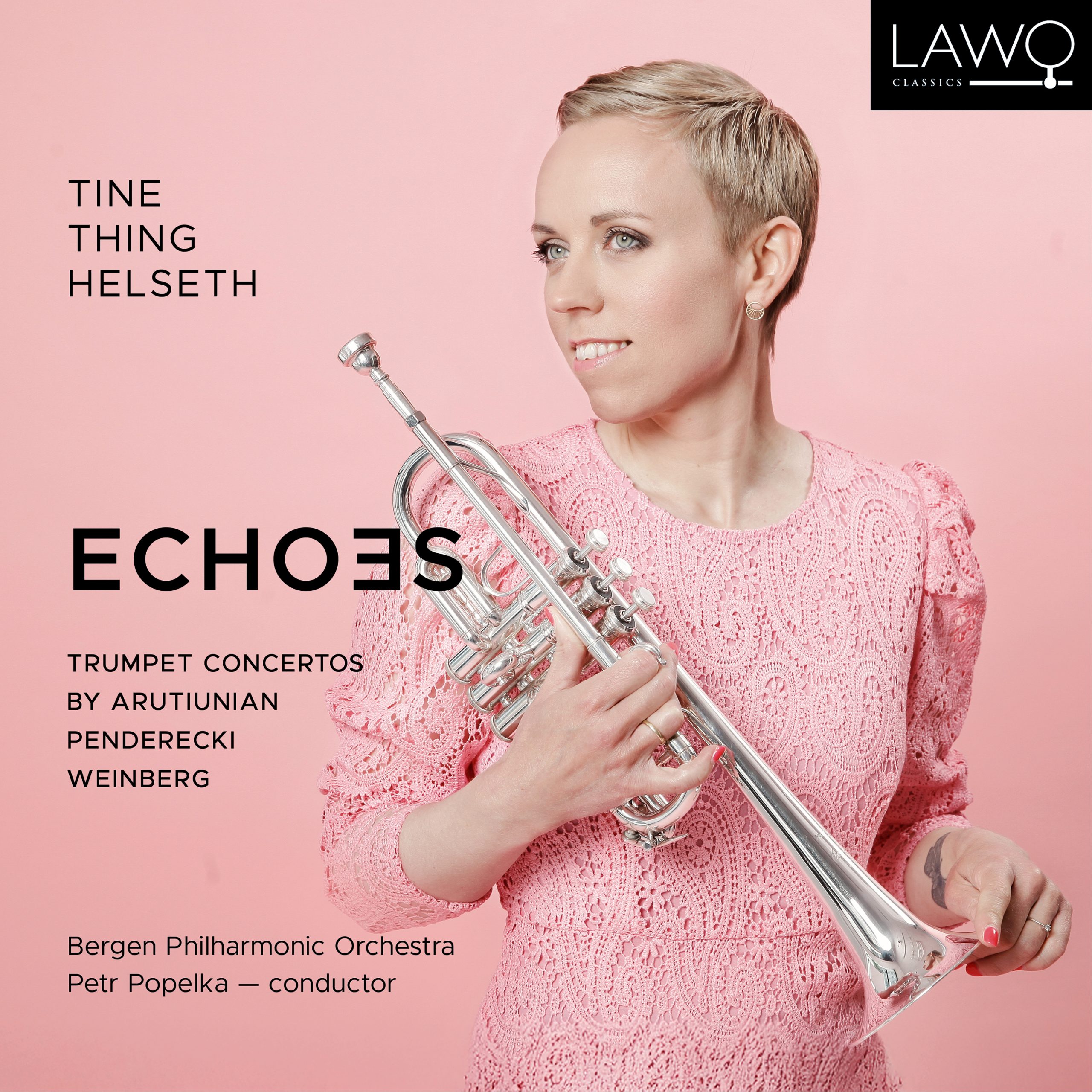
Echoes: Trumpet concertos by Arutiunian, Penderecki and Weinberg
Tine Thing Helseth (Trumpet) | Bergen Philharmonic Orchestra (Symphony orchestra) | Petr Popelka (Conductor)
Stream & download
Tracks
Alexander Arutiunian (1920–2012)
Krzysztof Penderecki (1933–2020)
Concertino per tromba e orchestra
Alexander Arutiunian (1920–2012)
Theme and Variations
Mieczysław Weinberg (1919–1996)
Concerto for Trumpet and Orchestra, Op. 94
Credits
- Conductor
- Petr Popelka
- Performer
- Tine Thing Helseth (Trumpet) | Bergen Philharmonic Orchestra | Petr Popelka
- Symphony orchestra
- Bergen Philharmonic Orchestra
- Composer
- Alexander Arutiunian | Krzysztof Penderecki | Mieczysław Weinberg
- Producer
- Vegard Landaas
- Engineer
- Thomas Wolden
- Editing
- Vegard Landaas
- Mastering
- Thomas Wolden
- Liner notes
- Andrew Mellor
- Executive producer
- Vegard Landaas
- Booklet editor
- Torgeir M. Landaas
- PR
- Camilla Momkvist-Skau
- Accounting
- Torgeir M. Landaas
- Cover photo
- Anna-Julia Granberg
- Artist photo
- Tine Thing Helseth by Anna-Julia Granberg
- Design
- Anna-Julia Granberg | Blunderbuss
- Recording location
- Grieghallen, Bergen
- Recording country
- Norway
- Recording year
- 2024
- Recording dates
- 14.08.2024 | 15.08.2024 | 16.08.2024
- Original source
- DXD (352.8 kHz, 24 bit)
- Discs / tracks
- 1 disc | 14 tracks
- Release year
- 2025
- Label
- LAWO Classics
- Duration
- 67:51
- EAN
- 7090020183633
- ISRC
- NOEHX2520010-140
Booklet text
ALEXANDER ARUTIUNIAN was born in the Armenian capital Yerevan, just before the country was subsumed into the Soviet Union. He studied at the conservatories of Yerevan and Moscow before becoming one of his homeland's most pivotal musical figures, leading the Armenian Philharmonic Society for decades.
Arutiunian's intense and resourceful music combines elements of Russian romanticism and modernism with the composer's own brand of scented melodiousness. The latter is derived in part from his country's tradition of 'ashugs' - travelling mystics who would communicate by means of improvised, looping songs. Arutiunian's works tend to carry a strong emotional impulse and with it, the distinct national character of a country straddling the oriental divide.
Both are apparent from the off in Arutiunian's Trumpet Concerto, one of four concerti the composer wrote for brass instruments. He started work on the piece in 1943 and it was conceived for first performance by the composer's friend Zsolak Vartasarian, solo trumpet of the Armenian Philharmonic Orchestra. But Vartasarian was killed in action during the remainder of the Second World War. The piece was set aside and only completed in 1950, when it was first performed in Moscow by the trumpeter Haykaz Mesiayan.
It took a third trumpeter, however, to make the work famous. Timofei Dokschitzer, solo trumpet of the Bolshoi Theatre Orchestra in Moscow, made the first recording of Arutiunian's concerto, sending it on its way to becoming a staple of the trumpet repertoire. It was also Dokschitzer who, in 1977, wrote the composer-sanctioned cadenza - the soloist's final monologue reveling in virtuosity and expression.
Plenty more virtuosity is demanded by the concerto. While Arutiunian understood the trumpet's lyrical qualities, he was also fascinated by its capacity for dynamic articulation. The score demands frequent rapid tonging from the soloist as well as long-breathed tunes. Dokschitzer, who was renowned for underlining the trumpet's capacity for strength and bravado, could dispatch both with flair - often literally.
The single-movement work opens with a series of flourishes before a frisky main melody takes root, including punctuating orchestral decoration in the Armenian style. This prefaces a secondary tune introduced by the clarinet. The central slow section resembles a tango, the trumpet's mute taking it into the domain of the speakeasy. More sprightly, interactive music returns before Dokschitzer's cadenza and a stentorian ending.
Nearly three decades after starting work on the concerto, Arutiunian composed his Theme and Variations for Trumpet and Symphony Orchestra. Unlike the concerto, this score was written expressly for Dokschitzer; as a result, it seems to be less about Armenia and more about the trumpeter and his musical personality, as conveyed via the instrument. There are elements of neoclassical writing to the piece that may have been influenced by Prokofiev. After the concerto, the character of this piece, on the whole, is of a more guarded sort of bravado. The alternating (and dominating) slow tempi of the variations allow plenteous space for the more sultry elements of the composer's style.
The theme, built on a straightforward major triad, is adumbrated by the orchestra and almost immediately introduced in full by the solo trumpet. The variations sections are clearly demarked thereafter with the arpeggaic shape of the theme clearly discernable. Variation 1 (Moderato sostenuto) makes use of Arutiunian's favoured repeated notes, the slow disposition returning for the more intense Variation 3, its long orchestral interlude leading to a nocturnal-feeling passage in which the soloist applies a mute. A fast coda glances again at the mystical spirit of the ashugs.
KRZYSZTOF PENDERECKI was still a child when the Nazis invaded Poland and was barely an adult when his country became part of the Soviet Union. The composer lived for many years, until his death in 2020, on the outskirts of Kraków.
For all that consistency, Penderecki's musical voice underwent one particularly significant change. In 1960, the composer signaled his dissatisfaction with the standard pitches of the chromatic scale with his Threnody for the Victims of Hiroshima. This landmark score exploded the sonic possibilities of the orchestra by asking musicians to play notes-in-between-notes, sliding glissandi and non-specific notes such as 'the highest pitch available'.
Then, in the mid-1970s, the first of Penderecki's violin concertos heralded a new direction. The musical notation was conventional (based mostly on tones and semitones) and there was a new emphasis on melodies rooted in the framework of standard scales. Some accused Penderecki of resorting to the rhetoric of the Romantic era. But a thrilling sense of oppression, tension and existential conflict came with the technical shift.
Besides, the move allowed Penderecki to focus more on musical architecture, with the resulting scores often proving more meticulously built and rigorously worked-out than their predecessors. Penderecki's Concertino for Trumpet and Orchestra is a case in point. It is one of the composer's last works, completed in 2015; like many pieces from his last decade, it packs a lot of music into a relatively short span.
The concerto was written for the Hungarian trumpeter Gábor Boldoczki. When Penderecki heard Boldoczki playing Haydn's E flat trumpet concerto in Warsaw - a piece he had furnished with newly-written cadenzas - he was inspired to write a concerto for the musician. The trumpeter visited the composer's studio with five varieties of trumpet, demonstrating their sound and capabilities. Penderecki alighted on the C trumpet and flugelhorn (an alto variant of the standard trumpet), whose more mellow sound is put to use for the lyrical melody that opens the slow movement.
Dramatic gambits from the orchestra herald the arrival of the solo trumpet, initially playing off-stage. The opening movement takes the form of an extended fanfare supported by orchestral interjections. The remaining three movements of the compact concertino proceed without a break, embracing the brittle good humour that is central to Penderecki's late style. A flute prefaces the melancholy-tinged slow movement that gradually ratchets tension before dissolving into droll gestures from wind and percussion. These set up the energetic finale, in which the trumpet's athleticism echoes that of Arutiunian's concerto.
MIECZYSŁAW WEINBERG was born into persecution. He escaped from Warsaw in 1939 just before Hitler's forces murdered his immediate family. When he eventually settled in Moscow, he was subjected to the new anti-Semitism of Stalin's final years. He had survived the Nazis, Stalin and even the Soviet Union by the time of his death in 1996. But he hadn't lived long enough to witness the significant surge in enjoyment of his music that took root this millennium.
Weinberg is closely associated with Dmitri Shostakovich, who risked his own life to protect that of his friend and arranged safe passage for the composer to Moscow in 1943 (before the two had even met). Both men were forced, in their art, to react to the very worst of humanity and the music they wrote shares a great deal from a distinctive tense lyricism and sardonic humour to the countering of anguish and darkness with hope. The fortitude with which Weinberg bore his torrid existence made his music particularly tough. His works contains elements of Jewish, Polish, Russian, and Moldavian folk music.
The metabolic rate of Weinberg's striking Trumpet Concerto is even higher than that of Penderecki's. Again, this is a work written for Timofei Dokschitzer, who gave the first performance in Moscow in January 1968 (the score was completed the year before). Movement titles 'Etudes', 'Episodes' and 'Fanfares' belie music that powers onwards with nervous energy and brittle tension.
Shostakovich described the concerto as 'a symphony for trumpet and orchestra.'
As in much of Shostakovich's work - and his own aborted concerto for trumpet (that became the Concerto for Piano, Trumpet and Strings) - the solo instrument's heritage in the Russian circus tradition resounds through much of the animated repartee of the opening movement, characterized principally by rapid exchanges of five-note scales.
Anxieties stalk the slow movement, 'Episodes' - the trumpet wearing a mute for much of the discourse and whose music, for the Weinberg expert David Fanning, 'rarely crawls out of its shell' despite the orchestra's attempts to instill martial confidence. The final movement, 'Fanfares', follows without a break, beginning with an accompanied cadenza from the soloist whose pregnant opening ticks-off canonic trumpet solos from Mendelssohn's Wedding March, Mahler's Symphony No 5, Rimsky-Korsakov's The Golden Cockerel, Stravinsky's Petrushka and more. The ensuing waltz never quite achieves the traction it promises - for Fanning, the central feature of a concerto by a composer whose personal trauma so often peers out through his music.
— Andrew Mellor, 2025
Andrew Mellor is author of The Northern Silence: Journeys in Nordic Music and Culture (Yale University Press, 2022)