
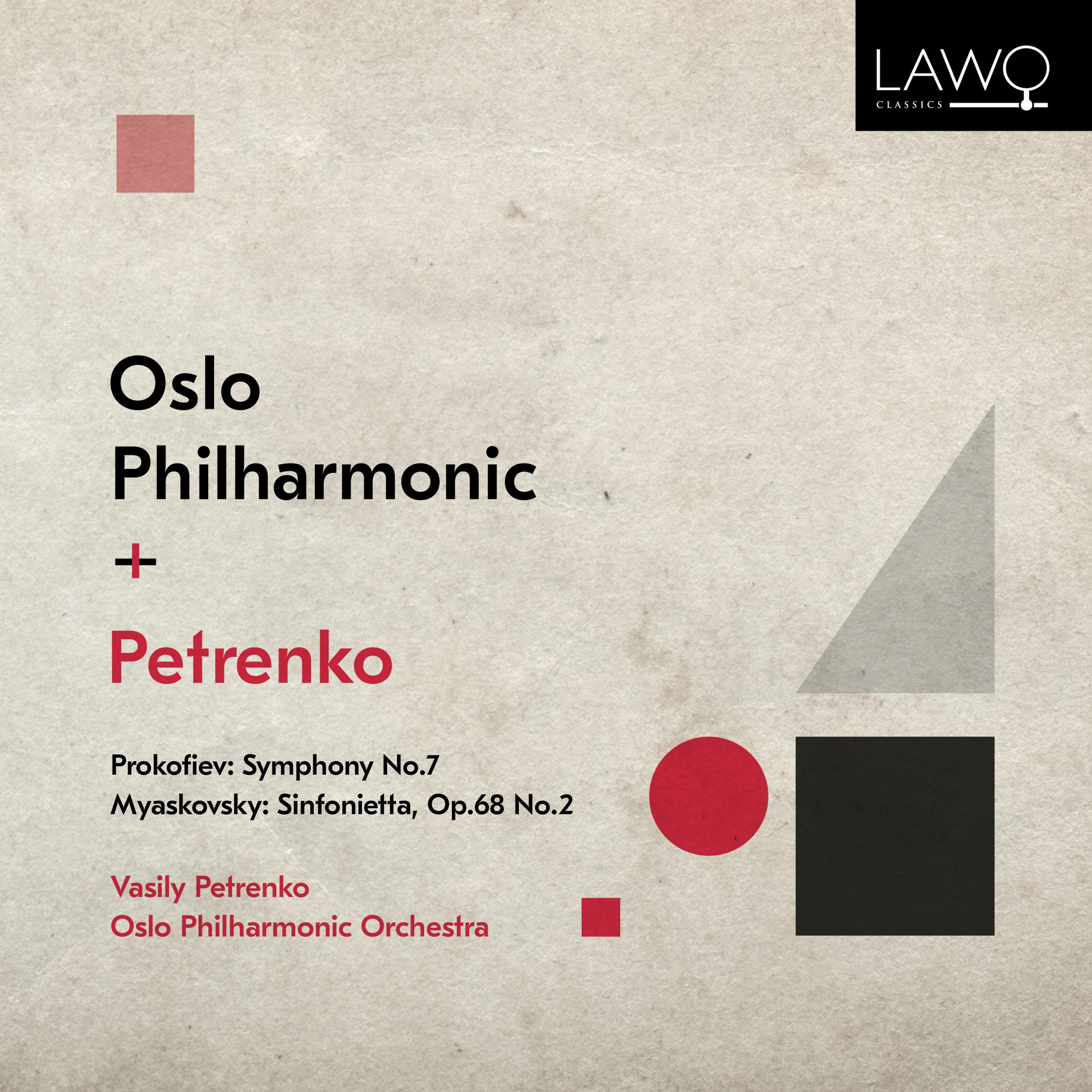
Sergey Prokofiev | Miaskovsky
Prokofiev Symphony No. 7 / Myaskovsky Sinfonietta, Op. 68 No.2
Oslo Philharmonic Orchestra | Vasily Petrenko (Conductor)
Stream & download
Tracks
Sergey Prokofiev (1891–1953)
Symphony No. 7, Op. 131
Miaskovsky (1881–1950)
Sinfonietta, Op. 68
Credits
- Conductor
- Vasily Petrenko
- Performer
- Oslo Philharmonic Orchestra | Vasily Petrenko
- Composer
- Sergey Prokofiev | Miaskovsky
- Producer
- Vegard Landaas
- Engineer
- Thomas Wolden
- Editing
- Vegard Landaas
- Mastering
- Thomas Wolden
- Liner notes
- Philip Borg-Wheeler
- Executive producer
- Vegard Landaas
- Booklet editor
- Torgeir M. Landaas
- PR
- Camilla Momkvist-Skau
- Accounting
- Torgeir M. Landaas
- Design
- Anna-Julia Granberg | Blunderbuss
- Recording location
- Oslo Concert Hall
- Recording country
- Norway
- Original source
- DXD (352.8 kHz, 24 bit)
- Discs / tracks
- 1 disc | 8 tracks
- Release year
- 2025
- Label
- LAWO Classics
- Duration
- 58:27
- EAN
- 7090020183626
- ISRC
- NOEHX2519010-80
Booklet text
Prokofiev completed his seventh and final symphony in 1952, not long before his death the following year. His original plan was to compose a symphony for young people, specifically for the children's programmes of the Soviet State Radio, but the music outgrew this idea, evolving into a work of more stature. Yet a childlike quality remains. In 1936 Prokofiev had made a surprisingly ill-judged return to Russia from exile, just as Stalin's purges and campaign of artistic censorship were gathering momentum. In 1948 Andrei Zhdanov of the Communist Party Central Committee emphasised his Doctrine of 1946 by officially reprimanding Shostakovich, Khachaturian and Prokofiev himself. The Zhdanov Doctrine, as it is known, was a cultural policy aimed at the promotion of socialist ideals and the interests of the Soviet state. Artists, writers and composers who failed to comply were in danger of persecution. The authorities' demand for more accessible music, free from "formalist perversions" (whatever that meant), had to be observed, and this partly accounts for the "new simplicity" which characterises much of Prokofiev's later music. Following the Zhdanov Doctrine, Prokofiev apologised and promised to write "melody that is immediately understandable". His outstanding melodic gift – he was one of the most gifted melodists of the twentieth century - had never been in doubt, but now it was advisable to subdue the spiky, disturbing elements of his language, especially as his Sixth Symphony had been criticised as "unpatriotic". The Seventh Symphony in C sharp minor Opus 131 – Prokofiev's last major work - has melodic directness and simplicity, but nevertheless the lyricism is sometimes tinged with darker, more anxious undercurrents and a wistful sense of resignation. Ukrainian conductor Kirill Karabits has remarked: "It's a symphony that looks back over his life and childhood – an old man's dream of childhood."
The opening movement has three principal themes beginning with the first violins' spacious theme at the outset. A transition characterised by running semiquavers leads to the second theme - a broad, aspirational melody introduced by lower strings, cor anglais, bassoons and horns. The third theme (poco meno mosso) is a playful staccato idea played by woodwind instruments, with glockenspiel adding vibrancy. After a compact development section free from drama, all the material is recapitulated with modifications. The second theme in particular now has more elaborate accompanying figuration for piano and lower strings. The movement's understated ending briefly refers to the opening theme.
Not entirely free from brief unsettling elements while accommodating many characteristic side-steps into unrelated keys, the second movement is predominantly balletic. (Prokofiev was one of the great composers of ballet scores, the outstanding examples being Romeo and Juliet and Cinderella.) The graceful waltz-like manner gives way to a more robust character before Prokofiev introduces a childlike idea from pizzicato strings. A passage of brilliant, skittering violins gives way to more waltz material before a beguiling new section brings an expressive violin melody, taken up by oboe then clarinet. The reprise of the initial material leads, with a little soloistic trombone-writing along the way, to an increasingly hectic coda, incorporating two increases of tempo. In this movement, rich in melodic material and rhythmic vitality, the percussion section and to a lesser extent the piano, play important roles.
Including music from Prokofiev's melodrama based on Pushkin's Eugene Onegin, the slow movement begins with a rich and sustained lyricism which a second theme (oboe above rhythmic string accompaniment) does nothing to disturb, though there is an unmistakeable tinge of poignancy. Towards the end rippling figuration on harp and piano enrich the texture, before the subdued conclusion.
Reminiscent of the circus – an important feature of Russian culture, also evoked in works by Shostakovich - the finale soon develops into a galop. Again, there are many changes of key, but the tempo relaxes for new material of lyrical, then more sardonic character. Eventually there is a very recognisable recall of the aspirational theme from the first movement, then subsequently the playful staccato idea with glockenspiel. Prokofiev's prominent use of the glockenspiel (with piano) at the end is reminiscent of the Astrologer's music in Rimsky-Korsakov's opera The Golden Cockerel. The original ending (recorded here) is understated but Prokofiev was persuaded to provide an alternative, vivid conclusion aimed at securing the Stalin Prize. Stalin died on the same day as Prokofiev in March 1953, but four years later the composer was posthumously awarded a Lenin prize for this work. Long regarded as lightweight, the Seventh Symphony has in recent decades attracted more appreciation as music of subtlety and depth.
Nikolai Myaskovsky (1881-1950) was one of the most prolific symphonic composers of the twentieth century. He was born in Novo-Georgievsk, which was then part of the Polish territories of the Tsarist empire. He received piano lessons from an aunt but taught himself the violin. Following his education at various military schools, he was increasingly drawn towards a career in music. He took private tuition with Glière in Moscow then, deciding to devote himself to composition, studied with Rimsky-Korsakov and Lyadov at the St. Petersburg Conservatory from 1906. At this time, he began what would prove to be a life-long friendship with Prokofiev. Each composer would invite from the other his comment and criticism of the latest piece. Myaskovsky's earliest composition was a group of piano preludes (1896-8) but it was not until 1908 that he wrote the first of his twenty-seven symphonies. Called up to serve as a military engineer in World War I, he was wounded and suffered from shellshock. His other major works include two concertos, thirteen string quartets and nine piano sonatas. With the rise to pre-eminence of Prokofiev and Shostakovich, Myaskovsky (and several other fine Russian composers) were relegated to the sidelines.
In 1921 Myaskovsky was appointed to the staff of the Moscow Conservatory, where he remained professor of composition until his death. Increasingly he moved towards the requirements and approval of the Soviet authorities. The Association for Contemporary Music, a fellowship of the more avant-garde composers of which he had been a founder-member, disbanded after a wrangle with the Russian Association of Proletarian Musicians. Yet, as Richard Taruskin has written, his "simple, pretty, anodyne style" of that period did not originate merely as a result of the Soviet censorship of Shostakovich's opera Lady Macbeth of the Mtsensk District and the subsequent crackdown. "As early as 1910 …. Myaskovsky tossed off a light and tuneful Sinfonietta in A, and he maintained his heavyweight and featherweight styles thereafter in a sort of Coplandesque alternation." Myaskovsky's twenty-seven symphonies (composed over more than forty years) are diverse in style, character and form, ranging from a single movement to five movements, and from profundity to Soviet-required banality. Generally, he was conservative in his approach, especially in terms of tonality and structure. Above all, Myaskovsky was a born symphonist, serious-minded, deeply engaged and committed, and with an absolute grasp of traditional methods. As Richard Taruskin wrote (A Fabled Beast is Bagged, in his On Russian Music): "The flow is seamless; the often cyclic culminations are expertly wrought; the affective reward to a patient listener is very satisfying." He adds: "... after hearing him complete [i. e. all twenty-seven symphonies], I think him distinctly greater than before." Nevertheless, sinfoniettas, divertimentos and concertinos run throughout his creative output and should not be dismissed as peripheral or insignificant.
Myaskovsky's Sinfonietta in A minor for string orchestra, Opus 68 No 2 dates from 1945-6. This four-movement work exemplifies the rather less serious side of Myaskovsky's temperament, mentioned above. Several times in the mid-1940's Myaskovsky reworked previous material into new works, such as the fourth and fifth piano sonatas and the string quartets Nos. 10 and 11. In 1946 he again turned to earlier works in composing his Sinfonietta in A minor – his four sketches (or Frolics) for piano from 1907: Petite gavotte, Plein-air, Quasi rigaudon and Fughetta, and an Epilogue from 1912. He added brief introductory material to the Fughetta to create the Sinfonietta's first movement, placed the Gavotte and Plein-air second and third respectively, then reworked the Epilogue to form the finale. In the summer of 1946 Myaskovsky scored the work for string orchestra. The opening movement begins with a 9-bar introduction, before moving into an Andante characterised by free imitative writing. An even slower section (Largo pesante e severo) follows, intense and brooding and culminating in a sustained fortissimo.
The charming Gavotte second movement has two trios, the first of which is enhanced by running semiquavers. The second trio adapts these semiquavers within a new lyrical idea before Myaskovsky adds some felicitous pizzicato in violas and cellos. Throughout this movement a gentle simplicity prevails.
The ternary-form third movement (Andante elevato) has a heart-on-sleeve principal melody of tender lyricism, reminding us of the emotional impact Tchaikovsky's music had upon the teenage Myaskovsky. A slightly faster middle section (Poco allegretto) has a dance-like spirit. The finale (Allegro con fuoco) returns to the very opening music of the work, though what was a mere introduction is now the motivation for a fully developed and resolute movement. A rhythmic figure of two hammered triplets, introduced at bar 10, will play an important role, returning intermittently throughout the finale. The contrastingly lyrical second theme – first violins above a repeated-note accompaniment – but the bold opening theme is also transformed into a legato version at one point. At the emphatic end Myaskovsky changes the triplet figure into an up-beat in a manner reminiscent of Haydn's similar shift of emphasis at the conclusion of his last symphony.
— Notes: Philip Borg-Wheeler