
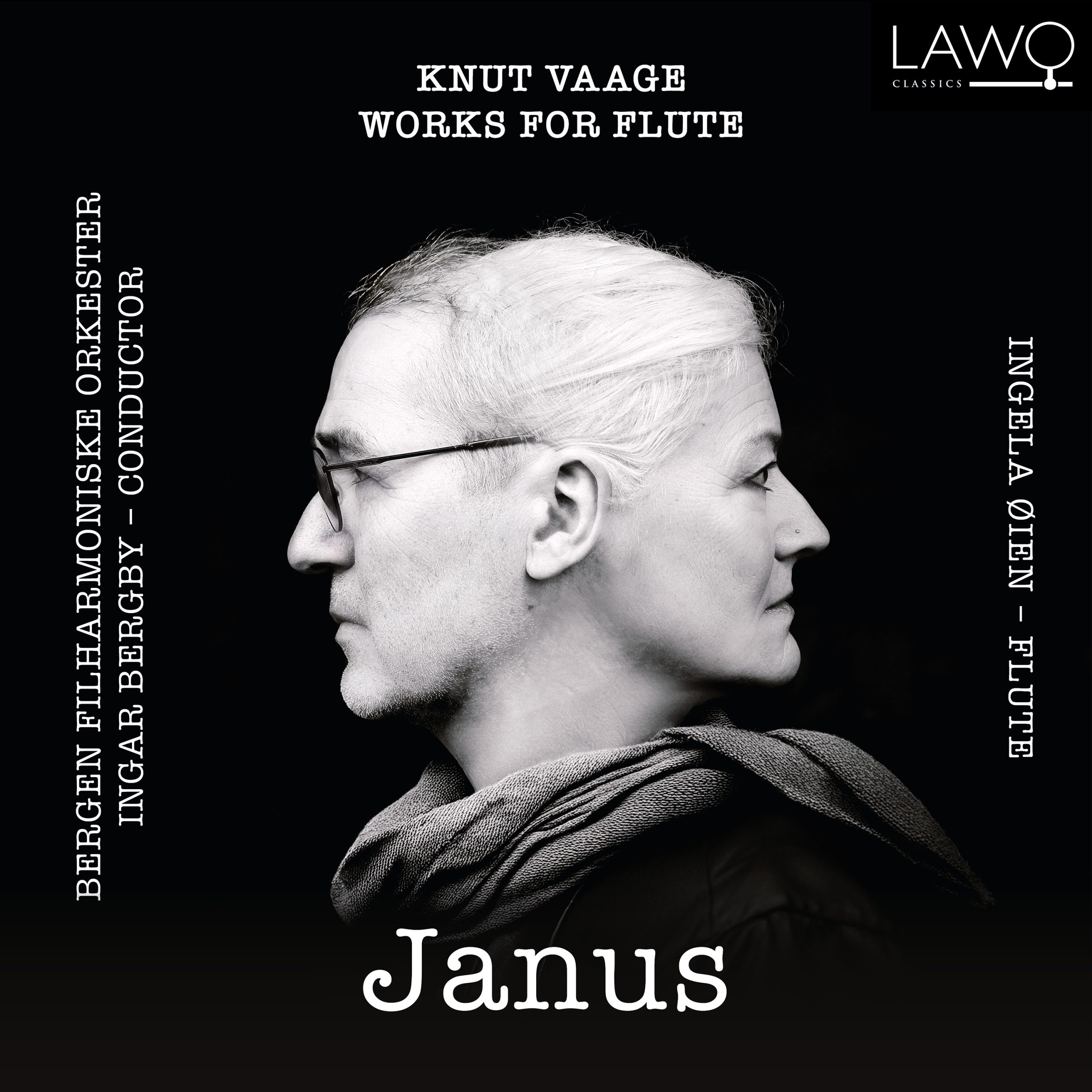
Janus
Ingela Øien (Flute) | Bergen Philharmonic Orchestra (Symphony orchestra) | Ingar Bergby (Conductor) | BIT20 Ensemble (Contemporary music ensemble)
Two faces, forty years of collaboration: Ingela Øien and Knut Vaage on Janus
A new flute concerto and four shorter works for flute, with the Bergen Philharmonic Orchestra, BIT20 Ensemble and Ingar Bergby
Janus is a portrait of the composer Knut Vaage and the flautist Ingela Øien. Their artistic partnership has lasted more than forty years. The album’s title is the Roman god of gates and beginnings, who has two faces looking in opposite directions, one to the future and one to the past. The album works as a double portrait of the two musicians.
The main work is the flute concerto Janus, written for Øien and premiered in Bergen in October 2022 by Øien, the Bergen Philharmonic Orchestra and conductor Ingar Bergby. Øien has been a flautist in the orchestra for 43 years, and the concerto brings her back to her “former” orchestra as soloist. BIT20 Ensemble, where she has also played for forty years, joins the orchestra on the recording.
Four shorter works complete the programme: Tapt slag (en elegi) for flute and percussion, with Owen Weaver and a text by Hanne Bramness, Medusa and Får eg likna deg for solo flute, and Electra II for flute and live electronics, with Thorolf Thuestad. The pieces are very different in character, but Øien’s warm, present sound runs through them all, and it ties together the composer’s fantasy and the soloist’s art.
Stream & download
Tracks
Knut Vaage (*1961)
Tapt slag for flute and percussion
Ingar Bergby (conductor) | Bergen Philharmonic Orchestra | BIT20 Ensemble | Hanne Bramness | Ingela Øien
Tapt slag
Ingar Bergby (conductor) | Bergen Philharmonic Orchestra | BIT20 Ensemble | Hanne Bramness | Ingela Øien
Medusa for solo flute
Ingar Bergby (conductor) | Bergen Philharmonic Orchestra | BIT20 Ensemble | Ingela Øien
Credits
- Conductor
- Ingar Bergby
- Performer
- Ingela Øien (Flute) | Owen Weaver (Percussion) | Hanne Bramness | Thorolf Thuestad
- Symphony orchestra
- Bergen Philharmonic Orchestra
- Contemporary music ensemble
- BIT20 Ensemble
- Composer
- Knut Vaage
- Lyricist
- Hanne Bramness
- Producer
- Vegard Landaas
- Engineer
- Thomas Wolden
- Editing
- Vegard Landaas
- Mastering
- Thomas Wolden
- Liner notes
- Øivind Hånes
- English translation
- Paul Holden
- Executive producer
- Vegard Landaas
- Booklet editor
- Torgeir M. Landaas
- PR
- Camilla Momkvist-Skau
- Accounting
- Torgeir M. Landaas
- Cover photo
- Anna-Julia Granberg
- Artist photo
- Ingela Øien by Anna-Julia Granberg | Knut Vaage by Anna-Julia Granberg | Hanne Bramness by Anna-Julia Granberg | Bergen Philharmonic Orchestra by Lars Svenkerud | Thorolf Thuestad by Thomas Wolden
- Design
- Anna-Julia Granberg | Blunderbuss
- Recording location
- Gunnar Sævigs Sal, Grieg Academy, Bergen | Grieghallen, Bergen
- Recording country
- Norway
- Recording year
- 2023
- Recording dates
- 28.02.2023 | 01.03.2023 | 02.03.2023
- Original source
- DXD (352.8 kHz, 24 bit)
- Discs / tracks
- 1 disc | 9 tracks
- Produced with support from
- Arts and Culture Norway | The Audio and Visual Fund | Norwegian Society of Composers | Municipality Of Bergen | Fund for Performing Artists
- Release year
- 2024
- Label
- LAWO Classics
- Duration
- 67:14
- EAN
- 7090020183503
- ISRC
- NOEHX2454010-90
Booklet text
KNUT VAAGE / INGELA ØIEN: Janus
Composers write the music they have to, and for ensembles they believe best suit the material. But can the relationship between composer and musician also be symbiotic? This is both possible and probable. When something resonates in both parties to the point of feeling at home in company of the other, then we are touching upon a vital aspect of music creation.
In the world of fungi it's called mycorrhiza. Many fungi colonise trees with roots that supply them with carbohydrates, while the trees receive minerals and water via the fungi. It is a mutually beneficial relationship. Music history is full of such symbiotic relationships between composers and performers. They learn to get to know each other both as humans and musicians, and this understanding can lead to remarkable achievements in the world of sound — symbiotic variations, versions of mycorrhiza.
Janus is a creature with two faces who in Roman mythology is the god of gates and doorways, of beginnings and endings. Janus's two faces are on one head, each facing in opposite directions — one looking into the future, the other into the past. No wonder then that composer Knut Vaage and flautist Ingela Øien have chosen Janus as the name for their album, as it represents a double portrait of their 40-year collaboration.
The pieces on the album are rather diverse, but they do share a common denominator — that of Ingela Øien, who for decades has been one of Norway's foremost flautists. You would be hard pressed to think of a more ideal collaborator for Øien than Knut Vaage, and vice versa. Her presence ensures that the connection between composer and soloist is always tangible. There is a warmth and presence to her playing, which Vaage fills with suggestions, instructions, requests, recommendations, and imperatives. She channels the material through herself, producing something which is uniquely her own, while remaining deeply rooted in Vaage's distinctive sound palette.
Though the flute is made of metal, it possesses a warmth and softness that evokes lush gardens and alluring aromas in the air. We are inevitably transported to composers such as Debussy and Ravel, and for some reason there's something inherently French about pieces where the flute plays a central role, be it alongside a full orchestra, as part of a smaller ensemble, or as a solo instrument. Yet the flute, one of the oldest instruments known, also points toward folk music and traditional melodies.
The album opens with Janus (2022), a powerful, fleshy work that begins at a lingering pace. Gradually though, cracks, tears, fissures and crystals appear in a frigid world of ice and frozen formations. Cascades of percussion are pumped out — marimba, vibraphone, crotales, gongs, flexatone, tam-tam, snare drum, gran cassa, bongos, and congas. In fact, Vaage notes in the score that this arsenal can be played by two percussionists, though he suggests that three or four musicians could take part, which is not a bad idea considering how much there is to do. The dynamics range from crystal-clear quietude, shattered by fierce explosive outbursts. A clear pulse is absent for much of the piece, but after seven and a half minutes it kicks in with a rhythm that evokes the wildness of Russian ballets in Paris at the beginning of the last century. The ending is magical, with Øien playing overtones on the flute, creating a comet's tail that fades into infinity — a powerful and magnificent journey.
Tapt slag (1994, revised 2023) shows us Vaage in a completely different mood. The first version was created 30 years ago, and you can sense that he was in a different phase of his development, though his later style is also unmistakably present. Poet Hanne Bramness provides the text, which she reads herself, with the music cautiously meandering around her voice. This is a canvas where tones repeat in long sequences and series, with percussionist Owen Weaver delicately propelling the music forward and Øien sprinkling flute tones into this tender gamelan.
Medusa (2023) is a solo flute piece which brings Øien's artistry to the fore. It teems with diverse techniques and playing styles, with the dynamics again spanning the spectrum from the softest of the soft to the wildest of the wild. In folk music there's a concept called dåm — a subtle sound that can only be sensed, and is part of an underlying world. Here, the sound colours shift through varying playing techniques, creating different dåm throughout the piece. Medusa was of course the mythological Greek monster with a woman's face and live venomous snakes for hair.
Får eg likna deg for solo flute was written in 2006 (revised 2023) and is based on a piece from the 1991 song cycle entitled Eg strøyer mine songar ut. These were inspired by poems by Vaage's grandfather, Ragnvald Vaage. Originally written for soprano, flute, and piano, this piece evokes Norwegian folk melodies, with echoes of the music of Fartein Valen. Both Valen and Vaage have the coastal nature of their native Hordaland in western Norway in their musical DNA, and the connection here is palpable.
The album closes with Electra II (2023) for solo flute and electronics. Abrupt jolts, piercing cries into the night, and dense dissonances fill a foggy soundscape. Thorolf Thuestad's masterful and sensitive electronic processing creates the illusion of two flutes. The sounds twist and turn slowly, reminiscent of string instruments and at times evoking the hardingfele. Long threads of sound are served up, and they stretch endlessly up into a dark sky, above the clouds and into the stratosphere. Where do they go, and what source are they connected to? Øien brilliantly handles the lightning fast passages, explosive bursts, signal tones, and drawn-out, delicate notes, providing a worthy conclusion to an album that covers a vast terrain.
Symbiosis, mycorrhiza, synergy, and a fundamental shared understanding of where one wants to go, and where one is actually going. We need no more arguments to understand how Øien and Vaage found each other 40 years ago, and that there is a good chance that they will be able to continue this journey together in the wonderful world of the flute. This head has two faces, and like Janus, they look back into the past and forward into the future.
— Notes: Øivind Hånes · English translation: Paul Holden