
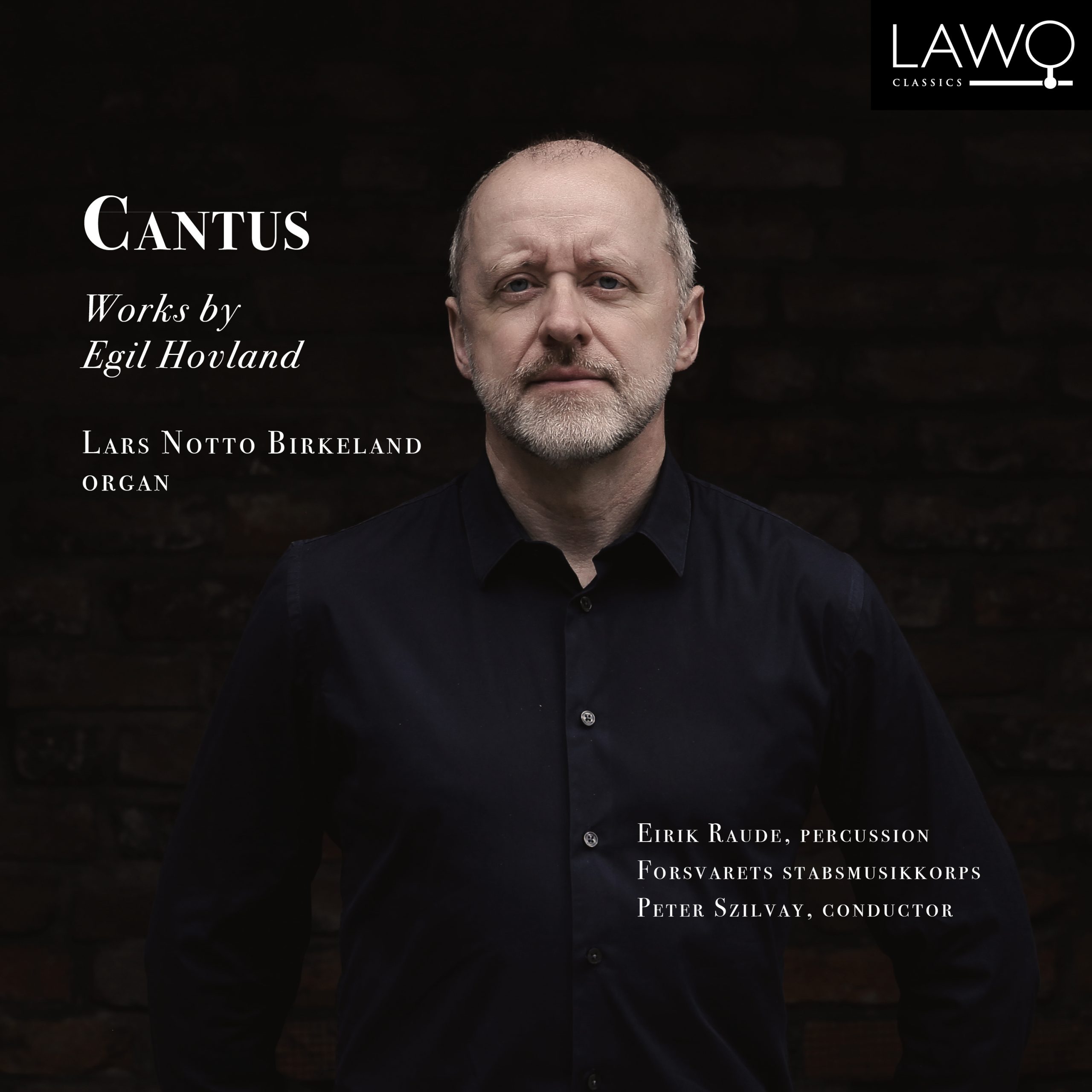
Cantus – Works by Egil Hovland
Lars Notto Birkeland (Organ) | Staff Band of the Norwegian Armed Forces (Wind band) | Peter Szilvay (Conductor) | Eirik Raude (Percussion)
CANTUS
Cantus – Works by Egil Hovland, a compelling new album that pays tribute to one of Norway’s most visionary composers. The recording features acclaimed organist Lars Notto Birkeland, renowned percussionist Eirik Raude and Forsvarets stabsmusikkorps (The Norwegian Armed Forces Band), conducted by Peter Szilvay.
Egil Hovland (1924–2013) was a central figure in Norwegian sacred music, known for his bold synthesis of tradition and modernity. Cantus presents a selection of his works for organ and brass ensemble, for organ and percussion and solo organ revealing the spiritual depth, harmonic richness, and expressive power that define his musical legacy.
Lars Notto Birkeland delivers a masterful interpretation of Hovland’s organ writing, while Eirik Raude brings nuance and vitality to the percussion parts. Forsvarets stabsmusikkorps, under the baton of Peter Szilvay, adds precision, warmth, and grandeur. Together, these artists offer a deeply moving and sonically immersive experience.
This release continues to showcase Norwegian composers and performers at the highest artistic level. Cantus is a celebration of Egil Hovland’s enduring influence and a testament to the power of sacred music in contemporary performance.
Stream & download
Tracks
Egil Hovland (1924–2013)
Cantus VII, Op. 132
Lars Notto Birkeland (organ) | Sebastian Haukås (trumpet) | Tone Fossum Olsson (trumpet) | Tormod Åsgård (trumpet) | Thomas Gimse (horn) | Simen Aleksander Olsen Hagen (horn) | Karoline Trondsen (trombone) | Ingebjørg Bruket (trombone) | Joar Lemme (trombone) | Snorre Sivertsen (tuba) | Rune Heggli (timpani) | Peter Szilvay (conductor) | Staff Band of the Norwegian Armed Forces
Cantus IX, Op. 133
Lars Notto Birkeland (organ) | Eirik Raude (percussion) | Peter Szilvay (conductor) | Staff Band of the Norwegian Armed Forces
Crux Ave, Orgelpartita No. 7 "Variationen über Jerusalem, du hochgebaute Stadt"
Lars Notto Birkeland (organ) | Peter Szilvay (conductor) | Staff Band of the Norwegian Armed Forces
Den vakreste rosen
Lars Notto Birkeland (organ) | Peter Szilvay (conductor) | Staff Band of the Norwegian Armed Forces
Nu la oss takke Gud
Lars Notto Birkeland (organ) | Peter Szilvay (conductor) | Staff Band of the Norwegian Armed Forces
Credits
- Conductor
- Peter Szilvay
- Performer
- Lars Notto Birkeland (Organ) | Sebastian Haukås | Tone Fossum Olsson | Tormod Åsgård | Thomas Gimse (Horn) | Simen Aleksander Olsen Hagen | Karoline Trondsen | Ingebjørg Bruket (Trombone) | Joar Lemme | Snorre Sivertsen | Rune Heggli | Eirik Raude (Percussion)
- Wind band (military)
- Staff Band of the Norwegian Armed Forces
- Composer
- Egil Hovland
- Producer
- Sean Lewis
- Engineer
- Sean Lewis
- Editing
- Sean Lewis
- Mastering
- Thomas Wolden
- Liner notes
- Harald Herresthal
- Executive producer
- Vegard Landaas
- Booklet editor
- Torgeir M. Landaas
- PR
- Camilla Momkvist-Skau
- Accounting
- Torgeir M. Landaas
- Artist photo
- Lars Notto Birkeland by Anna-Julia Granberg
- Design
- Anna-Julia Granberg | Blunderbuss
- Recording location
- Sofienberg Church, Oslo | Fagerborg church, Oslo
- Recording country
- Norway
- Recording year
- 2024
- Recording dates
- 05.04.2024 | 06.04.2024 | 27.05.2024 | 28.05.2024 | 29.05.2024 | 16.08.2024 | 17.08.2024
- Original source
- DXD (352.8 kHz, 24 bit)
- Discs / tracks
- 1 disc | 15 tracks
- Release year
- 2025
- Label
- LAWO Classics
- Duration
- 58:21
- EAN
- 7090020183497
- ISRC
- NOEHX2510010-150
Booklet text
Egil Hovland (1924-2013) is considered one of Norway's significant composers in the second half of the 20th century. His concertos, symphonic music and chamber music are central to post-war Norwegian music history, but it is in the field of church music that he has made his greatest mark.
From 1949 until his retirement, Hovland was organist at Glemmen Church in Fredrikstad. After completing his organist degree at the Oslo Conservatory of Music, he studied composition with Bjarne Brustad, Vagn Holmboe, Aaron Copland and Luigi Dallapiccola. The study trip to the international courses for new music in Darmstadt and the studies of Gregorian chant at the monastery in Solesmes demonstrate the breadth of Egil Hovland's musical interests as a church musician and composer. Between these extremes there is a conglomerate of stylistic elements that he chose to use: «In my constant struggle to create something new, I draw inspiration from all kinds of music, from all kinds of impressions that the outside world gives.»
After being at the forefront of musical development in the 1960s with experimental works such as Lamenti for orchestra, Missa Vigilate or Elementa pro organo, a change of style occurred in the years around 1970. Hovland wanted to «speak more simply, more amiably, preferably more romantically». «Interludium» from Den vakre rosen (The Most Beautiful Rose) op. 71 (1970) is a good example of Hovland's desire to reach more people with his music. This small organ piece is taken from a commissioned work for NRK — Norwegian television — called «Reflections in music, pictures and words on a fairy tale» by H.C. Andersen for narrator, four sopranos, organ and orchestra.
The same year, Hovland composed Toccata on «Nu la oss takke Gud» (Now Thank We All Our God) on the occasion of his daughter's wedding. Here, to typical features from the romantic organ tradition, are added cascades of cluster sounds as «a greeting» from the former avant-garde composer.
Hymns played a central role in Hovland's life. As an organist and as a member of committees tasked with revising and renewing the Norwegian Church's singing tradition, he created hymn melodies that have become an indispensable part of the Norwegian hymnal treasury. From the 1970s, he used hymn melodies and texts as a source of inspiration and thematic material in almost everything he composed. As a chorale in Crux Ave (1979) op. 102, the seventh of a total of nine organ partitas, Hovland chose «Jerusalem du hochgebaute Stadt» (Jerusalem, Thou City Fair And High). The partita was commissioned for the inauguration of the new organ in Trømborg Church, Østfold, Norway, and was premiered by Harald Herresthal. All the verses in the German text are reproduced below the chorale in each variation. Hovland said «the music is like a life that crawls upwards until it reaches a plateau, and then the last verse comes, quietly and calmly, mit jubelklang, mit Instrumenten schön» (with jubilant sounds, with beautiful instruments). The contrast between the hope and jubilation of the text, and the introverted, and gradually brutal character of the music is striking. There is something symbolic in the fact that the chorale almost disintegrates along the way. Towards the end the melody is completely fragmented and almost unrecognizable before it re-emerges as a conclusion with new colors. Behind the work lay personal experiences of sorrow and pain, but also of hope. This is reinforced by the fact that Hovland quotes some verses from Revelations (21:3-4) at the beginning of the printed score:
«Look! God's dwelling place is now among the people, and he will dwell with them. They will be his people, and God himself will be with them and be their God.
He will wipe every tear from their eyes. There will be no more death or mourning or crying or pain, for the old order of things has passed away.»
The partita is treated contrapuntally, which has associations with Bach's canonical variations on «Vom Himmel hoch». Contrary to what Hovland had previously said, that he would use musical means that would allow him to reach his listeners, this music was created without any possible thought of pleasing the audience.
In the absence of a good title, Hovland used the title «Cantus» for the first time in 1964. He claims that the title «was just plucked out of the air». The term was, in music history, originally used for the melodic leading voice in medieval and Renaissance vocal music. Hovland's ten works with this title, with one exception, have in common that they are written for one melodic instrument with instrumental accompaniment. The vocal element that justifies the title is that they all have a chorale or a folk tune as their starting point.
Cantus VII (Il Maestro) op. 132 is composed for organ and nine brass instruments. It is a commissioned work from the St Olav's Days in Trondheim. The work was premiered in the Nidaros Cathedral in 1985 by Per Fridtjov Bonsaksen on the occasion of Johann Sebastian Bach's 300th anniversary. The well-known B-A-C-H motif is built into the twelve-tone scale that forms the melodic base. The Bach-motif is easily recognizable when it appears in the work's three movements. In the last movement, the chorale «Allein zu Dir, Herr Jesu Christ» (In Thee Alone, O Christ, My Lord) is introduced with Bach's own harmonization. The chorale is played by the brass and allows the organ to perform interludes as was the practice in Bach's time.
Cantus IX (Te Deum) op. 133 for organ and percussion was commissioned by Uranienborg Church and was premiered by Jon Lammetun and percussionist Allan Suttie in 1986. The work is based on Egil Hovland's own melody on «O store Gud, vi lover deg» (Martin Luther's version of the Te Deum hymn: Lord God, Thy Praise We Sing). The text is a hymn of praise and deals with God's omnipotence, Judgment Day, the seraphs' praise, and the vision of the host of the saved in the feast hall of the Father's House. The basic character is still the oppressed man who, in a mixture of pain and joy, begs for mercy. This is also how the work ends with a «pain motif», a falling minor second, which Hovland often uses in music with similar content. Cantus IX is, as a whole, colorful and varied music, characterized by virtuosity and musical contrasts.
— Harald Herresthal
Appendix: Egil Hovland — Cantus I–X (complete cycle, for reference)
Cantus I — for flute and harpsichord, op. 45 (1964)
Cantus II (Variations on a French Noël) — for soprano recorder and piano, op. 83 (1975)
Cantus III (Maria Gnadenmutter) — for violin and piano, op. 103 (1980)
Cantus IV — for brass quintet, op. 97 (1979)
Cantus V — for trombone and organ, op. 120 (1982)
Cantus VI (Ved haandarbeidet) — for recorders, flute, and piano, op. 118 (1982)
Cantus VII (Il Maestro) — for organ, 9 brass instruments and timpani, op. 132 (1985)
Cantus VIII — for oboe and string quartet, op. 129 (1986)
Cantus IX (Te Deum) — for organ and percussion, op. 133 (1986)
Cantus X — for trumpet and organ, op. 168 (2002)
Biographies
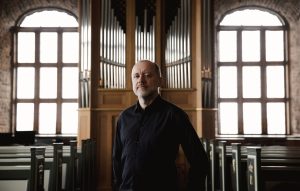
Lars Notto Birkeland
Lars Notto Birkeland (b. 1969) is one of Norway's leading concert organists, and maintains an extensive career as a pianist, conductor, accompanist, and educator. Since 2014 he has served as an organist at Akershus Castle Church in Oslo. He was previously organist at Fagerborg Church in Oslo, has taught at the Norwegian Academy of Music and the Barratt Due Institute of Music, and has worked as répétiteur and chorus master at the Norwegian National Opera.
He studied at the Norwegian Academy of Music with Professor Harald Herresthal, continued his training with Kåre Nordstoga in Oslo and Guy Bovet in Switzerland, and participated in numerous masterclasses with artists such as Marie-Claire Alain, Luigi Ferdinando Tagliavini, and Jon Laukvik. Birkeland made his debut in Oslo Cathedral in 1998 and is active as a concert organist both in Norway and abroad. With the Oslo Philharmonic, he has appeared as a soloist in Poulenc's Organ Concerto and Saint-Saëns' Organ Symphony, among other works, and has performed with several other orchestras and at major festivals throughout Norway and Europe.
He places strong emphasis on chamber music and interdisciplinary collaborations. In 2011 he released a critically acclaimed recording of Jehan Alain's complete organ works (Simax Classics), followed in 2018 by a recording of concertos for organ, percussion, and string orchestra by Bjørn Kruse and Kjell Habbestad, in collaboration with the Norwegian Radio Orchestra (Aurora Records). Birkeland also works extensively with organ transcriptions of orchestral music. Since 2025 he has been the recipient of Norway's 10-year Government Grant for Established Artists.
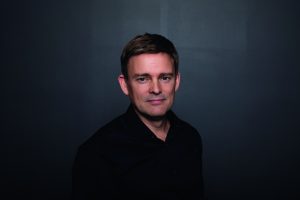
Eirik Raude
Eirik Raude is considered one of the foremost percussionists in the Nordic region and has been a soloist with world-renowned orchestras such as the Berlin Philharmonic and the Los Angeles Philharmonic. He has won numerous awards and premiered dozens of works, including compositions by Sofia Gubaidulina. In addition to classical and contemporary percussion music, he is involved in the intersection of music and other art forms.
Eirik is a graduate of the Norwegian Academy of Music and Yale University and serves as the director of the Risør Chamber Music Festival.
Staff Band of the Norwegian Armed Forces
Forsvarets stabsmusikkorps (The Staff Band of the Norwegian Armed Forces) is one of the Norwegian Armed Forces' five military bands and is Norway's largest professional wind orchestra. Based at Akershus Fortress in Oslo, it was established in 1818. The band is Oslo's oldest musical institution and serves as the Armed Forces' most important ceremonial band, with regular assignments for the Royal Family, the Parliament, the Government, and various military units.
The band has an extensive concert program in Oslo and the eastern part of Norway, and it also participates in international military music festivals and tattoos. It collaborates with music institutions, music festivals, cultural centers, and other cultural organizations. Over the course of a year, the band performs up to 150 concerts and engagements of various sizes.
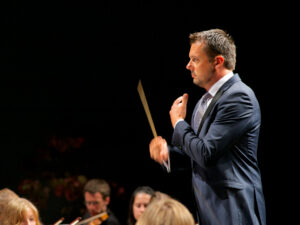
Peter Szilvay
Peter Szilvay began his career as a viola player. He spent three years playing in the Oslo Philharmonic, where he met Mariss Jansons, for whom he served as an assistant conductor for three years. His years as a musician were soon replaced by a steady stream of requests to conduct. This was followed by a position as assistant conductor at Stavanger Symphony Orchestra before Szilvay took on conducting engagements in his own right.
Early in his career, he made an impressive contribution to contemporary music, performing more than 150 new works with leading ensembles at home and abroad. However, his interest in classical and romantic music has grown steadily. Szilvay is passionate about working with singers, and conducting opera is high on hispriority list.
Szilvay has conducted orchestras and opera in Norway and abroad, including the Oslo Philharmonic, Bergen Philharmonic, St. Petersburg Philharmonic Orchestra, the Gothenburg Symphony Orchestra, Orchestra Philharmonique de Radio France and the Royal Danish Orchestra. Szilvay has conducted opera productions at the Norwegian Opera & Ballet (Oslo) and Opera Sør in Kristiansand, as well as in Würzburg, Germany.