
Stream & download
Tracks
David Friedemann Strunck (*1974)
Eugène Bozza (1905–1991)
David Friedemann Strunck (*1974)
Julius Röntgen (1855–1932)
Benjamin Godard (1849–1895)
Scènes écossaises, Op. 138
David Friedemann Strunck | Ensemble Allegria | Oslo Kammerakademi
David Friedemann Strunck (*1974)
Carl Gustav Sparre Olsen (1903–1984)
Josef Gabriel Rheinberger (1839–1901)
Andante Pastorale for Oboe and Organ (after Organ Sonata No. 4, Op. 98
David Friedemann Strunck | Lars Notto Birkeland
David Friedemann Strunck (*1974)
Camille Saint-Saëns (1835–1921)
Sonata Op. 166 for Oboe and Piano
Christian Ihle Hadland | David Friedemann Strunck
Josef Gabriel Rheinberger (1839–1901)
Rhapsodie, Andante for Oboe and Organ (after Organ Sonata No. 7, Op. 127
David Friedemann Strunck | Lars Notto Birkeland
David Friedemann Strunck (*1974)
Kjell Mørk Karlsen (*1947)
Sonatina for Oboe and Piano, Op. 44
Christian Ihle Hadland | David Friedemann Strunck
Joseph Noyon (1888–1962)
Concertino Pastorale (dit du cou cou) for Oboe and Organ
David Friedemann Strunck | Lars Notto Birkeland
Credits
- Performer
- David Friedemann Strunck (Oboe)
- String orchestra
- Ensemble Allegria
- Ensemble members
Ensemble Allegria on this recording
- Maria Angelika Carlsen (Violin)
- Patrycja Blazsak-Bienkunska (Violin)
- Ragnhild Lien (Violin)
- Emilie Benedicte Haagenrud (Violin)
- Amanda Håøy Horn (Violin)
- Maria Eikefet (Violin)
- Mons Michael Thommessen (Violin)
- Andreas Haug (Violin)
- Ingvild Finset Spilling (Viola)
- Elzbieta Frajzyk (Viola)
- Sunniva Tønnesen Norberg (Viola)
- Sverre Kyvik Bauge (Cello)
- Jan-Øyvind Grung Sture (Cello)
- Mathias Sunde Valseth (Bass)
- Producer
- Vegard Landaas
- Engineer
- Thomas Wolden
- Editing
- Vegard Landaas
- Mastering
- Thomas Wolden
- Liner notes
- David Friedemann Strunck
- English translation
- Leann Currie
- Executive producer
- Vegard Landaas
- Booklet editor
- Torgeir M. Landaas
- PR
- Camilla Momkvist-Skau
- Accounting
- Torgeir M. Landaas
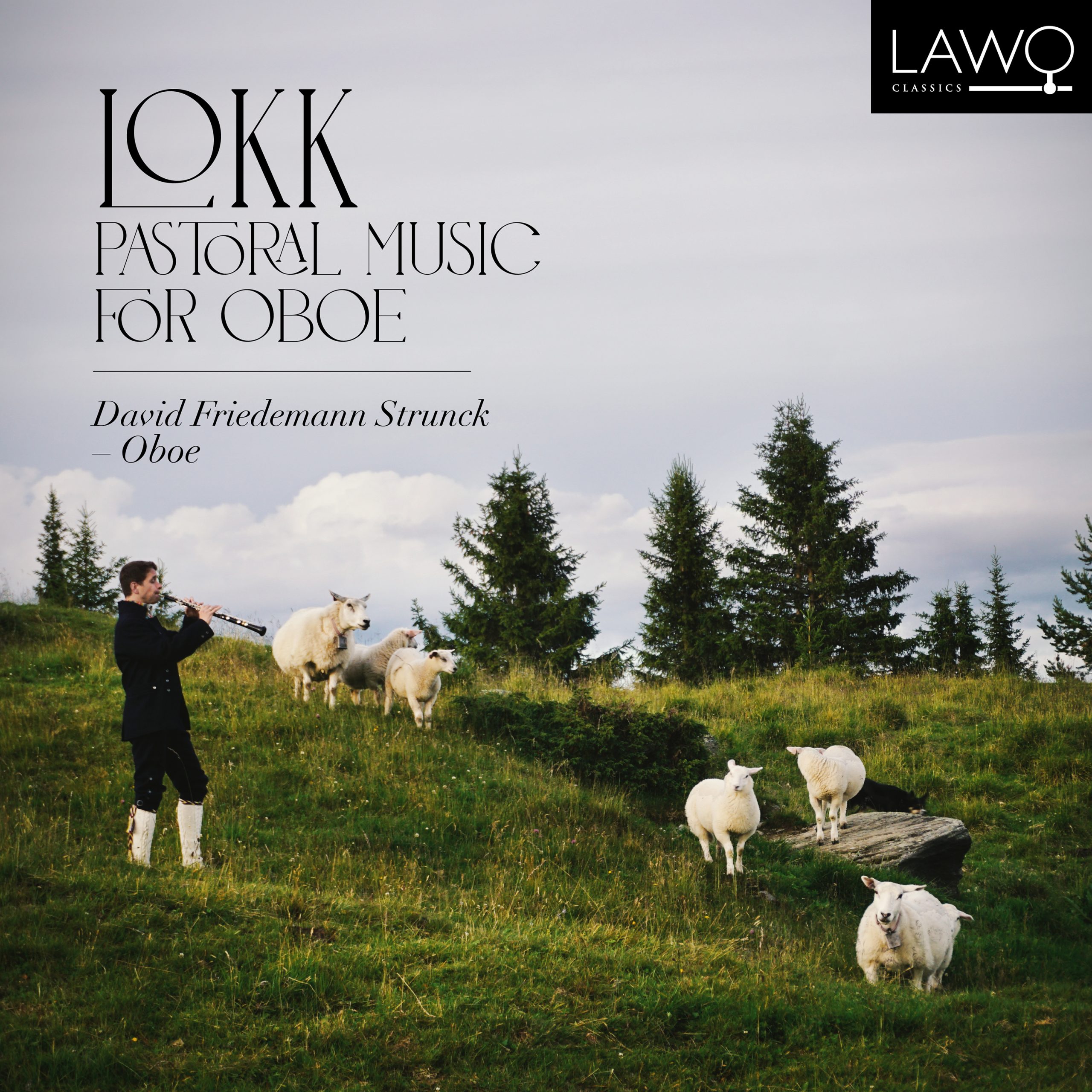
- Cover photo
- Nora Dahl Nilsen
- Artist photo
- David Friedemann Strunck by Nora Dahl Nilsen
- Design
- Anna-Julia Granberg | Blunderbuss
- Recording location
- Sofienberg Church, Oslo
- Recording country
- Norway
- Recording year
- 2022–2023
- Recording dates
- 19.09.2022 | 12.04.2023 | 13.04.2023 | 14.04.2023
- Original source
- DXD (352.8 kHz, 24 bit)
- Discs / tracks
- 1 disc | 22 tracks
- Produced with support from
- Arts and Culture Norway | The Audio and Visual Fund
- Release year
- 2024
- Label
- LAWO Classics
- Duration
- 74:26
- EAN
- 7090020183398
- ISRC
- NOEHX2443010-220
Booklet text
Lokk is the Norwegian term for herding calls used by milkmaids (budeie) and shepherds (gjeter). Traditionally practiced in mountain regions, even to this day, lokk were used by herders to reach, attract, and assemble livestock over long distances. The herders would use either their voice or an instrument to summon the herd, and in a way, lokk can be seen as a musical genre. Calling and gathering both people and animals conjures the pastoral scenes that have had a noted influence on classical music.
When one thinks of pastoral music, we must look no further than the Sinfonia from the second cantata of Bach's Christmas Oratorio. Here the oboe melody evokes the scene of the shepherds at the stable in Bethlehem. The inspiration for using the oboe for pastoral expression likely originates in Italy, where shepherds from the countryside came to Rome during the Christmas season to play the piffero, a folk instrument similar to the shawm, in the streets. Although the form of the pastorale changed significantly after the Baroque period, the sound of the oboe remained closely linked to it. Therefore, it is not surprising that composers in later periods also chose to utilize the oboe for this quality. The oboe (and in this case, also the English horn), finds its most significant pastoral role in orchestral literature in the third movement of Berlioz's Symphonie fantastique. Here we find two shepherds (played by the oboe and English horn) conversing over a rather free 6/8 time signature, establishing the pastoral mood of the movement.
Even though the shawm as a shepherd's instrument was most traditional, in Norway the lur and the bukkehorn were more prevalent as herding instruments. While the tradition of lokk was practiced with the lur, it was primarily performed with the human voice. Norwegian folk music has a rich tradition of various lokk melodies.
Improvising a lokk on the oboe is, therefore, an attempt at cultural rapprochement. Through active musical and cultural exchange, the oboe has also gained its place as a pastoral instrument in Norwegian classical music. The sound of the oboe, not least through the story of the Pied Piper of Hamelin, also has a reputation for being able to enchant. The earliest existing depiction of the Pied Piper shows him bearing a shawm, so considering the oboe as instrument to lure creatures is really not so far fetched.
Eugène Bozza is still well known for his chamber music works for winds. His Fantaisie pastorale for oboe is a virtuosic showpiece, delicately colored with elements of Impressionism and jazz, set in a neoclassical style. Bozza's inspiration of nature mainly comes from Provence, and he uses the oboe to fully explore the composition's idyllic nature.
The German-Dutch composer Julius Röntgen, a friend of Grieg, visited Norway several times. He was likely inspired by the Norwegian landscape and later befriended the dairymaid and folk singer Gjendine Slålien. The Hirtenlied, with its ornamented styling, reflects this sure influence.
Benjamin Godard's Scènes écossaises remains a relatively unknown but highly attractive work for oboe. The choice of solo instrument is likely intended to mimic the sound of the bagpipes and provides the scenes of nature with the necessary color. While the first movement describes a bucolic scene in the Scottish countryside, the second movement is a sort of love song. The final movement is a march inspired by the sounds of Scottish bagpipers.
Gustav Sparre Olsen composed his Pastorale for oboe during his years in Gausdal, a region still intensively involved in mountain dairy farming. The suggestive and repetitive calls in his work must be a direct reference to the calls of the herders. Sparre Olsen's interest in Norwegian nature is clearly reflected in the musical language of work.
Josef Rheinberger, who hailed from the small Alpine country of Liechtenstein, arranged two movements of his organ sonatas for oboe and organ and gave them distinct titles. These movements were likely especially popular, or Rheinberger found them suitable enough for the oboe, to benefit from increased performance. While the idyllic Andante assigns the melody mainly to the oboe, the oboe is more integrated into the work in the Rhapsody, providing the organ a lively yet expressive role in the composition.
Camille Saint-Saëns' Oboe Sonata was composed in the last year of his life. His primary motivation was to write for the lesser appreciated woodwind instruments, and with his oboe sonata, he succeeded in creating a composition that excellently showcases the characteristics of the instrument. The first movement incorporates Baroque elements, bringing to mind the oboe's golden age. The bell-like theme is often associated with the melody of the Westminster Chimes. Bells have had the age old function of gathering people. The second movement is dedicated entirely to the pastoral expression of the oboe and moves in a lilting 9/8 time. The movement is framed by an arabesque-like free section, possibly inspired by Saint-Saëns' numerous travels to North Africa. The main theme of the third movement is based on four insistent and repetitive eighth notes, reminiscent of Beethoven's fate motive. The movement culminates in a display of virtuosity.
Kjell Mørk Karlsen composed his Sonatina for oboe and piano in 1977 in the neoclassical style. The work was revised and expanded in 1983, and this recording features the revised version. The piece offers a broad palate of expressiveness, particularly in the first movement, where Karlsen contrasts the tonal colors of the two instruments, creating strong dissonances at times. While the Rhapsody provides both instruments with a showcase of virtuosity and rhythmic energy, the Pastorale is simpler in form and tonality, bringing the Sonatina to a meditative close.
Joseph Noyon was a composer and organist, and his Concertino from 1958 is a highlight in the repertoire for oboe and organ. Unlike Rheinberger's works for this combination, here the oboe takes a pronounced role, freely unfolding over the organ counterpoint and chords. The pastoral mood of this neo-romantic work is brought forth by the increasingly prominent cuckoo calls throughout the three movements, sometimes enticing, sometimes sadly anticipating, and other times exuberantly cheerful.
— Text: David Friedemann Strunck · Translation/editing: Leann Currie
(Note: the printed booklet also includes a full German-language version of this essay. Per LAWO convention, only the English text is reproduced here as canonical booklet text.)