
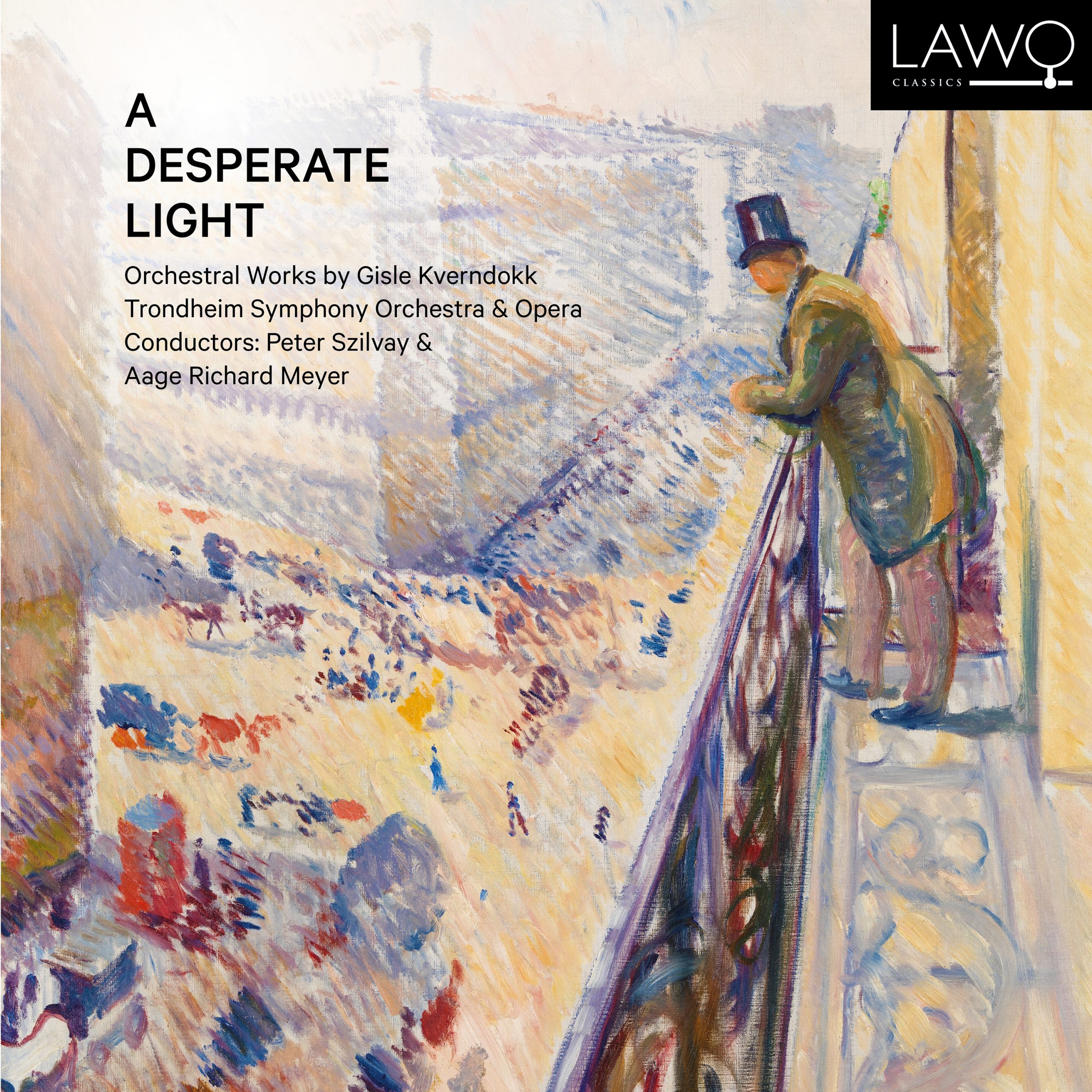
A Desperate Light – Orchestral Works by Gisle Kverndokk
Trondheim Symphony Orchestra | Peter Szilvay (Conductor) | Aage Richard Meyer (Conductor)
Stream & download
Tracks
Gisle Kverndokk (*1967)
Three pictures Suite for Orchestra
Aage Richard Meyer (conductor) | Trondheim Symphony Orchestra
Symphonic Suite from "Around the World in 80 Days"
Reviews





Credits
- Conductor
- Peter Szilvay | Aage Richard Meyer
- Composer
- Gisle Kverndokk
- Producer
- Vegard Landaas
- Engineer
- Thomas Wolden
- Editing
- Vegard Landaas
- Mastering
- Thomas Wolden
- Liner notes
- Øystein Wiik
- English translation
- Jim Skurdall
- Executive producer
- Vegard Landaas
- Booklet editor
- Torgeir M. Landaas
- PR
- Camilla Momkvist-Skau
- Accounting
- Torgeir M. Landaas
- Cover art
- Edvard Munch
- Artist photo
- Peter Szilvay by Lars Igesund | Gisle Kverndokk by David Dawson | Aage Richard Meyer by Andreas Roksvaag | Trondheim Symphony Orchestra by Thomas Wolden
- Design
- Anna-Julia Granberg | Blunderbuss
- Recording location
- Olavshallen Concert Hall, Trondheim
- Recording country
- Norway
- Recording year
- 2023
- Recording dates
- 12.06.2023 | 13.06.2023 | 14.06.2023 | 15.06.2023
- Original source
- DXD (352.8 kHz, 24 bit)
- Discs / tracks
- 1 disc | 11 tracks
- Produced with support from
- Arts and Culture Norway | The Audio and Visual Fund | Norwegian Society of Composers
- Release year
- 2024
- Label
- LAWO Classics
- Duration
- 76:58
- EAN
- 7090020183312
- ISRC
- NOEHX2435010-110
Booklet text
Symphonic Suite from Around the World in 80 Days
The musical dramatic work 'Around the World in 80 Days' has been on a long journey. It began as a commissioned work for the opening of the Norwegian National Opera at Bjørvika in 2008, after which it was rewritten as a musical commissioned by the Linz State Theatre in Austria and premiered in 2016. The musical is one of Europe's most award-winning musical theatre works.
The journey continues now via yet another artistic form: a symphonic suite based on the themes of the opera version. The composition can be characterized as 'musical drama without words', for it is the music alone that describes both the inward and outward journey on which the story's protagonist, the pedantic and somewhat callous Phileas Fogg, embarks in the hope of becoming a more well-rounded human being.
Symphonic Suite from 'Around the World in 80 Days' opens with a theme of seven notes, which are the notes of Fogg's creed: 'All things are numbers and numbers are everything!' — a postulate that has gained new relevance in today's world through artificial intelligence.
It is this assertion that propels him out into this opulent adventure. To prove his point, he accepts a wager that he can travel around the world in precisely 80 days.
Gisle Kverndokk sprinkles themes from the opera throughout the various movements and allows new musical constellations to emerge, not always in chronological order.
The subtitle of the musical is: 'How many operas fit into a musical?'
Fogg's journey around the world is in fact a journey through the world of opera, and it is in his encounters with a variety of famous opera characters that Fogg is put to the test, compelled to reflect on his own life and decide what kind of person he shall be.
The observant listener can make a sport of revealing how many operas fit into Kverndokk's seven-movement suite. It isn't an easy task, as the old and the new are woven together here with utmost care and discretion. The seven movements, chapters or scenes are a musical horn of plenty, a richly coloured flight through themes from a musical dramatic work encompassing melody lines of earlier operas in such a way that a new and independent organism emerges. It is not possible to establish where Kverndokk begins and Puccini ends, since Kverndokk wisely slips his feet into the shoes of earlier masters with respect, creativity and affection. And I dare say, the shoes fit to perfection!
The format gives the composer the opportunity to fully exploit the breadth of his versatile mastery — or should one rather say circumference? For this is about a world-encompassing journey with music as its propelling force. The work can seem natural, playful and spontaneous, but from my almost thirty-year-long collaboration with Kverndokk, I know that no note, rhythmic figure, or chord in his music is there by accident, but rather fits into the logic of the work as a whole. Yet the suite is brimming with humor in its characterization of persons, and in its grand drama and generous lack of restraint. The composer manages to play with the themes, liberated as he is from the original structure of a musical theatre work. Here melody lines are thrown about and merged with new sounds and rhythms.
Fogg's inward journey in particular grows within this musical language. His conflicted inner self is played out in a symphonic format, which in turn expands the boundaries of what musical theatre is able to communicate — perhaps because what is unspoken now has a voice that resounds in a full register through Trondheim Symphony Orchestra.
Symphonic Suite from 'Around the World in 80 Days' is also the story of a man in search of himself: Seven words, seven notes and seven movements, in which Fogg is transformed through his encounters with seven different women and seven different aspects of love: Violetta, Tosca, Salome, Aouda, Turandot, Minnie and Fionula.
The first woman, the famous courtesan Violetta, lives from love, rather than for it. The passionate Tosca is willing to die for love, whereas the figure of Salome exposes love as betrayal through 'The Dance of the Seven Veils'. Aouda's form of love is a consequence of Fogg's having saved her life, while Turandot, on the other hand, executes suitors who offer her love. Minnie represents love that never manages to choose, and private detective Fionula Fix falls in love with Fogg against her will and decides in the end to sacrifice her own happiness that Fogg might win his wager. Seven movements, seven notes, seven words, seven aspects of love and seven women. Does Fogg end up in seventh heaven after having sailed the seven seas? The answer lies concealed in the Kverndokk soundscape.
A desperate light
How does an idea originate? In Kverndokk's universe two lines from a poem can give rise to an entire work:
Today is that day, the day that carried / A desperate light that since has died … — Pablo Neruda
The piece opens as a cry for help. It is the struggle and despair of being locked up, wings clipped, denied access to life, without knowing when it will all be over. Relations, isolation, the longing to meet others again — everything we experienced together during the COVID lockdown.
This is a work tailor-made for a choreographer, and once again I am struck by how visually Kverndokk composes, and with what agility.
The source of inspiration here is stated by the composer himself: it is a tribute to Leonard Bernstein, inspired by maestro Bernstein's symphony 'The Age of Anxiety'.
But what is impressive and fascinating is this: despite the nod to his hero in his themes that touch upon scenes in 'West Side Story', such as 'Mambo' and 'The Rumble', it is Kverndokk through and through, and not Bernstein.
When all is said and done, I would like to quote Stephen Sondheim, who also wrote the lyrics to 'West Side Story', and the protagonist of his musical, 'Sunday in the Park with George': Finishing the hat, mapping out the sky! That is always what it's about.
The work was written during the pandemic, but it would be inappropriate to associate it with this period, for the dramatic scope of the work is larger than what the lockdown of the country gave us.
The contemplative theme, which is introduced after barely four minutes and which also contains an echo of 'Maria' and 'Tonight', is a melodic passage you can spend all day with, play over and over, drink wine to, letting your thoughts wander. Linger there, for soon desperation will really cut loose, before fading away and ending with an open question: will the world ever be the same again?
Three pictures
This work was originally a trio for trumpet, violin and piano, commissioned by Tine Thing Helseth for her chamber music festival at the Munch Museum in 2013. Kverndokk thought for a long time that the piece would be exceedingly well suited for orchestra, so as one of his pandemic projects this suite was orchestrated in 2021.
In this work Kverndokk finds inspiration in three Munch paintings: 'Rue Lafayette', 'Night in Saint-Cloud', and 'At the Roulette Table in Monte Carlo'. It is not the first time his music depicts the works of a painter.
In 2001 we had the premiere of a musical based on the life of the painter Vincent van Gogh, at the Schlossfestspiele Ettlingen, and a clear line of association runs between the hero of that musical, Vincent van Gogh, and the tonal depiction of Munch's paintings.
Rue Lafayette
An impressionist work painted by an expressionist artist. This paradox certainly has had a stimulating effect on a crossover composer like Kverndokk. A catchword here: recognition. The composer has strong ties to Paris himself, and a good many works have been composed in or inspired by the city. To start with, the music is overpowering, as a big city can be on a first visit — the multitudes, traffic, noise, immensity and chaos. The musical expression then becomes impressionist — observing, contemplative — with an expressive longing, as fragments of human destinies from the myriad of people below float up to us there where we share the perspective of the man leaning over the balcony railing.
Night in Saint-Cloud
The painting can be linked to the memory of the artist's father, who died one year earlier.
In the same way that the enigmatic figure of the man across the room by the window catches our eye, Kverndokk's tonal language draws our mind into the darkest corners of the same room. There is a tenderness in the music, like when the party is over and everyone has been sent home, and it is time to tidy up.
At the Roulette Table in Monte Carlo
A hint of Degas, Gauguin and van Gogh. Once again, Kverndokk's tonal language captures the anticipation, the nervousness, the suspense, the almost tactile uneasiness, the distinct colours in the painting, and the moral disintegration around the roulette table, an emotional chaos of losses and winnings. Legend has it that as soon as Munch had won a round at the gambling table, he made straight for Café de Paris to celebrate with champagne until he had drunk up his winnings, then returned to roulette. If we take the music literally in part three, it ends as a fiasco for the gambler in the final spurt.
An inside tip for listeners of this work: find the paintings online and study them as Trondheim Symphony Orchestra plays. The paintings expand on the music and the music illuminates the paintings.
— Notes: Øystein Wiik · English translation: Jim Skurdall
Biographies
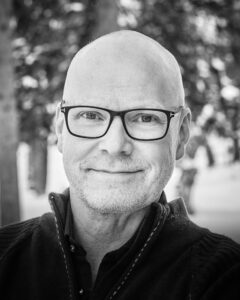
Gisle Kverndokk
Gisle Kverndokk (b. 1967) is a Norwegian composer with an extensive output of symphonic music, music theatre and opera, church music, chamber music and film music.
He studied at the Norwegian Academy of Music and at The Juilliard School. He won the Juilliard Composers' Competition in 1992 and First Prize at the International Rostrum of Composers in Paris in 1993 for young compers, and in 1997 received the Anders Jahre Award for young artists.
His orchestral works include the double concerto The Crystal Cabinet (Oslo Philharmonic, 2003), and Symphonic Dances (Stavanger Symphony Orchestra, 2014), released on SSO Recordings and nominated for a Grammy i 2020. The album A Desperate Light, with orchestral music recorded by Trondheim Symphony Orchestra, was released by LAWO Classics in 2024. Together with librettist Øystein Wiik he has written many musicals and operas, including Martin L. (nominated for the Nordic Council Music Prize) and Around the World in 80 Days, the opening production of the new Oslo opera house in 2010. A new version premiered by Landestheater Linz in 2016 won the Musical Theatre Award in Germany and Austria.
With librettist Ivar Tindberg he has written the radio opera Bokken Lasson which won the Prix Italia in 2000, and the opera The Fourth Watch of the Night (Norwegian National Opera, 2005) which won the Edvard Prize. His musical Letters from Ruth (libretto by Aksel-Otto Bull) premiered in Musical Frühling in Gmunden, Austria, i 2023, and won the German Musical Theater Award. The production at The Kammeroper in Vienna, won the Austrian Music Theater Award in 2026. His operas, Ingrid fra Barrøy (2024) and Klovnen (2025) were premiered by The Arctic Philharmonic.
The children's opera Purriot og den forsvunne bronsehesten won the Norwegian Critics' Award in 2018, and in 2019 he was named Composer of the Year at the Norwegian Music Publishers Awards. His vocal album Fuge der Zeit with Nordic Voices was nominated for a Spellemann Award. An album of his songs, Så kort ein sommar menneska har, was released in 2021 by LAWO Classics.
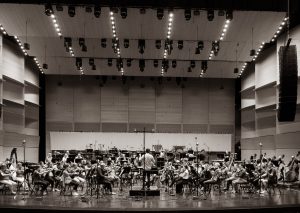
Trondheim Symphony Orchestra
The Trondheim Symphony Orchestra (TSO) is a powerhouse of the central Norwegian cultural landscape, providing a broad range of music of the highest artistic quality and contributing to the promotion and development of general interest in music locally, nationally and internationally.
Trondheim Symphony Orchestra & Opera (TSO) is one of Norway’s largest cultural institutions with a history stretching back to 1909. After the establish ment of the Trondheim Chamber Orchestrain 1947, the professional orchestra began to take shape. TSO was taken over by the state and NRK in 1962, and gradually became one of the country’s leading orchestras. In addition to classical symphony concerts, TSO performs a wide range of music including opera, contemporary music, early music and popular concerts. Its educations activities include talent development, as well as projects for children and youths. TSO is based in the Olavshallen Concert Hall in Trondheim, where most of its concerts are held throughout the season. In addition, it performs on tour in and around central Norway, as well as nationwide and international tours and assignments. TSO collaborates with TrondheimSolistene and the Trondheim Vocal Ensemble, as well as the Trondheim Symphony Opera Choir (TSO-koret), which is naturally an integral part of its opera productions.
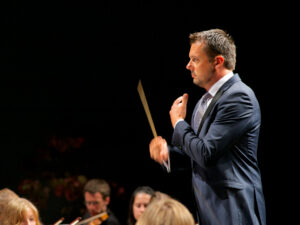
Peter Szilvay
Peter Szilvay began his career as a viola player. He spent three years playing in the Oslo Philharmonic, where he met Mariss Jansons, for whom he served as an assistant conductor for three years. His years as a musician were soon replaced by a steady stream of requests to conduct. This was followed by a position as assistant conductor at Stavanger Symphony Orchestra before Szilvay took on conducting engagements in his own right.
Early in his career, he made an impressive contribution to contemporary music, performing more than 150 new works with leading ensembles at home and abroad. However, his interest in classical and romantic music has grown steadily. Szilvay is passionate about working with singers, and conducting opera is high on hispriority list.
Szilvay has conducted orchestras and opera in Norway and abroad, including the Oslo Philharmonic, Bergen Philharmonic, St. Petersburg Philharmonic Orchestra, the Gothenburg Symphony Orchestra, Orchestra Philharmonique de Radio France and the Royal Danish Orchestra. Szilvay has conducted opera productions at the Norwegian Opera & Ballet (Oslo) and Opera Sør in Kristiansand, as well as in Würzburg, Germany.
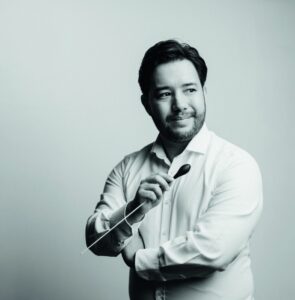
Aage Richard Meyer
Aage Richard Meyer is one of the young, promising conducting talents to have emerged from the 'Dirigentløftet' scheme. He served as assistant conductor to the Bergen Philharmonic Orchestra and its chief conductor Edward Gardner in the period 2020–2023.
Since then he has worked with several of Norway's professional ensembles, including the Oslo Philharmonic, Stavanger Symphony Orchestra, Trondheim Symphony Orchestra, and several of the Norwegian professional military orchestras. In 2023 Aage Richard made his opera debut at the Norwegian National Opera and Ballet in Oslo with three performances of Giuseppe Verdi's Un Ballo in Maschera.
He has also assisted on several opera productions, most notably Alban Berg's Wozzeck at the Palau de la Reina Sofia in Valencia under chief conductor James Gaffigan.