
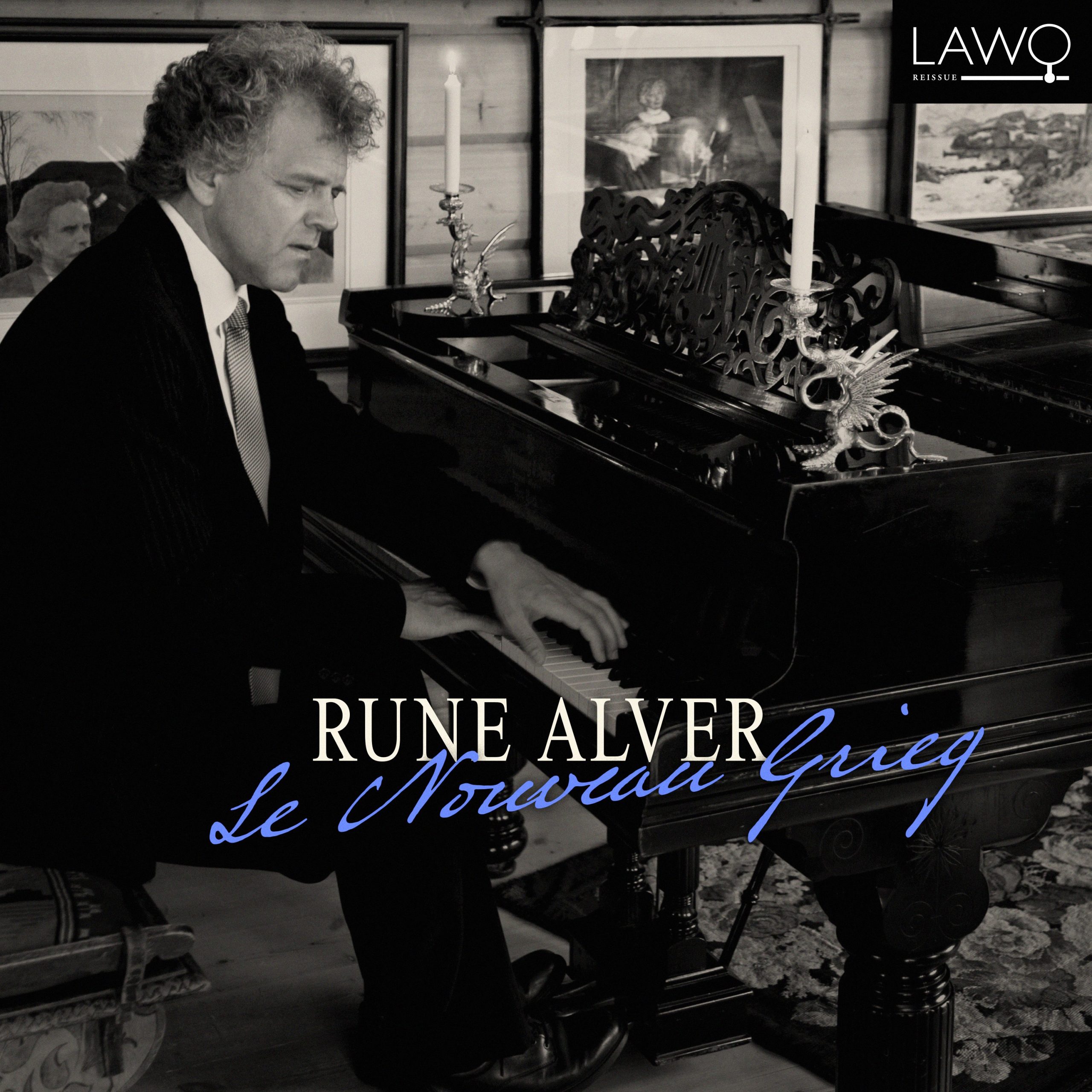
Listen
Tracks
Edvard Grieg (1843–1907)
Lyric Pieces, Op. 71
Norwegian Peasant Dances, Op. 72
Credits
- Performer
- Rune Alver (Piano)
- Composer
- Edvard Grieg
- Producer
- Jørn Pedersen
- Engineer
- Thomas Wolden
- Editing
- Jørn Pedersen
- Mastering
- Thomas Wolden
- Piano tuner
- Richard Brekne
- Liner notes
- Nils M. Stene
- English translation
- Mary R. Alver
- Executive producer
- Vegard Landaas
- PR
- Camilla Momkvist-Skau
- Accounting
- Torgeir M. Landaas
- Design
- Anette L’orange | Blunderbuss
- Recording location
- Troldhaugen, Bergen
- Recording country
- Norway
- Original source
- 96 kHz, 24 bit
- Discs / tracks
- 1 disc | 24 tracks
- Produced with support from
- Edvard Grieg Museum Troldhaugen
- Release year
- 2024
- Label
- LAWO Classics
- Duration
- 1:02:44
- EAN
- 7090020188249
- ISRC
- NO2J82402010/240
- Previously released as
- LWR3017 on LAWO Reissue
Booklet text
Le nouveau Grieg
In a letter dated 11 December 1932 Nina Grieg writes to the former house help at Troldhaugen, Ms Sofie Halseide:
At Troldhaugen there was a small concert to commemorate the 25 anniversary of Grieg's death-day. It was so remarkable listening to the old grand piano. It sounded of all memories from the old days.*
This grand piano was a gift to Nina and Edvard Grieg for their silver wedding 11 June 1892, a Steinway donated by music friends in Bergen. A hundred years after his death the instrument is still sounding with memories: the very same grand piano that was of so great inspiration for Edvard Grieg has been used for the recording of this CD. Links are drawn between the creation of his works more than a century ago and the exceptional atmosphere in Nina and Edvard Grieg's home.
Edvard Grieg (1843–1907) left behind him a number of ever-lasting musical treasures. He is remembered by music lovers all over the world for his many master pieces. As he said himself: Artists like Bach and Beethoven have built churches and temples on the hill tops. I have, as Ibsen expresses in his last dramas, made houses for human beings, where they can feel at home and happy –
Edvard Grieg created 66 Lyric Pieces, published in 10 albums. The last album, Lyric Pieces Op.71, is created in the very beginning of the 20th century. The titles indicate the poetically inspired artist. We can identify themes typical for the Lyric Pieces: nature, mysticism, folklore, yearning and memories.
The albums of the Lyric Pieces are published at regular intervals throughout Grieg's life. They are his musical life companions, constantly keeping him alert, urging him to create poetic expressions for the piano. The lyric pieces are also typical expressions of Grieg's national identity.
This 10th and last album concludes with a waltz, easily recalled from the Arietta of the first album, Lyric Pieces Op.12. The composer seems to dance into eternity in the triple time movement and cheers back to his source of origin. As an effect, the lyric pieces stand forward as a complete and coherent work, a life's work of extraordinary music of outstanding quality.
Logically, Edvard Grieg's work might have ended with Opus 71; he was feeble and unhealthy during his last years. But what happens? His opus list ends with number 74, and among these last opuses we find two of the works that add to his status as an innovator in music: Peasant Dances Op.72 and Psalms Op.74. The winter of his life becomes the peak of his composing performance. One can but wonder how he might have developed in a longer life.
Peasant Dances Op.72 is Grieg's most radical piano work. The composition dates from the years 1902 and 1903. It is the master fiddler Knut Johannessen Dahle (1834–1921) from the Vestfjorddalen valley in Tinn, the county of Telemark, who is the source for the peasant dances himself once learned from the master fiddler Myllarguten, Torgeir Augundson (1801–1872) and other fiddlers. Dahle wanted to preserve the tunes by writing them down. Traditionally, they had been passed on from one fiddler to another «by the ear». This task was finally completed by the composer Johan Halvorsen (1864–1935) who sends the notations to Edvard Grieg. Grieg replies promptly:
That's what I call a Saturday evening, dear Halvorsen. Outside a storm is raging, with a fierce south wind that shakes the house, and on top of that a veritable deluge is pouring down from the heavens. But here in the living room it is cozy. I recently received your peasant dances and I have just finished reading through them - all the while absolutely trembling with delight… At the moment it feels to me as if it would be a sin to arrange these dances for the piano. But sooner or later I no doubt will commit that sin. It is too tempting…
Grieg's outstanding ability to build on the Norwegian folk music further develops in this work. Here we meet a pioneering musical effort in composition. His genuine way of adapting the tunes for the piano points to a new era. The Hungarian conductor Antal Dorati reports that when he visited his close friend Béla Bartók shortly before he died in 1945, they talked about Grieg, and Bartók declared:
Grieg has to be taken utterly serious. He was a major composer. Don't you know that he was one of the first to shake off the German yoke and to turn to the music of his own people?**
In the foreword to his gigantic work, Grieg writes: Anyone who has a feeling for these sounds will be entranced by their great originality, their juxtapositions of fine and delicate graceful beauty and bold power and untamed rhythms, melodically and especially rhythmically. They bear the stamp of an imagination that is as audacious as it is bizarre – relics from a time when Norwegian peasant culture was isolated in remote mountain valleys from the outside world and precisely for that reason have preserved their authenticity.
At a concert in Kristiania (Oslo) on 21 March 1906 Grieg himself plays six peasant dances, and in his diary the same evening he writes:
What hurt me was that the Norwegian Peasant Dances didn't strike home as they should have. I played them with all the affection and magic that I could muster. But – where my development as a composer has now led me, I don't have my own people with me, and that is hard to bear. Here they always draw heavily on works from my youth, which on suitable occasions are praised at the expense of my recent ones. But – I must not let that hinder me. I hope that I can continue to develop as long as I live. That is my fondest wish. In due course the great public will understand.
However, the centre for the musical avant-garde by the turn of the century was Paris. On the 29 June 1906 Grieg writes:
And in Paris – according to Halvorsen – the Peasant Dances have been discovered by some young musicians, they are infatuated by «le nouveau» Grieg. I mention this to you because it has really delighted me. Young people, you know, are the future.
NILS M. STENE
Translated by Mary R. Alver