
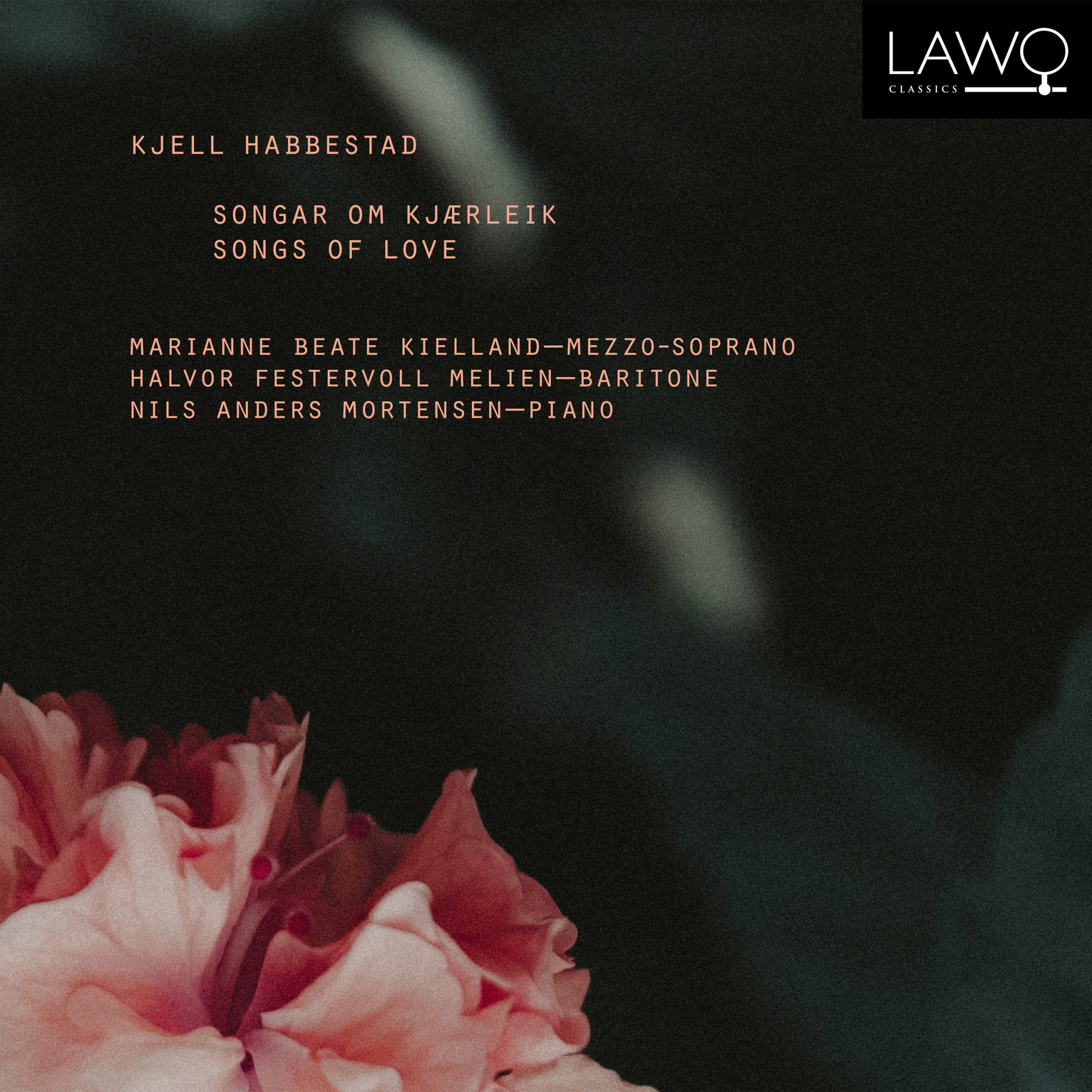
Kjell Habbestad: Songar om kjærleik / Songs Of Love
Marianne Beate Kielland (Mezzo-soprano) | Halvor F. Melien (Baritone) | Nils Anders Mortensen (Piano)
SONGS OF LOVE
The acclaimed Norwegian composer Kjell Habbestad takes listeners on an emotional journey with his latest release, Songar om kjærleik (Songs of Love). Together with mezzo-soprano Marianne Beate Kielland, baritone Halvor Festervoll Melien and pianist Nils Anders Mortensen, Habbestad has created a work that explores love in a deeply moving way.
On the album Habbestad also collaborates with flautist Ida Habbestad, violinists Ingvild Habbestad and Janina Kronberger, violist Einar Kyvik Bauge, cellist Erlend Habbestad and percussionist Rob Waring. Together they create a diverse soundscape that explores the many shades and emotions of love.
With beautiful melodies, rich harmonies and poignant texts, the album takes listeners through the many facets of love, from the tender and heartfelt to the passionate and intense, and explores different aspects of loving and being loved.
Kielland and Melien, who sing on the release, share their enthusiasm for the project: “It has been an incredibly inspiring experience to interpret Kjell Habbestad’s beautiful music. We hope audiences will be touched by the strong emotions in these songs.” Songar om kjærleik will appeal to anyone who appreciates beautiful and profound music.
Stream & download
Tracks
Kjell Habbestad (*1955)
3 Høgsongar for låg røyst, Op. 12
12 blad frå ein austleg hage, Op. 46
6 Ibsensanger, Op. 50
Halvor F. Melien | Nils Anders Mortensen
Jenny et tonemaleri
Marianne Beate Kielland | Nils Anders Mortensen
Epitaf, Op. 75
Halvor F. Melien | Nils Anders Mortensen
Credits
- Performer
- Marianne Beate Kielland (Mezzo-soprano) | Halvor F. Melien (Baritone) | Nils Anders Mortensen (Piano)
- Composer
- Kjell Habbestad
- Producer
- Vegard Landaas
- Engineer
- Thomas Wolden
- Editing
- Vegard Landaas
- Mastering
- Thomas Wolden
- Piano tuner
- Tone Torine Røimål
- Liner notes
- Kjell Habbestad
- English translation
- William H. Halverson
- Executive producer
- Vegard Landaas
- Booklet editor
- Hege Wolleng
- PR
- Camilla Momkvist-Skau
- Accounting
- Torgeir M. Landaas
- Cover photo
- Anette L'Orange / Blunderbuss
- Artist photo
- Marianne Beate Kielland by Liv Øvland
- Session photo
- Kjell Habbestad
- Design
- Anette L’orange | Blunderbuss
- Recording location
- Sofienberg Church, Oslo
- Recording country
- Norway
- Recording year
- 2022
- Recording dates
- 08.11.2022 | 09.11.2022 | 10.11.2022 | 11.11.2022
- Original source
- DXD (352.8 kHz, 24 bit)
- Discs / tracks
- 1 disc | 31 tracks
- Produced with support from
- Arts and Culture Norway | Norwegian Composers’ Remuneration Fund
- Release year
- 2024
- Label
- LAWO Classics
- Duration
- 77:32
- EAN
- 7090020182902
- ISRC
- NOEHX2317010/310
Booklet text
Looking through my songs I discovered that most of them deal with love, often lost or unrequited love; yes, even with the same aspects that one finds in Edvard Munch's central themes: love, angst and death.
With one exception, the songs in the album are arranged more or less chronologically according to the date of the source, from the Bible to poems by contemporary Norwegian poet Paal-Helge Haugen. Surprisingly, this sequence results in a dramaturgical movement from the love described in the Song of Songs, through the angst-filled life, to death. In order that the album not end on a negative note, however, I have placed the poem by Olav H. Hauge (1908–1994) after the Haugen (1945–) poems.
And there is one more coincidence: Almost without exception the chronological sequence coincides with the order in which the songs were composed—from "3 Canticles" in 1984 to "It is that Dream" in 2015.
3 Canticles, Op. 12 (1984). The musical material here is inspired by the Yemenite-Judaic song as written down and recorded by Yehiel Adaqi, Uri Sharvit and Ovadya Tovya in Jerusalem. This material has functioned primarily as a creative point of departure and in varying degrees has been altered as I have adapted it to my own tonal language and to the contours of the text. The songs have also been clad in a "jazz-harmonic" dress; this is especially alien to the source culture, which uses drums and copper tray as the sole accompaniment. The texts as sung come from the biblical Song of Solomon in the nynorsk version by Alexander Seippel and Ragnvald Indrebø published in 1938. The English versions are from the King James Bible.
I — I sleep, but my heart waketh. The melodic starting point, Wa(I)nabi Law Dirit, is a four-measure tonal formula that is repeated. The song belongs to the Yemenite-Judaic repertoire for women; it is sung in the home of the bride on Monday of the wedding week. In my version the song is more meditative than jubilant but with an undertone of blessedness.
II — By night on my bed I sought him. The melodic source here is also a Yemenite-Judaic song for women in 7/8 time with short phrases endlessly repeated. In my version the beloved is far away and the song does not conclude with his homecoming; I use the static quality of a round to depict the aimlessness and hopelessness in the woman's anxious searching.
III — I am the rose of Sharon. The thematic material is borrowed from two Yemenite songs for women, "Wahin Ya Galbi" and "Hin Ya Galb," both connected to the henna ceremony of the bridal week. In my version the lovers find each other after this song and confirm the bond between them in dance, in burning love, in ecstasy. This cycle was composed in fulfillment of an assignment at the Bergen Music Conservatory in 1984.
12 Leaves from an Eastern Garden, Op. 46 (1995). The texts are literal Norwegian translations by Paal-Helge Haugen of 12 Japanese haikus — the first two by Matsuo Bashō (1644–1694), the rest by Kobayashi Issa (1763–1827) — taken from Haiku, 200 norske versjonar (1992). Whereas a poem can be viewed countless times, music is bound to time. I chose to clothe the text in music and, with few exceptions, not repeat a single word, resulting in very short performance times — about 30 seconds for most of them — in the hope that the listener will remember the gist of the text even without reading it. The piece was composed as a gift to Paal-Helge Haugen for his 50th birthday, 26 April 1995.
6 Ibsen Songs, Op. 50 (1996). These songs are part of my 14 Ibsen-sanger, Op. 50, commissioned by Norwegian baritone Njål Sparbo for a concert in Skien (Ibsen's home town) in 1996, at which Grieg's Op. 25 (1876), Six Songs to texts by Henrik Ibsen, was also performed. The commission specified overlapping texts with Grieg's — "With a Water-Lily," "A Swan" and "Departed!" — a distance of over a century that nonetheless resulted, to my surprise, in songs closer to Grieg's 19th-century idiom than I had expected, in part because the archaic Danish-influenced Norwegian of the texts carries strict rhyme and metre. In my cycle "With a Water-Lily," "A Swan," "Thanks" and "Moonlight Wandering After a Ball" are neo-romantic in character, "The Eider Duck" is more impressionistic, and "Departed!" more expressionistic. In most cases the underlying theme is that the poet could not reconcile his art and his love within the moral norms of his time — the exception being "Thanks," a private tribute: Ibsen showed his wife Suzannah the poem titled "Tak" ("Thanks") and asked her to read the title backwards — "Kat" ("Cat"), her childhood nickname.
Jenny — a tone poem, Op. 62 (2001). Jenny is a 1911 novel by Sigrid Undset (1882–1949), her artistic breakthrough and, with its fearless openness about erotic relationships, one of the earliest depictions of female sexuality in Norwegian literature. Jenny, a successful young artist, becomes engaged to Helge Gram, falls instead for his father Gert Gram, becomes pregnant, loses the child, and after being raped by Helge, takes her own life. Gunnar Heggen compares Jenny to a lily: "She was like the lily, that cannot right itself again when its stem has been broken." The song was composed as a gift to Ragna and Trond Dahlen for their silver wedding anniversary in 2001; the text selection is by Ragna Dahlen.
Epitaph, Op. 75 (2004). An epitaph is a text written in memory of someone who has died. In the first song (departure) the deceased has "gone and left it behind you… the looming, dazzling white absence." In the second (he embarks) we meet Kharon, the ferryman who in Greek mythology transports the dead over the river Styx. In the last (epitaph) we go through graveside rituals as the mourners "rock [the deceased] back through time." The text is by Paal-Helge Haugen, with whom I have worked on many projects including the operas Hans Egedes natt (1995), The Maid of Norway (2000) and Nenia — til minne om Fartein Valen (2014). The work was commissioned by Håkan Hagegård for En nordisk sangantologi for det 21. århundre and premiered at the Norwegian Academy of Music, Oslo, in 2004.
It is That Dream, Op. 94 (2015). Olav H. Hauge was one of the most important lyricists of the 20th-century modernist tradition and has always been my model as a poet. The poem, from Dropar i austavind (1966), has many layers and deals with a dream or longing that everyone carries in their heart — voted by the audience of the NRK programme "Dikt & forbannet løgn" the best Norwegian poem ever. Since Hauge's landscape is often the Hardanger region, I employ both a musical quotation from Hardanger composer Geirr Tveitt (1908–81) and a passage evoking the Hardanger fiddle. My composition was commissioned by Andreas Sønning with assistance from the Norwegian Composers' Fund and premiered at the John F. Kennedy Center for the Performing Arts, Washington, DC, in October 2015.
I am indebted to the following sources for factual information and interpretive insights: "A Treasury of Jewish Yemenite Chants" (The Israel Institute for Sacred Music, 1981), Masahiko Inadomi and Paal-Helge Haugen in "Blad frå ein austleg hage," Henrik Ibsens skrifter, Bokkilden, Atle Næss, Aschehoug, Feministen, Haugesenteret, Cappelen Damm, Kritikerlaget, Store norske leksikon and Wikipedia.
— Notes: Kjell Habbestad · English translation: William H. Halverson