
Stream & download
Tracks
Johann Sebastian Bach (1685–1750)
Die Kunst der Fuge, BWV 1080 (arr. Eric Haas)
Traditional
Johann Sebastian Bach (1685–1750)
Die Kunst der Fuge, BWV 1080 (arr. Eric Haas)
Antonio Vivaldi (1678–1741)
Concerto in B-Flat Major "Il Corneto da Posta", RV 363 (arr. Conny Campagne & Pernille Petersen)
Georg Philipp Telemann (1681–1767)
Concerto in G Major, TWV 40.210 (arr. Andrea Bornstein)
Traditional
Johann Sebastian Bach (1685–1750)
Die Kunst der Fuge, BWV 1080 (arr. Eric Haas)
Turlough Carolan (1670–1738)
Ruaidhrí Dall Ó Catháin (1600–1653)
Traditional
Pernille Petersen (*1983)
Traditional
Antonio Vivaldi (1678–1741)
Concerto in C Major, RV 443 (arr. Bertho Driever)
Reviews
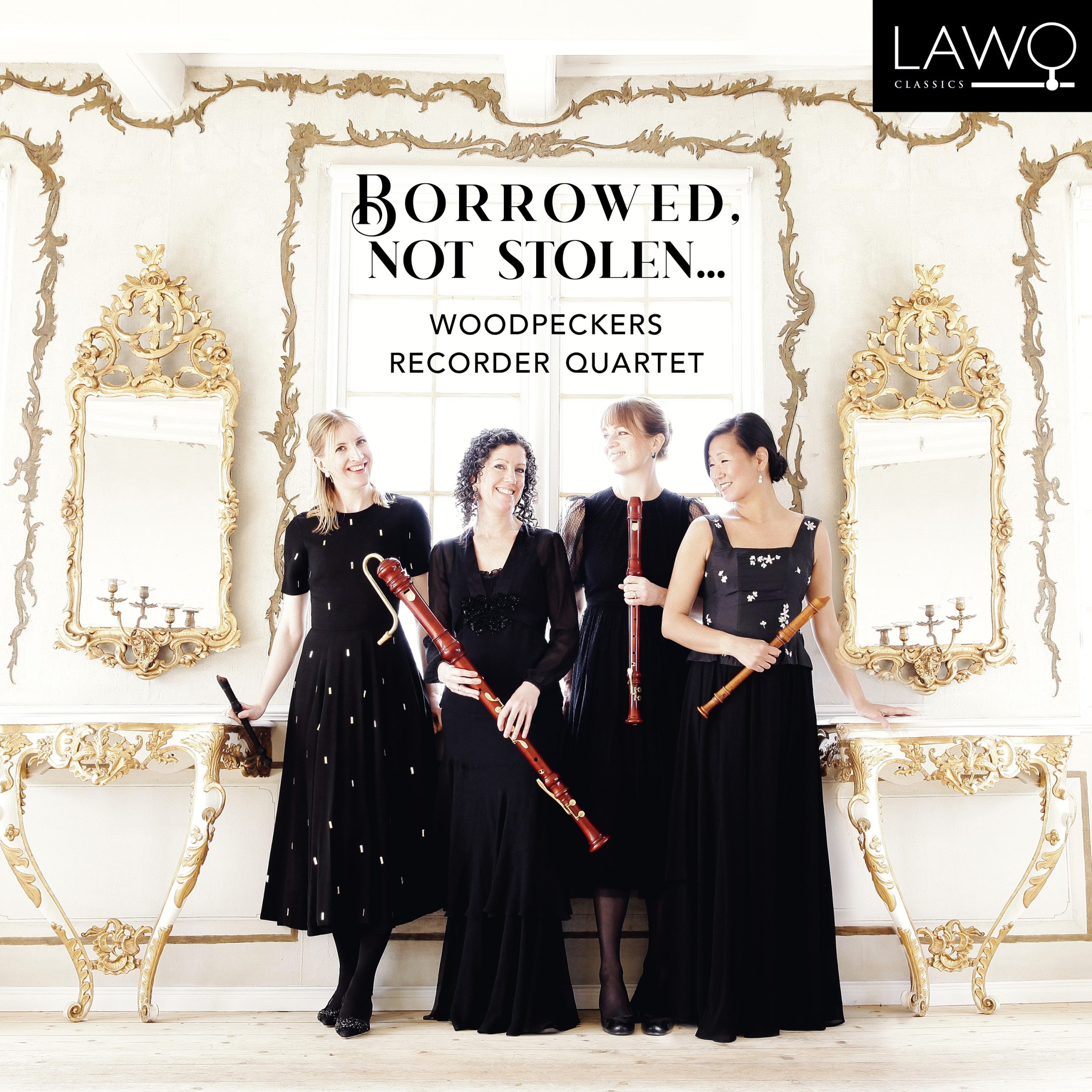
The four musicians – Caroline Eidsten Dahl (Norway), Kate Hearne (Ireland), Pernille Pedersen (Denmark) and Katarina Widell (Sweden) – make use of a veritable arsenal of recorder varieties on this album.…
Show more Show less
The four musicians – Caroline Eidsten Dahl (Norway), Kate Hearne (Ireland), Pernille Pedersen (Denmark) and Katarina Widell (Sweden) – make use of a veritable arsenal of recorder varieties on this album. Sopranino, soprano, alto, tenor and bass recorders create a rich sound in the first pieces. The programme on the album is excellent. The fact that the musicians intersperse the Baroque pieces with folk tunes makes for a truly delightful experience for us here on the sofa. The Baroque music is by Johann Sebastian Bach (1685–1750), Georg Philipp Telemann (1681–1767), Antonio Vivaldi (1678–1741), as well as the two Irish composers Turlough Carolan (1670–1738) and Ruaidhri Dall ó Catháin (1580–1653). The latter was reportedly also a harpist, though doubts have been raised about his very existence. Neatly interspersed amongst these are folk tunes from Sweden, Norway, Scotland and Denmark. The four musicians’ performances are particularly fine. The sound is exquisite and, as usual, credit is due to the sound engineers at LAWO – Thomas Wolden and Vegard Landaas. Give this album a chance and your ears are sure to be treated to a good hour of positive vibes. Kate Hearne has penned the informative liner notes in the CD booklet.Show original
De fire musikerne Caroline Eidsten Dahl (Norge), Kate Hearne (Irland), Pernille Pedersen (Danmark) og Katarina Widell (Sverige) bruker et sant arsenal av blokkfløytevarianter på denne platen. Sopranino-, sopran-, alt-, tenor- og bassblokkfløyter skaper en rik klang i de firstemte stykkene. Programmet på platen er godt. At musikerne brekker opp de barokke stykkene med folketoner gjør opplevelsen for oss i sofakroken blir av det fine slaget. Barokkens musikk er skrevet av Johann Sebastian Bach (1685-1750), Georg Philipp Telemann (1681-1767), Antonio Vivaldi (1678-1741) samt de to irske komponistene Turlough Carolan (1670-1738) og Ruaidhri Dall ó Catháin (1580-1653). Sistnevnte var etter sigende også harpist, men det er også sådd tvil om hans eksistens. Pent plassert innimellom disse finner vi altså folketoner fra Sverige, Norge, Skotland og Danmark. Formidlingen til de fire musikerne er særs gode. Klangen er utsøkt og som vanlig kan en sende en blomst til lydfolket i LAWO - Thomas Wolden og Vegard Landaas. Gi denne platen en mulighet og ørene dine vil helt sikkert få en drøy time med gode vibrasjoner. Det er Kate Hearne som har forfattet den informative teksten i cd-heftet.

Credits
- Ensemble
- Woodpeckers Recorder Quartet
- Composer
- Johann Sebastian Bach | Antonio Vivaldi | Georg Philipp Telemann | Turlough Carolan | Ruaidhrí Dall Ó Catháin
- Producer
- Vegard Landaas
- Engineer
- Thomas Wolden
- Editing
- Vegard Landaas
- Mastering
- Thomas Wolden
- Liner notes
- Kate Hearne
- Executive producer
- Vegard Landaas
- Booklet editor
- Hege Wolleng
- PR
- Camilla Momkvist-Skau
- Accounting
- Torgeir M. Landaas
- Cover photo
- Anna-Julia Granberg
- Artist photo
- Woodpeckers Recorder Quartet by Anna-Julia Granberg
- Design
- Anna-Julia Granberg | Blunderbuss
- Recording location
- Jar Church, Bærum
- Recording country
- Norway
- Recording year
- 2022
- Recording dates
- 29.03.2022 | 30.03.2022 | 31.03.2022
- Original source
- DXD (352.8 kHz, 24 bit)
- Discs / tracks
- 1 disc | 23 tracks
- Produced with support from
- Arts and Culture Norway | The Audio and Visual Fund | Dansk Musiker Forbund | The Norwegian Society of Soloists
- Release year
- 2023
- Label
- LAWO Classics
- Duration
- 72:23
- EAN
- 7090020182834
- ISRC
- NOEHX2310010/230
Booklet text
When four friends create an ensemble where their biggest love is playing Baroque music on recorders, one has to get creative. There is a serious lack of original Baroque repertoire for this combination, and that's how our concept 'Borrowed, not Stolen...' was brought into being. Our journey began 17 years ago while we were all living in Stockholm, Bach's wonderful 'Art of Fugue' being an integral part of the programming in our first concerts. The idea has developed over the years into the format that you find on this recording. We have 'borrowed' music of all kinds and turned it into our own: some arrangements came into being through improvising and playing around in rehearsals, while others were commissioned by us, and some were already in existence and too good to leave out or tamper with. Despite our wanderings in life, the four of us are still deeply rooted in our childhood traditions stemming from Sweden, Norway, Denmark and Ireland, and some of our favourite folk tunes, many of which date from the Baroque era or even earlier, appear on this CD.
It feels only natural to open this recording with Bach's Contrapunctus I, a piece in which we feel very grounded, and to which we return again and again to find each other, our ensemble sound, and unity of phrasing. It is unclear whether Bach intended his momentous Art of Fugue purely as a didactic exercise, or whether the lack of clarity over instrumentation renders it open to endless performance possibilities. Presenting this work through the medium of four recorders results in an organ-like quality of sound, while at the same time allowing for musical flexibility and expressiveness to shine through the individual lines. We see it as some kind of ultimate chamber music experience.
Bach embarked on a new engraving of the complete Art of Fugue during his final years, revising both the order of movements, as well as the content. Upon his death in 1750, C.P.E. Bach undertook the supervision of completing the publication, but whether he fully complied with his father's wishes for the work can be put into question. In the opening four-part fugue, Bach presents the principal subject, which he carries with him in many different forms throughout the work. The theme is presented in an augmented version in the opening of Contrapunctus 7, doubling all note lengths, the main subject and its inversion appearing also in diminished versions throughout, earning it the title per Augmentationem et Diminutionem.
We've had a lot of fun compiling and arranging folk tunes from our individual countries to include both on this CD and in our concert programme 'Borrowed, not Stolen...'. Our first stop is Sweden, but as the name suggests, the Swedish Schottis dance most likely originates from Scotland, while the dance steps themselves, in the form of a partnered country dance, are of Bohemian origin. Its popularity is evident to the extent that it has left traces in the folk music of countries worldwide. We learnt this tune from our colleague Göran Månsson, and have adapted it ourselves for quartet.
The melody of Värmlandsvisan is derived from the Dutch song Oh Nederland! Let op U saeck (Valerius, 1577). It made its way to the county of Värmland around 1700, becoming one Sweden's best loved folk songs.
The title alla Duodecima of Bach's feisty Contrapunctus 9 refers to the subjects being presented against each other either a 12th up or down, rendering the interval changes between the subjects ever changeable — sometimes appearing an octave apart, sometimes a fifth apart.
For the average person living in the 18th century, the sound of the post-horn was a regular and meaningful part of their everyday lives. The importance of these horns, and the music they produced, inspired many composers to incorporate these signals and sounds into their works. Vivaldi's concerto Il Corneto da Posta is truly programmatic in nature, the horse drawn postal carriage and post-horn call clearly depicted. As with many of Vivaldi's works, the slow movement shows off his abilities as a superb melody writer. The work concludes with a hunting movement, not unlike that found in the last movement of his Autumn from The Four Seasons. Although the original concerto is written for violin, we have chosen to present the work on the sopranino recorder, an instrument with which Vivaldi was known to like, and which we think depicts the sound of the post-horn just as well as a violin can!
Georg Philipp Telemann, a good friend of J.S. Bach and godfather to his son Carl Philipp, was much loved during his lifetime. He wrote a huge amount of music, and being a true businessman, he knew how to make money from his compositions. He published works one movement at a time in his own magazine, Der Getreue Music-Meister, forcing people to keep buying his publications if they ever wanted to play complete pieces. For the most part, he was open to his music being played by any instrument, which ensured a greater intake of income in sales. The Concerto for four violins in G is one of four concertos existing in a manuscript in the possession of the Universitäts- und Landesbibliothek in Darmstadt. We think it works fantastically well on four recorders, and we haven't had to make any changes other than transposing it to fit our treble recorders.
Gamle Guro is an old folk dance or 'springar' from Telemark in Norway. Written for a flute called the sjøfløyte, or 'sea-flute', the tune is closely associated with the legendary sjøfløyte expert Knut N. Juveli. Today the sjøfløyte is mainly used in Norwegian folk music, but the origin of the instrument is, however, quite closely related to the recorder. The tuning of this instrument is quite special, and Caroline has managed to recreate the sound and tuning of the sjøfløyte on her tenor recorder.
We move seamlessly over to Bach's unfinished four-voiced triple fugue Fuga a 3 Soggetti. The work breaks off in the middle of the third section, the autograph manuscript containing a hand-written note by C. P. E. Bach stating: "At the point where the composer introduces the name BACH (for which the English notation would be Bb-A-C-B), the countersubject to this fugue, the composer died." There are many things about this final fugue which are disputed, and it may well be that Bach could not possibly have written it on his deathbed due to illness and his ever worsening eyesight. The fugue may, in fact, not have been intended for publication at all, but as an exercise in seeing how far the boundaries of the form could be pushed.
Staying with sombre thoughts on death, we move to Ireland. The haunting lament written on the passing of counsellor Turlough Óg McDonough is presented here in two versions, the first from the earliest existing set of tunes from the Irish language tradition, A collection of the most celebrated Irish tunes, compiled and published by the Neal brothers in Dublin in 1724, and the second from Edward Bunting's A General Collection of the Ancient Irish Music, published in 1797. Both sources attribute this tune to the famous blind harpist and composer Turlough Carolan.
Another professional itinerant Irish harpist of the times, Ruadhrí dal Ó Catháin, (Blind Rory O'Cahan), spent most of his life in Scotland, as a patronised, eminent composer and performer. As the story goes, in around 1603, the Scottish noble Lady Eglinton, being unaware of his rank, managed to offend the harpist during a musical soirée at her home. On realising his rank and status, she later wrote a letter of apology, which in return prompted Ó Catháin to write Tabhair dom do lámh, Give me Your Hand, which he sent in acceptance of her apology. The piece became a sensation, being played far and wide throughout Europe, prompting invitations from royalty, and ensuring its continuous inclusion in collections of Irish music after it was first published in the Lady Margaret Wemyss manuscript of 1643, under the latin title Da Mihi Manum.
The lively Scottish country dance, Coxetown, completes our Celtic set. It appears as the opening tune in the compilation Aria da Camera, A collection of Scottish, Irish and Welsh airs, published by Daniel Wright in 1727.
The poem Chrysillis, Du Mit Verdens Guld, My Gold of the World, was written by the Danish poet Thomas Kingo for his beautiful young bride, Sille (Chrysillis), in 1669. The equally beautiful melody exists in several publications from the early 1800s, and unusually for poetry set to music from Baroque times, the song has remained popular in Denmark throughout the centuries.
Mikkel's Journey is a compilation of different aspects of the old Danish folk melody 'Fætter Mikkel'. The melody appeared far and wide during the 1700s within Denmark and Germany, alternating between the sung version and a dance in the Polish style. It became so popular that it was adapted and used by many composers during the second half of the 18th century. Pernille wanted to display the journey of this song through landscapes and centuries and has made this arrangement to include variations by Von Herrn B. (from the Gieddes Collection, Royal Danish Library, mid 1700s) and Scheindienst (Germany 1815), while also incorporating the Norwegian folk melody Erru gæren gut.
We leave our folk set with the humorous children's song Hønsefødder og Gulerødder (Chicken Feet and Carrots), which dates back to at least the 17th century, being sung in both Denmark and Skåne (an area in the south of Sweden which belonged to Denmark until 1658). The song declares that despite years of war and unrest across the waters of the Öresund, it is still possible for love to blossom. The comical thing with the lyrics is that they display very different sentiments depending on which language you choose. In Danish it is declared that 'The one who kisses the girls, he has a nasty habit' while in Swedish 'The one who kisses the girls, he has a festive habit'. Purely an anomaly, or something more deeply rooted in the social habits and acceptances of the different nations?
We conclude this disk with Vivaldi's uplifting C-major concerto, a well-loved standard in any recorder players' repertoire. Vivaldi most likely wrote it for one of his talented students at the Ospedale della Pietà in Venice. The arrangement for four recorders gives in to our indulgences, presenting the piece in a new and interesting way in an arrangement by Bertho Driever of the Loeki Stardust Quartet.
— Kate Hearne