
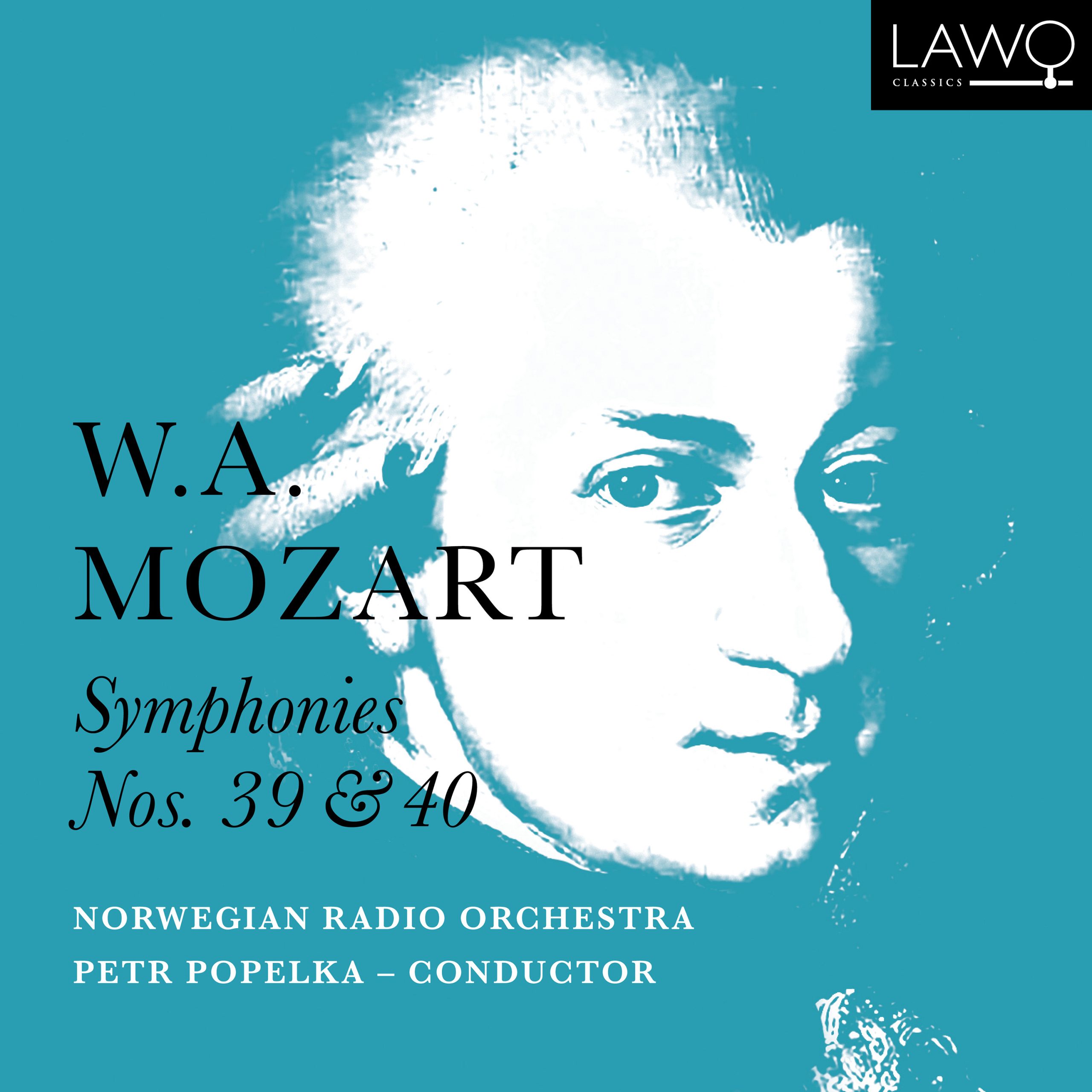
Mozart Symphonies Nos. 39 & 40
Norwegian Radio Orchestra (Orchestra) | Petr Popelka (Conductor)
Stream & download
Tracks
Wolfgang Amadeus Mozart (1756–1791)
Symphony No. 39 in E-Flat Major, K. 543
Symphony No. 40 in G Minor, K. 550
Reviews
There’s a lot to this performance!
 Radio France
The now 37-year-old Czech Petr Popelka, principal conductor of the Vienna Symphony Orchestra, was in the same position with the Norwegian Radio Orchestra when he recorded these Mozart symphonies.…
Show more Show less
The now 37-year-old Czech Petr Popelka, principal conductor of the Vienna Symphony Orchestra, was in the same position with the Norwegian Radio Orchestra when he recorded these Mozart symphonies. Now, a new recording of Symphonies Nos. 39 and 40 is not necessarily what one would have painfully waited for. But Popelka puts such an individual stamp on the 39th Symphony in particular that we decided to feature this album. He begins the 39th Symphony briskly and freshly, with a very bright and clear sound, so that the music appeals immediately. The rhetorically formulated Andante of moto also commands the listener’s attention. The last two movements are very lively and sparkle with original ideas for arrangement. It all seems so spontaneous that it is a pure joy. Popelka conducts the first movement of the 40th Symphony very briskly. The Andante is alive with fine momentum, the Minuet is vital and fluid. The finale sounds very dance-like and at the same time rich in contrast. Overall, this interpretation is less characteristic than that of the 39th Symphony.
 pizzicato.lu | 22.09.2023
Read at pizzicato.lu →
it is a relevant testimony of a conductor whose notoriety can only continue to grow." "Throughout this disc, we discover diligent musicians, systematically up-to-date" "Symphony No.…
Show more Show less
it is a relevant testimony of a conductor whose notoriety can only continue to grow." "Throughout this disc, we discover diligent musicians, systematically up-to-date" "Symphony No. 39 is a great success with this mixture of controlled generosity and tone. From the first measures, the ear is attracted by this accuracy of tone and the beautiful balance between the sections
 Crescendo | 23.10.23
Read at Crescendo →
Credits
- Conductor
- Petr Popelka
- Orchestra (unspecified)
- Norwegian Radio Orchestra
- Composer
- Wolfgang Amadeus Mozart
- Producer
- Vegard Landaas
- Engineer
- Thomas Wolden
- Editing
- Vegard Landaas
- Mastering
- Thomas Wolden
- Liner notes
- Philip Borg-Wheeler
- Executive producer
- Vegard Landaas
- Booklet editor
- Hege Wolleng
- PR
- Camilla Momkvist-Skau
- Accounting
- Torgeir M. Landaas
- Cover photo
- Barbara Kraft
- Session photo
- Thomas Wolden
- Design
- Anna-Julia Granberg | Blunderbuss
- Recording location
- NRK Radio Concert Hall, Oslo
- Recording country
- Norway
- Recording year
- 2022
- Recording dates
- 24.01.2022 | 25.01.2022 | 26.01.2022 | 27.01.2022 | 28.01.2022 | 22.08.2022
- Original source
- DXD (352.8 kHz, 24 bit)
- Discs / tracks
- 1 disc | 8 tracks
- Release year
- 2023
- Label
- LAWO Classics
- Duration
- 53:18
- EAN
- 7090020182803
- ISRC
- NOEHX2307010/80
Video
Booklet text
Mozart composed his last three symphonies (Nos. 39–41) in the space of six weeks during the summer of 1788, at a time when he had sunk into poverty, regularly borrowing money from his friend Michael Puchberg and pawning household items. In recent years he had been organising many concerts in Vienna and was equally in demand as a teacher. Then, in Prague, he had enjoyed the tremendous acclaim of his Marriage of Figaro (1786) and Don Giovanni (1787). Now, however, he struggled to find subscribers for the publication of three string quintets and faced what seemed to be the end of his Viennese concerts. No doubt he recalled the warning of Count Karl Arco, court chamberlain to his employer at that time, the Archbishop of Salzburg — "A man's reputation here [Vienna] lasts a very short time ... after a few months the Viennese want something new." Mozart had quickly outgrown his native city, while his unconcealed disdain for the archbishop's boorish manner did nothing for their working relationship. In spite of Count Arco's warning, his urge to leave for Vienna was unquenchable.
Apparently, in June 1788, Mozart planned a subscription series of concerts in Vienna for which he specially composed his last three symphonies, but there is absolutely no evidence that the performances actually took place. In a letter to Michael Puchberg, written in June that year, he does mention an imminent series of concerts, but it is believed that only one of the three works (possibly No. 40) was performed in the composer's lifetime — in April 1791 in Vienna's Burgtheater.
Symphony No. 39 begins with an imposing Adagio of increasing intensity. This in itself is remarkable, as few of Mozart's major works begin with a slow introduction. Superficially reminiscent of the Baroque French Overture style with its sharply dotted rhythms, scale-passages, etc, this Adagio gives the impression of a fully developed movement in its own right rather than a mere introduction. Among its many striking features is the insistent clash of C against D flat between the violins at bar 18 — such a full-blooded dissonance (marked forte) is uncommon in Mozart's music. The final chromatic phrase, full of pathos and mystery — how does he arrive in this alien territory from such an assertive beginning? — is followed by the first theme of the Allegro. Here again, with a melody unlike any other in Mozart's output, the character of the music takes on a new, beautifully intimate character. To move (in the space of two minutes) from the stern opening, via the mysterious four bars, to this warm, elegant theme, reveals a composer of exceptional expressive range, at the height of his powers. However, the first tutti passage brings a fierce energy, with descending violin scales recalling the same feature from the Adagio. In the lyrical second subject group both themes are based on dialogue between strings and woodwind, with the clarinets' distinctive tone-colour especially prominent. It was Mozart who first understood — just as he understood the character of every woodwind instrument — the full potential of the clarinet. Inspired by the outstanding playing ("soft and lovely" … "imitating the human voice") of his friend Anton Stadler, he composed major solo works (concerto, quintet, trio) and many beautiful parts in his orchestral works. In the terse development section Mozart avoids the expressive first subject. Instead he makes powerful use of a subsidiary idea of insistent rhythm — just as Beethoven would sometimes do in his mature sonata-form structures.
The slow movement begins in a mood of idyllic serenity, with no hint of the harmonic tension and more aggressive dotted rhythms to come. Its calm phrases eventually giving way to a turbulent F minor episode of assertive rhythmic character. Unusually the second subject is in the form of a canon played by the woodwind instruments. The stormy episode returns in B minor with renewed insistence, before the lead-back to the recapitulation restores the original lyricism and the movement ends as peacefully as it began.
The successive phrases of the stately Minuet are alternately sturdy and graceful. In the wide-eyed innocence of the Trio section the clarinets enjoy a prominence rare in the 18th-century symphonic repertoire, but again this is due to the artistry of Stadler.
The finale is essentially monothematic, a characteristic much more common in Haydn's symphonies. Mozart's subsequent treatment — in the development section — of the first notes of the joyful opening theme is unusually obsessive, with intense imitative writing between first violins and cellos, before it exhausts itself below legato clarinets and bassoons. This 7-note melodic fragment even has the very last word in the witty final bars.
It is believed that Mozart's revision of the Fortieth Symphony (now including clarinets, played by Stadler and his younger brother) was performed in April 1791 in Vienna. It is improbable that Mozart would have taken the trouble to revise the symphony to include clarinets unless a specific performance was planned. Anton Stadler may have become available for this supposed performance, which would explain why Mozart was motivated to revise the orchestration accordingly.
When Mozart chose G minor he composed music of special pathos or emotional intensity, the Fortieth Symphony being one of the greatest examples. In his own day many of what we now regard as his greatest works — the profoundest or most emotionally penetrating — were not found to be readily comprehensible or digestible, but rather unsettling. The restless opening of the Fortieth Symphony has two surprising features — firstly, the dynamic is piano, not forte (— to find the previous quiet beginning one has to go as far back as the Symphony No. 29 of 1774); and secondly the divided violas' agitated accompaniment of quavers begins before the melody enters. The second theme, a dialogue between strings and woodwind, is inflected with many chromatic notes but is more relaxed in character. In the powerful development section, with its extraordinarily frequent modulations and determined counterpoint, the turbulent aspect of Mozart's many-faceted musical temperament prevails. Here Mozart eventually reduces his opening theme to its first three notes, obsessively exploiting this fragment almost to exhaustion, in a manner more typical of the motivic (rather than thematic) development often favoured by Haydn or Beethoven. In the recapitulation there is further development in the form of close imitation of a sharply rhythmic motif between lower and upper strings, and the coda begins poignantly before being dismissed by the last emphatic bars. The second movement — also in sonata form — begins innocuously in imitative style, but this Andante only temporarily provides the relaxation usually afforded by a slow movement. A little figure consisting of graceful pairs of demi-semiquavers, seeming merely decorative when it appears early in the movement, becomes increasingly assertive, assuming unimagined power as it becomes the driving force of the development section. Later, in the recapitulation, this little figure re-assumes its initial innocence.
The rugged, severe Minuet, in which Mozart combines three-bar phrasing and, subsequently, imitative counterpoint, has a grim intensity worlds away from the traditional dance-form in which it originated. Edward Fitzgerald (translator of The Rubaiyat of Omar Khayyam) made this simple but perceptive observation — "People will not believe that Mozart can be powerful, because he is so beautiful." In the idyllic Trio section in G major Mozart provides essential contrast, with two horns prominent in the latter half. The Finale is taut and implacable in character, the only relief from its driving energy being provided by the suave second theme. Numerous minor-key works end with a less stressful movement or coda in the tonic major key — one pertinent example being Mozart's G minor String Quintet — but this finale reinforces the emotional weight of G minor. The development section — preceded by an alarmingly abrupt passage which temporarily destroys all sense of key — is one of the most fiercely concentrated passages in all Mozart's music. Here again the counterpoint, inspired by his close study of works by Bach and Handel, is unusually intense and overpowering.
This contrapuntal mastery would be taken several stages further in the finale of Mozart's last symphony. It is worth emphasising again the astonishing diversity he achieved in Symphonies 39 and 40, together with No. 41. It is tempting to suggest that he deliberately set out to demonstrate in these three wide-ranging masterpieces, just as Bach had done in his six Brandenburg Concertos, his phenomenal expressive and imaginative range.
— Philip Borg-Wheeler