
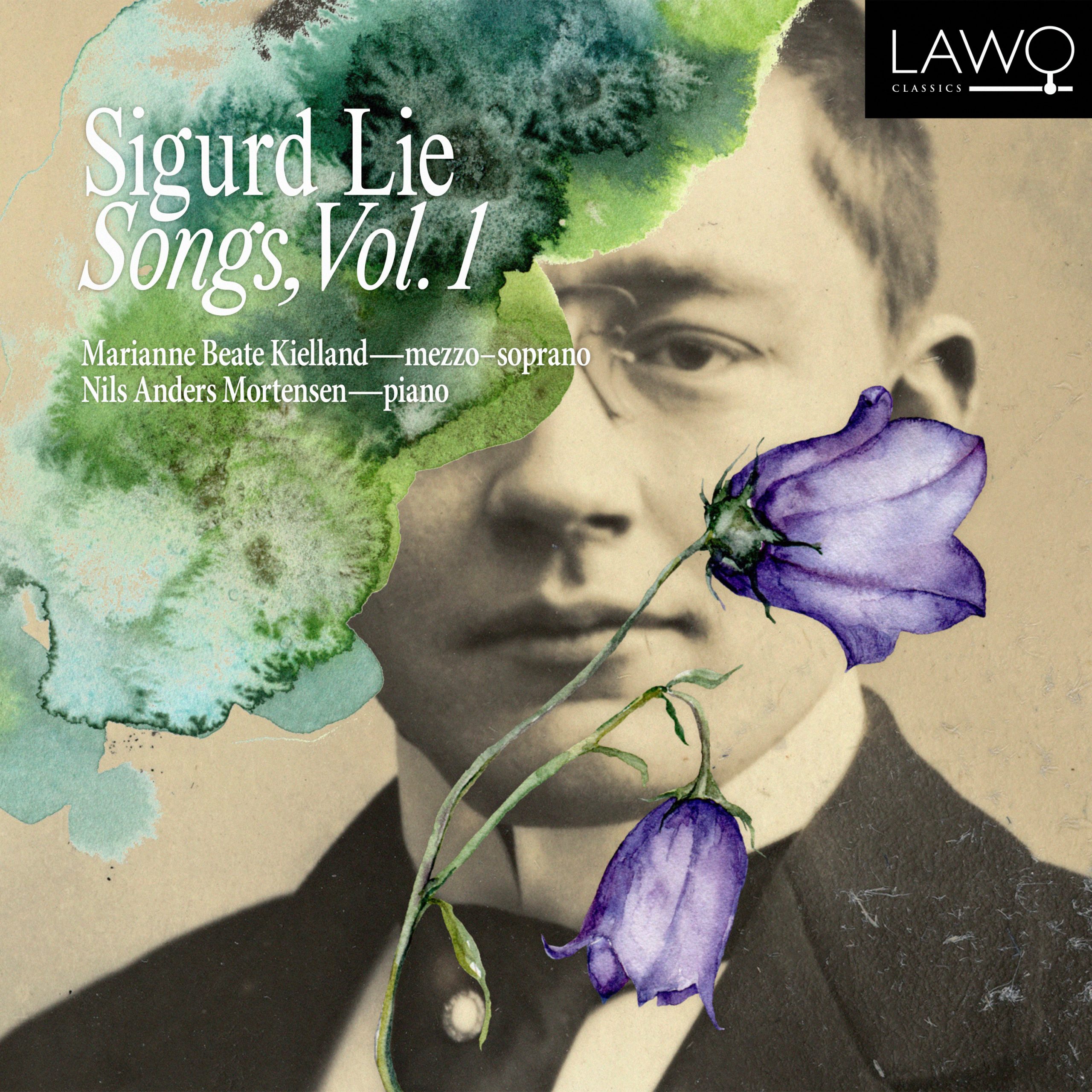
Sigurd Lie
Sigurd Lie Songs, Vol. 1
Marianne Beate Kielland (Mezzo-soprano) | Nils Anders Mortensen (Piano)
Stream & download
Tracks
Sigurd Lie (1871–1904)
Seks sange til tekster av Vilhelm Krag, Op. 1
Fire sange til tekster av Krag og Caspari, Op. 2
Seks sange
Fem sange til tekster av Per Sivle
Sange for mellemstemme
8 sange for en dyb stemme til tekster av Helge Rode
Tre sange af “Kongesønner” af Helge Rode
Syv sanger til tekster av I. Handagard
Credits
- Performer
- Marianne Beate Kielland (Mezzo-soprano) | Nils Anders Mortensen (Piano)
- Composer
- Sigurd Lie
- Producer
- Vegard Landaas
- Engineer
- Thomas Wolden
- Editing
- Vegard Landaas
- Mastering
- Thomas Wolden
- Piano tuner
- Eric Shandall
- Liner notes
- Marianne Beate Kielland
- English translation
- Jim Skurdall
- Executive producer
- Vegard Landaas
- Booklet editor
- Hege Wolleng
- PR
- Camilla Momkvist-Skau
- Accounting
- Torgeir M. Landaas
- Cover photo
- Anette L'Orange / Blunderbuss
- Artist photo
- Marianne Beate Kielland by Knut Åserud | Marianne Beate Kielland by Liv Øvland
- Design
- Anette L’orange | Blunderbuss
- Recording location
- Sofienberg Church, Oslo
- Recording country
- Norway
- Recording year
- 2022
- Recording dates
- 07.06.2022 | 08.06.2022 | 09.06.2022 | 10.06.2022 | 08.11.2022
- Original source
- DXD (352.8 kHz, 24 bit)
- Discs / tracks
- 1 disc | 42 tracks
- Produced with support from
- Arts and Culture Norway | The Audio and Visual Fund | Norwegian Academy of Music | The Lindeman Foundation
- Release year
- 2023
- Label
- LAWO Classics
- Duration
- 79:22
- EAN
- 7090020182780
- ISRC
- NOEHX2305010/420
Booklet text
If Sigurd Lie is known at all as a song composer in our day, it is for having written the wonderful romance Sne (Snow) with lyrics by Helge Rode. Today this song may still be found in the occasional rare concert programme, and there are various recordings of the song. But when I began to take an interest in Sigurd Lie and to have a look at the body of work he had penned, a wealth of songs emerged. It was exciting to delve into what for us was an unfamiliar repertoire. Indeed there was something here for every taste: songs rendered with broad strokes, and simpler, almost folk song-like melodies. More on this a little later, but first something about Sigurd Lie himself.
He was born in Drammen in 1871, and while growing up in Kristiansand he received lessons in piano, violin and music theory. He had a talent for mathematics as well — classmate Vilhelm Krag once saying that "Sigurd Lie was always the brightest of us all." He chose however to focus on the violin, and as a student at the Lindeman Music and Organist School in Kristiania (Oslo) he earned a living playing at night in some of the town's seedier establishments. It was most likely here that he contracted tuberculosis, an illness that marked him for the rest of his short-lived adult life.
Yet it was not his violin playing first and foremost that helped Sigurd Lie gain stature within Norwegian musical life, but rather his life as a composer. He had received good basic training in composition from Iver Holter in Kristiania, and like many other young composers of his time, he spent several periods of study in Germany. In Leipzig from 1891 to 1893 his teacher was Carl Reinecke, who had also been the teacher of Edvard Grieg and Johan Svendsen. From 1894 to 1895 he studied in Berlin with Heinrich Urban, and in 1899 he received a new scholarship that enabled him to continue studying in Berlin intermittently until 1902. The cultural life he encountered on the Continent was entirely different from his experience at home in Norway, and the late-Romantic influence is apparent in his instrumental music, as well as in some of his exceptionally wide-ranging songs.
Right from the time he returned home from his studies in Leipzig, Lie began to distinguish himself in Norwegian musical life. From 1895 to 1898 he served as concertmaster of Harmonien, today Bergen Philharmonic Orchestra, while conducting "Musikkforeningen", the town's amateur orchestra, and he received praise in the press for extensive works he composed for male choir and orchestra. At "the large music festival in Bergen" in 1898 — arranged at the initiative of Edvard Grieg — Lie was represented by his romances, and his songs became popular and were performed in many contexts.
In 1898 he moved to Kristiania, where he served as kapellmeister at the Central Theatre. He continued to compose new works, and in 1902 he was appointed choir director of "Handelstandens Sangforening" in Kristiania. He seems to have had a particular preference for male choirs; besides instrumental works and songs, his list of compositions includes many large and small works for male choir.
There were those who expected great things to come from Sigurd Lie. Composer Otto Winter-Hjelm wrote in the Norwegian newspaper Aftenposten in 1899: "… we may dare say that with time he will be one of our leading composers."
But despite his initiative, enterprising spirit and incessant composing, Sigurd Lie's adult life was sadly marked by his struggle with tuberculosis, and he died in the autumn of 1904, just 33 years old.
In purely compositional terms, Sigurd Lie's music lies within late Romanticism. He died just before the major disruptions in European classical music that came with Claude Debussy and Arnold Schoenberg. Lie's songs inhabit the same general terrain as do works of Wagner and earlier German Romanticists, but he was influenced to a lesser extent by National Romanticism than were other Norwegian composers of his time. In a letter to Iver Holter in 1903 he wrote: "As a composer I suppose I am primarily a lyric poet shaped essentially by Schumann and Grieg — and I imagine Wagner has also had a 'stimulating' influence on my instrumental compositions."
Sigurd Lie composed something over 70 songs. In this collected release (volume 1 and 2) it has been my ambition to include "as many songs as possible." In this context it means all the songs printed before or after Lie's death. Most were in fact published during his lifetime, while approximately 15 songs were left as unpublished manuscripts and were revised and prepared for printing by (ADD INFO).
In my encounter with the songs of Sigurd Lie I have been struck by the fact that he thought in larger terms than did other song composers of his time. The songs are demanding and often have a wide vocal range. Here one must have control of the high and low register, as well as dynamics. Tonally the songs are firmly rooted in major/minor tonality, but occasionally one finds musical phrases that are particularly surprising and perhaps to some degree unmotivated. Yet often the composer's intentions emerge more clearly after a little deeper dive into the dynamics, tempo indications and melodic development.
Unfortunately, I know nothing about whom these songs were written for, but it would be interesting to know the sound of the voices Sigurd Lie imagined as his ideal when he wrote his songs. Most of the songs are not written for "amateurs", they demand extreme professionalism in their execution, so there must have been good singers around!
It is an adventure to immerse oneself in the Norwegian treasury of song. There is so much magnificent music, and so much of it bears witness to the time in which it was written. It tells which poets were setting the tone, how strong were the influences from European musical life, or whether the composer looked more to what Norwegian traditional music had to offer.
I hope this recording can inspire others in some small measure to sing the songs of Sigurd Lie. He is indeed deserving of this as a composer, as are we who carry on the musical tradition that has brought us to where we are today.
Volume 1:
The songs on this release — volume 1 — are all songs that were published during Sigurd Lie's lifetime. Apart from the "super hit" Sne (Snow), with which the album begins, the songs follow in chronological order. There are texts from Vilhelm Krag, Theodor Caspari and Per Sivle, all well-known and acclaimed lyric poets whose verse has been set to music by many other Norwegian composers. But we also find a large number of texts by Helge Rode and Idar Handagard, who are lesser known. Idar Handagard (1874–1959) was a doctor, botanist, writer and poet, while Helge Rode (1870–1937) was a Danish poet and writer whose verse was also set to music by Carl Nielsen.
— Notes: Marianne Beate Kielland · English translation: Jim Skurdall