
Stream & download
Tracks
Åsmund Feidje (*1948)
Credits
- Conductor
- Marit Tøndel Bodsberg | Christian Eggen | Bjarte Engeset
- Performer
- Bjørg Lewis (Cello) | Håkon Thelin (Double bass) | Dan Styffe (Double bass) | Kenneth Ryland (Double bass) | Glenn Lewis Gordon (Double bass) | Kolbjørn Holthe (Violin) | Jon Wien Sønstebø (Viola) | Marius Flatby (Double bass) | Christian Krogvold Lundqvist (Vibraphone)
- Composer
- Åsmund Feidje
- Producer
- Vegard Landaas
- Engineer
- Thomas Wolden
- Editing
- Vegard Landaas
- Mastering
- Thomas Wolden
- Liner notes
- Åsmund Feidje
- English translation
- Jim Skurdall
- Executive producer
- Vegard Landaas
- Booklet editor
- Hege Wolleng
- PR
- Camilla Momkvist-Skau
- Accounting
- Torgeir M. Landaas
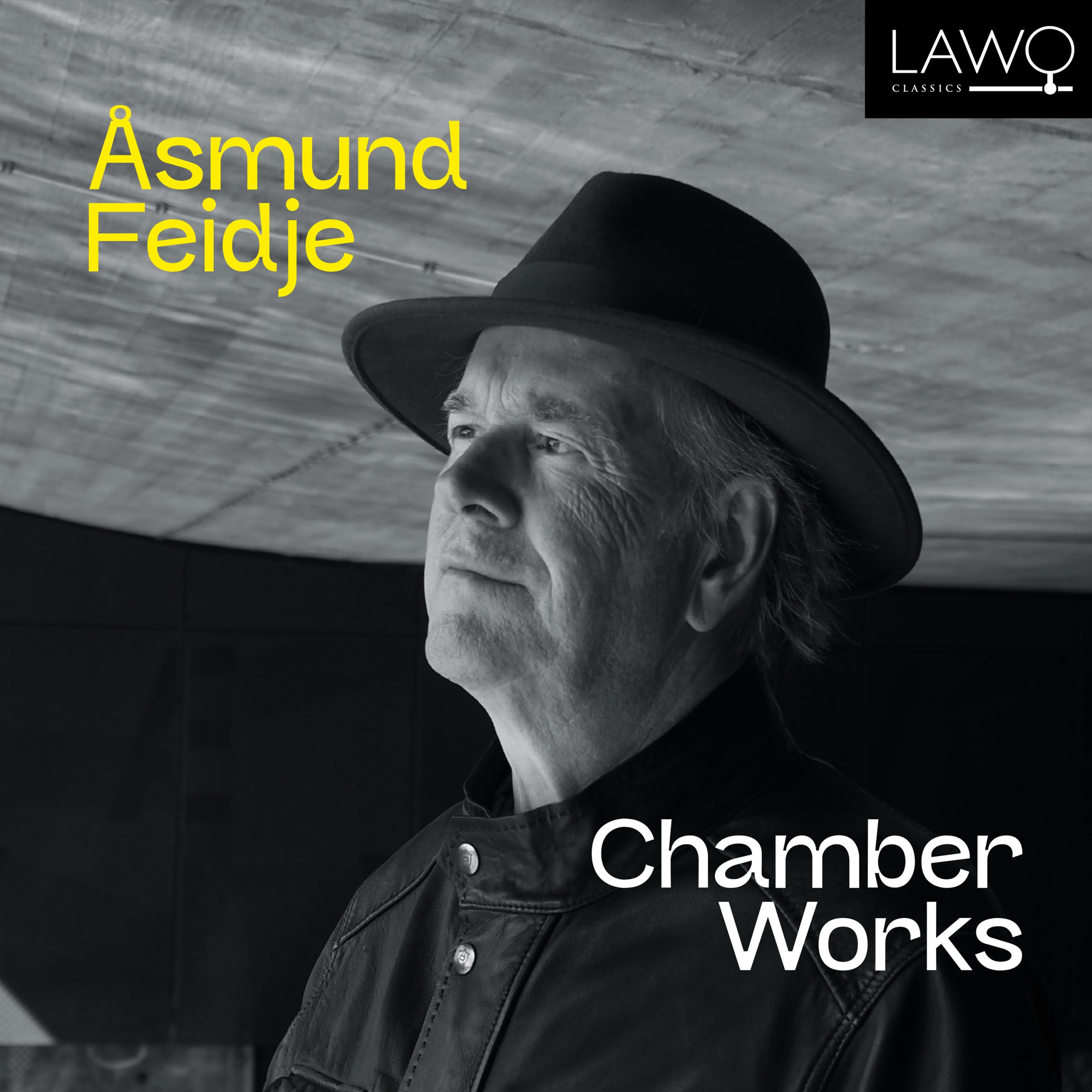
- Cover photo
- Knut Bry
- Artist photo
- Knut Bry
- Design
- Anette L’orange | Blunderbuss
- Recording location
- Sofienberg Church, Oslo | NRK Radio Concert Hall, Oslo | Grorud Church, Oslo | Newtone Studio, Oslo
- Recording country
- Norway
- Recording year
- 2017–2022
- Recording dates
- 01.06.2017 | 19.03.2018 | 13.01.2020 | 07.02.2020 | 30.11.2020 | 26.04.2022
- Original source
- DXD (352.8 kHz, 24 bit)
- Discs / tracks
- 1 disc | 7 tracks
- Produced with support from
- Arts and Culture Norway | The Audio and Visual Fund | Norwegian Society of Composers
- Release year
- 2023
- Label
- LAWO Classics
- Duration
- 79:22
- EAN
- 7090020182766
- ISRC
- NOEHX2303010/70
Booklet text
Chamber Works
Etüde für Violoncello solo was composed and premiered in 1989 during a seminar in Bad Ischl, Austria, under the auspices of Polish composer and professor Bogusław Schaeffer. It was Schaeffer's inspiring ethos and extensive know-how that opened up the opportunity for me to explore the cello's full potential for virtuosic development and exploit its rich tonal potential. The piece is an etude for both composer and performer and is dedicated to Bogusław Schaeffer, who, however, felt that the title was a bit too modest!
Sonnet No. 8 for Women's Choir was commissioned and premiered by Christiania Damekor in 2010. In my search for a text that suited my needs, I found this beautiful and very inspiring re-interpretation of Shakespeare by Erik Bystad, which was just asking to be turned into a choral piece:
Hvorfor så nedslått når musikken lyder? Alt skjønt vil skjønnhet, glede vil ha fest. Kan du da elske det som ikke fryder, og glede deg ved det som kjeder mest? Hvis toner som er ett i harmoni fornærmer øret ditt med renstemt klang, da refser tonene deg mildt, fordi du aldri søker samspill noen gang. Hør hvordan enkeltstrenger inngår pakt, og i gjensidig veksling faller inn, lik far og mor og barn i nær kontakt; én samklang toner gjennom alles sinn, en flerstemt, ordløs sang som sier deg: Alene gjør du intet av ditt jeg.
Music to hear, why hear'st thou music sadly? Sweets with sweets war not, joy delights in joy. Why lov'st thou that which thou receiv'st not gladly, Or else receiv'st with pleasure thine annoy? If the true concord of well-tunèd sounds By unions married, do offend thine ear, They do but sweetly chide thee, who confounds In singleness the parts that thou shouldst bear. Mark how one string, sweet husband to another, Strikes each in each by mutual ordering, Resembling sire, and child, and happy mother, Who all in one, one pleasing note do sing; Whose speechless song, being many, seeming one, Sings this to thee: 'Thou single wilt prove none'.
William Shakespeare, Norwegian re-interpretation by Erik Bystad
1905 – Duel for String Quartet is an adaptation of the ballet Kvinner selv stod opp og strede (Women stood up and fought) by choreographer Sølvi Edvardsen from 2005, commissioned by the "No to EU" movement and performed to coincide with 100 years of Norway's independence. The music focuses on the duel between Sweden and Norway, mainly using the two respective national anthems in a type of contrapuntal scherzo. You will gradually recognise more Norwegian musical elements creeping in: Grieg and Ole Bull hover over the waters, and other small surprises shift the centre of gravity towards a Norwegian dominance.
Contrabbacchus per contrabbasso solo is, as the name suggests, intended to be a joyous feast for the double bass, the performer and the audience. When put in the right hands, the double bass can swing from great heights to deep valleys, with a range of tonal possibilities like few other instruments. This piece is dedicated to Bjørn Ianke, who after having premiered it in Berlin in 1991, played it in several venues around Europe as well as on his CD release The Contemporary Solo Double Bass II. Håkon Thelin performed Contrabbacchus at his diploma exam concert at The Norwegian Academy of Music, and I am delighted that we can now enjoy his exciting interpretation through this recording.
Kort møte (Brief Encounter) for Chamber Ensemble consists of tender, intense and confrontational musical encounters within the ensemble, between each instrument's small solo wanderings, before finally uniting harmoniously. I would like to dedicate this piece to my close friend and colleague Alfred Janson, who played the melodica part at the premiere performance, but who unfortunately passed away by the time this recording became a reality. The piece was commissioned by the Norwegian Ensemble for Contemporary Music and was premiered in 1991.
Fragment for Double Bass Quartet was commissioned by Bassissimo 2000 in Odense, Denmark, a large, international double bass convention with seminars, master classes and concerts. Material from Contrabbacchus is further explored here and performed by an ensemble consisting of two solo-tuned (F♯ B E A) and two orchestral-tuned (E A D G) basses. This consequently doubles the natural flageolet (string harmony) possibilities, so that new chords and timbral possibilities arise. The double bass is particularly suitable to micro-tonality due to the considerable physical distances between semitones.
Pas de deux for Chamber Ensemble and String Orchestra is an adaptation of the music for the ballet Access by Sølvi Edvardsen, commissioned by the Norwegian National Ballet and performed on the main stage of the new opera house in Oslo (The Norwegian Opera & Ballet) in 2010. The ballet was indeed a pas de deux, and it marked Christopher Kettner's swan song as an active dancer. The music here has been abridged and condensed, owing to the fact that the visual element is no longer there, and the new title Pas de deux now points to the purely musicality, namely the playing- and interaction- between the chamber ensemble and the string orchestra.
I would like to express my sincere gratitude to all the musicians who have performed on this production. When so many excellent musicians and ensembles combine to contribute on the same record, it can be quite a puzzle, but with a bit of patience we managed to get it together.
Thank you to every one of you for finding the time to participate, and for the great work you have all been doing.
Åsmund Feidje (translated by Paul Holden)
A word about the pictures
It is not without reason that Knut Bry has taken the photos of me for this recording. Knut is an internationally renowned and award-winning fashion and art photographer who in recent years has devoted his life to voluntary aid work among the refugees on the Greek island of Lesbos.
Back in 1968, while he was working as a cook at Norum Hotell in Oslo and I was playing in the experimental rock group RAIN, word got round that Knut had been developing a way of creating psychedelic light. This idea appealed to us, as we were looking for an all-encompassing experience at our concerts. Using rather primitive equipment — an old-fashioned slide projector with glass frames into which he dripped liquid so that the heat from the bulb caused it to boil, bubble up and explode — he managed to fill the entire stage, both the musicians and the backdrop, with mind-blowing psychedelic effects. He eventually got to know the music inside out, so he could synchronise releasing the drops exactly when it would bring about maximum results.
Our collaboration ended naturally enough when the band started working for the National Theatre and our musical paths took on new directions. Knut then went out into the world and on to a fabulous career. It was really great to meet up again after all these years! Seems we've come full circle, so a big heartfelt thank you for the pictures, Knut!
Åsmund Feidje