
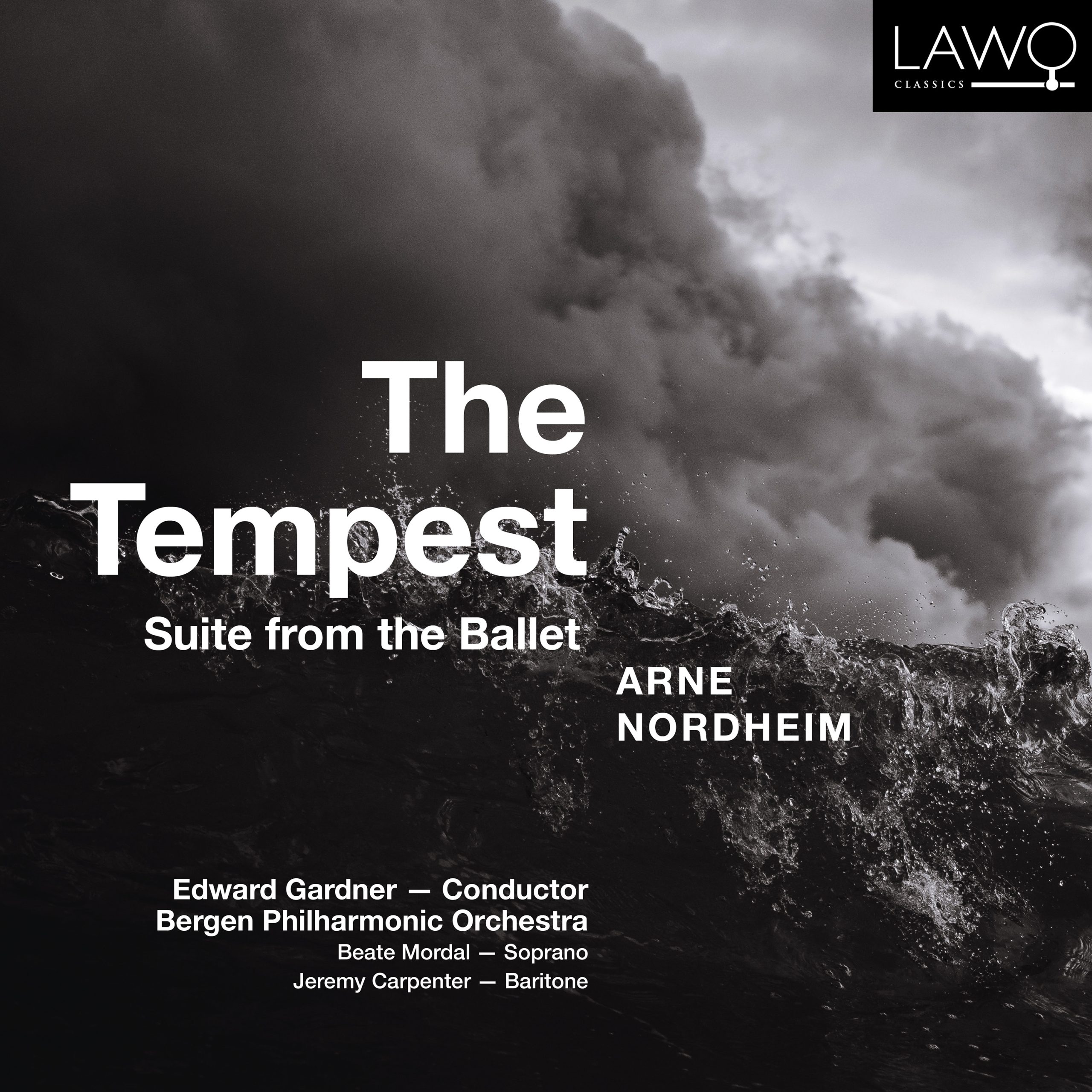
Arne Nordheim
The Tempest – Suite from the Ballet
Beate Mordal (Soprano) | Jeremy Carpenter (Baritone) | Bergen Philharmonic Orchestra (Symphony orchestra) | Edward Gardner (Conductor)
Stream & download
Tracks
Arne Nordheim (1931–2010)
The Tempest (Suite from the Ballet)
Credits
- Conductor
- Edward Gardner
- Soloist
- Beate Mordal (Soprano) | Jeremy Carpenter (Baritone)
- Symphony orchestra
- Bergen Philharmonic Orchestra
- Ensemble members
Bergen Philharmonic Orchestra on this recording
- Alexander Kagan (Violin 1)
- Mari Birgitte Bølgen Halvorsen (Violin 1)
- Åsta Jørgensen (Violin 1)
- Gunvor Agnete Holtlien (Violin 1)
- Frode Sævik (Violin 1)
- Hilary Ramsey Foster (Violin 1)
- Geir Atle Stangenes (Violin 1)
- Ellisiv Sollesnes (Violin 1)
- Julia Imelda Dibley (Violin 1)
- Elisabeth Svanes (Violin 1)
- Alexey Cherkasov (Violin 1)
- Martin Shultz (Violin 1)
- Andreas Block Laberg (Violin 1)
- Mons Michael Thommesen (Violin 1)
- Hayato Naka (Violin 2)
- Sergey Letyagin (Violin 2)
- Liv Elise Nordskog (Violin 2)
- Tone Martinsen Birkeland (Violin 2)
- Tom Birger Bratlie (Violin 2)
- Annette Myking (Violin 2)
- Judith Starr (Violin 2)
- Åse Solheim (Violin 2)
- Siri Einen (Violin 2)
- Natasa Vidacic (Violin 2)
- Emilie Benedicte Haagenrud (Violin 2)
- Carl Anders Sponberg (Violin 2)
- Hsiang-Yin Hsiao (Violin 2)
- Ilze Klava (Viola)
- Liene Klava (Viola)
- Nora Villanueva Lopez (Viola)
- Helga Steen (Viola)
- Yumi Shultz (Viola)
- Christine Schneider (Viola)
- Berend Wiebe Mulder (Viola)
- Rushana Brandanger (Viola)
- Ingrid R. Eriksen (Viola)
- Zane Kalnina (Viola)
- Melanie Packer (Viola)
- Frida Fredrikke Waaler Wærvågen (Cello)
- Agnese Rugevica (Cello)
- Bodil Erdal (Cello)
- Jane Elizabeth Odriozola (Cello)
- Karen Tvedegaard (Cello)
- Ingrid Stensland (Cello)
- Benjamin Nation (Cello)
- Andreas Kaleb Øhrn (Cello)
- Torbjørn Eide (Double bass)
- Adam Kieszek Ottesen (Double bass)
- Jon Åsnes (Double bass)
- Bjgrn Terje Jensen (Double bass)
- Gregory Koeller (Double bass)
- Callum Hay Jennings (Double bass)
- Kaja Marie Andersen (Flute)
- Sigrid Holmstrand (Flute)
- Arnulf Johansen (Oboe)
- Sveinung Birkeland (Oboe)
- Håkon Nilsen (Clarinet)
- Diego Lucchesi (Clarinet)
- James Lassen (Bassoon)
- Oddmund Økland (Bassoon)
- Ragnhild Lothe (Horn)
- Martin Winter (Trumpet)
- Vidar Nordli (Trombone)
- Håkon Kartveit (Timpani)
- Gard Nørvåg Garshol (Percussion)
- Øyvind Øksnes (Percussion)
- Peter Kates (Percussion)
- Johannes Wik (Harp)
- Line Jacobsen (Keyboard)
- Alina Letiagina (Keyboard)
- Composer
- Arne Nordheim
- Producer
- Vegard Landaas
- Engineer
- Thomas Wolden
- Editing
- Vegard Landaas
- Mastering
- Thomas Wolden
- English translation
- Jim Skurdall
- Executive producer
- Vegard Landaas
- Booklet editor
- Hege Wolleng
- PR
- Camilla Momkvist-Skau
- Accounting
- Torgeir M. Landaas
- Cover photo
- Anna-Julia Granberg
- Artist photo
- Beate Mordal by Lars Svenkerud | Beate Mordal by Benjamin Ealovega | Beate Mordal by Anita Grønland | Beate Mordal by Mats Bäcker
- Design
- Anna-Julia Granberg | Blunderbuss
- Recording location
- Grieghallen, Bergen
- Recording country
- Norway
- Recording year
- 2021
- Recording dates
- 16.08.2021 | 17.08.2021 | 18.08.2021
- Original source
- DXD (352.8 kHz, 24 bit)
- Discs / tracks
- 1 disc | 8 tracks
- Release year
- 2022
- Label
- LAWO Classics
- Duration
- 49:41
- EAN
- 7090020182728
- ISRC
- NOEHX2219010/80
Video
Booklet text
Some Enchanted Island
It isn't the proliferation of songs that make The Tempest Shakespeare's most musical play, so much as the work's unrelentingly odd, fascinating and tantalising realm — a world of artful noises, enchantments and conjuring tricks. In The Tempest, nothing is certain. Illusion, disillusion and unpredictability collide in a curious self-contained space that may well sit on the Mediterranean fault-line separating European restraint and North African expression…but then again may not.
All this has long proved an invitation too strong for composers to resist. The first to be indulged was Robert Johnson, chief lutenist at the court of James I and the man who wrote a handful of songs for Shakespeare's original production. Matthew Locke and Henry Purcell followed. When it became fashionable to stage Shakespeare with proto-Wagnerian grandeur a few centuries later, the likes of Alexander Alyabiev and Jean Sibelius furnished his words with incidental music.
Full operatic treatment of The Tempest didn't arrive until the second half of the twentieth century; perhaps a drama consisting mostly of individuals conducting elusive conversations didn't suit the pre-war operatic aesthetic. The many songs cued in the script proved fertile ground for the British composer Thomas Adès. But he and others were almost certainly drawn more to the play's strange musical atmosphere — for Shakespeare scholar Martin Butler, "an autonomous theatrical laboratory with its own internal logic."
Even Adès struggled with the fact that The Tempest isn't all that operatic. It seems doubly wise of Arne Nordheim to choose to see the work not as a work of lyric theatre but as a ballet, scored for orchestra, electronics and two voices mostly without words.
The ballet was first seen in May 1979 at the Schwetzingen Festival. The suite drawn from it represents a further distillation of an already distilled view of Shakespeare's world, a series of "postcards of moods" for conductor Edward Gardner that "demands so much of us individually and collectively as an orchestra." Gardner's words were connected to his presentation of the score, with his Bergen Philharmonic Orchestra, at the 2021 Bergen International Festival. It combined Nordheim's music not with dance but with a visual retelling by video artist Sarah Derendinger that viscerally portrayed the character of Miranda, Prospero's daughter, on a journey to maturity and self-knowledge.
Arne Nordheim was Norway's most significant and respected composer until his death in 2010, and one of the few figures in contemporary western music who proved himself able to move beyond traditional harmonic relationships while maintaining a distinct ability to communicate widely through his striking, physical music. The Bergen Philharmonic has been far from immune to that music's power, championing it throughout the composer's lifetime and premiering his first orchestral work, Canzona, as well as his last, Fonos. It has given multiple performances of Nordheim's orchestral works and has recorded Tenebrae (Cello Concerto), Aurora and Wirklicher Wald. In 1992, Nordheim was the subject of a special focus at the Bergen International Festival, where the orchestra premiered Magic Island — a revised version of Be Not Afeard (the starting point for The Tempest).
Nordheim studied at the Norwegian Academy of Music with Bjarne Brustad and at the Royal Danish Academy of Music with Vagn Holmboe. In the 1950s, he became acquainted with electronic music in Paris and spent time in Bilthoven, Warsaw (where he worked at Polish Radio's experimental studio) and with György Ligeti in Stockholm. He returned to Oslo determined to pioneer new techniques, undoubtedly breathing fresh life into Norway's relatively conservative new music scene in the process.
Nordheim was not a modernist for modernism's sake. Working as a critic and as a composer for theatre, film and television gave him an acute sense of music's place in the wider world and the need to find workable solutions for the stylistic and ideological confusion of the post-war period. The solutions he explored included new views of tonality and the augmentation of the orchestral palette via electronic means, the latter taken forward in The Tempest but heard first in the exploratory Epitaffio per orchestra e nastro magnetico (1963).
In seeking out new musical paths, Nordheim was prone to looking backwards as well as forwards. He maintained an intense interest in early music and never forsook his spiritual affinity with Gustav Mahler. He displayed a very Nordic tendency to drill deep into simple concepts and/or material with a view to reimagining them — be those materials timbral, thematic, harmonic or rhythmic.
The concept of time — its indiscriminate control and its potential manipulation, in the broadest sense — came to fascinate Nordheim and shape a great deal of his music including the score for The Tempest. Collaborating on the ballet with choreographer Glen Tetley, reported the composer, "brought me to understand his [Tetley's] singular concept that music can be compared to a time machine that propels forward both men and action; it is the driving mechanism which keeps everything moving — like Prospero his universe."
Tetley had his own recollections on the collaboration. "Every afternoon Arne walked around the mountain to my house [in Italy]. At that time of the day, the silence highlights the church bells and all the bird and animal sounds in the forest. The fog rises: mountains become islands, valleys become seas, the city disappears into thin air. The atmosphere of The Tempest is magical and the language is a metaphor, just as the language of dance is a metaphor…the changes of the dream in sleep or awakening, the changes of the sea, the inner tempest of man."
In the 1970s, melody and tonality were returning to Nordheim's works but in new contexts that ensured their dynamism and relevance often pivoting on an ingenious view of musical time. The result, in Nordheim's music for The Tempest, is the conjuring of a musical realm as elusive as Shakespeare's stage equivalent — one in which time as we know it, along with so many other anchors (including text) barely exists. It is a world of "transfigured, consonant lyricism" to quote one critic, in which we clearly hear Nordheim's central creative urge to reconcile simple, lucid material with his own protracted schemes and techniques. For Edward Gardner, the process draws us into a "beautiful, seductive world" and music possessed of "a glow that can only be Nordheim's."
In his own preface to the score, Nordheim recalled that he "devoted himself to [Shakespeare's] The Tempest" for many months and years, "reading it in many countries and cities and in every season of the year, through all changes in weather and mood." He recalled that he had "frequently read it alone, filled with despair." The task, the composer concluded, was "to put The Tempest in a new musical setting", one for which the cooperation of Tetley was essential. The figure of Prospero loomed large as Nordheim was drawn towards the imperative of communicating silence, solitude and truth combined.
The electronic elements — developed with Nordheim's colleague from the experimental radio studio in Warsaw, Bohdan Mazurek — immediately put his score on a far more fantastical, unsettling and unpredictable keel than that of most equivalents, rendering it a worthy successor to its Nordic forbear by Jean Sibelius, who wrote music which seems to strain in its search for a new harmonic language. At the US premiere at the Brooklyn Academy of Music in 1982, a New York Times critic suggested the score lacked "internal logic". Considering how much of that exists in Shakespeare, perhaps that was never this score's intended function in the dramatic equation.
In fact, there is logic at work in Nordheim's score, particularly in its use of a five-note sequence derived from the spelling of the Italian word "Amore". The music we hear certainly doesn't benefit from a bar-by-bar analysis, and is often refreshingly self-explanatory right from the island noises with which "Calm Sea, Storm and Awakening" opens up. Timbre rules in this movement, an extension of principles laid down in the composer's own Aftonland for soprano and orchestra (1957).
The "awakening" portion draws listeners away from the surrounding beaches and deep into the frantic and magical disorientation of The Tempest's island domain, led for a time by a romping trombone that will return anon. The haziness with which the movement opened pervades the entire suite, however calligraphic the micro-mechanisms of "Magic Circle", which glistens when it's not rearing up. A cello solo — particularly evocative in cahoots with pitch-bending timpani and a xylophone — sets up the incantation-like solo cello monologue central to the next movement, "Lacrymae".
"A Mazed Trod" leads listeners on a cryptic dance for tuned and un-tuned percussion. The trombone is up to tricks again in "Four Legs and Two Voices", before antiphonal exchanges between the two singers ricochet Caliban's alcohol-smudged final stanzas from Shakespeare's Act II: "Ban' ban' Cacaliban / Has a new master, get a new man. / Freedom, high-day; high-day freedom; freedom high-day, freedom."
Something approaching an archetype Nordic chorale for strings follows before the stage of our consciousness is upset again in "Caliban's Warning". In an apparently amphibious domain, still more elasticated voices here recount Caliban's spirited explanation of the mysterious, magical music that is heard throughout the island: "Be not afeard. The isle is full of noises, / Sounds, and sweet airs, that give delight and hurt not." Nordheim's augmenting of the orchestra with sounds manipulated by electronics approaches the "thousand twangling instruments" to which Caliban refers. Is the music real, or just another manifestation of Prospero's magic?
— Andrew Mellor, author of The Northern Silence — Journeys in Nordic Music and Culture (Yale University Press)