
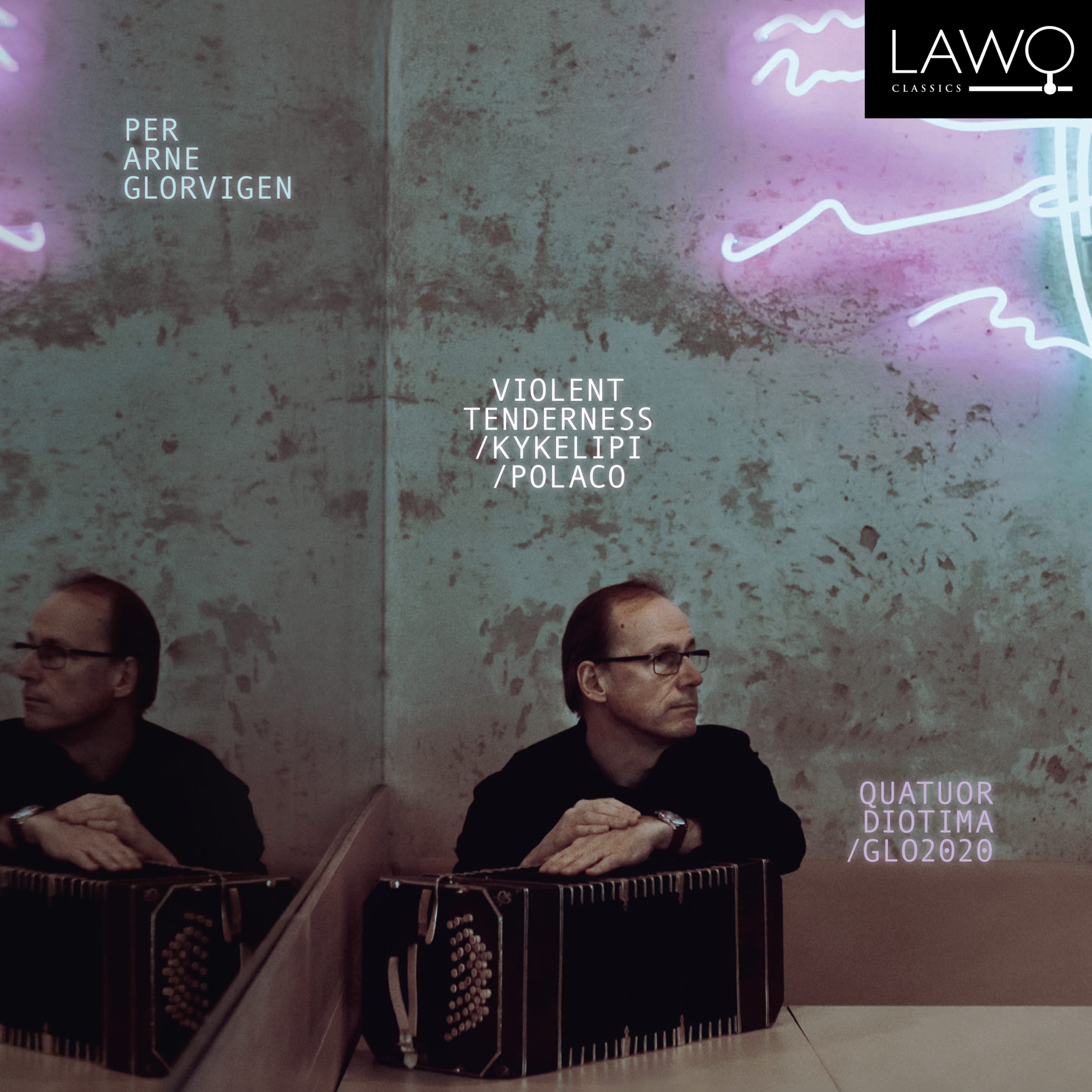
Violent Tenderness / Kykelipi / Polaco
Quatuor Diotima (String quartet) | Per Arne Glorvigen (Bandoneon)
Listen
Tracks
Per Arne Glorvigen (*1963)
Violent Tenderness
Kykelipi
Polaco
Credits
- Performer
- Bernt Ola Volungholen | Christian Ihle Hadland (Piano) | Øyvind Gimse | Yun-Peng Zhao | Constance Ronzatti | Franck Chevalier | Pierre Morlet | Per Arne Glorvigen (Bandoneon)
- String quartet
- Quatuor Diotima
- Composer
- Per Arne Glorvigen
- Producer
- Vegard Landaas | David Haroutunian
- Engineer
- Thomas Wolden | Olivier Manoury
- Mastering
- Thomas Wolden
- Liner notes
- Per Arne Glorvigen
- English translation
- Jim Skurdall
- Executive producer
- Vegard Landaas
- Booklet editor
- Hege Wolleng
- PR
- Camilla Momkvist-Skau
- Cover photo
- Jevgenija Frolova
- Artist photo
- Quatuor Diotima by Olivier Manoury | GLO2020 by Erik Hannemann | Per Arne Glorvigen by Jevgenija Frolova
- Design
- Anette L’orange | Blunderbuss
- Recording location
- Sofienberg Church, Oslo | Manoury Studios, Paris
- Recording country
- Norway
- Recording year
- 2020
- Recording dates
- 03.08.2020 | 04.08.2020 | 26.09.2020 | 27.09.2020
- Original source
- DXD (352.8 kHz, 24 bit)
- Discs / tracks
- 1 disc | 14 tracks
- Produced with support from
- Arts and Culture Norway | The Audio and Visual Fund | Norwegian Society of Composers
- Release year
- 2022
- Label
- LAWO Classics
- Duration
- 68:21
- EAN
- 7090020182629
- ISRC
- NOEHX2209010/140
Booklet text
Tangst
After having worked on several pieces for bandoneon and orchestra in recent years, I felt the urge to present some of my chamber music. All music featuring the bandoneon inevitably conjures up associations with tango, and yes, my music is no exception, most apparent here in my works for bandoneon and string quartet, Violent Tenderness and Polaco. In opposition to these two works it was important for me to find as much contrast within the ensemble and the works as possible. So I landed on piano, cello, baritone voice and bandoneon in my ensemble GLO2020, for the piece Kykelipi, with lyrics by Jan Erik Vold. My aim is to expand the repertoire of the bandoneon by bringing in new sources of inspiration such as French chansons, German 'lieder', soul, contemporary music, Norwegian lyric and folk music, and even the Polish national anthem. I've also brought in a new percussion instrument, the lurk. The desired result is to create something completely fresh where the listener can recognise the bandoneon sound and the tango rhythms but also be knocked out by the modern tonality, unpredictable chord combinations, the madness, humour, as well as some serious existential questions. Since I'm known to often use somewhat dissonant intervals such as tritones and seconds, I jokingly call my music TANGST (a combination of the words tango and angst). This can easily be translated into other languages too, such as Tanguish (in English), Tangústia (in Spanish), Tangoisse (in French) and Tansia (in Italian). Let me stress though, that this music is Tangst con brio or Tangst giocoso!
Violent Tenderness
This title is an oxymoron inspired by Pierre Chloderlos de Laclos' novel Les Liaisons Dangereuses (Dangerous Liaisons), where the contrast between seductive love and evil is a major theme.
The piece presents tango with modern tonality and the first movement Tango Musculoso has two repeated tones as its basic motif. It's a "muscular", aggressive and energetic tango culminating in a fugato in 5/4. What follows is a more delicate adagio, but even in this more tender and heart-rendering middle section, the two aggressive tones from the main motif are never far away. It's a bit like stroking your lover's back while you're actually annoyed with them at the same time.
In the calm second movement, there are also two tones which make up the motif, but in this case they are not repeated and the interval is a perfect fourth. The introduction starts first with a solo in the mysterious left hand of the bandoneon before the two violins take over. When viola and cello make their entrance, we slowly move towards a climax via a rhythmic tango-like build-up.
In the "groovy" and jocular final movement, my very first musical inspirations come to the fore — soul and rock'n'roll. The two repeated tones from the first movement are used here in a Motown-like groove with the bandoneon's left hand reminiscent of an electric bass. This groove is mixed with a slightly dogged, yet swinging milongar rhythm from the tango, before the theme from the 2nd movement also materialises, this time in a faster milongan rhythm.
Kykelipi
I discovered modern poetry as a young high school student through the collection of poems kykelipi (1969) by Jan Erik Vold. Until that time I'd thought of poetry as solemn romantic verse in rhyme, but Vold's works soon disabused me of that notion! To think, poetry could be fun while at the same time being reflective and beautiful! Forty years on I found that Vold's iconic collection and lyrics were strikingly beautiful, subtle and effervescent. As I composed this song cycle during the pandemic, lines such as "Take care of friends, take care of friendliness" and "It's not me who's sick, it's the world" took on a whole new relevance.
Poems such as Pornodiktet (the Porn Poem) may seem provocative to this day, but one can never be indifferent to the language and choice of words.
Polaco
This work was originally written for the brilliant Polish string quartet Apollon Musagète Quartet and so all movements are in one way or another linked to Poland. "Polaco" simply means "Polish" and is also the nickname of Argentine tango singer Roberto Goyeneche. It is my personal tribute to an artist who, perhaps more than anyone else, emphasises the free phrasing of the traditional Argentine dance tango.
In the first movement we hear the verse of the Polish national anthem Mazurek Dąbrowskiego (Dabrowski's mazurka), composer unknown. The movement has a clear ABA form with allegro-lento-allegro.
Second movement; Czas (time) is as the name suggests a reflection on time, and uses sound effects that imitate clocks, metronomes etc., such as a teaspoon against the metal on the bandoneon!
The third movement is a Rørospols called Fandens Polsdans, inspired by Sven Nyhus. The Pols is a dance that came to Norway (mainly around the town of Røros) from Poland via Sweden, where it is called "Polska" (Polish). In this newly re-written pols, we finally hear the chorus of the Polish national anthem with the text "March, march, Dabrowski!". The stamping from the dance hall in Røros is followed by the march of an entire Polish army heading towards Poland to liberate the country. Finally, the two themes meet; the Rørospols and Dabrowski's masurka. History shows that both Paderewski and Elgar have used the Polish national anthem in their works before me, both works going by the name Polonia.
The fourth movement is loosely based on Chopin's Marche Funèbre (Funeral march), the third movement of the Piano Sonata No. 2 (opus 35), reworked into a modern tango — Tango Funèbre. The idea is to re-create the morbid and dramatic mood of a Chopin sonata. Still, it turns around at the end of the movement and the funeral march is transformed into a sweeping 'tarantella', making death perform an about-face.
— Notes: Per Arne Glorvigen · English translation: Paul Holden