
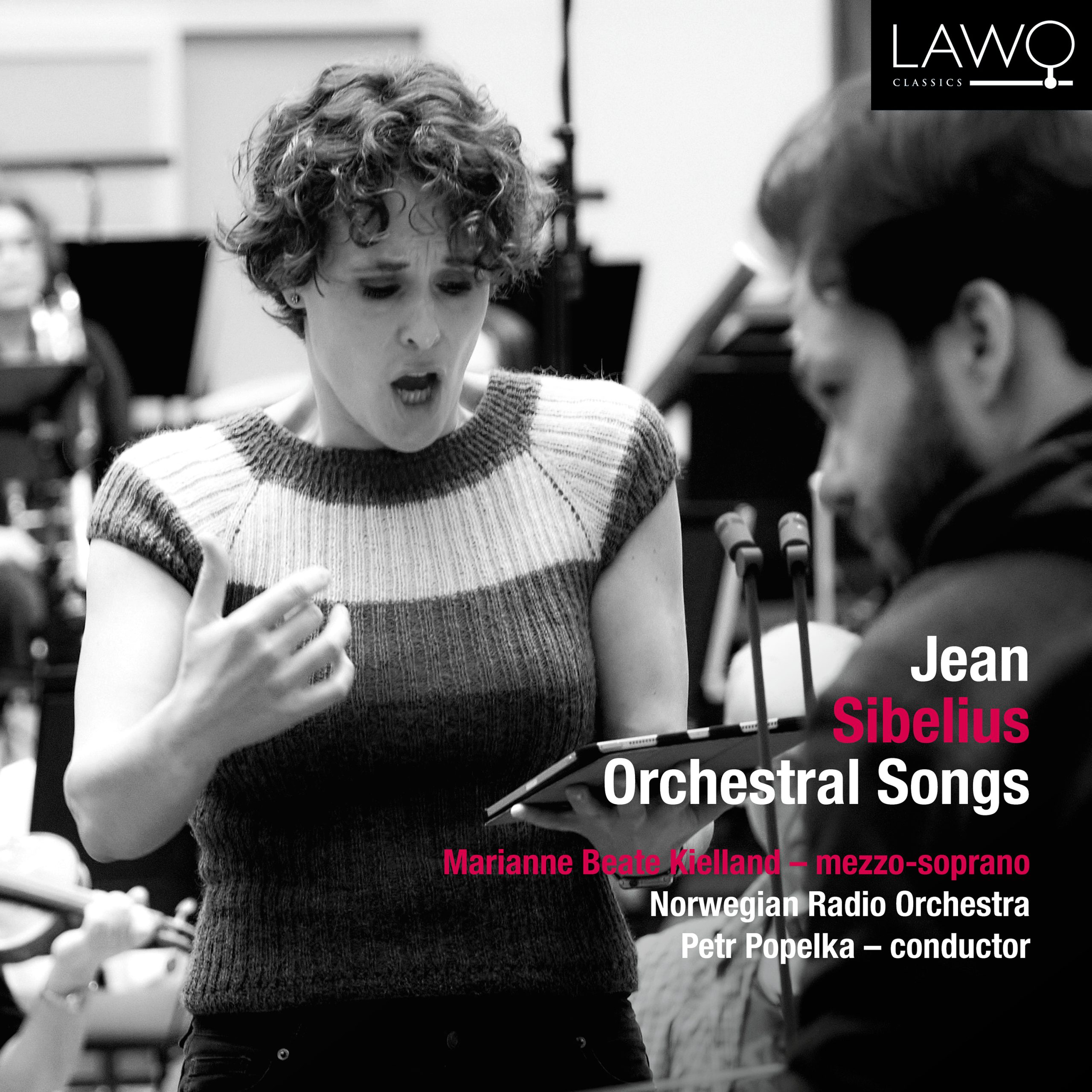
Jean Sibelius
Jean Sibelius Orchestral Songs
Marianne Beate Kielland (Mezzo-soprano) | Norwegian Radio Orchestra (Orchestra) | Petr Popelka (Conductor)
Stream & download
Tracks
Jean Sibelius (1865–1957)
5 Songs, Op. 38
7 Songs, Op. 17
6 Songs, Op. 36
5 Songs, Op. 37
Credits
- Conductor
- Petr Popelka
- Soloist
- Marianne Beate Kielland (Mezzo-soprano)
- Orchestra (unspecified)
- Norwegian Radio Orchestra
- Composer
- Jean Sibelius
- Producer
- Vegard Landaas
- Engineer
- Thomas Wolden
- Editing
- Vegard Landaas
- Mastering
- Thomas Wolden
- Liner notes
- Marianne Beate Kielland
- English translation
- Jim Skurdall
- Executive producer
- Vegard Landaas
- Booklet editor
- Hege Wolleng
- PR
- Camilla Momkvist-Skau
- Cover photo
- Anna-Julia Granberg
- Artist photo
- Marianne Beate Kielland by Julia Marie Naglestad | Marianne Beate Kielland by David Dawson | Marianne Beate Kielland by Thomas Wolden
- Design
- Anna-Julia Granberg | Blunderbuss
- Recording location
- NRK Radio Concert Hall, Oslo
- Recording country
- Norway
- Recording year
- 2021
- Recording dates
- 09.02.2021 | 10.02.2021 | 11.02.2021 | 12.02.2021
- Original source
- DXD (352.8 kHz, 24 bit)
- Discs / tracks
- 1 disc | 18 tracks
- Produced with support from
- Arts and Culture Norway | The Audio and Visual Fund | Fund for Performing Artists
- Release year
- 2022
- Label
- LAWO Classics
- Duration
- 44:20
- EAN
- 7090020182612
- ISRC
- NOEHX2208010/180
Video
Booklet text
I was only eighteen the first time I held the score of a song by Jean Sibelius in my hands, his much-loved Svarta rosor. Of course I was far too young to be able to shape this dramatic, intense and all-embracing song in a proper manner, but I was immediately captivated by its tonal language and the profound depth of the text. I sensed that here was a treasure trove of songs in which I could identify with the composer's symbiosis of text and music. And it turned out to be correct. Every time I came across a new Sibelius song, it made a deep impression, both the music and the text, and soon a number of them were a part of my repertoire. Flickan kom ifrån sin älsklings möte, Illalle, Den första kyssen and Se'n har jag ej frågat mera, together with Svarta rosor, became some of my favourite songs, and with the passing years I increasingly felt that they were right for my voice. I often included them in concert programmes, and singing them was always a gratifying experience.
As my career has progressed, I have had the chance to make numerous recordings featuring a variety of repertoires, and I have always felt the desire to record the songs of Sibelius. A wonderful opportunity presented itself when the Norwegian Radio Orchestra with Chief Conductor Petr Popelka expressed its willingness to be part of such a recording. Virtually all Sibelius songs are written for voice and piano, but many of them seem as though made for orchestral sounds and instrumental subtlety. Therefore a number of his finest songs have fortunately been orchestrated, and it is these editions we have used for this recording. A few of the orchestrations were done by Sibelius himself, one by his contemporary, Simon Parmet (né Pergament), while several were orchestrated by his own son-in-law, conductor Jussi Jalas.
The songs of Sibelius are at the centre of his list of compositions. His first published work was the song Serenade from 1888. Here he already used a poem of Johan Ludvig Runeberg, a poet who was to become the most important contributor to the 109 songs Sibelius composed. They are largely collected in eight opus numbers, without necessarily having any common threads or general themes. Sibelius studied in Vienna towards the end of the 1890s, and even though he is regarded as a forward-looking symphony composer, his songs carry on the tradition of the past and the German masters. We hear echoes of Beethoven, Brahms and Wagner in this music.
This album presents orchestrated songs of Sibelius from four opus numbers: 17, 36, 37 and 38.
Although Sibelius wrote most of his songs to Swedish texts, in opus 17 we find two Finnish poems, Illalle and Lastu lainehilla. The opus was composed between 1891 and 1904. The songs in this opus have a lighter quality, especially En slända, distinguished by its longer a capella vocalise sections and vibrating tones, but also the songs Fågellek and Sov in!. The one that particularly stands out in opus 17 is Se'n har jag ej frågat mera. With its serious text, sad melody and high climax, it is in form and content quite typical for the later songs of Sibelius.
Opus 36 and 37 contain the most popular audience favourites from the composer's output. Opus 36 was written towards the end of the 1890s, while opus 37 was composed in 1904. Here we have many splendid depictions of nature (Marssnön, Demanten på marssnön and Soluppgång), but also ardent love songs with betrayal and the pain of love as themes (Svarta rosor, Säv, säv, susa, Var det en dröm? and Flickan kom ifrån sin älsklings möte).
Opus 38 was composed in 1903. These songs were also written originally for voice and piano, but Sibelius made his own orchestral versions. In form and melody they are well-suited to the orchestral format, and, in particular, the sweeping and dramatic Höstkväll. Here the singer has a superb opportunity to showcase her voice in almost Wagnerian style. På verandan vid havet is also filled with dramatic musical intensity, while I natten is more subdued, mystical and dreamlike.
From the very beginning, the songs of Sibelius were embraced by performers, audience and critics, and they are the favourite of many. The Scandinavian language can be challenging for some, since most of the songs are in Swedish. Here I received magnificent help in polishing my pronunciation from Professor Barbro Marklund, whom I thank most sincerely!
— Marianne Beate Kielland (Translated by Jim Skurdall)