
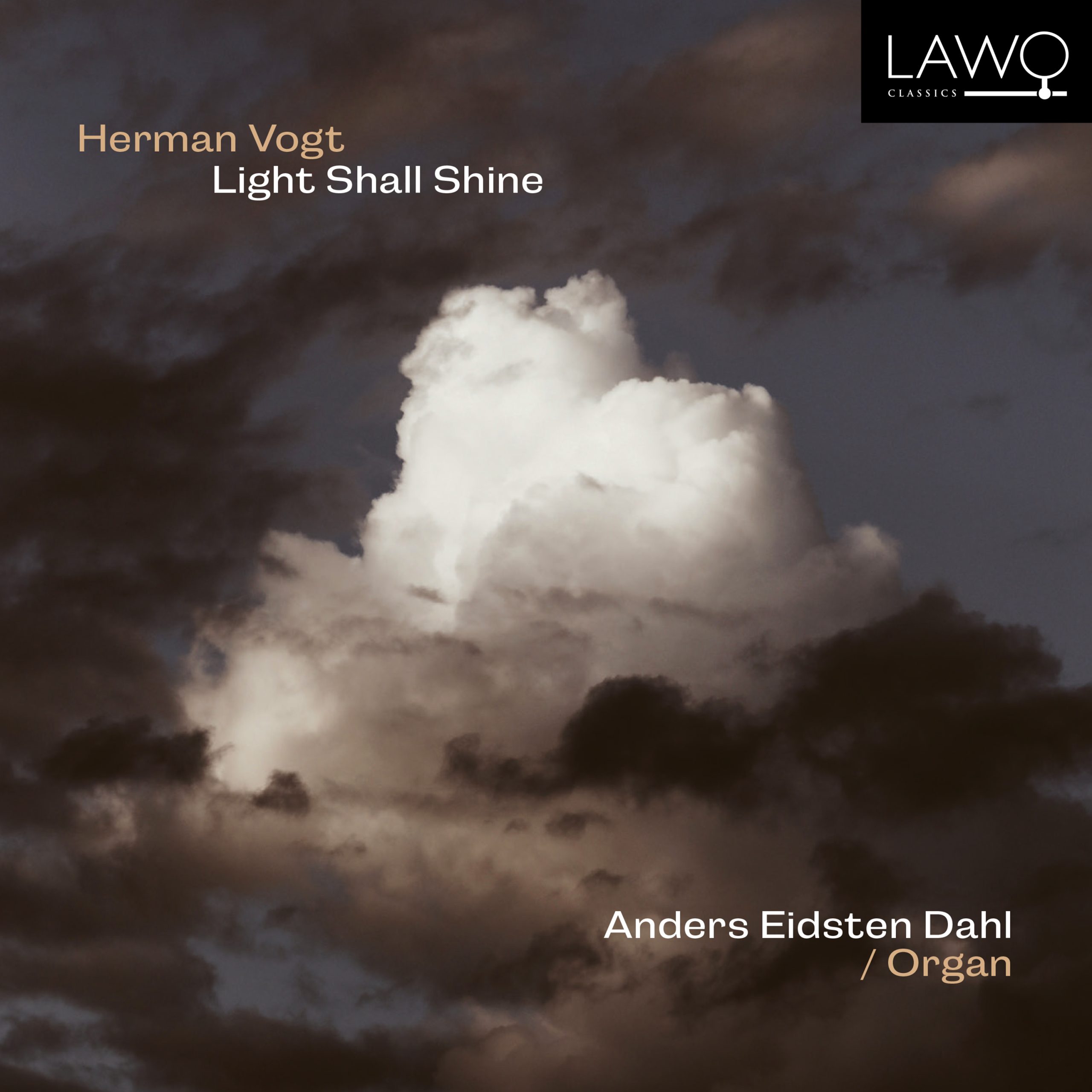
LIGHT SHALL SHINE OUT OF DARKNESS
On the CD “Light Shall Shine” organist Anders Eidsten Dahl performs three works of Herman Vogt on the magnificent Carsten Lund organ in Bragernes Church. The release is the result of a collaboration over more than ten years between the performer and the composer. The music spans a wide palette in its tonal language, everything from simple and naivist music to complex polyphony.
Vogt says himself about the music: “Working together with Anders has resulted in a very personal and inner-directed music and represents in large part a spiritual journey for me as composer.” The musical expression ranges from an inner, contemplative stillness to eruptive bursts of raw power, in many ways the church organ presented in all its symphonic breadth. Eidsten Dahl’s playing expresses the music’s true essence while allowing its power and vitality free rein.
The works are presented here in reverse chronological order. The most recent of them — “Light Shall Shine Out of Darkness” from 2020 — is a wide-ranging composition in five movements, while the two earlier works — “Ré-sur-Ré…exit” from 2016, and “The Marvel of Turin” from 2012 — are individual one-movement pieces. All the works are based on Christian ideas and phenomena. The thematic content embraces central elements of Jesus’s teachings and Christian tradition, apocryphal texts, German Passion literature, Jesus’s resurrection, and something as concrete as a Christian relic.
Listen
Tracks
Herman Vogt (*1976)
Light Shall Shine Out of Darkness
Credits
- Performer
- Anders Eidsten Dahl (Organ)
- Composer
- Herman Vogt
- Producer
- Vegard Landaas
- Engineer
- Thomas Wolden
- Editing
- Vegard Landaas
- Mastering
- Thomas Wolden
- Liner notes
- Herman Vogt
- English translation
- Jim Skurdall
- Executive producer
- Vegard Landaas
- Booklet editor
- Hege Wolleng
- PR
- Camilla Momkvist-Skau
- Cover photo
- Jan Ove Iversen | Over Pari
- Artist photo
- Anders Eidsten Dahl by Elin Eike Worren | Herman Vogt by John Andresen
- Design
- Anette L’orange | Blunderbuss
- Recording location
- Bragernes Church, Drammen
- Recording country
- Norway
- Recording year
- 2020–2021
- Recording dates
- 03.11.2020 | 04.11.2020 | 26.05.2021
- Original source
- DXD (352.8 kHz, 24 bit)
- Discs / tracks
- 1 disc | 7 tracks
- Produced with support from
- Arts and Culture Norway | Norwegian Society of Composers
- Release year
- 2022
- Label
- LAWO Classics
- Duration
- 69:46
- EAN
- 7090020182575
- ISRC
- NOEHX2204010/70
Booklet text
Light Shall Shine
This CD is the result of a collaboration over a number of years between the performer and the composer. The outcome: three relatively different works. The most recent is a wide-ranging work of five movements, while the two preceding works are isolated, one-movement pieces. All the works are based on Christian ideas and phenomena. The thematic content embraces central elements of Jesus's teachings and Christian tradition, apocryphal texts, German Passion literature, Jesus's resurrection, and something as concrete as a Christian relic. Together the works represent in a way a free-thinking, non-dogmatic religious point of view, possibly a modern approach to faith.
The organ as instrument has an extraordinary capacity for variations in sound quality. For a composer without thorough knowledge of the instrument these many possibilities can seem overwhelming and be experienced as a barrier in the encounter with the medium. In more recent times we find those who as composers are closely attached to the organ, particularly the French composer and organist Olivier Messiaen, an important figure in post-war classical music. And this leads to a respectful question on the part of a composer today: How to compose for the organ after Messiaen? The instrument's ability to produce sustained and long-drawn-out tones has been at the centre of my compositional approach to the organ, an inherent timbral quality that in principle can classify it as a wind instrument. This perspective has been a gateway into a world of opulent homophonic and polyphonic sound. The vertical element in music (chords) can audibly and directly enter into the horizontal passage (lines and melodies). A potentially very complex sound is created moreover by just one musician, almost like a condensed orchestra! The virtually limitless possibilities for nuance of sound has in essence played a subordinate role in the compositional process.
In their musical language the three works span over a wide palette, everything from simple and naivist music to complex superimposed, dissonant polyphony. The musical expression ranges from an inner, contemplative stillness to eruptive bursts of raw power, in many ways the church organ presented in all its symphonic breadth.
Light Shall Shine Out of Darkness (2020)
The title of the work, Light Shall Shine Out of Darkness, is taken from Paul's Second Letter to the Corinthians in the translation of the New American Standard Bible (2 Corinthians, chapter 4): For God, who said, "Light shall shine out of darkness," is the One who has shone in our hearts to give the Light of the knowledge of the glory of God in the face of Christ. The light metaphor is used by Paul to describe Jesus as the light of the world, while at the same time alluding to the creation of the Earth in Genesis (Then God said, "Let there be light"; and there was light.). Regarded in the light (!) of today's scientific understanding of the beginning of the universe with the Big Bang, the title represents moreover a poetic image of the origin of the world from nothing. All matter, all light, all life, all thoughts and ideas, everything, originated in absolute emptiness.
The work is divided into five parts.
Part 1, The Kingdom Is Within You, and It Is Outside You, takes its title from the apocryphal Gospel of Thomas (saying 3). A possible version of this quotation of Jesus is found in the canonical gospels. Indeed we have two different translations of Luke 17:21 with somewhat different meanings: … for, behold, the kingdom of God is within you. (King James Bible/New King James Version); and the alternative translation: … because the kingdom of God is in your midst. (New International Version). The variant saying in the Gospel of Thomas can be interpreted as offering deeper insight: It is through getting to know oneself that one is able to see the beauty of the world and become fully human. When you know yourselves, then you will be known, and you will know that it is you who are the sons of the living Father. (Gospel of Thomas, saying 3) The movement is laid out as contemplative, inner-directed music.
Part 2, I Am the Light of the World, takes its title from the Gospel of John: I am the light of the world. Whoever follows me will not walk in darkness, but will have the light of life. (John 8:12, English Standard Version) The antithesis light/darkness in the Gospel of John is, for that matter, compatible with the Essenes' use of the concepts, whereby light is a symbol for truth and goodness, while darkness represents deceit and malice. The Essenes were a Jewish sect in Judea before, during and after Jesus's time (cf. the Dead Sea Scrolls). A possible connection between the Essenes, John the Baptist and Jesus has been brought up in a number of different contexts. This is a powerful and luminous movement with fiery crescendos and diminuendos, punctuated in a middle section by tranquil tonal textures.
The title of part 3 has two parts: See the Saviour's Outstretched Hands; And He Took the Children in His Arms. The first quotation is taken from Bach's St. Matthew Passion, where Jesus is hanging on the cross, an alto aria with choir (text by Christian Friedrich Henrici [Picander]):
Sehet, Jesus hat die Hand, Uns zu fassen, ausgespannt, Kommt! — Wohin? — in Jesu Armen Sucht Erlösung, nehmt Erbarmen, Suchet! — Wo? — in Jesu Armen. Lebet, sterbet, ruhet hier, Ihr verlass'nen Küchlein ihr, Bleibet — Wo? — in Jesu Armen.
The movement's second title is taken from the Gospel of Mark (Mark 10:15–16): Truly, I say to you, whoever does not receive the kingdom of God like a child shall not enter it. And he took them in his arms and blessed them, laying his hands on them. (English Standard Version) This movement is placed in the middle of the work, as a symbol of the cross, as the cross is in itself a symbol of Jesus's outstretched arms. The movement is a lullaby.
Part 4, You Are the Light of the World, takes its title from the Gospel of Matthew (Matthew 5:14), where Jesus refers to His disciples as the light of the world. There is a similar utterance in the Gospel of Thomas: There is light within a man of light, and he lights up the whole world. If he does not shine, he is darkness. (saying 24) The movement presents continuous rhythmic music, like a grand-sounding march. It symbolizes a steadfast faith in love and goodness that can be found in us humans, and the possibility we have of choosing our actions, and faith in our good potential.
Part 5, Our Lasting Peace; May He Find Rest in Me, which concludes the work, is designed as a prayer. The title is not a quotation, but rather alludes to the many references to peace in the New Testament, for example, in Paul's letter to the Galatians (5:22): But the fruit of the Spirit is love, joy, peace, patience, kindness, goodness, faithfulness, … (English Standard Version) The movement is at the same time both peaceful and subtle.
The entire work also exists as an instrumental version for symphony orchestra (2021).
The work was commissioned by Anders Eidsten Dahl and was premiered in Oslo Cathedral in 2020.
Ré-sur-Ré…exit (2016)
The title derives from the Latin word resurrexit (He is arisen). The word is divided and 'translated' into French, where ré means both the tone and chord D, and likewise also refers to the prefix ré-, meaning again. This duality is emphasized in the music by a recurring D major chord representing that which returns again.
The piece Ré-sur-Ré…exit stretches out a broad canvas. Here we have significant dynamic and melodic variations. Harmonic contrasts reflect a spectrum of expression from the almost banally simple to rather sharp dissonances. The piece opens with a musical presentation of Christendom's most central element of faith: Jesus's resurrection. This is followed by harmonic stillness in slow surging motion. Furthermore, there is a dialectic struggle representing our human endeavours, joys, sorrows and doubts, and trials in our lives. It ends with a vibrating memory of Jesus's resurrection, reverberating as an eternal idea. On the other hand, we are left with the challenges of choices and dilemmas large and small, as this existential idea fades away as an open question.
The work was commissioned by Anders Eidsten Dahl and was premiered in Bragernes Church in 2017.
The Marvel of Turin (2012)
The work The Marvel of Turin was inspired by the Shroud of Turin, the Christian relic called in Italian Sindone di Torino or Sacra Sindone. According to Christian tradition, this linen shroud was the burial shroud of the historical Jesus Christ. It is obviously not as well known in Protestant parts of the world as it is in Catholic regions.
Visible to the naked eye is a vague image of the full figure of a man (front and back) with hands crossed, and wounds with real blood on feet, wrists, head and on the right side of the chest. In a photographic negative of the shroud the image becomes astonishingly clear and the face of a man with beard and long hair emerges.
The Shroud of Turin has been examined by scientists on two occasions in an attempt to find out more about the origin and history of the shroud and how indeed the image of the man came to be. In 1978 the American STURP team (Shroud of Turin Research Project), consisting of a broad spectrum of experts from various research fields, conducted an extensive examination. In 1988 radiocarbon dating done on the shroud concluded that it can be dated to 1260–1390 AD, which thus characterized it as a medieval forgery. This result contrasts sharply with other known data that confidently put it in the correct place and time period (in the Middle East from sometime before the 8th century), in its connection with, among other things, the lesser known Sudarium of Oviedo — which is, according to tradition, the cloth covering Jesus's face when he was taken down from the cross. Radiocarbon dating does not lie. Yet many believe that something must have affected the dating results, and various theories regarding the reasons for this result have been put forward, some more credible than others.
The Shroud of Turin has been the object of intense debate ever since, not least regarding its historical authenticity. Most will agree that one will never be able to prove that this was the burial shroud of the historical Jesus Christ of Nazareth, for the simple reason that there is precious little to test it against. But one can, based on available information, operate with a certain degree of likelihood of historical authenticity!
Whatever the case, the Shroud of Turin is a mysterious and fascinating object that in a sense has provided more questions than answers after the scientific tests to which it has been put. To date, no one has managed to provide a clear scientific explanation of how the image came to be, let alone reproduce the shroud with all its unique features. Even after all this thorough research, it may ultimately remain a matter of faith.
The point of departure of the work The Marvel of Turin is this astonishing object and its remarkable and still relatively unknown history. The work portrays duality and flowing mysticism, followed by radiant bursts, always with an underlying ambiguity. The piece is constructed as a musical fantasy in relatively free form, in which quiet and contemplative aspects alternate with powerful and brilliant sounds. Some sections of this work served as the basis for an orchestral work written for Oslo Philharmonic Orchestra, Solsangen (English title: Canticle of the Sun) (2018), in which parts of the music are transferred to the orchestral medium, presenting the music in a new light.
The work was commissioned by Anders Eidsten Dahl and was premiered in Bragernes Church in 2013.
— Notes: Herman Vogt · English translation: Jim Skurdall
Biographies
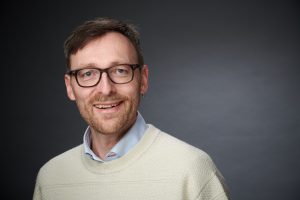
Herman Vogt
Herman Vogt (b. 1976) studied composition at the Norwegian Academy of Music from 1999 to 2004 with Bjørn Kruse, Lasse Thoresen, Olav Anton Thommessen and Henrik Hellstenius, and completed a master's degree in composition at the same institution in 2018 under Asbjørn Schaathun. In 2003 he studied composition at the Royal Conservatory in The Hague with Martijn Padding and Louis Andriessen. He also studied the violin at the Norwegian Academy of Music from 1995 to 1997.
Vogt's music has been performed at the ISCM World Music Days in Sydney and Belgium (the latter together with the Transit Festival), the Nordic Music Days in Copenhagen and Stockholm, ULTIMA in Oslo, Borealis in Bergen, and other festivals in Norway and abroad.
His works have been performed by the Oslo Philharmonic, Norwegian Radio Orchestra, Trondheim Symphony Orchestra, BIT20 Ensemble, Oslo Sinfonietta and Athelas Sinfonietta; pianists Ian Pace and Sveinung Bjelland; violinist Geir Inge Lotsberg; cellists Timo-Veikko Valve and Audun Sandvik; and organist Anders Eidsten Dahl. Conductors include Edward Gardner, Vasily Petrenko, Pierre-André Valade, Baldur Brönnimann, Christian Eggen, Ingar Bergby, Peter Szilvay, Per Kristian Skalstad and Anna-Maria Helsing, alongside many other ensembles and musicians in Norway and abroad.
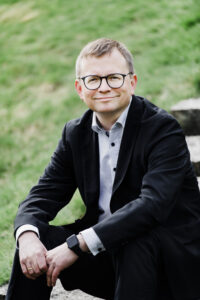
Anders Eidsten Dahl
Anders Eidsten Dahl (b. 1976 in Drammen) graduated with a degree in church music from the Norwegian Academy of Music and later completed a Master's degree in solo organ performance at the same institution. Following two years of solo performance study at the Royal Danish Academy of Music in Copenhagen, he gave debut concerts in Copenhagen and Oslo in 2003. He has studied organ with Professor Terje Winge, cathedral organist Kåre Nordstoga and Professor Hans Fagius. He holds the position as Associate Professor of organ at the Norwegian Academy of Music.
Eidsten Dahl is much in demand as organ soloist, chamber musician and harpsichordist, and he has given organ concerts at festivals in a number of European countries. His repertoire spans from the Baroque to the music of today, with emphasis on J. S. Bach and organ music from the Romantic period. Since 2001 he has served as organist and director of music at Bragernes Church in Drammen, where he is artistic and administrative director of the church's organ concert series.
A recipient of the Government Work Scholarship for Younger and Newly Established Artists, Eidsten Dahl has released a number of critically acclaimed albums on LAWO Classics.