
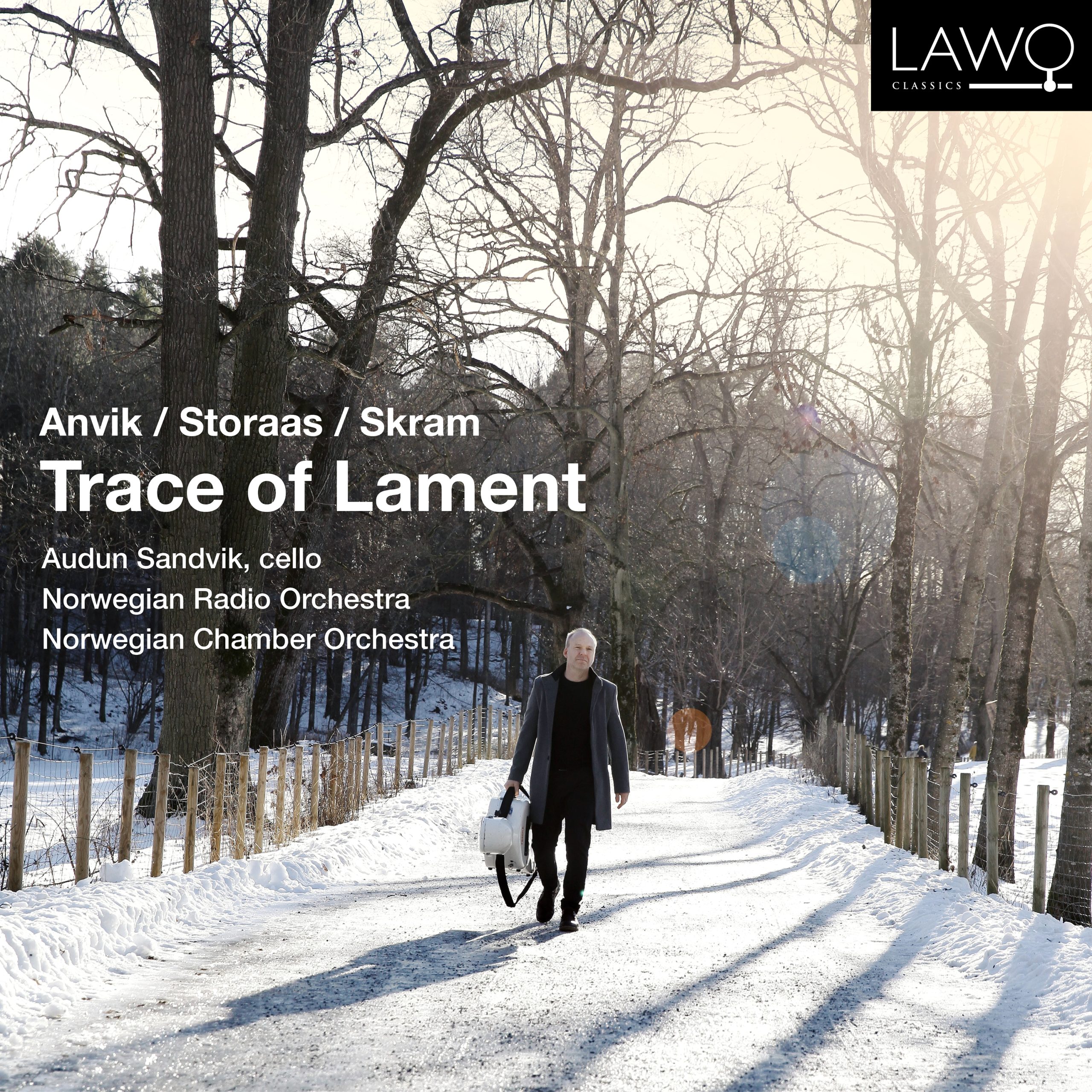
Trace of Lament
Audun Sandvik (Cello) | Norwegian Radio Orchestra (Orchestra) | The Norwegian Chamber Orchestra (Chamber orchestra)
Stream & download
Tracks
Ginge Anvik (*1970)
Gaute Storaas (*1959)
Ex Alia Parte
Henrik Skram (*1973)
Gaute Storaas (*1959)
Reviews
Requesting a disc of unknown (to me) contemporary composers on the basis of some favourable thirty-second samples is a lottery.…
Show more Show less
Requesting a disc of unknown (to me) contemporary composers on the basis of some favourable thirty-second samples is a lottery. I have done it before, and been very disappointed by works that start promisingly and then descend into hard-edged modernism or uninspired dullness. So it is with great relief that I can report that this disc of works by three Norwegian film and TV composers is really quite excellent throughout, and is very likely to feature in my Recordings of the Year. [...] The audio quality is very good, the cello sounds magnificent, though in the cadenza of Ex Alia Parte’s slow movement, there are some audible breathing noises from Sandvik. They are not enough to be distracting, but suggest that the microphone was perhaps a little close. Audun Sandvik is a name to look out for – I was very impressed by his playing, and the two Norwegian orchestras are very good as well. Having not had high expectations for this disc, its excellence has been a wonderful surprise. For those whose preference in contemporary classical music requires the presence of the three elements that have been the basis of Western music for so long, this should be very welcome.
 Musicweb International | July 2022
Read at Musicweb International →
[...] Audun Sandvik has done a wonderful job uniting different musical textures to testify and at the same time ennoble the traces of lament.
 Sonograma Magazine | 29.05.2022
Read at Sonograma Magazine →
Credits
- Conductor
- Thomas Klug | Per Kristian Skalstad
- Performer
- Audun Sandvik (Cello)
- Chamber orchestra
- The Norwegian Chamber Orchestra
- Orchestra (unspecified)
- Norwegian Radio Orchestra
- Composer
- Ginge Anvik | Gaute Storaas | Henrik Skram
- Producer
- Vegard Landaas
- Engineer
- Thomas Wolden
- Editing
- Vegard Landaas
- Mastering
- Thomas Wolden
- Liner notes
- Ginge Anvik | Gaute Storaas | Henrik Skram
- English translation
- Jim Skurdall
- Executive producer
- Vegard Landaas
- Booklet editor
- Hege Wolleng
- PR
- Camilla Momkvist-Skau
- Cover photo
- Anna-Julia Granberg
- Artist photo
- Audun Sandvik by Oyvind Eide | Audun Sandvik by Anne Valeur | Audun Sandvik by Per Kristian Hilden | Audun Sandvik by Harald Medbo | Audun Sandvik by Heide Benser
- Design
- Anna-Julia Granberg | Blunderbuss
- Recording location
- Oslo Concert Hall | NRK Radio Concert Hall, Oslo
- Recording country
- Norway
- Recording year
- 2018–2020
- Recording dates
- 17.01.2018 | 18.01.2018 | 19.01.2018 | 11.06.2020 | 12.06.2020
- Original source
- DXD (352.8 kHz, 24 bit)
- Discs / tracks
- 1 disc | 7 tracks
- Produced with support from
- Arts and Culture Norway | Norwegian Composers’ Remuneration Fund | UiT – The Arctic University of Norway | The Norwegian Chamber Orchestra
- Release year
- 2022
- Label
- LAWO Classics
- Duration
- 55:20
- EAN
- 7090020182568
- ISRC
- NOEHX2203010/70
Booklet text
The music on this CD release has been written by composers who often work within the audiovisual medium. When working on their creations, they are in dialogue with a starting point, a story, an expression, their surroundings, and an emotion — a series of images and actions that require interaction. This is a premise which fascinates me.
As a performer, I also operate with a great deal of interaction. I address an audience and I take on suggestions and the wishes of my fellow musicians. We form an expression together from each from our own standpoints, with our own bodies, and each with our own personality. We acquire material by digging from that quarry. Perhaps it could be said that our goal is, in principle, to create openings where what we play creates meaning for those who listen and where our interpretation can be perceived as meaningful. We want others to also find value in what obviously holds true value for us when we play.
So it makes sense for me that this release is a collection of music by composers who quite specifically relate to music through dialogue. At the same time, I wanted the composers to concentrate on the cello as a solo instrument and make music that at least in this context does not necessarily conform to a cinematic expression.
My experience tells me that composers are still on the lookout for dialogue, which can also be achieved through a strong adaptation to the instrument. Gaute Storaas, Henrik Skram and Ginge Anvik all have differing approaches, and the processes I have been through with them have their contrasts. However, it is their flexibility which has become a common denominator for our collaboration. What all three composers want is that the music should work, for the cello, for the ensemble and for the listeners. Functional thinking is perhaps the opposite end of a process where the composer instinctively wants to provide resistance, to invent new ways of playing, to strive for something that is nigh impossible to achieve — and which consequently creates demands on the listener. For me, both of these approaches are equally and clearly valid, and I want there to be room for both. In this release, I have chosen to highlight the perspective which has arguably been given the least amount of elbowroom. I've been aiming to show music where the intended material is good for my instrument, and which has been fine-tuned to my physique.
I hope with this perspective that this release will be a door-opener for new listeners of contemporary music. Most of all though I am proud to be able to present five new works which will resonate with me for a long time.
— Audun Sandvik (put in writing by Ida Habbestad)
About the Composers and Their Works
Ginge Anvik (b. 1970)
I was born in Japan to Norwegian missionary parents in 1970 and took up piano lessons from the age of 9 after the family had moved back to Norway. It quickly became clear to me that I struggled to read music, but in spite of this I began to compose from the get go.
One of my greatest interests when growing up was radio theatre and particularly how the stories and music would allow my imagination to run free. So when I moved out of home in 1989 I started composing for children's radio dramas for NRK (Norwegian Broadcasting Corporation) while at the same time studying musicology. After a couple of years at the University of Oslo in the early 90's, I found myself immersed in the electronica/rave/rock scene and concluded that my problems with reading musical notes was probably more deep-seated than mere reluctance.
My desire to pursue a future in film composition was seemingly fruitless, but as we moved into the 2000s, and after several releases with the electronics duo SubGud, albums in Namibia and South Africa, music for various radio dramas, dance performances and TV documentaries, I had built myself up a sizeable network of contacts.
However, none of this was actually lucrative in any way, and so when in 2005 I was quite randomly asked to submit some sketches for a feature film, I was close to the point of giving up music altogether. Receiving the commission for this first film was a gratifying fulfilment of a dream, and opened up a whole new world of possibilities. At the time of writing, I have been involved in a total of 31 feature films, as well as TV series, documentaries and short films, and have been afforded the use of increasingly larger teams of musicians according to the films' needs. This has all happened according to trial and error, since my note-reading challenges meant I never did dare to venture into composition studies in the end. I chose social anthropology instead.
Ostinat
Ostinat is based on a piece of music written for the 2015 film De nærmeste (The Closest), directed by Anne Sewitsky. The idea of adapting this to a cello piece was originally proposed by a mutual friend of Audun's and mine, Trond Husebø, who also conducted the music for the film. The piece's romantic character derives from a passage in the love story where everything seems to be going swimmingly, before the film takes a darker turn.
The original arrangement for piano and string orchestra was improvised along with pictures to create a digital sketch, so that the director could get an impression of whether it was the right atmosphere for the scene. When Audun asked if I could rewrite this into a solo piece, I proceeded in much the same way. I knew a bit about, and indeed was a fan of, Audun's energetic but also subtle playing style from his orchestral contributions to previous films, and I wanted to try and make room for the dynamics of this fine range. Removing the piano from what was originally a piano piece in itself is clearly a challenge. However, the other obvious menace for me was that I had never composed for solo cello before, so the process consisted of improvising digital sketches that Audun auditioned and provided feedback on, especially in terms of its playability and how my improvisations could best be conveyed by him as a soloist.
I tried to keep the piece's original, romantic feel that made him want to play it in the first place. The absence of momentum the piano had provided, as well as the limitations of the images, opened up the possibility to do away with form and allow more time and dynamic space for Audun, while varying the orchestra's role between being supportive and leading. For me with my problems with reading music, everything is a learning process, and Audun's input was invaluable. I am extremely grateful to have had the opportunity to write for him.
Gaute Storaas (b. 1959)
Jazz musician and composer Gaute Storaas (b. 1959) emerged from the vibrant musical environment of his hometown Bergen, Norway in the late 70s, where he was an active bass player in the local rock and jazz scene. He attended Berklee College of Music, Boston in 1984 where he received his Diploma in Arranging two years later. Back in Norway, he took up whatever writing jobs he could get his hands on, arranging shows, broadcasting, recording sessions, and composing for advertisements and other visual media. His music found its way into every Norwegian home in 1992 when he wrote the ident music for the country's first commercial tv-channel, TV2. He also won the Danish Radio Orchestra competition for younger composers in 1989, with the work Ouverture #2. Storaas is also noted for his work with the well-known Norwegian black metal band Dimmu Borgir.
The last 20 years has mainly been spent writing orchestral music for film and tv, ranging from animated movies for children, such as the Elias universe, to dramas such as The Last Sentence by renowned director Jan Troell, and the Oscar-nominated A Man Called Ove.
Ex Alia Parte
A couple of years ago, I received a phone call from one of my absolute favourite musicians, cellist Audun Sandvik, who wanted me to write a piece of some length for cello and strings which would be recorded with the Norwegian Chamber Orchestra. You simply can't turn down a challenge like that. I was both overjoyed and scared. I also had a film and a tv-series on my plate, so I had to keep it on the back burner for a while. I decided to dedicate each of the three movements to the main registers of the cello, hence the title Ex Alia Parte. The first movement starts out fast, concentrating on the cello's sonorous tenor register. In the second, the cello is in its extreme high register, over tense semi clusters. The cadenza transcends from the bottom to the top of the instruments, and jumps back down to the solo bottom register power chords in 7/4 that start off the third movement, where influences from my work with Norwegian black metal bands won't go unnoticed. My main objective was to write something that Audun would like to play, and audiences, including myself, would like to hear.
A Nordic Year
In 2018, I had a meeting with legendary director Colin Nutley (of House of Angels fame). He wanted to discuss music for a new tv-series he just had finished shooting. The series itself is about the lives of two families, and what happens in the aftermath of something that took place at a wedding. It was also framed by some particularly beautiful images of the Swedish countryside. This inspired me to write what would become the main theme for the series A Nordic Year. It was written for the nyckelharpa (a keyed fiddle, and the national instrument of Sweden) as well as strings. Audun became aware of this piece as he was playing cello on the series, and he asked me to create a cello version for him. The piece is essentially a rather simple folk-style melody, but the way it was conceived relied on the overtone spectra from the wooden stops and the sympathetic strings of the nyckelharpa to create the feel I was after. Audun managed to sort out these obstacles, and did remarkably well in retaining the openness and the folk-like inflections of the nyckelharpa in his rendition of the work.
Henrik Skram (b. 1973)
Henrik Skram (b. 1973) started playing the piano and composing music at an early age, and received his first tuition in composition from the late Antonio Bibalo. Later, he became apprentice of the American film composer Randall Meyers before moving on to formal studies in classical composition at the Guildhall School of Music and Drama in London, with Simon Bainbridge. Returning to film composing in Norway his debut was the feature film 90 Minutes (Eva Sørhaug) which received international acclaim and the score was nominated to both an Amanda Award and shortlisted for the World Soundtrack Awards (Public Choice Award). Since then he has scored several feature films like All the Beauty, Ballet Boys, Tordenskjold & Kold, CLUE and Rose. In 2016 Henrik composed the score for the 24-episode TV series Snowfall (Snøfall), produced by NRK, and was awarded his second Golden Screen Award for Best Original Score. He was also nominated as the Norwegian candidate for the 2018 Harpa Nordic Film Composer Award for that score. In 2018, Henrik made his debut as composer for dance with the 3-act ballet The Hamlet Complex, premiered at the Norwegian Opera & Ballet in Oslo. The following year, the musical drama for children Mia & the Troll Factory (Mia & Trollfabrikken), with script by Gudrun Skretting, was premiered by the Oslo Philharmonic Orchestra. In 2021 Henrik is composing the music for the theatrical version of Maja Lunde's The Snowsister (Snøsøstera), at Det Norske Teatret.
Henrik Skram is published worldwide by Edition Wilhelm Hansen.
The Dinner
The piece was written as a cue to the feature film 90 Minutes, a dark and disturbing film about domestic violence and suicide. In this scene, a husband poisons his wife during a lavish dinner, (she can't get enough of the gravy), he follows shortly; this is his suicide that tragically must involve his unknowing spouse. A key scene in the film, where the music is allowed full attention. It sets up conflicting feelings, one would perhaps expect music of a more thriller-esque character. But, the brilliant director Eva Sørhaug insisted that I write something romantic and "beautiful". It really gives the scene an even stronger impact, as it takes us into the head of the main character, played by Bjørn Floberg.
There is a well-known myth about film music, that the best scores go by unnoticed. I beg to differ; with a good director who knows how to use music as an emotional conveyor, it may well be playing a greater part.
Emerge
In Emerge, I am exploring the idea that tonality and gravity are related phenomena. Just as both weightlessness and the lack of a tonal base will disorient you, I wanted in this piece to set up musical situations where the perception of tonal grounding is constantly evolving, as massive objects in low-gravity space are influenced by small shifts in energy. Slowly pushed and pulled by the solo cello, the orchestra rearrange and reassemble, falling into different states. As the soloist emerges from inside the sounds, I wanted to explore how one voice can shift in and out of the whole.
The title also refers to the fascinating phenomena of emergent systems. Consider a flock of starlings in the thousands, creating cloud-shapes that change form so quickly and so naturally that one would think there was a central logic or control behind; but it appears quite on its own when the whole group reacts to small changes in the neighbour's behaviour. In the piece, I imagine such a flock, but slowed down. The agility of the players in KORK are just as graceful as the starling!