
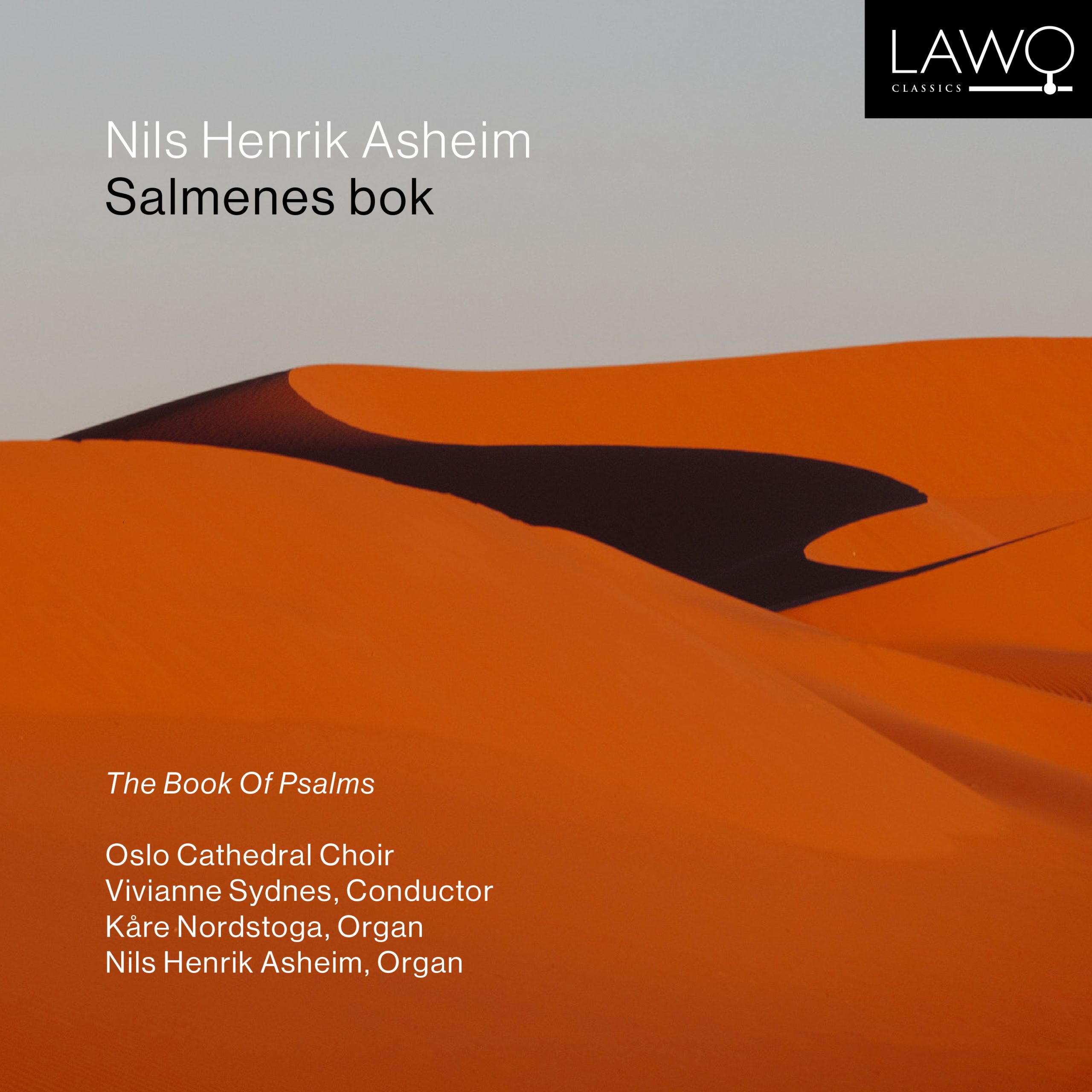
Salmenes bok
Oslo Domkor (Choir) | Nils Henrik Asheim | Kåre Nordstoga (Organ) | Vivianne Sydnes (Conductor)
Stream & download
Tracks
Nils Henrik Asheim (*1960)
Salmenes bok
Reviews
[...] As always with Asheim, the music is a masterclass in unconventional invention, bringing the psalms alive in an entirely new way, one that vividly reveals powerful, relatable emotional truths in their ancient words.
 5against4.com | 31.12.2022
Read at 5against4.com →
[...] The choir’s performance – and indeed Nordstoga’s and the composer’s performance at the organ – is both impressive and, at times, magnificent.…
Show more Show less
[...] The choir’s performance – and indeed Nordstoga’s and the composer’s performance at the organ – is both impressive and, at times, magnificent. The colours Asheim employs in his musical compositions are (judging by the lyrics) as if tailor-made for these verses. In other words: this is a must-have if you have even the slightest interest in major works of church music! (PS! Use the volume control – the sound engineered by Thomas Wolden at LAWO Classics is lovely!)Show original
[...] Korets innsats - ja også Nordstoga og komponistens innsats på orgelkrakken - er både imponerende og tidvis storslått. Fargene Asheim bruker i sine musikalske skriverier er (med et blikk på tekstene) som skapt for disse versene. Med andre ord; Denne bør anskaffes om du har et snev av interesse for større kirkemusikalske verk!(PS! Bruk volumknappen - Lyden tekniker Thomas Wolden hos LAWO Classics har skapt er nydelig!)

Credits
- Conductor
- Vivianne Sydnes
- Performer
- Nils Henrik Asheim | Kåre Nordstoga (Organ)
- Choir (mixed)
- Oslo Domkor
- Composer
- Nils Henrik Asheim
- Lyricist
- Bible
- Producer
- Vegard Landaas
- Engineer
- Thomas Wolden
- Editing
- Vegard Landaas
- Mastering
- Thomas Wolden
- Liner notes
- Elisabeth Thorsen
- English translation
- Lars Brusletto Sveen
- Executive producer
- Vegard Landaas
- Booklet editor
- Hege Wolleng
- PR
- Camilla Momkvist-Skau
- Cover photo
- Pexels.com CC licence
- Booklet photo
- Illustration by Pexels.com CC licence
- Artist photo
- Nils Henrik Asheim by Line Owren Fotografi | Vivianne Sydnes by Ellen Lande Gossner | Kåre Nordstoga by Ole Marius Jorgensen
- Session photo
- Thomas Wolden
- Design
- Anette L’orange | Blunderbuss
- Recording location
- Oslo Cathedral
- Recording country
- Norway
- Recording year
- 2020
- Recording dates
- 24.01.2020 | 25.01.2020
- Original source
- DXD (352.8 kHz, 24 bit)
- Discs / tracks
- 1 disc | 26 tracks
- Produced with support from
- Arts and Culture Norway | Norwegian Society of Composers
- Release year
- 2021
- Label
- LAWO Classics
- Duration
- 77:17
- EAN
- 7090020182544
- ISRC
- NOEHX2201010/260
Booklet text
The Book of Psalms: Amidst Art and Chaos, Cosmos and Mystery
I will incline my ear to a proverb; I will solve my riddle to the music of the lyre. (Psalm 49, verse 4)
In another time, amongst Bedouins in the regions between the Mediterranean, the Caspian Sea, the Persian Gulf and the Red Sea, songs that were capable of uniting people evolved. Their melodies not only assisted the memory in remembering the words, they also made the poetry solidify in the bodies as sensed perceptions of something they called wisdom.
Can this way of singing be understood as entering into an experience of connection, not only with one another and within oneself, but also with life and all living things? Not only with the visible and tactile, but also with what we long for, what we do not understand, what we call Origin or Goal, Purpose or God?
Can we say that this song is both something that really happened, and something that belongs to the world of myths, the world of fairy tales?
The oldest layers of what we today call the Book of Psalms have links going back to ancient singing. How the melodies developed is lost to us, the exact nature of the instruments as well. But fragments and portions of the poetry that was shared on the beautiful rugs, and preserved in the many bodies, still remain as signs. And archaeologists have found these signs carved onto clay tablets, on pieces of wood or copper, and written down on parchment. Their findings show that the oldest poetry from Egypt, Syria, Lebanon, Asia Minor, Mesopotamia and Canaan share many of the same themes and turns of phrase, and that much of this also has striking parallels in the Book of Psalms.
A fragmented and manifold hallelujah
When we read a modern book, we can generally assume that it has the wording and the grammatical signs that the author gave it and wanted it to have. When we read the Old Testament, the situation is entirely different. Long oral traditions predate any written form, centuries lie between the oldest surviving texts and the versions that we know today. Also in the Book of Psalms, we can catch a glimpse of these layers. They appear like sections of a living psalm tradition that both composed and used hymns continuously: Stanzas with nomadic motifs are assumed to have been in use before the First Temple in Jerusalem, in the time before 586 BCE, but also in it. Poetry with the Temple and sacrifices as themes is thought to have originated in both Temple periods. Other hymns, such as Psalm 137, refer to the Babylonian captivity (596 to 539 BCE), and we can assume that they date to the period of the Second Temple (after 515 BCE) or even from the time in exile. Later still, the canonisation of the Book of Psalms continued until around the year 100 CE.
Many psalms bear authors' names. David has the highest number of attributions. In addition, Asaph, Korah, Solomon, Moses, Ethan and Heman are mentioned. The authors' names represent milieus and reflect positions, and they contribute to the book being referred to as an anthology.
The Hebrew name for the Book of Psalms is Tehillim. This is a plural noun from the root H–L–L, meaning praise, laud or extol. When the Tehillim was translated into Greek, the collection was titled ψαλμοί (psalmoi), which means "instrumental music" or "the words that come with the music". From the New Testament and the Qumran community we know that ψαλμοί (psalmoi) was used extensively in ancient Judaism and early Christianity.
In the Jewish Bible, the Book of Psalms belongs to the Ketuvim, that is the writings. In the New Testament, tropes and verses are woven in as intertext. The Quran also contains references. Hymns from the Book of Psalms are part of both Jewish and Christian rituals. They also belong to the "secular library of the world". Reinterpretations of the poetic words and new musical settings to go with them are still created, both by independent artists and by composers and writers working within the religions.
Existence and mythopoetic reality
When I look at your heavens, the work of your fingers, the moon and the stars, which you have set in place, what is man that you are mindful of him, and the son of man that you care for him? (Psalm 8, verse 3–4)
The themes in the Book of Psalms appear in a bizarre disorder. Nevertheless, what can be called a theocentric architecture emerges. Everything that is, comes from a Creator who has a purpose with his work. Everything that is, speaks of this Creator.
The human being of the Book of Psalms is an image of "What cannot be imagined" (God). The driving force of all movements and actions is their longing for God, their longing back to "the original image". This specific attention to the connection between the heavenly and the worldly, and between the human being and God, unites hymns that are otherwise very dissimilar. It also portrays a mythopoetic reality.
Corresponding parallel lines is a literary device that propels poetry and its messages forward. We see it when one line overlaps the next to let the following carry on. It is somewhat like the drive mechanism of a locomotive or the legs of a trotting horse. The theological term for this is parallelismus membrorum, which is often interpreted anthropologically: the device reflects the human experience that reality can never be grasped directly, but has to be approached through associations, different layers of meaning, ruptures and new continuations. The poetry can also be called kaleidoscopic: As soon as an image is established, it muddles and is replaced with another. When the lens is rotated, movement and diversity emerge. The volatility and multiplicity of existence appear and are tolerated.
Themes in the psalms are connected with nature, society and temple, but also with different traditions within the Jewish Bible: the Law, the Prophets and Wisdom. As a kind of "glue" between these categories lies the mythical — which is about origin and beginnings and which tries to meet the "eternal questions" of every human. Midrash is the name of a way of reading which is about this "glue". Combining differing themes and images, reading "under" and "in between", it uncovers a meaning or a feeling. The creation hymns, for example, are brought in immediate connection with Genesis and allow a new story to arise: When the first human was formed from dust and made alive by the Creator's breath, this living creature responded by way of song, a first hallelujah. Tehillim is nothing more than a collection of these hallelujahs. It is the multitude of hallelujah-cries set in motion and juxtaposed.
It is written in the First Book of Moses (2:5–7): "When no bush of the field was yet in the land and no small plant of the field had yet sprung up — for the Lord God had not caused it to rain on the land, and there was no man to work the ground, and a mist was going up from the land and was watering the whole face of the ground — then the Lord God formed the man of dust from the ground and breathed into his nostrils the breath of life, and the man became a living creature."
What does it all mean?
In a world where the religious and the secular were not separated, we could perhaps call this existentialism? Myth-poetry with the ability to elucidate life experience and identity? Songs of origin and who we are? An "earthed form of mysticism"? An essential element of the poetry of the psalms is negation. It is reminiscent of what in mysticism is called via negativa. In theological thought this path finds its premise in "what we can never fully describe". God becomes the ultimate example of this. The mythopoetic universe of the Bible tells us that God is the only uncreated entity of all things that are. It follows, then, that we cannot recognise God as form or formula in the things that are. Should we nevertheless claim that God is this or that, we would at the same time have to claim that God is not this or that. We need to provide a "counter-image". Only then there is room for a living God. Only then there is room for the ineffability of existence.
Via negativa causes humans to enter into a process. Not towards emptiness and vanity, but towards certain filled voids. The consciousness and dignity of being human lie both in being remembered (8:4) and in being forgotten (13:2), both in being small and being great (8). Negation keeps the existential loss alive. Simultaneously it transforms the pain of loss precisely by expressing loss and pain, and by doing so establishing a communality again, a confirming and poetic reality. This is a duality that integrates rather than excludes. Opposites that embrace rather than extinguish.
To be comprehended by the incomprehensible
Blessed is the man … (Psalm 1:1a) … who murmurs on the Lord's law day and night (Psalm 1:2b)
The Hebrew word H–G–H has many different translations in the Book of Psalms. In Psalm 1 verse 2b it has usually been rendered as "meditate" (Blessed is the man who meditates on the Lord's law …). This translation seems a little strange when we know that words such as "moan", "growl", "utter", "speak" cover the basic meaning of the verb better. In monastery traditions H–G–H has often been translated as "ruminate" or "murmur". Choosing "murmur" for our translation of Psalm 1 brings us closer to the psalms as speech and praise. Choosing "ruminate" brings us closer to the reciting style of nomadic song, and also to the mystics' way of singing and what can resemble the philosophical or contemplative approach of existentialism.
There is a thread running through all the shifts in the Book of Psalms. This thread is about relations and longing, and a hope directed towards the deepest object of longing / the most steadfast / God.
For me to "murmur on the Lord's law" becomes both to "meditate on" what the words may contain — and to ruminate on them so that nourishment at last runs into me and my body.
Much is unclear and obscure in the Hebrew text, and has probably always been so. This implies that the Book of Psalms can never be a frozen text. A continuing work of translation will keep the words alive, lead to a diversity of understandings and discourses, and always challenge the language into which the hymns are translated.
The work of translation puts our capabilities for grammatical understanding, historical criticism and existential interpretation to the test, but the most important when confronting sacred texts is that our sense of wonder is aroused and kept awake. Perhaps "sacred texts" depend more on "wondrous reading" than other texts? Perhaps "the sacred" is situated more in strangeness than in what we have identified as "our own"?
When a text is called holy, the opposite movement also arises: hierarchical and dogmatic readings assert themselves. Because of the Book of Psalms' status as a sacred text, one can posit that "murmuring readings" have had to stand aside. The book has in a way been appropriated by the Abrahamic religions, and consequently it is read in the light of another cultural and spiritual project than the poetry itself embodies. The Christian church's use of these texts represent another kind of colonisation where also a "literal understanding" of the translated tropes destroy the poetry's deeper meaning.
Hermeneutic and literary approaches, historical-critical research and continuous artistic adaptations of the book all challenge this. Striving towards a reading that is personal, independent and open, the grip of power is released, creating a space of respect for the necessary sense of wonder, like a "starry firmament". Following every human who opens up and seeks, tries and fails, it will unfold and unite — like the manifold and broken hallelujah of the Tehillim.
— Elisabeth Thorsen
Elisabeth Thorsen (b. 1966) is a theologian educated at the University of Oslo, and is currently a priest at Oslo Cathedral. In addition, she writes non-fiction and fiction exploring the intersections of theology, philosophy and psychology.
The Hebrew text is taken from Biblia Hebraica Stuttgartensia. English translations of Psalm texts are from the English Standard Version.
Sources: Hauge, Martin Ravndal: Between Sheol and the Temple: Motif structure and function in the I—Psalms, Journal for the Study of the Old Testament, Supplement Series 178 (Sheffield, 1995). — Nida, Eugene: "Principles of correspondence", in: The translation studies reader ed. Lawrence Venuti (London, 2012). — Terrien, Samuel: The Psalms: Strophic structure and theological commentary (Cambridge, 2003). — Thorsen, Elisabeth: Mellom destruktiv representasjon og pågående skaperkraft, Agora 2/2019 (Oslo, 2019).
— English translation (booklet notes): Lars Brusletto Sveen
Salmenes bok (The Book Of Psalms), by Nils Henrik Asheim
The process behind this work originates from when Oslo Cathedral commissioned a large-scaled work by Nils Henrik Asheim for the inauguration of the church's new main pipe organ in 1998. The composer suggested including a choir to create a cycle of texts from the Book of Psalms, and the Oslo Cathedral Choir were more than willing to participate, with their dedication to the piece being integral to the work's development.
Organ builders Ryde & Berg made both the main organ (with 53 voices) and the choir organ (16 voices), with the combination of the two becoming central to the concept of the work. The two instruments bathe the room in an immersive soundscape, with the choir representing the voice inside this.
The composer himself chose a selection of lines taken from 21 hymns, with the view to creating a holistic narrative through use of contrasts. Five "Alleluja" movements for organ complete each of the sections of the work. In the 1998 version, these were improvised movements for solo organ, but in the revised version from 2019 the movements were re-composed as organ duos. The titles of these five movements are taken from Psalm 150, v. 1–3.
— Nils Henrik Asheim