
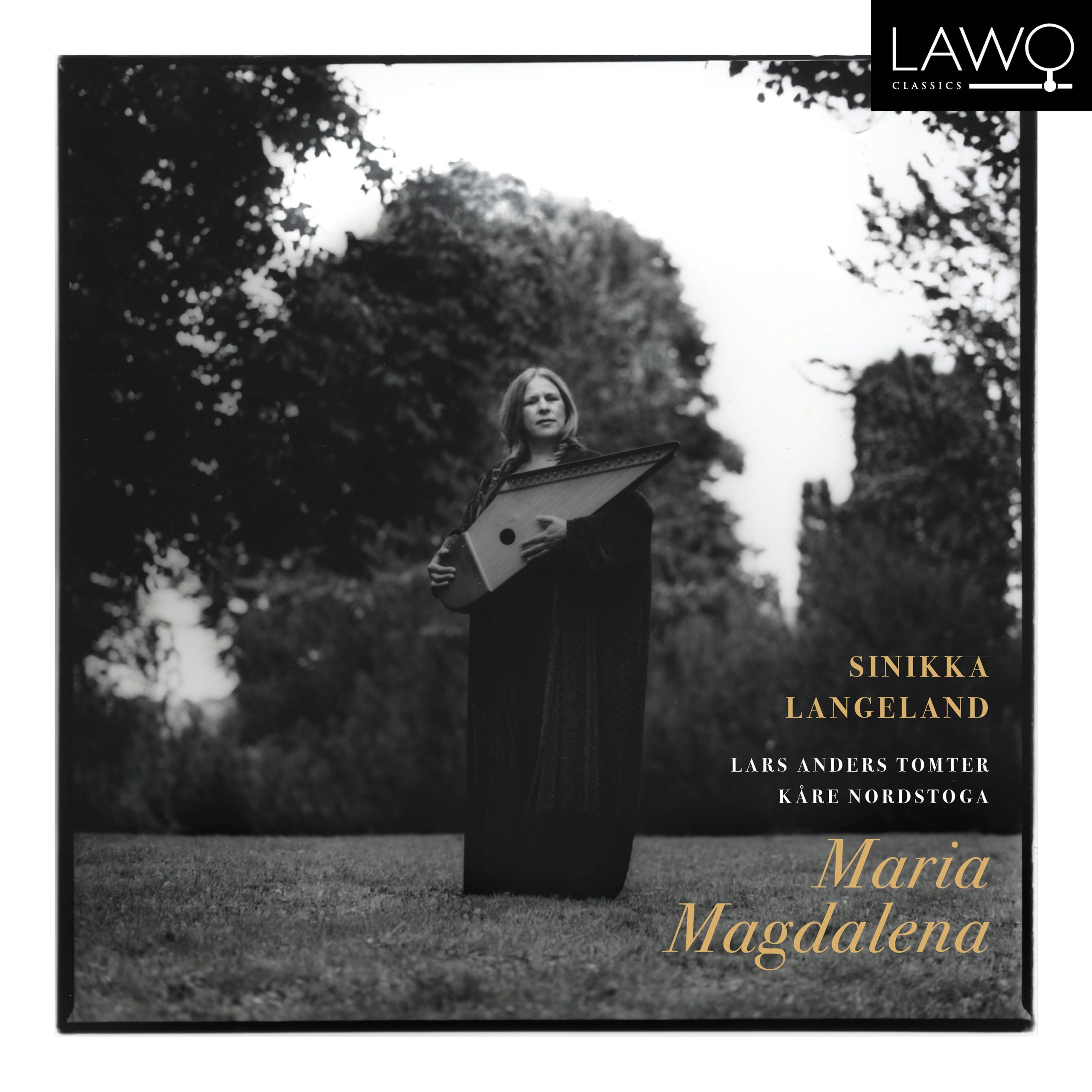
Johann Sebastian Bach | Sinikka Langeland
Maria Magdalena
Sinikka Langeland (Vocals) | Lars Anders Tomter (Viola) | Kåre Nordstoga (Organ)
Stream & download
Tracks
Traditional
Johann Sebastian Bach (1685–1750)
Traditional
Johann Sebastian Bach (1685–1750)
Concerto in G Major, BWV 592
Traditional
Johann Sebastian Bach (1685–1750)
Concerto in G Major, BWV 592
Traditional
Johann Sebastian Bach (1685–1750)
Cello Suite No. 6 in D Major, BWV 1012
Traditional
Johann Sebastian Bach (1685–1750)
Cello Suite No. 6 in D Major, BWV 1012
Traditional
Johann Sebastian Bach (1685–1750)
Cello Suite No. 6 in D Major, BWV 1012
Sinikka Langeland (*1961)
Johann Sebastian Bach (1685–1750)
Cello Suite No. 6 in D Major, BWV 1012
Sinikka Langeland (*1961)
Johann Sebastian Bach (1685–1750)
Credits
- Performer
- Kåre Nordstoga (Organ) | Lars Anders Tomter (Viola) | Sinikka Langeland (Vocals)
- Composer
- Johann Sebastian Bach | Sinikka Langeland
- Producer
- Ove Berg | Sean Lewis
- Engineer
- Sean Lewis
- Mastering
- Thomas Wolden
- Liner notes
- Sinikka Langeland
- English translation
- Jim Skurdall
- Executive producer
- Vegard Landaas
- Booklet editor
- Hege Wolleng
- PR
- Camilla Momkvist-Skau
- Cover photo
- Anna-Julia Granberg
- Artist photo
- Sinikka Langeland by Morten Krogvold
- Design
- Anna-Julia Granberg | Blunderbuss
- Recording location
- Nidaros Cathedral, Trondheim
- Recording country
- Norway
- Recording year
- 2008
- Recording dates
- February 2008
- Original source
- DXD (352.8 kHz, 24 bit)
- Discs / tracks
- 1 disc | 19 tracks
- Produced with support from
- Arts and Culture Norway
- Release year
- 2021
- Label
- LAWO Classics
- Duration
- 71:07
- EAN
- 7090020182506
- ISRC
- NOEHX2119010/190
Booklet text
The story of Mary Magdalene has been a source of comfort for many women, and research has shown that medieval ballads about Mary Magdalene are often sung by single mothers. Young women who were outcasts must have found some measure of consolation in the songs about Mary, who bore children with her father, her brother and a priest, but was cleansed of sin after doing penance in the wilderness for many years. But the possibility should not be overlooked that the songs could have been sung with a sarcastic undertone, becoming an unassailable and liberating weapon when there was no other recourse for rebelling against unjust treatment. The Bible actually says nothing about Mary Magdalene as a fallen woman. As Turid Karlsen Seim explains in her book about the Gospel of Mary Magdalene, published by Emilia Forlag, "The words of Jesus in the Gospel of Mary Magdalene, found in John 20:17, were the basis for her being called 'the apostle of the apostles' in the primitive church, because it was Mary Magdalene who brought the news of Jesus' resurrection to the male disciples. Early on, public acclaim also led to her being pronounced a saint by the primitive church. But when Christianity became the official religion of the Roman Empire in the 300s, it rested entirely on the apostolate and authority of Peter. Women were excluded from church affairs. All female imagery – as well as the women of the Gospels, apart from the Virgin Mary – was greatly toned down. Who Mary Magdalene really was, and the role she had actually played in the life and preaching of Jesus, became a controversial theological issue. In the time of Gregory the Great (540-604), it was accepted theology in the Roman Empire that Mary Magdalene was identical with the repentant female sinner of Luke 7:37-50, still referred to here as a prostitute, who had anointed his feet with her tears and dried them with her hair. In the late Middle Ages (1250-1500) this was the indisputable view of the church."
It has also become clear that the myth about Mary Magdalene as a sinner originated from a different Saint Mary. Mary of Egypt was a prostitute in Alexandria, but followed the pilgrims to Jerusalem and lived as a hermit in the desert to do penance for her promiscuous life. This closely resembles the story about Mary Magdalene in the medieval Norwegian ballads.
The Gospel of John paints an entirely different picture. There she is depicted as a brave woman who stood by Jesus' side during his suffering and death. Her encounter with the resurrected Jesus at the grave is presented in indescribably lovely words, with a tenderness and beauty that inspire comfort and hope in people who are mourning. In the Gnostic Gospel of Mary we also encounter her as Jesus' most trusted disciple, who holds secret knowledge and who, after having witnessed the resurrection, comforts the frightened disciples. Jesus has asked them to preach the Gospel of "the Son of Man is within you", and they are afraid of what the repercussions might be. There is no doubt that the discovery of Gnostic manuscripts in the 20th century, especially the writings called the Berlin Codex, has paved the way for a different view of Mary Magdalene. The Gnostic Gospel of Mary is among these writings.
The three Mary Magdalene ballads, found in Solør, Telemark and Gudbrandsdalen, along with other folk tunes and improvisations, form the musical basis of the vocal element, where I use the recitative form to tell the story while surrounded by works of Johann Sebastian Bach. The instrumental music is meant to intensify the emotions and atmosphere of the story although it is in itself, of course, some of the most beautiful music ever written. Bach/Vivaldi's well-known Concerto in G Major, Christ lag in Todesbanden, BWV 718 and Allein Gott in der Höh sei Ehr, BWV 664 are played by Kåre Nordstoga on the famous Wagner organ in the Nidaros Cathedral, and Bach's Cello Suite in D Major, BWV 1012 (here in G Major) is played on the viola by Lars Anders Tomter. I also improvise vocally to two of Bach's works. Between the texts that describe Jesus appearing to his disciples after the resurrection, I play a 15-string kantele.
The recording was made in the Nidaros Cathedral, and represents the continuation of a project of many years' standing to place Norwegian religious folk songs side by side with organ chorales by Bach, using the same hymn as a basis. Here I am taking a freer approach, but am still pairing folk songs with works by Bach, as on my earlier recording of songs about the Virgin Mary. Maria's Song was released by the ECM label in 2009.
This new release presents a fascinating and multifaceted portrait of the most prominent woman in the Christian world after the Virgin Mary. In the New Testament, Mary Magdalene is presented as Jesus' disciple and close companion. In the Gnostic Gospel of Mary she emerges as a spiritual teacher in a position of authority.
— Notes: Sinikka Langeland · English translation: Shari Nilsen