
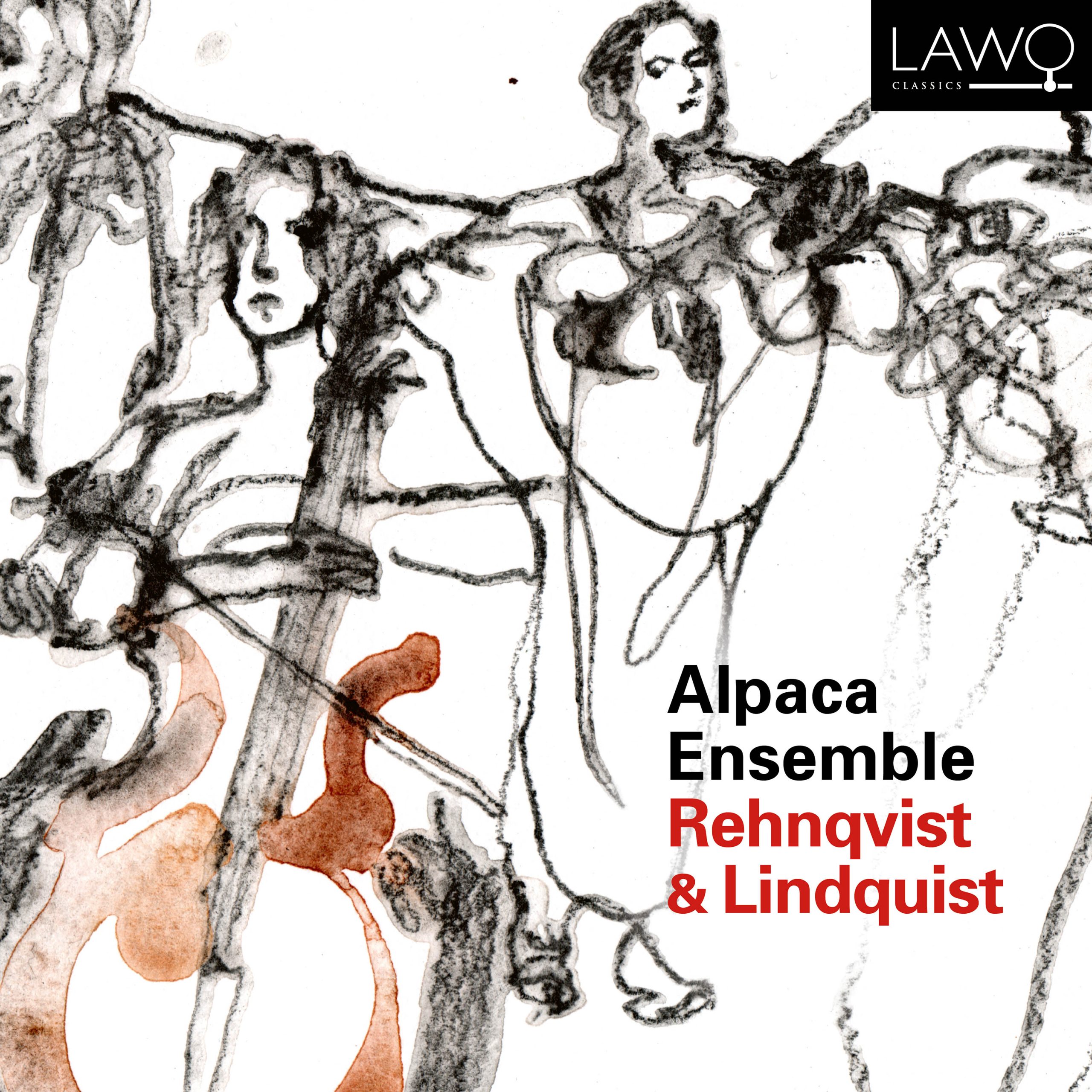
Karin Rehnqvist | Ellen Lindquist
Rehnqvist & Lindquist
Alpaca Ensemble (Contemporary music ensemble)
Stream & download
Tracks
Karin Rehnqvist (*1957)
In Orbit - a moving quartet
Ellen Lindquist (*1970)
Credits
- Performer
- Sigrid Elisabeth Stang (Violin) | Marianne Baudouin Lie (Cello) | Else Bø (Piano) | Rolf Borch (Clarinet)
- Contemporary music ensemble
- Alpaca Ensemble
- Composer
- Karin Rehnqvist | Ellen Lindquist
- Producer
- Vegard Landaas
- Engineer
- Thomas Wolden
- Editing
- Vegard Landaas
- Mastering
- Thomas Wolden
- Liner notes
- Karin Rehnqvist | Ellen Lindquist
- English translation
- Jim Skurdall
- Executive producer
- Vegard Landaas
- Booklet editor
- Hege Wolleng
- PR
- Camilla Momkvist-Skau
- Cover photo
- Anna-Julia Granberg
- Artist photo
- Alpaca Ensemble by Ronny Danielsen | Alpaca Ensemble by Heidi Rossow | Alpaca Ensemble by Ester Sorri | Alpaca Ensemble by Elise Maalo
- Design
- Anna-Julia Granberg | Blunderbuss
- Recording location
- Newtone Studio, Oslo
- Recording country
- Norway
- Recording year
- 2019
- Recording dates
- 11.12.2019 | 12.12.2019 | 13.12.2019
- Original source
- DXD (352.8 kHz, 24 bit)
- Discs / tracks
- 1 disc | 12 tracks
- Produced with support from
- Arts and Culture Norway | Fund for Performing Artists | Norwegian Society of Composers | Creo – The Union for Arts and Culture | Trondheim Municipality
- Release year
- 2021
- Label
- LAWO Classics
- Duration
- 61:03
- EAN
- 7090020182469
- ISRC
- NOEHX2115010/120
Booklet text
This recording is a result of Alpaca Ensemble's close collaboration with two living composers. The music of both of them is related by way of its contact with nature, though they both weave their sonic universes together in contrasting ways.
In the music of KARIN REHNQVIST, esoterism, mythicism and tradition are fused together with modernism's propensity for resistance and estrangement. At the same time, its dialogue with traditional music, liturgy, rituals and folklore and adherence to vocal musical practice, allows the music to break into open forms and address the listener very directly. The music is intrinsically linked to voices, language, movement and the body.
This ability to simultaneously resist and include also characterises Rehnqvist as a socially engaged artist. She was already a trained music educator when she started composing and has written several major works involving young performers. She set up the non-profit organisation KVAST, the Swedish Association of Women Composers, and since 2009 she has been Professor of Composition at the Royal College of Music in Stockholm. She has an extensive oeuvre consisting of over a hundred compositions.
The collaboration between Alpaca Ensemble and Karin Rehnqvist dates back to when the musicians in the ensemble heard her work for piano trio Beginning / Begynnelsen (2003) on the radio, and decided to rehearse it and take it on tour. Two years later they invited Rehnqvist to Trondheim, where she staged her children's opera Sötskolan / Beauty School (1999) — a self-described "horror" opera for young performers. The primary work for this recording, the quartet I banor / In Orbit (2017) was composed especially for Alpaca.
This record also contains the 2017 work Långt borta och nära / Far and near for solo clarinet and E-bow, where Rehnqvist builds on material from her clarinet concerto.
Several of Rehnqvist's works utilise the vocal technique of kulning, a mixture of shouting and singing that can be found both in Swedish and Norwegian traditional music. In Norwegian it is called laling or lokk. Kulning was used to communicate with people and animals over long distances outdoors. A similar sense of open space and distance is also evoked in the work In Orbit, which opens up large, serene expanses around penetrative instrumental lines and ornaments. This openness is also reflected in the way the music is composed. The outer movements are without barlines, so the musicians can decide the phrasing and tempo independently, within defined meeting points. Three movements and an epilogue are sewn together by short, airy sequences called transit.
The work's first motif slowly unfolds as if a melody were floating over the horizon, only to disappear, then return and emerge closer. The line is simple but focused in a way that invites the listener to follow it like a path through an open landscape. The inspiration of vocal music permeates into the instrumental parts, in organic phrasing and form, and a harmony that allows for quarter tones. In such a context, the keys of the grand piano would become consonants and contours of sorts, but eventually In Orbit moves into the actual body of the grand piano, rendering it a veritable string instrument. The composer's sense of tongue in cheek is also evident when the large instrument is also accompanied by the crisp, bright sound of a toy piano. The title In Orbit relates to celestial bodies and the music of the spheres. The motion of the planets in orbit also unfolds visually in the stage performance. In the live version, the work opens with the violinist moving through the hall and up on stage, thus connecting the listeners to the performers. During the course of the work, the performers change positions on stage according to a system described in the score. The subtitle "a quartet in motion" reflects how the composer is also constantly on the move.
Långt borta och nära / Far and near (2017) for solo clarinet and e-bow also intentionally uses space as a musical variable in a way that cannot be faithfully reproduced on a CD recording. The score suggests that the piece be "played preferably in darkness, and from an unexpected place in the room". The phrasing and ornamentation conveys a clear intention to narrate. In a recent podcast interview with the composer, you could hear Rehnqvist singing several times, either improvising a language that was unlike any other language, or in order to explain how an instrumental phrase could begin as a vocal improvisation. For Rehnqvist, prosody is never deliberately complex, unlike one of her teachers, British composer Brian Ferneyhough. Rehnqvist allows the unpredictable into her works by other means: keeping the listener engaged by trimming down and daring to wait. The alternation between long lines and more brisk ornaments in Långt borta och nära / Far and near sounds like starry writings in a cold sky.
In the music of ELLEN LINDQUIST, individual instruments and parts merge into large, sonorous landscapes. The composer often works in tandem with other art forms such as dance, poetry, performance and music theatre. In these interdisciplinary constellations, her music is allowed to insist on what is particular to instrumental music compared to other art forms, on its abstract, permeable qualities, which those other disciplines can approach, but never really achieve.
Of Dutch-American background, Lindquist has collaborated with Alpaca Ensemble since she moved to Norway in 2012, and the ensemble has both commissioned new works and performed some of her previously composed works. These sessions contain four earlier works that have been reworked for the ensemble. They share a concentrated format which connects them to each other almost as if they were four movements, even though the different pieces were written over a long period of time.
Groundings for piano trio (2004) revolves around a base or central note, departing from it with the smallest possible interval in music of equal temperament, the semitone. Around this lingering circular movement, the music grows with sonorous, open intervals and clear, small ornaments. Occasionally one of the instruments breaks out into an effervescent flurry. The composer herself writes that the piece "reflects the ongoing cycles of 'groundedness' and 'ungroundedness' that we as human beings all face throughout our lives."
The cello solo Gaia (1998) was originally commissioned by the dancer and choreographer Andrea Olsen. The solo was developed in a collective process whereby the music, dance and choreography were all allowed to inform each other as they evolved over the course of a month or so. At the same time, the choreographer also wrote the text Something Heard, which is included elsewhere in this booklet. In Greek mythology, Gaia was the goddess who gave birth to the Earth and all living things, and in the choreographer's text the earth and hunger are written together with birds, wings, myths and dreams. In the music, three slower, more reflective parts provide a frame for two others which are faster and more radiant. The first version of Gaia was written for violin and was later reworked for cello and performed again with a video installation. The version on this disc has been edited for the cellist in Alpaca.
Somniloquy (2010), named after the act of talking in one's sleep, develops from an initial sound of pure breathing. Here too, the music moves in semitone steps, but this time faster and more energetically. The composer writes of sleep as an opening to the subconscious, which is evidently not merely a peaceful state, as the clarinet occasionally breaks out into more unpleasant, nightmarish shrieks. The piece has a cyclical form wherein the energy levels rise and fall just as a slow breath would. The recording ends with the piano piece Pastorale (1991), an earlier work which, as the title would suggest, echoes a landscape, open and with clear colours.
— Hild Borchgrevink · English translation: Paul Holden