
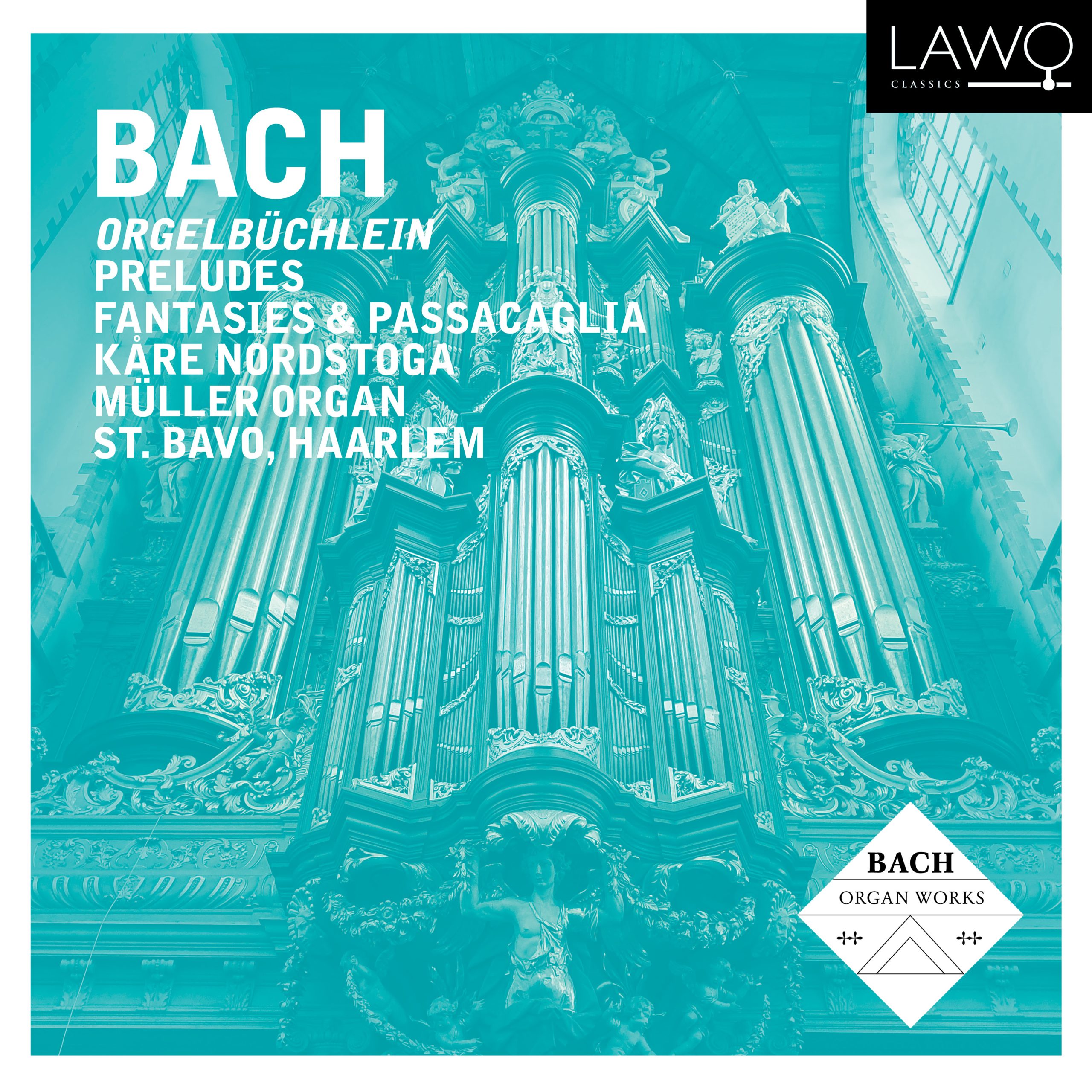
Bach: Orgelbüchlein, Preludes, Fantasies & Passacaglia – Müller Organ St. Bavo Haarlem
Kåre Nordstoga (Organ)
THE LITTLE ORGAN BOOK
On CD 11 and 12 of Kåre Nordstoga’s series of recordings of Johann Sebastian Bach’s complete organ works the listener is introduced to “Orgelbüchlein”. In this familiar collection of 45 organ chorales the composer has, in Albert Schweitzer’s view, realised the ideal of the chorale prelude. Each of the small miniatures is an elaborate chorale harmonization, in which every single motif and every single polyphonic idea seems to have meaning related to the hymn’s content.
We hear in addition some of the large preludes and fugues, together with the monumental “Fantasia and Fuge in G minor” and “Passacaglia in C minor”. The release was recorded on the famous historic Müller organ in Haarlem, Netherlands. At the time of its completion in 1738 it was the world’s largest organ, which both Mozart and Handel are known to have played. All previous releases in this series of Nordstoga’s recordings of Bach on historic organs of Europe have received fine reviews both in Norway and abroad.
Listen
Tracks
Disc 1
Johann Sebastian Bach (1685–1750)
Fantasia et Fuga in G, BWV 542
Fantasia et Fuga in C, BWV 537
Praeludium et Fuga in G, BWV 541
Praeludium et Fuga in D, BWV 539
Praeludium et Fuga in C, BWV 547
Disc 2
Credits
- Performer
- Kåre Nordstoga (Organ)
- Composer
- Johann Sebastian Bach
- Producer
- Vegard Landaas
- Engineer
- Thomas Wolden
- Editing
- Vegard Landaas
- Mastering
- Thomas Wolden
- Liner notes
- Torkil Baden
- English translation
- Jim Skurdall
- Executive producer
- Vegard Landaas
- Booklet editor
- Hege Wolleng
- PR
- Camilla Momkvist-Skau
- Cover photo
- Thomas Wolden
- Artist photo
- Kåre Nordstoga by Anna-Julia Granberg
- Design
- Anna-Julia Granberg | Blunderbuss
- Recording location
- St. Bavokerk (Grote Kerk), Haarlem
- Recording country
- Germany
- Recording year
- 2019
- Recording dates
- 10.09.2019 | 11.09.2019 | 12.09.2019
- Original source
- DXD (352.8 kHz, 24 bit)
- Series
- Bach Organ Works
- Discs / tracks
- 2 discs | 56 tracks
- Release year
- 2021
- Label
- LAWO Classics
- Duration
- 80:01
- EAN
- 7090020182339
- ISRC
- NOEHX2102010/560
Booklet text
Little Organ Book, in which a beginning organist is given instruction in performing a chorale in a multitude of ways, and also in mastering the use of the pedal, since in the chorales offered here the pedal is used to its full extent. Glory be to God alone, thereby may we our knowledge hone.
THE LITTLE ORGAN BOOK
This collection, one of the most familiar and beloved of all Bach's organ music, was conceived under dramatic circumstances. Difficult working conditions, a dismissal, and even the haunting prospect of prison form the backdrop of the 45 organ chorales and chorale preludes.
Following the instructive title page of the manuscript, which today is kept in the Staatsbibliothek in Berlin, there are many empty pages among the 45 (+ 1 variant = 46) pages of compositions. The plan was to write more than three times as many, a total of 164, and the titles are already written at the top of the empty pages. Why did he not complete them?
Bach scholars disagree as usual on the dating, but they all place this work of 92 sheets in the period 1708–1717. Bach served at that time as concertmaster, chamber musician and court organist in Weimar. He may have begun working on his Orgelbüchlein early in this Weimar period. He had brought along music that could be used from his previous positions as organist in Arnstadt and Mühlhausen.
"Helft mir" BWV 613 is the last one he composed and added in the late 1720s in Leipzig. He may have intended to complete the collection at that time, but other projects with more extensive chorale works perhaps rendered the short format in Orgelbüchlein less challenging.
The 164 titles are a journey through the church year, and the sequence is the same as found in the hymnals then and now. We are led through Advent, Christmas, New Year's, Passion, Easter, Ascension, Pentecost, Holy Trinity, Feast of Saint John, and other Church red-letter days. The last part, which is less floridly composed, belongs to "cantica omne tempore", hymns for a variety of occasions, such as catechism, thanksgiving, Christian life, succession, the Church, war and peace, judgement, matins, vespers and grace. (The only piece composed in the section "Christliches Leben" is one of the most often played and most beautiful, "Ich ruf zu dir" BWV 639.)
QUARREL AT THE CASTLE
The organ bench in Weimar was in the loft of the castle church, above the third floor, and it was a long way down to the altar. Wilhelm Ernst, Duke of Saxe-Weimar, was a demanding employer. To his great dismay, Bach was in the habit of spending time with the Duke's nephews, two young princes. He taught them instrumental skills and composition, and a result of this is Bach's arrangements of two orchestral works of Prince Johann Ernst. Under Bach's hand they became the organ concertos in G major and C major.
This was perhaps the reason that Bach did not receive the expected promotion to kapellmeister in 1716. The rebuff was the straw that broke the camel's back, and he made plans to leave. He received an attractive offer to serve as kapellmeister at the court in Köthen, but when he dared to submit his resignation, the Duke became enraged. Bach was jailed on 6 November 1717 for "too stubbornly forcing the issue of his dismissal". On 2 December he was "freed from arrest by the court secretary with notice of his unfavourable discharge".
It was an unusual Advent for the court organist. There is every reason to believe that the resourceful Bach did not sit quietly twiddling his thumbs during the next four weeks. Did he perhaps receive staff paper and continue working on his Orgelbüchlein? He had many blank pages to fill.
These chorale arrangements are in small format. Kåre Nordstoga's renditions of the shortest ones last less than one minute each, and most are under three minutes. In most of the chorales, the melody, embellished to a greater or lesser extent, lies in the upper part. It then appears in short imitations or complete counterpoint in other parts.
The harmonization is, as always with Bach, so lush that it can bear comparison with the Romanticists fifty to a hundred years later. Many observers, not least Albert Schweitzer, have over the years found musical effects full of text interpretation and symbolism. There is, naturally enough, a luminous quality to a text about Christmas angels, while a text about Good Friday is in a five-part movement, perhaps with a view to the five wounds of Jesus. Adam's fall from grace is illustrated with falling motion and large downward leaps. Bach always grasps and enriches the basic qualities of the text and melody in such a way as to turn them into gems each and every one, even the shortest among them.
What did Bach intend with his Orgelbüchlein?
It is possible that as court organist he initially intended to use it for his own purposes in the regular worship services at the castle church in Weimar. The booklet was arranged so that one did not have to turn pages, and there are a few notes for practical use. But the project grew.
The title page indicates that it is an instructional book, but the title was added some years later. Bach was an eminent teacher of composition, and a CV showing one had studied with him was a good qualification. Especially in his last years in Leipzig he had a large group of students who could boast of being Bach pupils. Recent research (Koska 2019) has recorded 50 private pupils in Leipzig and reveals an additional 38 names of possible pupils.
Orgelbüchlein has become a treasure chest for posterity to dip into. Mendelssohn, Reger and Busoni wrote piano editions. For Schumann, Brahms and Reger and numerous composers up to our own time, in Norway as well, the Orgelbüchlein style has been an inspiration in chorale style with its concentrated elaboration in melody, polyphony and harmony.
Bach elevates the most important hymns, the same ones often used in church life today. "Nun komm, der Heiden Heiland", "Puer natus in Bethlehem", "Vom Himmel hoch", "In dulci jubilo", "O Lamm Gottes", "Christ lag in Todesbanden", "Komm, Gott, Schöpfer, heiliger Geist", and "Liebster Jesu, wir sind hier" are the most familiar. He adds new depth to the classic hymn repertoire through an ingenious union of text and opulent musical elaboration.
FIVE PRELUDES / FANTASIAS AND FUGUE
Fantasia and Fugue in C minor BWV 537: The choice of C minor suggests a mood of sorrow that is intensified by the ascending sixth, as in "Erbarme dich" from the St Matthew Passion. The fugue theme's ascending half-tone step following the repetitive notes in the opening can be regarded as a resurrection motif that triumphs over sorrow (Hoffmann). That we even have the fugue today is due to the fact that the manuscript was used as wrapping paper, but was salvaged at the last moment!
Prelude and Fugue in D minor BWV 539: The introductory prelude is for the manual. Bach liked the spirited fugue so well that he used it three times, including in the violin sonata in G minor and the fugue for lute in G minor.
Prelude and Fugue in G major BWV 541: In 1733 the 23-year-old Wilhelm Friedemann wished to be hired as organist in Dresden. For his audition in St. Sophia's Church, papa Johann Sebastian wrote out a copy of this work so that his eldest son could make a good impression. Not so strange that he got the position with his performance of this lively work in which the choice of the key of G major generates a positive mood. Father Bach himself had played it in a concert in Dresden two years earlier.
Fantasia and Fugue in G minor BWV 542: In 1720, while Bach was employed at the castle in Köthen, he felt the desire to work in the church again. He applied for a position at St. James Church in Hamburg, and even though he played this virtuosic work at his audition, he was not hired. (A godsend for Leipzig three years later!)
The passionate and harmonically daring fantasia with two meditative sections lives its own life before connecting with the fugue. The cheerful fugue theme is a traditional folk tune from the Netherlands, "Ik ben gegroet van" ("I am greeted by").
Bach's biographer Spitta believes that the first performance in Hamburg was an improvisation on the theme and that the choice of a Dutch melody was a homage to Hamburg organist Adam Reinken, whom Bach admired and knew.
The pedal part is demanding, and a copy of the piece contains a note, possibly a quote from son Carl Phillip Emanuel, reading: "The very best pedal part by Herr Johann Sebastian Bach." It is not without reason that the work is also referred to as "The Great Fantasy and Fugue".
Prelude and Fugue in C major BWV 547: The prelude sways upward in 9/8 time signature that Albert Schweitzer called "majestic monotony". The fugue explores the manual in a four-part movement before the pedal makes a grand entrance, adding yet another part and creating one of Bach's few five-part fugues. The advanced style makes this one of Bach's late organ works, from the 1740s in Leipzig.
PASSACAGLIA BWV 582
That Bach was a composer with international orientation is shown by his choice of a French theme as the basis of his greatest organ work. (There are some who believe that it was written for a pedal harpsichord.) André Raison was an organist in Paris at the time of the Sun King, and when Bach came across a mass from 1688, he fell for the theme, which aspires determinedly upwards, originally in G minor.
The work was composed before 1714, which is the date of the oldest manuscript. Some (Zehnder 1990) point to a figuration technique from Bach's first stay in Weimar, related to the beginning of Orgelbüchlein, perhaps around 1713.
Buxtehude lurks in the background of a work of variations of this kind, and Bach had strong memories of his journey to Lübeck eight years earlier. He had at that time stretched a four-week leave of absence into a four-month stay without permission, in order to experience the musical life flourishing around Buxtehude.
But the pupil surpassed his master. Bach's theme comprises eight bars, while Buxtehude usually used four-bar themes. Bach is more complex with varied rhythm and with an opulent latticework of upper parts. After twenty variations, he crowns the work in his original manner with a fugue.
Many (including Marie-Claire Alain) have found theological symbolism in this instrumental work, such as Advent in the middle of the passacaglia through a quote from Bach's arrangement of "Nun komm, der Heiden Heiland". Others believe that the old-fashioned passacaglia represents the Old Testament and the innovative fugue the New Testament. The first part can be seen as the Ten Commandments with the ten repetitions of the passacaglia theme. The Neapolitan sixth chord toward the end (at 14' in Nordstoga's recording) stands for the crucifixion prior to the liberating major-mode conclusion. The main theme appears 21 times in the passacaglia and inverted 12 times in the fugue, all together 33 times, equal to the number of years Jesus lived. 21 can be seen as 3 x 7, the Trinity and the perfect number 7, including in Revelations 4,5: "The seven spirits of God".
Also musically the work has inspired new thinking. By 1864 there was already a first orchestral arrangement of the passacaglia, and then came Stokowski, Respighi, Ormandy, and many others. Reger created a version for two pianos, and the author Jean Cocteau and choreographer Roland Petit used it in the ballet "The Young Man and Death" (Paris 1946). In it, this passacaglia of all passacaglias ends with Death as a woman leading the man high above the rooftops of Paris — there where Bach found his theme!
— Notes: Torkil Baden · English translation: Jim Skurdall
Biographies
Kåre Nordstoga
Kåre Nordstoga (b. 1954) studied at the Norwegian Academy of Music under Søren Gangfløt, Bjørn Boysen and Kaare Ørnung, among others. Following his debut concert in 1978, he continued his studies under David Sanger in London, and was for a time organist at Ullern Church before coming to Oslo Cathedral in 1984. He has also been associated with the Norwegian Academy of Music, where he was appointed professor in 1994.
As cathedral organist at Oslo Cathedral, Nordstoga frequently performs a large repertoire, which has included two popular concert series with Bach's complete organ works. His recordings include the organ music of Bach, Brahms, Franck, Widor and Liszt, all of Bach's violin sonatas recorded on the cathedral's chancel organ in collaboration with violinist Geir Inge Lotsberg, as well as several recordings of Norwegian organ music. Nordstoga is an active concert organist.
In recent years he has been soloist with the symphony orchestras of Oslo, Bergen and Trondheim, and he has been invited to organ festivals abroad, including Aarhus, Notre Dame in Paris, and the Musashino Cultural Center in Tokyo. In 2006 he was awarded the Lindeman Prize for his active contribution to musical life.
Johann Sebastian Bach
Johann Sebastian Bach was born on 21 March 1685 in Eisenach into an extensive family of musicians. Orphaned by the age of ten, he was raised by his elder brother Johann Christoph in Ohrdruf before receiving a scholarship to the Michaelisschule in Lüneburg in 1700. His first appointment, in 1703, was as a court violinist to Duke Johann Ernst of Saxe-Weimar, but within months he became organist at the Neue Kirche in Arnstadt, composing his first significant organ works and, in 1705, travelling to Lübeck to study with Dietrich Buxtehude. In 1707 he became organist of St Blasius's Church in Mühlhausen and married his cousin Maria Barbara; the following year he entered the service of Duke Wilhelm Ernst in Weimar as court organist, rising to concertmaster in 1714 and building a reputation as an organ virtuoso.
In 1717 Prince Leopold of Anhalt-Köthen appointed him Hofkapellmeister, a productive period that yielded much of his instrumental output, including violin concertos and orchestral suites, though it was also marked by the death of his wife in 1720; he remarried the following year to Anna Magdalena Wilcke. In 1723 Bach was elected Thomaskantor in Leipzig, a post he held for the rest of his life, composing there his great vocal works, including the St John and St Matthew Passions and over two hundred cantatas, until his death on 28 July 1750.