
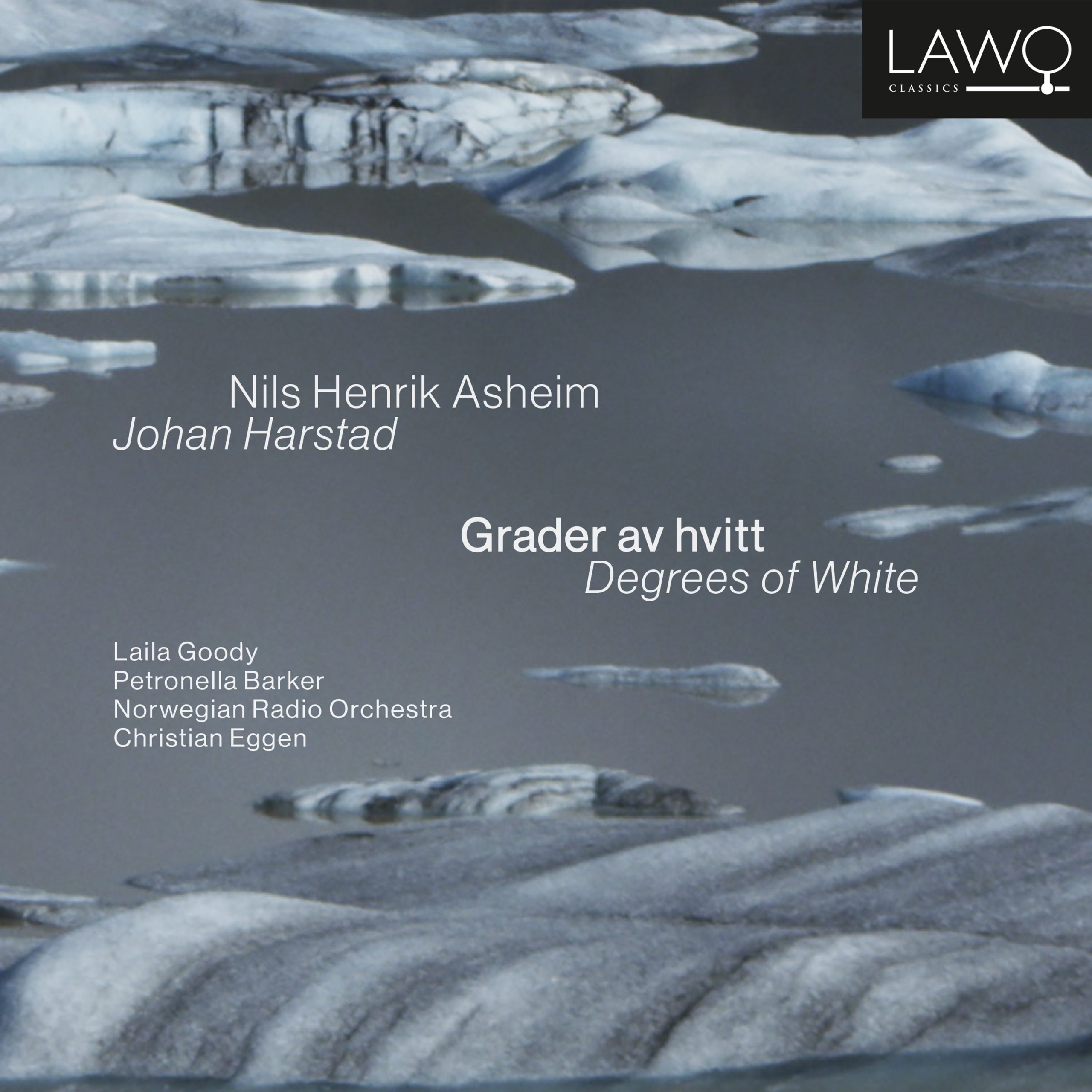
Grader av hvitt / Degrees of White
Laila Goody (Narrator) | Petronella Barker (Narrator) | Norwegian Radio Orchestra (Orchestra) | Christian Eggen (Conductor)
Stream & download
Tracks
Nils Henrik Asheim (*1960)
Grader av hvitt
Christian Eggen (conductor) | Norwegian Radio Orchestra | Emery Cardas | Harald Aadland | Laila Goody | Willy Aase | Jon Wien Sønstebø
Degrees of White
Christian Eggen (conductor) | Norwegian Radio Orchestra | Emery Cardas | Harald Aadland | Petronella Barker | Willy Aase | Jon Wien Sønstebø
Credits
- Conductor
- Christian Eggen
- Performer
- Harald Aadland (Violin) | Willy Aase (Violin) | Jon Wien Sønstebø (Viola) | Emery Cardas (Cello) | Lasse Marhaug | Laila Goody (Narrator) | Petronella Barker (Narrator)
- Orchestra (unspecified)
- Norwegian Radio Orchestra
- Composer
- Nils Henrik Asheim
- Producer
- Vegard Landaas
- Engineer
- Thomas Wolden
- Editing
- Vegard Landaas
- Mastering
- Thomas Wolden
- Liner notes
- Nils Henrik Asheim | Johan Harstad
- English translation
- Jim Skurdall
- Executive producer
- Vegard Landaas
- Booklet editor
- Hege Wolleng
- PR
- Camilla Momkvist-Skau
- Artist photo
- Laila Goody by Line Owren Fotografi | Laila Goody by Marius Arnesen | Laila Goody by Oyvind Eide | Laila Goody by John Erik Riley CC | Laila Goody by Gisle Bjorneby
- Session photo
- Thomas Wolden
- Design
- Anette L’orange | Blunderbuss
- Recording location
- NRK Radio Concert Hall, Oslo | Notam, Oslo
- Recording country
- Norway
- Recording year
- 2017–2019
- Recording dates
- 20.02.2017 | 21.02.2017 | 22.02.2017 | 23.02.2017 | 22.02.2018 | 14.05.2019
- Original source
- DXD (352.8 kHz, 24 bit)
- Discs / tracks
- 1 disc | 8 tracks
- Produced with support from
- Fund for Performing Artists | Norwegian Society of Composers | Stavanger Municipality
- Release year
- 2020
- Label
- LAWO Classics
- Duration
- 57:32
- EAN
- 7090020182285
- ISRC
- NOEHX2015010/80
Booklet text
In his orchestral work Degrees of White (2006), composer Nils Henrik Asheim invites an author, an actor, and a noise musician into the symphony orchestra.
"I wanted to work with (or against) a stream of text and thought of this text as its own sound, close to the soundscape," Asheim writes on his website. He commissioned a text from author Johan Harstad, who then wrote Degrees of White, a script that vacillates between the novel and the stage. In the preface to his book Bsides (2008) where the text is published, Harstad writes about how he consciously "...searches for a positive side to monotony, forcing the prose to become drama and forcing the drama to retain an element of prose[.]"
The narrator in the text is a woman, and in retrospect, we understand that she has long fantasized about freezing to death. In the present time of the text, she is skiing across Greenland with her husband, and the reader follows her through an inner monologue. She declares early on that she has removed her coat. "And I am beginning to freeze to death. That's the kind of thing I know."
So we're dealing with a human being who is apparently freezing to death while she is talking to us. At first glance, the woman's emotional frigidity appears even more biting than the meteorological one. Eventually it becomes clear that she also took her husband's coat. She's abandoned him and their tent without him taking notice and lets us know that it's about time – she should have left long ago, maybe even before they had children.
The inhospitable surroundings open up a literary productive state of doubt on the extent to which we can believe in the woman telling the story. At one point, she says she doesn't know why she left. She then tells the reader that she will turn around and make her way back. But for how long does she have control over the story? At what point does the frostbite affect how the story is told?
The orchestral work allows the frost and the stark whiteness to be expressed in several ways. The work consists of four parts. The color white is explicitly introduced early in the first section, when a recording of the actor's voice complements the small outbursts in the orchestra, with the words "White. In the white." Within the orchestral landscape we find the winds placed into three groups, each containing both woodwinds and brass, creating a sound more uniform across the room. A quartet, plucked out of the string section, lies far ahead within the soundscape, with musical material consisting of short, pale white tones and friction sounds.
The color white also serves as a motif in the text, where the woman tells us about a wedding dress "so white that I almost disappeared." We also learn that Greenland sends off blocks of 25,000 year old ice — "encapsulated air from a time when no human being yet walked the earth" — for exclusive ice cubes for Japanese bars. Variations of this story return as a refrain throughout the work.
The percussion equipment is supplemented with Styrofoam boxes filled with gravel, shells, and glass, plus loose Styrofoam pellets — materials which, when set in motion, bring nature, frost, and a squeaky discomfort into the musical equation. These materials also produce soundscapes that build a bridge between the orchestra's score and the electronic soundtracks created by noise musician and composer Lasse Marhaug. His soundtracks also interpret the color white with various noise qualities such as radio noise, sinusoidal pure tones, and crackling or rounder, foggy drones that partly melt into and partly protrude from the orchestral sound.
The work opens with greyish-white, electronic noise and sounds of falling gravel, produced by the percussionists slowly digging into it with their hands, before the orchestra then takes over with what is conceivable as an exposition. Here groups of short, sudden eruptions alternate with translucent stretches of sound that culminate in a metallic resonance. Many of the eruptions are also falling, and this fall returns as an idea through the movement. Throughout both the first and second sections, the winds constantly return to these small, hollow figures with longer and longer pauses between – as if the movement strives to hide something from us, to maintain control, but occasionally must vent, must release some tones and give us stolen glimpses into the drama to come. Towards the end of the first part, the figures are more and more slippery. In the orchestral strings, the energy bubbles more openly, like water under the ice, while the overall impression is still static.
Excerpts from Johan Harstad's text have been placed into the hands of an actor who shares the stage with the orchestra. In some places she speaks alone, but often the orchestra also interferes with her stream of thought, like a kind of enveloping nature that disturbs and at times overwhelms her. In the long sections, the orchestra also takes over the narrative, and although the music here is quite condensed, these parts also function as a space of reflection for the listener.
Harstad inserts sober facts into the narrator's inner monologue. A wristwatch measures the world – sunrise and sunset, high tide, the age of the moon. The woman lists what happens in the cells of a human body as it cools down. Behind these semi-scientific texts, Asheim's music also becomes noticeably drier, more percussive, and transparent. In the first section, the perforated rhythms move out into the wooden instruments of the percussion. This somehow more objective material propels the music out to a cosmic, deterministic perspective where people and their emotions become paltry and irrelevant. At the same time though, the absurd, distant, and indifferent are reinforced in the narrator's attitude towards her surroundings.
As the frost gnaws through our narrator's skin, the soundscapes become more intrusively present. Throughout the second part, the winds play a mobile form, each at an individual pace. One section should be stretched towards the slightly untuned, and the segment ends in a wild and furious fortissimo. The adjacent and acute within the string quartet format is set against more viscous, lingering constructions in the orchestra, and the winds turn in unforeseen jolts.
These weighty sound parts can conjure associations to the movement we find in heavy masses of ice, to restricted blood flow, to how long it actually takes to freeze to death. During the third part, the woman's voice on stage is infiltrated more and more by fragments of her own voice from a recording, entering into her speech like confused memories. Maybe the narrator at this point is so numb that her language is about to disappear, while her body keeps going on for a while longer? Musically, the sections that point toward a conclusion are interrupted by ones that energetically move on. At one point, the music thins out into dry, wooden sounds, but suddenly a cohesive gust of wind brings the entire orchestra back to life. An interval of a fourth spins like a sort of skewed siren through several layers of strings, winds, and percussion along with electronics and a steady pulse in the bass drum. Towards the end of the fourth part, even the pulse disappears, and the narrator's voice dissolves into single words and sentence fragments before the gray-white noise from the beginning cuts in. The tempo becomes even slower and a choral-like row of chords, which may have been in the background all along, emerges to the surface. The orchestra floats away in something reminiscent of a prolonged chorale, whose last chord hangs on the air, undissolved.
— Notes: Hild Borchgrevink · English translation: Leann Currie