
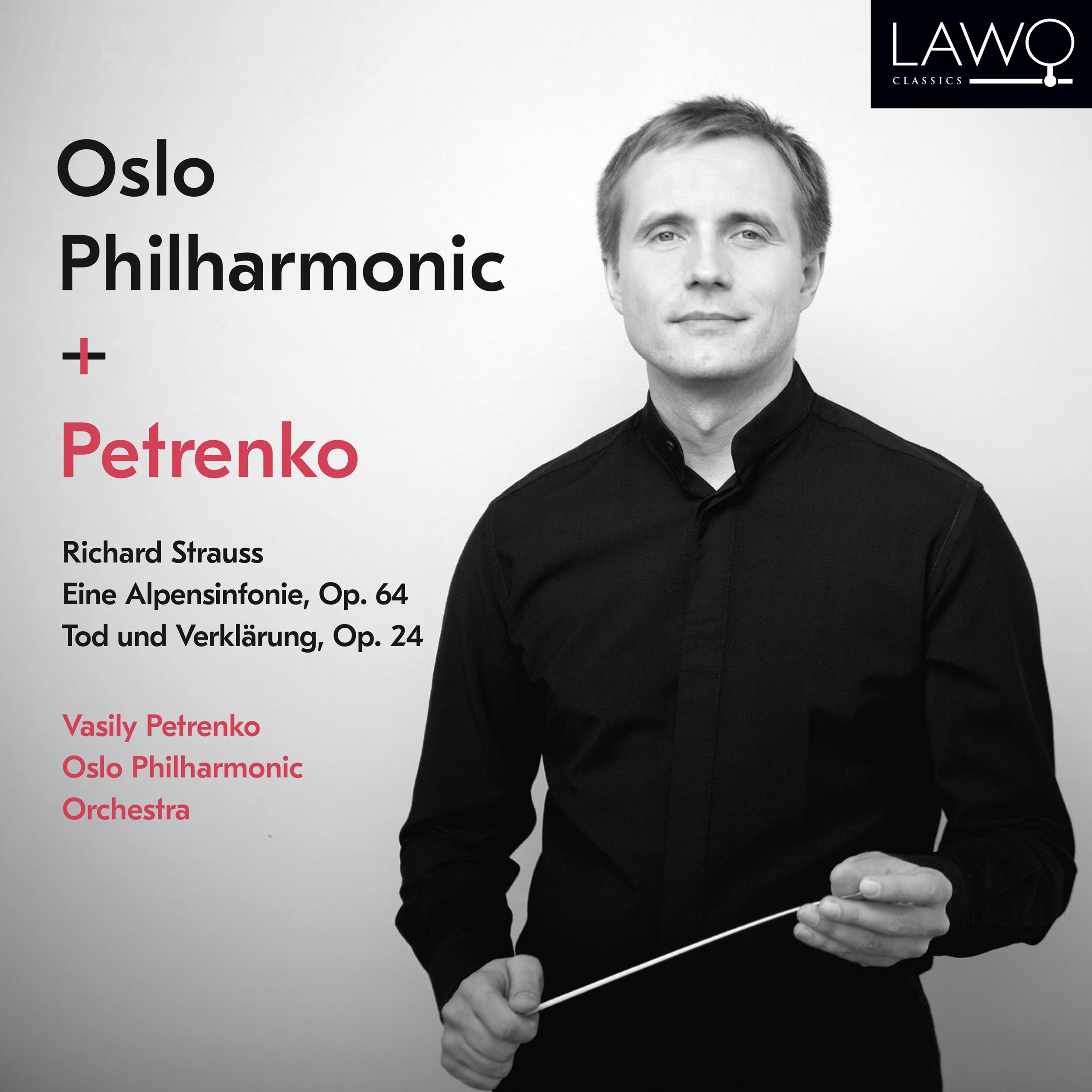
Richard Strauss – Eine Alpensinfonie, Op. 64 / Tod und Verklärung, Op. 24
Oslo Philharmonic Orchestra (Symphony orchestra) | Vasily Petrenko (Conductor)
Stream & download
Tracks
Richard Strauss (1864–1949)
Eine Alpensinfonie, Op. 64, TrV 233
Reviews
Petrenko’s is a vivid realisation of these various states, the Oslo Phil responsive to the moods and their swings.…
Show more Show less
Petrenko’s is a vivid realisation of these various states, the Oslo Phil responsive to the moods and their swings. [...] If Petrenko is more scenic than probing, with the Oslo Phil in top form and sound-quality that marries natural space (not least for the off-stage horns, Strauss so extravagant), clarity and a wide dynamic range, this is a recommendable version in terms of atmosphere and suggestion, not least the climber being intimidated by the height to be conquered, making the arrival at the Summit all the more significant. Downwards, the Storm is of elemental vibrancy and later eloquences are not glossed over. [...] I am nevertheless pleased to have Petrenko’s considered view of and from the mountain. Peak listening on Lawo Classics LWC1192.
 Classical Source | 26.04.2020
Read at Classical Source →
[...] Again, Petrenko is alert to detail here, but also the essential trajectory of Strauss’ story-telling arc.…
Show more Show less
[...] Again, Petrenko is alert to detail here, but also the essential trajectory of Strauss’ story-telling arc. Highly recommended.
 Nicks Classical Notes | 13.07.2020
Read at Nicks Classical Notes →
Credits
- Conductor
- Vasily Petrenko
- Performer
- Elise Båtnes (Violin)
- Symphony orchestra
- Oslo Philharmonic Orchestra
- Composer
- Richard Strauss
- Producer
- Andrew Walton
- Engineer
- Vegard Landaas | Thomas Wolden
- Mastering
- Thomas Wolden
- English translation
- Jim Skurdall
- Executive producer
- Vegard Landaas
- Booklet editor
- Hege Wolleng
- PR
- Camilla Momkvist-Skau
- Cover photo
- Anna-Julia Granberg
- Artist photo
- Oslo Philharmonic Orchestra by CF Wesenberg
- Session photo
- Fred-Olav Vatne
- Design
- Anna-Julia Granberg | Blunderbuss
- Recording location
- Oslo Concert Hall
- Recording country
- Norway
- Recording year
- 2017
- Recording dates
- 17.10.2017 | 18.10.2017 | 19.10.2017 | 20.10.2017 | 21.10.2017 | 29.11.2017 | 30.11.2017 | 01.12.2017
- Original source
- DXD (352.8 kHz, 24 bit)
- Discs / tracks
- 1 disc | 23 tracks
- Release year
- 2020
- Label
- LAWO Classics
- Duration
- 75:44
- EAN
- 7090020182148
- ISRC
- NOEHX2001010/230
Video
Booklet text
Richard Strauss wasn't afraid to engage with death, philosophically or physically. Asked what plans he had for the future by a British journalist in 1946, the tired composer responded unforgettably: 'to die, of course.' He reprised that caustic wit on his actual deathbed three years later, turning to his daughter-in-law Alice with the remark 'dying is just the way I composed it in Death and Transfiguration.'
He had composed that score sixty years earlier when the world, and Strauss's career, looked rather different. Before becoming the pre-eminent German opera composer of the twentieth century — and long before the rise of Nazism destroyed the infrastructure Germany's operatic culture had amassed — Strauss had written a string of glistening orchestral scores that may not have pioneered the genre of the 'tone poem' but certainly perfected it.
Many had stood in Strauss's way. In his youth, a brigade of musicians and theorists decreed that 'programme music', in which a story or philosophy was recounted without recourse to words, should be avoided by serious composers. Among the naysayers was the composer's horn-playing father Franz, who forbade his son from reading any scores other than those of the pure classicists and their successors (Mozart, Beethoven and Brahms). It was an orchestral violinist, Alexander Ritter, who urged Strauss to break free of such dusty ideologies — to search for a new language far removed from Mendelssohn's and Schumann's, one adumbrated instead by Franz Liszt.
Strauss's early tone poems were a product of their time and place: a Germany in thrall to new philosophies (from the likes of Nietzsche) and new sciences (from the likes of Sigmund Freud). In 1888, Strauss saw Wagner's Tristan und Isolde in Bologna, an opera full to bursting with ideas about transcendence and transfiguration and with a highly emotive musical language to match (unsurprisingly, Wagner was there on the blacklist handed down to Strauss).
After the success of the swashbuckling tone poem Don Juan that effectively birthed Strauss's career [LWC1184] in 1889, the composer began to discuss a new tone poem with Ritter. In common with An Alpine Symphony, this next outing would not use an existing literary or philosophical source but one dreamed-up by Strauss himself and with more than a little help from Ritter. In fact, it was the violinist who outlined the work's narrative, later expanding it into the 62-line poem that made its way into the printed score. The composer himself described the work's genesis in a letter from 1896:
'It occurred to me to present, in the form of a tone poem, the dying hours of a man who had striven towards the highest idealistic aims [an artist]. The sick man lies in bed, asleep, with heavy irregular breathing; friendly dreams conjure a smile on the features of the deeply suffering man; he wakes up; he is once more racked with horrible agonies; his limbs shake with fever. As the attack passes and the pains leave off, his thoughts wander through his past life; his childhood passes before him, the time of his youth with its strivings and passions and then, as the pains already begin to return, there appears to him the fruit of his life's path, the conception, the ideal which he has sought to realize, to present artistically, but which he has not been able to complete, since it is not for man to be able to accomplish such things. The hour of death approaches, the soul leaves the body in order to find gloriously achieved in everlasting space those things which could not be fulfilled here below.'
The idea is consistent with almost every one of Strauss's tone poems, in which a hero figure is defeated physically but scores a spiritual victory, often tasting a sliver of the afterlife as a result. Also consistent with this score's companions is Strauss's ability to conjure a place and mood and fill it with cinematic detail. Here as elsewhere, he managed to do those things while incorporating elements of formal classical design in yet more novel ways, proving to cynics that the symphonic properties of thematic development and key structure were not incompatible with the tone poem — that, indeed, they could prove complementary (an idea taken forward once more in An Alpine Symphony).
Listen hard, and you might detect the existence of another new building block, too: the Wagnerian leitmotif. Indeed, Strauss may well have envisaged Death and Transfiguration as a response to Tristan und Isolde, and the chronology checks out. The opera would have given him the most graphic experience of death he had yet experienced, albeit a musical one. The most obvious point of comparison is the final 'transfiguration' itself. When the work was first performed on 8 June 1890 in Eisenach, with the composer on the podium, it was this ending that prompted most discussion.
As in Tristan, the final bars of Death and Transfiguration prove music's unparalleled abilities in the domains of transformation and transcendence. 'Out of the realm of heaven,' writes Ritter in his poem, 'what [the artist] has been longing for and seeking resounds mightily towards him: redemption of the world, transfiguration of the world.' Strauss gives it to us in a blaze of C major — the 'white light' portal into another world.
But first there are the nuts and bolts of death to get through. According to Strauss's synopsis, we initially hear the sick artist in quiet suffering and can even sense an irregular heartbeat from alternating strings and timpani. After laments from the woodwinds, we hear a solo violin descend through a scale, from which the work's main theme is derived, but in a version that climbs up rather than falling down. The next section brings us the artist's last, torrid struggle, what Ritter refers to as a confrontation between 'the urge to live and the power of death.' It is here, in the first unified statement from the orchestra, that we hear the theme transformed into its 'upward' shape.
The artist survives still longer, experiencing a moment of peace in which woodwinds induce a recollection of his life, from childish innocence to adult heroism and passionate love. But agony bursts back in, the music suddenly agitated and contrapuntal. A stroke on the tam-tam marks the moment of death, and the ascending tune representing the hero's transfiguration is heard again and again, pulling the music upwards and the artist's soul with it.
In the five magnificent tone poems that followed Death and Transfiguration, keen listeners could detect more and more of Strauss himself — famously so in Ein Heldenleben, in which Strauss settled some scores while espousing his own heroism with his tongue planted firmly in his cheek [LWC1166]. It was in the opera house that the composer went on to enjoy major success. In 1908, flush with cash following the success of his opera Salome, Strauss moved into a bespoke-built villa high up in the Bavarian Alps at Garmisch. Awaiting the libretto for a new operatic project that would become Die Frau ohne Schatten in 1914, the composer sat in his new composing room, which afforded him panoramic views of the mountains, and wrote An Alpine Symphony. It would be his last tone poem and also his grandest, his most cinematic and his most awe-inspiring.
Thirty-five years earlier, Strauss had joined friends on a mountain climb in Upper Bavaria that made quite an impression on the imaginative 14-year-old. The party got caught in a storm, found itself lost in thick mist, was soaked by rain and blistered by the sun. Strauss recounted the experience excitably in a letter to his fellow music student Ludwig Thuille, which included a blow-by-blow account, recalling that 'the next day I described the whole hike on a piano. Naturally, huge tone-paintings and smarminess à la Wagner.'
An Alpine Symphony certainly approaches the Wagnerian in scale. An orchestra of 130 asks for wind machine, thunder machine, cowbells, celesta, organ, heckelphone (a sort of supercharged cor anglais), four tenor tubas (also known as 'Wagner Tubas') and an off-stage band comprising a mere sixteen brass instruments of which twelve are horns. Despite a gratuitously deep score for a symphony written at a time of war, Strauss handled every one of his instruments with care. 'I have finally learnt how to orchestrate,' he joked to members of the Dresden Staatskapelle while he rehearsed them for the work's premiere, in Berlin, on 28 October 1915.
While Strauss harboured the power of his large ensemble with supreme skill in An Alpine Symphony — not least in his conjuring of huge expanses of space — he also made his strongest argument for the symphonic potential of the tone poem (probably why he included the word 'symphony' in its title). Throughout this chronological journey from pre-dawn to nightfall, through ascent and descent, Strauss also included elements of sonata and variation form, and with telling innovations. For his traditional symphonic 'recapitulation', Strauss conjures up a musical palindrome: a storm sequence which canters through everything heard so far but in reverse, akin to halting a film at a certain point and watching it in rewind. Overarching that device and more is a comprehensively conceived sonata form which means, like the mountain climber, we arrive at the place where we began. In between and across 22 brief episodes, we encounter everything we would expect to along the way: weather phenomenon, panoramic views, moments of treacherous danger and thrilling endeavor.
As always with Strauss, the philosophical provides a counterpoint to the literal. Yet again, the composer's interest had been piqued by Nietzsche — specifically by the philosopher's 1888 essay The Antikrist (the title was originally to have been Strauss's too). On one level, the score gives us impressions of nature as experienced by humans: it is the awe felt on reaching the summit that the music tells us about, rather than the detail of the view itself. Nietzsche's essay had persuaded Strauss that nature represented more than beauty with no philosophical strings attached. Rather, it posed a potential alternative to Christianity, offering 'moral purification', challenging us to 'liberation through work' and inviting us to 'worship the eternal, the magnificent' (Strauss's interpretations). Clearly, this philosophy called for the ultimate fusion of the narrative and the symphonic.
Still, Strauss did let his proto-cinematic imagination run wild in An Alpine Symphony and he knew precisely which instrument to reach for in each episode. After thick, mountainous low brass chords pick out the peaks in the darkness of 'Night', a soaring theme tears through the entire orchestra in 'Sunrise' and a new day dawns. The 'Ascent' begins vigorously with an upward-pining theme on cellos and basses. As the party makes progress, the off-stage band salutes from afar like climbers waving from a distance.
In 'Entering The Forest', horns and trombones sing a subdued theme over tremolo strings; as the wood thickens, woodwinds sing out like birds. The serene 'Brook' flows into a mighty 'Waterfall'; violins, harp and percussion tumble through motifs already heard at cascading speed. In a moment of fantasy, Strauss imagines an 'Apparition' formed by the waterfall (oboe and celesta), before pizzicato strings lead us into a 'Flowering Meadow'.
We hear cowbells 'On the Alpine Pasture', before the lucid theme thickens, tangling itself in counterpoint for 'Through Thicket and Briar'. The music frees itself with a return of the mountainous chords, opening out into the dazzling whiteout of 'Glacier'. The texture thins again for a 'Dangerous Moment' on the final ascent, with a bassoon negotiating the narrow path step-by-step. A hesitant oboe thinks it has glimpsed the 'Summit', and was right: four trombones pick out the mountainous motif as the music appears to survey peaks on every side.
'Vision' introduces the organ for the first time, while slender scales in the strings usher in the cloudy harmonies of 'Mist'. Next 'The Sun Gradually Darkens', prompting the 'Elegy' sung by an English horn and 'The Calm before the Storm', with rumbling drums and an ominous clarinet solo.
A classic storm scene follows in 'Thunder and Storm: Descent', featuring the heaviest orchestration yet and Strauss's clear recollection of his experience as a teen (this is the point of Strauss's reminiscent palindrome). After that, the climbers glimpse the outline of the mountains against the 'Sunset', prompting another reprise of the mountainous chords (recalling Strauss's own Also sprach Zarathustra [LWC1166]). In 'Ending', brass take on the downward scale heard on strings, before 'Echo' happily recalls music heard throughout the day. The chords return one final time, mountains as silhouettes in the darkness, after 'Night' has fallen.
As Strauss's biographer Michael Kennedy observed, there is a solemnity to the work's steady descent that can feel uniquely affecting. It could be interpreted as a farewell from Strauss: to the day's walking, to the tone poem, and indeed to the excesses of the post-Wagnerian age. Strauss retained his penchant for large orchestras, but after the first war they were less prone to grandeur and more to self-destruction, resignation and elegy.
— Andrew Mellor (Ritter poem translation: John Dunston)