
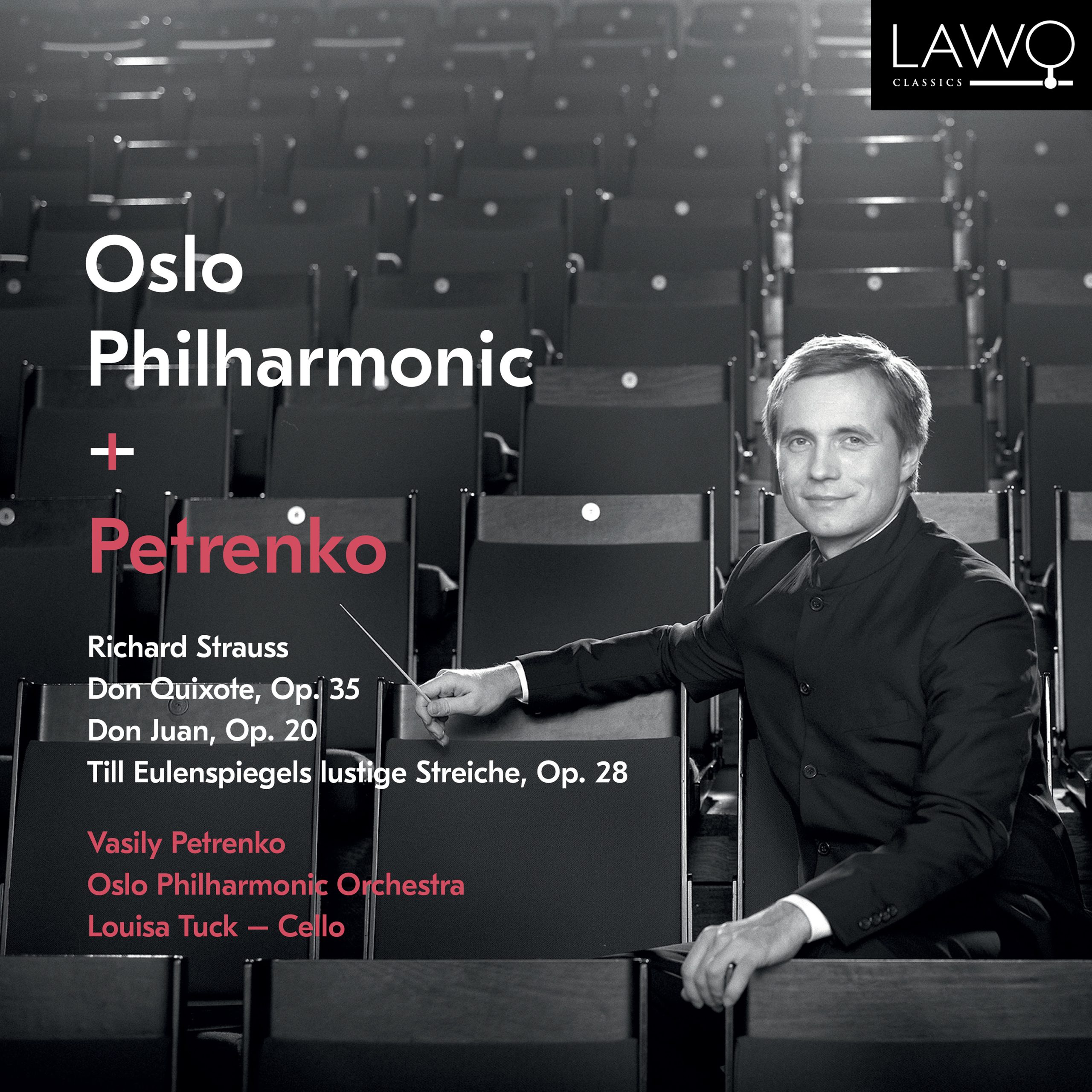
Richard Strauss – Don Quixote, Op. 35 – Don Juan, Op. 20 – Till Eulenspiegels lustige Streiche, Op. 28
Oslo Philharmonic Orchestra (Symphony orchestra) | Vasily Petrenko (Conductor)
Stream & download
Tracks
Richard Strauss (1864–1949)
Don Quixote, Op. 35, TrV 184
Vasily Petrenko (conductor) | Oslo Philharmonic Orchestra | Catherine Bullock | Louisa Tuck
Reviews
The magnificent performance by the orchestra’s violin soloist, Louisa Tuck, who is the soloist in Don Quixote, is a testament to the power of sublimity.…
Show more Show less
The magnificent performance by the orchestra’s violin soloist, Louisa Tuck, who is the soloist in Don Quixote, is a testament to the power of sublimity. Strauss wanted to write an opera, but he dismissed the idea because he felt that Cervantes’s character was too superficial a dramatic figure. Petrenko tackles Don Juan – and his madness – with boldness. The oboe’s captivating love theme stands out elegantly against the energetic woodwind section of the Norwegian orchestra. The final moments, depicting their twilight years and their deaths, resound with Wagnerian splendour. In the final work, Till Eulenspiegel, the Oslo Philharmonic Orchestra captures the composer’s brilliant tone. The interpretation stands out for its attention to detail and elegance. A new recording that showcases the musicality of these superb musicians.Show original
Den praktfulle tolkningen av orkesterets fiolinsolist, Louisa Tuck, som er solist i Don Quixote, tar av med sublimitetens kraft. Strauss ønsket å lage en opera, men han avfeide den fordi han mente at karakteren til Cervantes var en for overfladisk dramatisk personlighet. Petrenko behandler Don Juan , og galskapen hans, frimodig. Det attraktive kjærlighetstemaet til oboen skiller seg elegant ut fra det energiske treseksjonen i det norske orkesteret. De siste øyeblikkene, som beskriver deres skumringsår og deres død, høres med en Wagnerian- glans . I det endelige verket, Till Eulenspiegel, tar Oslo Filharmoniske Orkester opp den geniale tonen til komponisten. Tolkningen skiller seg ut for sin detalj og eleganse. En ny plate som fremhever musikalen til disse flotte musikerne.

Strauss’s gift for counterpoint reached a peak in the work’s extended introduction, a dazzling, playful overlaying of the three main themes.…
Show more Show less
Strauss’s gift for counterpoint reached a peak in the work’s extended introduction, a dazzling, playful overlaying of the three main themes. One of this performance’s joys is cellist Louisa Tuck – crucially not an imported celebrity soloist but the Oslo Philharmonic’s regular principal. Meaning that her exchanges invariably ring true; Quixote's bittersweet death is exquisite here, Vasily Petrenko capping it with the sweetest of codas. The orchestral playing is superb throughout: sheep, flying horses and windmills uncannily vivid. My new favourite Don Quixote, magnificently engineered.
 theartsdesk | 16.11.2019
Read at theartsdesk →
Although Strauss’s Fantastic Variations on a Theme of Knightly Character was first performed with a renowned soloist – and has been recorded by the greatest cellists – the…
Show more Show less
Although Strauss’s Fantastic Variations on a Theme of Knightly Character was first performed with a renowned soloist – and has been recorded by the greatest cellists – the instrumental personification of Don Quixote, and the viola solos portraying his esquire Sancho Panza, suggest players integrated into the orchestra. Louisa Tuck and Catherine Bullock are both superb in this brilliantly played account.
 Sunday Times
...the Oslo-Filharmonien orchestra’s playing is magnificent and the LAWO Classics recording does it total justice.…
Show more Show less
...the Oslo-Filharmonien orchestra’s playing is magnificent and the LAWO Classics recording does it total justice. Petrenko, especially in the later variations, whips up a storm with the best of them. He’s not afraid to let loose and yet deeply impresses with the work’s more reflective music. [...] I have no hesitation in considering this new production now the best way to collect these three Strauss works on a single disc.
 Musicweb International | December 2019
Read at Musicweb International →
The Oslo Philharmonic and Vasily Petrenko have released their second Richard Strauss album.…
Show more Show less
The Oslo Philharmonic and Vasily Petrenko have released their second Richard Strauss album. And it is a fine follow-up, in which the orchestra – and not least the soloist Louisa Tuck – are in fine musical form. It is a sparkling cello performance that ignites the musical passion in ‘Don Quixote’, Op. 35. The Oslo Philharmonic’s principal cellist brings a good dose of passion to her playing and paints the musical narrative beautifully. […] Petrenko demonstrates here that he is helping to preserve the spirit of Janson’s orchestral development in a very fine manner. The orchestra boasts a number of talented soloists in its ranks. Notably, cellist Louisa Tuck’s brilliant playing, along with the other solo contributions on this album, helps to lend the recording an air of grandeur.Show original
Oslo-filharmonien og Vasily Petrenko er ute med den andre Richard Strauss-platen. Og det er en god oppfølger, der orkester og ikke minst solisten Louisa Tuck er i musikalsk godlune. Det er et glitrende cellospill som tenner den musikalske lidenskapen i «Don Quixote» op.35. Oslo-filharmoniens solo-cellist serverer en god dose lidenskap i sitt spill og maler den musikalske historien på godt vis. […] Petrenko viser her at han er med på å forvalte gløden fra Jansons orkesterbygging på en meget god måte. Orkesteret har en rekke dyktige solister i sine rekker. Nevnt er cellisten Louisa Tucks briljante spill, med også de andre solo-innslagene på denne platen er med på å gi innspillingen et skinn av storhet.

Show all 8 reviews
For Don Quixote Petrenko follows the score’s lead in casting his orchestra’s superb principal cello, Louisa Tuck, as the Knight.…
Show more Show less
For Don Quixote Petrenko follows the score’s lead in casting his orchestra’s superb principal cello, Louisa Tuck, as the Knight. Her playing is beautifully integrated and superbly eloquent – the hush and tenderness of the final minutes is especially moving. Tuck’s interplay, too, with Catherine Bullock’s bumptious Sancho Panza is a delight; […] The couplings are outstanding, too. Don Juan bristles with energy and anticipation but Petrenko also brings subtlety and, as the piece progresses, a growing sense of our protagonist’s conscience catching up with him. […] With superb playing and excellent engineering, this is another highly recommended album in what’s turning into a very fine series.
Like the Maazel [VPO/Decca], Petrenko's Don Quixote is with orchestra principals (ladies from London and Yeovil here!), in this generously filled second Oslo Strauss disc.…
Show more Show less
Like the Maazel [VPO/Decca], Petrenko's Don Quixote is with orchestra principals (ladies from London and Yeovil here!), in this generously filled second Oslo Strauss disc. Louisa Tuck is eloquent in the 'Knight's Vigil' and touching in her 'expiry' and if the orchestra hasn't the burnished gloss of the Berlin Philharmonic they make up for that in vital characterisation under Petrenko. He is particularly good at seamless transitions in these three pieces (where both Dons and Till all perish!) and this is far from a 'hear once and then forget' trio of performances. You'll discover lots of orchestral details lost with other conductors.
 hifinews.com | 2020
Read at hifinews.com →
These are good, if not exceptional recordings of three of Strauss’s most popular tone poems.…
Show more Show less
These are good, if not exceptional recordings of three of Strauss’s most popular tone poems. (The three works have racked up a total of over 350 recorded performances.) Louisa Tuck plays in Don Quixote with virtuosic skill and an appealing tone quality. Her interpretation of the title role—it must be so described—is sympathetic and movingly emotional. Petrenko’s tempos are flexible, but with an ear towards the overall design of each piece. This especially makes Don Quixote cohere. Recorded sound is fine.
 American Record Guide | Mar 2020
Credits
- Conductor
- Vasily Petrenko
- Performer
- Elise Båtnes (Violin) | Catherine Bullock (Viola)
- Symphony orchestra
- Oslo Philharmonic Orchestra
- Composer
- Richard Strauss
- Producer
- Andrew Walton
- Engineer
- Vegard Landaas | Thomas Wolden
- Mastering
- Thomas Wolden
- English translation
- Jim Skurdall
- Executive producer
- Vegard Landaas
- Booklet editor
- Hege Wolleng
- PR
- Camilla Momkvist-Skau
- Cover photo
- Anna-Julia Granberg
- Artist photo
- Oslo Philharmonic Orchestra by CF Wesenberg | Oslo Philharmonic Orchestra by Ettore Causa
- Design
- Anna-Julia Granberg | Blunderbuss
- Recording location
- Oslo Concert Hall
- Recording country
- Norway
- Recording year
- 2017
- Recording dates
- 17.10.2017 | 18.10.2017 | 19.10.2017 | 20.10.2017 | 21.10.2017 | 29.11.2017 | 30.11.2017 | 01.12.2017
- Original source
- DXD (352.8 kHz, 24 bit)
- Discs / tracks
- 1 disc | 16 tracks
- Release year
- 2019
- Label
- LAWO Classics
- Duration
- 76:27
- EAN
- 7090020182063
- ISRC
- NOEHX1915010/160
Video
Booklet text
It took many hours of rehearsal for the Weimar Orchestra to get its lips and fingers around Richard Strauss's tone poem Don Juan in the Autumn of 1889, even with the benefit of the composer himself in charge. Not much about this music was conventional. Certainly not its opening page. The piece launches, off the beat, with an elusive upward flourish metamorphosing into a string of motifs that spans more than three octaves. It is the libertine Don Juan leaping out in front of us, and the 25-year-old Strauss introducing himself to the world with the piece that would make his name.
Most composers endure a crisis of identity before finding their true voice, but Richard Strauss was forced to do so against the backdrop of a fierce ideological battle. In his twenties, Strauss felt he was stalling: preoccupied by a functionary conducting position at the Munich Court Opera and unsure where his calling as a composer lay following a moderately successful symphony and some promising songs. It was an orchestral violinist, Alexander Ritter, who urged Strauss to explore the genre defying 'tone poems' of Franz Liszt, in which wordless orchestral music was used to recount a story.
Strauss had been instructed by his horn-playing father to avoid such 'programme music' at all costs. Franz Strauss forbade his son from reading any scores other than those of the pure classicists and their successors (Mozart, Beethoven and Brahms). But when Strauss eventually discovered Wagner, Liszt and Berlioz thanks to Ritter, it proved a revelation. Before he focused his attentions resolutely on opera from 1900 onwards, Strauss created a string of magnificent orchestral tone poems that heralded a new age of orchestral virtuosity and owed a clear debt to all three composers. But he cited Beethoven too – specifically, the music for Goethe's play Egmont – in trying to persuade his father and others that the path was a legitimate one.
Strauss's triumph in the domain of the tone poem was connected as much to his recognizing of its potential as to his transformation of its parameters. No composer of the time possessed a comparable ability to define a character in a few concise gestures, or to conjure a place and mood and fill it with cinematic detail. Strauss managed to do that but incorporate elements of formal classical design as well, knowing that features of sonata form such as clear differentiation of keys and themes could bolster the expressive effects of his musical stories. He explored all those things in Don Juan, first performed under his own baton on 11 November 1889 in Weimar.
Before long, Richard Strauss's fascination with Richard Strauss would produce a string of tone poems (and an opera) that bordered on autobiography. But in the early days, Strauss confined himself to describing figures from literature and philosophy. In the run up to starting work on Don Juan in 1888, he had conducted Mozart's Don Giovanni in Munich, seen Paul Heyse's play Don Juans Ende and read Nikolaus Lenau's unfinished verse play on the character. It was the latter work that Strauss chose to quote in relation to his orchestral fantasy: 'Fain would I run the magic circle, immeasurably wide, of beautiful women's manifold charms, in full tempest of enjoyment, to die of a kiss at the mouth of the last one' was one of three quotes he eventually appended to the score.
Lenau's vision of the Don was a little subtler than Mozart and Da Ponte's. It presented a figure whose racking up of sexual conquests served a higher purpose (the pursuit of the ideal) and who soon came to realise the folly of that exercise, tasting the self-disgust and disillusion that lay as a prize and ultimately seeking death. Strauss, able to add filmic detail to the sort of narrative sweep demonstrated by Liszt, shows us a frantic individual burning energy at an unsustainable rate and with wicked and contagious excitement (Strauss was himself falling in love as he wrote, with the soprano Pauline de Ahna). Behind the dazzle, the Don is a figure for whom passion is as complex, fragile and fickle as it is overwhelming.
The Don is referenced in that strident theme and stands before us in the form of four unison horns. We hear him flirt (violin and oboe), fall in love (sweeping violin solo), break free from the constraints of a relationship (the return of the original flourish), come to see that 'the fuel is all consumed and the hearth is cold and dark' (lonely silence) and allow himself to be killed in a duel (a trumpet's single stab to the heart). Strauss had already written his tone poem Macbeth, but Don Juan acted as the manifesto for the next decade or more of his career.
The score covers a great deal in its relatively short span. But Strauss was determined to demonstrate that a large-scale tone poem was capable of pushing orchestral music to its expressive limits. If there was a faint suggestion in Don Juan's score that the character's quest for women is also a quest for meaning in life, another Don would provide Strauss with the opportunity to explore that idea from multiple angles and with irony thrown in. In 1897, the composer was drawn to Cervantes' 1605 novel Don Quixote, which tells of a chivalrous but deluded knight errant setting out to put the world to rights – even inventing a woman, whose hand he will win, to make the enterprise worthwhile.
Though Strauss had the epic philosophical tone poem Thus Spake Zarathustra under his belt already, his Spanish tale introduced multiple complications, notably the new level of detail required in recounting handpicked scenarios from a sprawling novel that enters the domain of magical realism. One of Strauss's solutions was to place the story – his selected segments of it, at least – in the service of what is effectively an extended character portrait. Strauss subtitled his work 'Fantastical Variations on a Theme of a Knightly Character'. It is a tone poem, a theme with ten variations, and more: with an extensive solo role for cello and more minor supporting roles for solo violin, viola and bass clarinet, it is a solo concerto and a concerto grosso too.
We can associate those instruments with particular characters: the cello with Quixote, the long viola solo with his prattling sidekick Sancho Panza, and the oboe with the Don's imaginary bride Dulcinea (though the characters aren't confined to those instruments and vice versa). The themes presented for variation are, principally, the Don's ascending flourish and slow climb-down (probably metaphorical) and Dulcinea's warm, loving theme first heard on an oboe. After the initial statement of both, Strauss weaves a complex contrapuntal web that could be a picture of the Don's mind struggling with its own fantasies.
What follows is a set of free variations as Quixote's misadventures begin with Sancho Panza by his side. They discuss knight errantry, with the Don grandstanding in the face of his companion's doubts to levels of comic self-righteousness (cello and viola duet). He later mistakes windmills for fierce giants (Strauss has them crush the Don's ascending theme mercilessly, ending with a timpani thump), takes a flock of sheep for an attacking army (Strauss seizes the opportunity to indulge in some more literal tone-painting, asking the brass players to flutter their tongues in the imitation of bleating), ambushes a group of marching pilgrims, experiences a grand vision of Dulcinea and sees himself flying on a magic horse to win her. One moment of clarity clears the decks before, like Don Juan before him, he accepts death (another longstanding theme in Strauss's works).
Don Quixote was first performed on 8 March 1898 in Cologne, conducted by Franz Wüllner with Friedrich Grützmacher as the soloist. In some ways, it is the most ambitious of Strauss's tone poems if not the loudest nor grandest. But with Strauss, ambition has a multi-directional trajectory. Two years later he delivered a depiction of another doomed soul, this time one with a far surer idea of himself. Till Eulenspiegel is a fearless scamp hailing from deep within German folklore. With none of Quixote's delusions of gallantry and little of Juan's suave hedonism, Till goes about playing the fool while exposing vice and corruption in German society – perhaps the noblest of all three characters if judged on the moral impetus of his pursuits (his name literally translates as 'wise mirror').
But Till was still a rogue and a tease, one in whom we see a premonition of the later tone poem Ein Heldenleben (already recorded by the Oslo Philharmonic). Strauss loved to cock a snook at tastemakers, bureaucrats and self-aggrandizers using wicked musical satire; he had at least as much in common with Till as with the idealized hero of Ein Heldenleben and the dreamer-idealist Quixote. Listening to his musical depiction of Till, it's hard not to conclude that Strauss created his musical vision of the trickster with extreme pleasure. The composer was determined to challenge himself afresh with each of his tone poems and for this score dating from the winter of 1894-95, the composer adopted yet another form – a 'rondo in the old-style, roguish manner' according to his own words on the score.
The story of Till existed in various sources, most famously a 1500 publication titled Till Eulenspiegel: His Adventures, containing 95 episodes and attributed only to the author 'N'. Strauss was therefore faced with a similar editing job to that presented by Cervantes. He had abandoned thoughts of an opera believing Till 'too superficial a dramatic personality,' but that didn't preclude him from becoming a nifty orchestral caricature well suited to the rondo form, in which his visage might resurface with a cheeky smile after each crafty episode.
Those episodes include Till gallivanting through the marketplace upending stalls and knocking the housewives's baskets, Till masquerading as a clergyman and delivering a racy sermon, Till flirting and seducing (with various degrees of success) and generally mocking the powerful, pious and prudish. Two themes are overtly associated with him. The first is heard, just after the work's 'once upon a time' introduction, on a solo horn: a malleable theme ranging almost four octaves (even broader than Don Juan's) and filled with shape-shifting syncopations. The next, even more sly, is heard throughout on a saucy clarinet. Each undergoes transformations but it's the horn call that becomes notably audacious, manipulative, crude and even faux-noble.
Strauss declined to spell out Till's antics in detail, 'let us leave the audience to crack the nuts which the rogue has prepared for them,' he once said. But the episode when Till meets his fate is clear enough: a drum roll interrupts a passage of notable excitement before heavy chords pronounce the charge, answered by Till's insolent clarinet motif. At his death by hanging, we are returned to the music of the opening – it was all just a story. Or was it? The character of Till is based on an actual person, and Strauss's final gesture suggests that this musical Till outsmarts the hangman's noose.
Strauss was prone to answering questions he didn't feel inclined to answer with a dismissive joke – something else he had in common with Till. Asked about the advancing of his musical style in this piece following the premiere on 5 November 1895 in Cologne, Strauss proclaimed that he 'just wanted to give people in the concert hall a good laugh for once'. But in the extended joke of Till Eulenspiegels lustige Streiche, he had actually advanced the structural, descriptive and coloristic elements of the tone poem to their highest form yet, while demonstrating once more his unparalleled ability to sketch a character with concise but fertile musical means.
— Andrew Mellor