
Alberto Ginastera
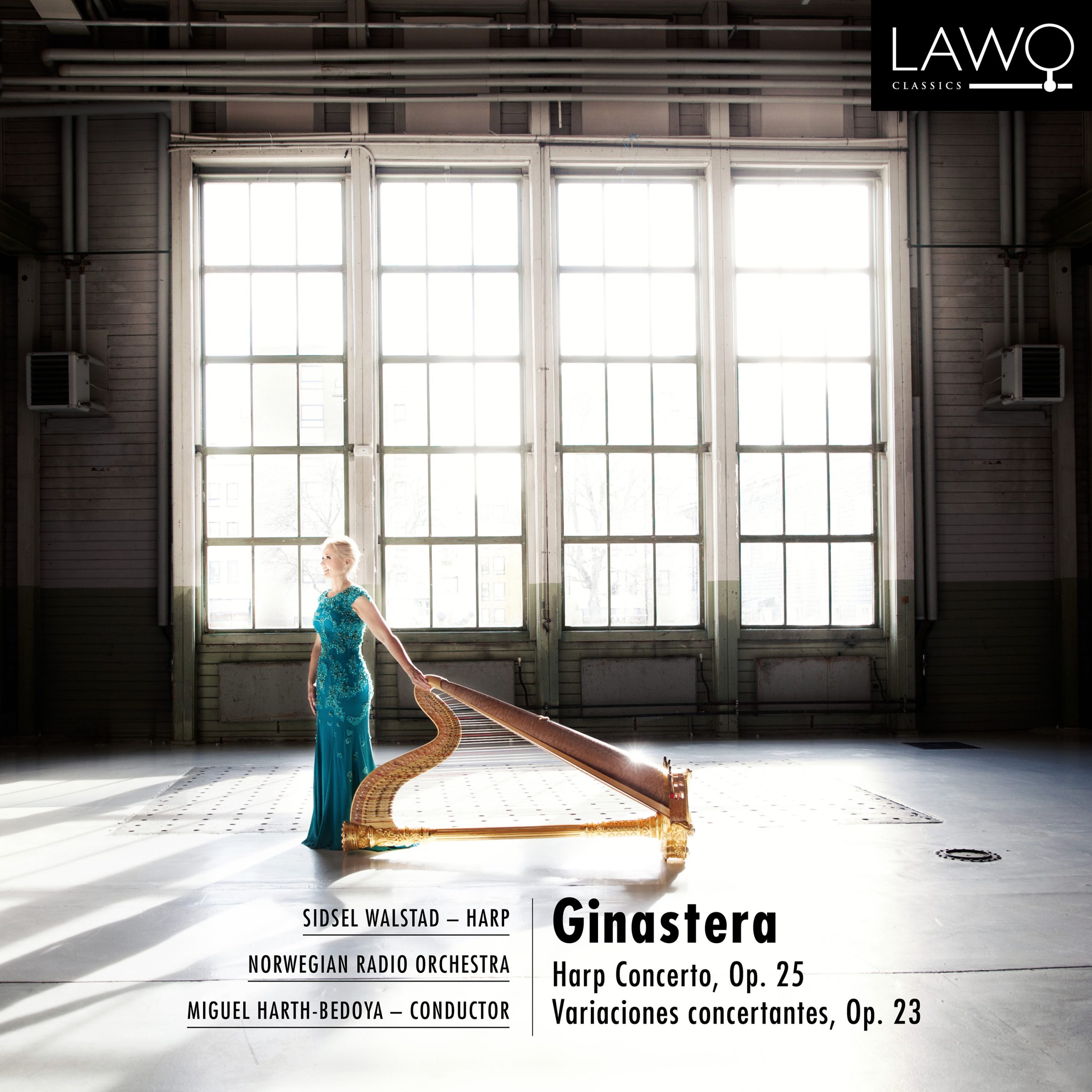
Ginastera Harp Concerto, Op. 25 & Variaciones concertantes, Op. 23
Sidsel Walstad (Harp) | Norwegian Radio Orchestra (Orchestra) | Miguel Harth-Bedoya (Conductor)
Stream & download
Tracks
Alberto Ginastera (1916–1983)
Harp Concerto, Op. 25
Miguel Harth-Bedoya (conductor) | Norwegian Radio Orchestra | Sidsel Walstad
Variaciones concertantes, Op. 23
Reviews
Norwegian harpist Sidsel Walstad is technically and musically a force of nature, holding her own against the massive orchestration of the harp concerto, and protean in her ability…
Show more Show less
Norwegian harpist Sidsel Walstad is technically and musically a force of nature, holding her own against the massive orchestration of the harp concerto, and protean in her ability to spin a long legato line with an instrument notoriously hard to master. But master she does deliver a memorable performance that will surely become a standard against which to judge future attempts at this musical minefield. Aside from praising the mere value of representing the genius of Alberto Ginastera in this perfectly engineered compact disc, perfectly played, perfectly produced, perfectly packaged (and annotated by Jan Hedrick Hayerdahl) we salute the LAWO label for its enterprise and hope that the future will bring more interesting releases. Extraordinary.
 rafaelmusicnotes.com | 14.10.2019
Read at rafaelmusicnotes.com →
Sidsel Walstad has a great command of her instrument, which is essential to balance the sound game with the Norwegian Radio Orchestra.…
Show more Show less
Sidsel Walstad has a great command of her instrument, which is essential to balance the sound game with the Norwegian Radio Orchestra. The Variaciones concertantes, op. 23, were released in Buenos Aires in 1953. In this work we find many virtuosical elements of the thematic and rhythmic elements. Miguel Harth-Bedoya focuses on the sound quality of the instrumentalists, in the tonality, atonality, strength, virtuosity and expressiveness of the Ginastera style in an artistic context that shared the American and European tradition.
 Sonograma Magazine | 29.11.2019
Read at Sonograma Magazine →
Alberto Ginastera (1916-1983) began composing his Harp Concerto in 1956, but it was only first performed in 1965 by the Spanish harpist Nicanor Zabaleta.…
Show more Show less
Alberto Ginastera (1916-1983) began composing his Harp Concerto in 1956, but it was only first performed in 1965 by the Spanish harpist Nicanor Zabaleta. On this CD, Sidsel Walstad plays the revised version from 1968. Ginastera’s Concerto is technically very challenging and also broadens the expressive spectrum of the harp concerto in general. The soloist is technically flawless and, together with the conductor Miguel Harth-Bedoya, she underlines the sometimes gloomy drama of the work. The Variaciones concertantes were premiered in Buenos Aires in 1953. According to Ginastera, they have a « subjective Argentinean quality », which he achieves not through themes, but merely from moods of traditional music. It is a kind of a playful and elegant concerto for orchestra with many solos for various instruments. The Norwegian Radio Orchestra under Harth-Bedoya delivers an expressive and exciting performance, which is undoubtedly one of the best available for this composition.
 Pizzicato | 14.12.2019
Read at Pizzicato →
[…] Ginastera’s Harp Concerto (1965) combines fierce rhythmic energy with passages of ethereal beauty and calm.…
Show more Show less
[…] Ginastera’s Harp Concerto (1965) combines fierce rhythmic energy with passages of ethereal beauty and calm. It is fiendishly demanding for the soloist – harpist Sidsel Walstad describes its performance as akin to “climbing a mountain” – but she makes light work of the Concerto’s technical rigours in this wonderfully spirited and sensitive interpretation, well-supported throughout by the Norwegian Radio Orchestra. […] With a further fine performance here from NRO, this disc offers an accomplished and exuberant celebration of Argentina’s vibrant musical culture.
 BBC Music Magazine | 2020
[…] The first movement in particular has a special energy with plenty of rhythmic drive, the orchestration vital but transparent, allowing the soloist to shine but also creating a…
Show more Show less
[…] The first movement in particular has a special energy with plenty of rhythmic drive, the orchestration vital but transparent, allowing the soloist to shine but also creating a highly dramatic, almost cinematic atmosphere. […] The Norwegian Radio Orchestra proves itself entirely capable of creating Ginastera’s desired Argentinian moods, skilfully led by Peruvian conductor Miguel Harth-Bedoya, whose “heart pounds for South American music and culture”. […] It may in the end be the couplings that tips the balance, and short playing time is less in this Lawo release’s favour than some. The recording and performances are, however, pretty impeccable.
 Musicweb International | 2020
Read at Musicweb International →
Show all 9 reviews
[…] Soloist Sidsel Walstad is superb throughout.…
Show more Show less
[…] Soloist Sidsel Walstad is superb throughout. Especially in the third movement’s opening soliloquy, Walstad running her fingernails over the strings at several points. Miguel Harth-Bedoya’s valiant Norwegian Radio Orchestra are game accompanists in this tricksy repertoire, the frenzied final minutes (including what sounds like a direct reference to Messiaen's Turangalîla Symphony) tightly controlled and terrifically exciting. This is a great concerto, not just a great harp concerto. Ginastera's Variaciones concertantes was composed in the early 1950s. Like a South American take on Britten's Young Person’s Guide, the opening cello and harp theme is developed by different orchestral and sections. There's no concluding fugue; instead, a propulsive rondo finally reuniting the players. Listen out for the solo violin variation, and the double bass’s reprise of the theme just before the last section. A highly enjoyable, cleverly structured work, it's neatly performed. Lawo's sound has plenty of punch – a fascinating release.
[...] Both Walstad and the orchestra deliver fine performances of two of Ginastera’s eminently paradigmatic works.…
Show more Show less
[...] Both Walstad and the orchestra deliver fine performances of two of Ginastera’s eminently paradigmatic works. Walstad’s playing is eloquently dreamy and distinctively ripe in tone. Her performance, based on the 1968 revision (also performed by Nicanor Zabaleta), is scintillating. The orchestra, under Harth-Bedoya’s baton is stunning. What musicians across the board deliver is startlingly fresh and alive.
 thewholenote.com | 27.01.2020
Read at thewholenote.com →
Ginastera’s harp pieces redefined the expressive and technical possibilities of the instrument.…
Show more Show less
Ginastera’s harp pieces redefined the expressive and technical possibilities of the instrument. Though written in the 50s, the Harp Concerto premiered in 1965 with the Spanish harpist Nicanor Zabaleta. In this attractive recording, Sidsel Walstad turns in a colorful, sharply articulated performance, with poetry and virtuosity to spare. Her coordination with the Norwegian Radio Orchestra is deft, and her cadenza in the finale is stunning. Aggressively rhythmical and hauntingly lyrical, the concerto is a mesmerizing work, full of special effects for the harp and colorful solos for other instruments as well, especially brass and percussion. The slow movement is a mournful song initiated by strings. The percussive finale ends with a startling dissonance. Variaciones Concertantes, from a decade earlier, is an even more entertaining piece, creating what Ginastera calls an “Argentinean mood” with folkloric solos for just about everyone in the orchestra as well as the harp. These sound like folk song quotations, but the tunes are Ginastera’s own. At the end, all the forces come together for a joyous rondo.
 American Record Guide | Mar 2020
[...] A cadenza of surprising extended techniques opens the final movement, the harp strumming the open notes of a guitar as a kind of dare.…
Show more Show less
[...] A cadenza of surprising extended techniques opens the final movement, the harp strumming the open notes of a guitar as a kind of dare. Walstad whispers, wails, growls, hisses, and intones gloriously, leaving us eating out of her hands. When the final harp gasp leads to the orchestra entering in a wild duet of percussion and ostinato strings, the game is on. The harp cuts through the fray, exchanging the lead line with the vigor of an orchestra playing as one, her nails-on-strings a chance to play alongside the superb percussion section. The orchestra never stops in this folk-inflected dance as it pushes to a magnificent ending. [...]
 harpcolumn.com | 01.05.2020
Read at harpcolumn.com →
Credits
- Conductor
- Miguel Harth-Bedoya
- Performer
- Sidsel Walstad (Harp)
- Orchestra (unspecified)
- Norwegian Radio Orchestra
- Composer
- Alberto Ginastera
- Producer
- Vegard Landaas
- Engineer
- Thomas Wolden | NRK Musikkteknikk
- Editing
- Vegard Landaas
- Mastering
- Thomas Wolden
- English translation
- Jim Skurdall
- Executive producer
- Vegard Landaas
- Booklet editor
- Hege Wolleng
- PR
- Camilla Momkvist-Skau
- Cover photo
- Anna-Julia Granberg
- Artist photo
- Sidsel Walstad by Anna-Julia Granberg
- Design
- Anna-Julia Granberg | Blunderbuss
- Recording location
- NRK Radio Concert Hall, Oslo
- Recording country
- Norway
- Recording year
- 2017–2018
- Recording dates
- 01.09.2017 | 01.03.2018 | 02.03.2018 | 23.04.2018 | 25.04.2018 | 27.04.2018
- Original source
- DXD (352.8 kHz, 24 bit)
- Discs / tracks
- 1 disc | 15 tracks
- Produced with support from
- Arts and Culture Norway | The Audio and Visual Fund | Fund for Performing Artists
- Release year
- 2019
- Label
- LAWO Classics
- Duration
- 48:52
- EAN
- 7090020182049
- ISRC
- NOEHX1913010/150
Video
Booklet text
Alberto Ginastera (1916-1983) is a distinctive voice in twentieth-century classical music, and together with the master of the tango, Astor Piazzolla, he is the towering musical figure of Argentina.
Born in Buenos Aires of an Italian mother and a Catalonian father, Ginastera is a complex composer and personality, shaped by the traditional folk culture and history of his native country and by impulses from the world at large, during a time of radical upheavals in the realm of Western classical music.
His 54 opuses encompass many genres: songs, solo instrumental music, chamber music, orchestral music, choral works, ballets, operas and film and incidental music.
Individual works have been spread widely and have become standard works within their respective spheres of influence, but despite the special ability of Ginastera's music to communicate and captivate an audience, many of his compositions have yet to find their proper place in the concert repertory.
The works on this recording are, on the other hand, two of his most often performed compositions - the Harp Concerto, one of the best of the genre, and Variaciones concertantes, which with its orchestral equilibrium can set a concert hall on fire.
It can be very welcome when composers themselves help us sort out their distinctive stylistic features, and Ginastera divided his own production into three periods: Objective Nationalism, 1937-1947, with direct use of traditional Argentine musical elements; Subjective Nationalism, 1947-1957, where the Argentine folk themes have a more indirect, symbolic quality; and Neo-Expressionism, 1958-1983, during which he uses twentieth-century modernist compositional devices.
The validity of the three periods is the subject of debate, especially because the composer himself later expressed the view that his music in actual fact consisted of only two periods, a tonal/polytonal phase up until 1958, followed by an atonal period up to his last opus.
The scholars may go on quarrelling, and everything is further complicated knowing that throughout his life as a composer, Ginastera was eclectic in terms of musical style. There are elements of both Stravinsky and serialism as early as his op. 1 (the ballet Panambí), and toward the end of his life his music still contained traditional folk elements and tonal tendencies.
Although it is difficult to pigeonhole Ginastera, it is possible to associate both names and stylistic elements from twentieth-century music with his compositions: the rhythmic and percussive elements of both Bartók and Stravinsky (the Rite of Spring left an indelible impression on the fourteen-year-old Alberto), the timbres of the French Impressionists, the 12-tone technique and serialism of the Second Viennese School, and even use of aleatoric techniques. Ginastera never tried to conceal that he dipped into the stylistic toolbox of the time, yet what is striking about this Argentinian cosmopolite is that he retained his own genuine musical expression to the end. He is Ginastera through and through, while freely using the entire palette of compositional devices. Ginastera's music never seems whimsical; it is characterized by a remarkable sense of structure and his craft. He said himself that 'to compose is to be an architect.'
It may be worth paying added attention to the traditional folk elements in Ginastera's music, since they (objectively or subjectively) are present in one form or another in all his compositions and, unquestionably, in both works on this recording.
A backdrop for Argentinian literature, visual art and music in the centuries before Ginastera was born is gaucho culture. The gaucho is the Argentinian cowboy, the tough guy of the Pampas who can sing, dance and fight - a symbol of freedom and, for many, a symbol of Argentina itself.
In Ginastera's music, we hear the gaucho in his proper element. The sound of the open strings of the gaucho's guitar (e-a-d-g-b-e) crops up in the cadenza of the harp concerto and in the opening of Variaciones. Ginastera's melodies are often based on the related pentatonic scale, often in combination with the use of church modes.
The rhythmic quality, which always features prominently in Ginastera's music, is taken from traditional Argentinian dances, and the characteristic 6/8 rhythm that we hear in the fast sections (divided into groups of two or three), originate in particular from the malambo, a virile dance with which one gaucho challenged another.
The Harp Concerto was commissioned in 1956 by Edna Phillips. Composing commissioned works was, however, not always Ginastera's strong suit, so the work was not premiered until 1965, and then it was the Spanish harpist Nicanor Zabaleta. (Thus regarded, the harp concerto belongs both to the composer's second and to his third composition period.) Sidsel Walstad has studied the original manuscripts and read the correspondence between Ginastera and Zabaleta and discovered that the composer added a few cubits to his knowledge of the harp in the process. Walstad bases her recording on a revised version from 1968 (also recorded by Zabaleta).
When the concerto first appeared, it became a brilliant addition to the harp literature and twentieth-century instrumental concertos. Ginastera significantly expands the range of expression as well as the expectations of what a harp can represent as a solo instrument. Here we encounter the harp as a rhythmic motor that accentuates the percussive quality of the music, but also brings out parts with intense and mystical beauty. Ginastera's work calls for a level of pedal technique not attempted until then and introduces nail effects on the strings. Despite the tremendous demands on the soloist, the concerto has become a standard work (still one of very few) for harp and orchestra.
Variaciones concertantes was completed more than ten years earlier and was premiered in Buenos Aires in 1953. In Ginastera's own words: 'These variations have a subjective Argentinian quality. Instead of using traditional folk material, I try to achieve an Argentinian mood by using my own thematic and rhythmic elements.' The music is an irresistable combination of orchestral timbres and virtuosity communicating directly with the listener, especially as regards the entertainment aspect inherent in virtuosic orchestral sound and a demanding soloist performance. Solo parts are given to all the instruments in the orchestra, before the gauchos ride again in orchestral tutti in the closing rondo.
— Notes: Jan Fredrik Heyerdahl / NRK · English translation: Jim Skurdall