
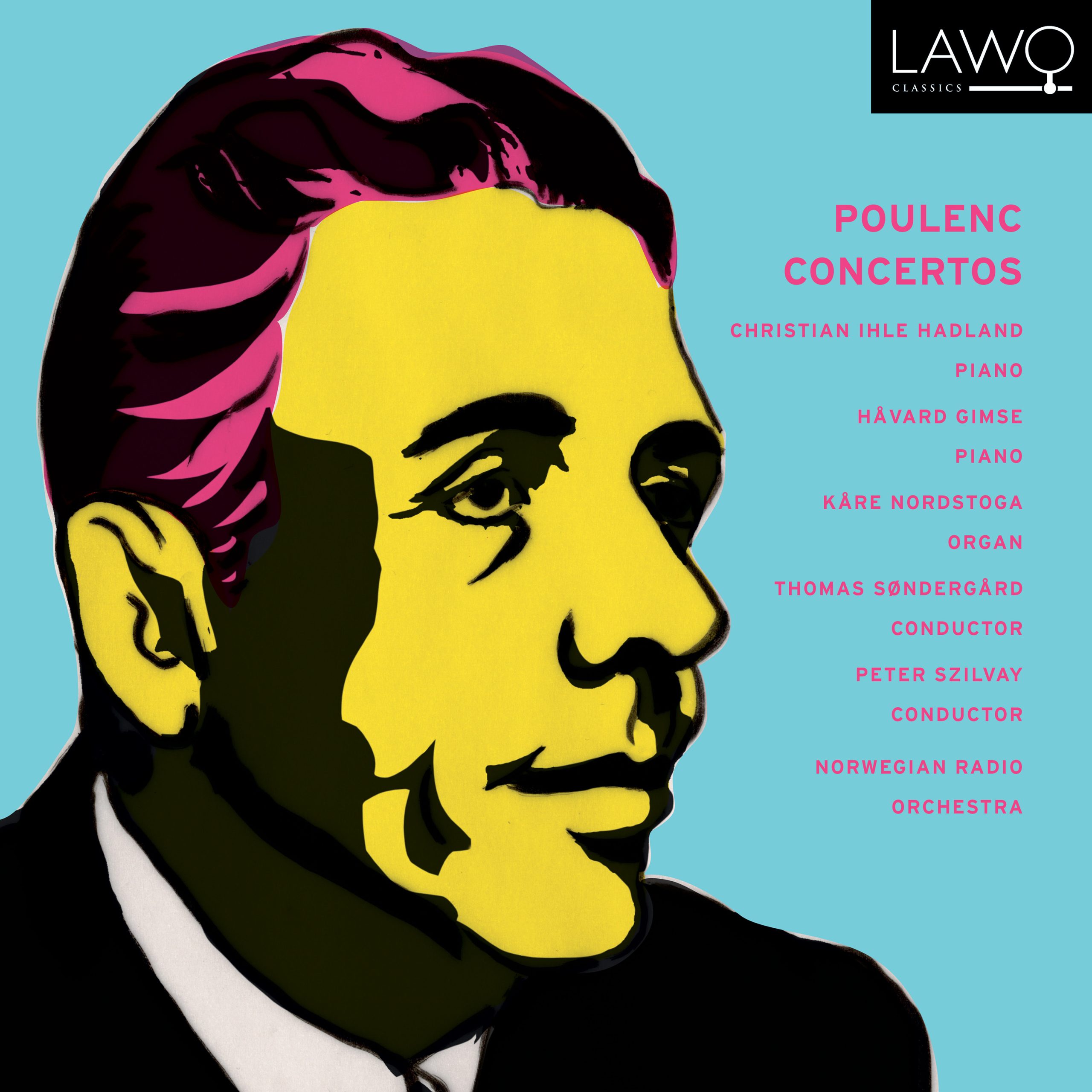
Francis Poulenc
Poulenc Concertos
Norwegian Radio Orchestra (Orchestra) | Håvard Gimse (Piano) | Christian Ihle Hadland (Piano) | Kåre Nordstoga (Organ) | Thomas Søndergård (Conductor) | Peter Szilvay (Conductor)
Stream & download
Tracks
Francis Poulenc (1899–1963)
Concerto pour piano et orchestre
Thomas Søndergård (conductor) | Peter Szilvay (conductor) | Norwegian Radio Orchestra | Christian Ihle Hadland
Concerto en ré mineur pour deux pianos et orchestre
Thomas Søndergård (conductor) | Peter Szilvay (conductor) | Norwegian Radio Orchestra | Christian Ihle Hadland | Håvard Gimse
Reviews
On this fine Francis Poulenc album featuring the Norwegian Radio Orchestra, we are treated to three concertos with three soloists: Prince Christian Ihle Hadland in the elegant…
Show more Show less
On this fine Francis Poulenc album featuring the Norwegian Radio Orchestra, we are treated to three concertos with three soloists: Prince Christian Ihle Hadland in the elegant Piano Concerto in C-sharp minor (1949), in which Poulenc plays with Russian-Romantic melodies and Baroque rhythms. Then Hadland joins Håvard Gimse in the Piano Concerto in D minor (1932), with its flowing, Mozart-like second movement. And finally, the highlight: the Organ Concerto in G minor (1938), which begins with leaden organ chords in the style of J.S. Bach. [...] The interplay that cathedral organist Kåre Nordstoga achieves here with the Norwegian Radio Orchestra in Oslo Cathedral is simply marvellous.Show original
På dette fine Francis Poulenc-albumet med Kringkastingsorkesteret får me tre konsertar med tre solistar: Fyrst Christian Ihle Hadland i den nette Klaverkonsert i ciss-moll (1949), der Poulenc leikar seg med russisk-romantiske melodiar og barokke rytmar. Så Hadland saman med Håvard Gimse i Konsert for klaver i d-moll (1932), den med den smeikjande, Mozart-aktige andresatsen. Og til slutt høgdepunktet, nemleg Orgelkonsert i g-moll (1938), som byrjar med blytunge orgelakkordar a la J.S. Bach. [...] Samspelet som domorganist Kåre Nordstoga her får til med Kringkastingsorkesteret i Oslo domkyrkje, er lytelaust.
 Dag og Tid | 12.07.2019
Norwegian
Francis Poulenc, who is still not sufficiently esteemed, has composed a wonderfully fresh music full of virtuosity, brilliance and musical imagination.…
Show more Show less
Francis Poulenc, who is still not sufficiently esteemed, has composed a wonderfully fresh music full of virtuosity, brilliance and musical imagination. The recordings that Lawo now releases are lively and virtuosic, but also nuanced, well-balanced, tastefully shifting between sweetness, spirited verve and reflectivity. The recorded sound is perfect for this type of music, not reverberant, not too wide, and not too compact.
 pizzicato | 19.07.2019
Read at pizzicato →
These are works of high musical level, which - to a large extent - the soloists of this recording reveal.…
Show more Show less
These are works of high musical level, which - to a large extent - the soloists of this recording reveal. […] Organist Kåre Nordstoga and pianists Håvard Gimse and Christian Ihle Hadland are the creators and stylists who move more comfortably in these versions directed by directors Peter Szilvay, Thomas Søndergård at the head of the Norwegian Radio Orchestra. A version that emphasizes, besides the fractures of the formal structure of the classical concert, the vision that Poulenc had of that Europe, from 1918 to 1939, a historical period that was possibly the one of the highest artistic level of the whole century.
 Sonograma Magazine | 29.7.2019
Read at Sonograma Magazine →
The Norwegian Radio Orchestra (KORK) is joined by organist Kåre Nordstoga, as well as pianists Christian Ihle Hadland and Håvard Gimse, in a musical tribute to the French composer Francis Poulenc (1899–1963).…
Show more Show less
The Norwegian Radio Orchestra (KORK) is joined by organist Kåre Nordstoga, as well as pianists Christian Ihle Hadland and Håvard Gimse, in a musical tribute to the French composer Francis Poulenc (1899–1963). And this varied music is very much to my taste. The music is playful, inquisitive and stylistically elegant. It is therefore a delight to hear that the musicians of KORK really know how to accompany three of the country’s most talented soloists.Show original
Kringkastingsorkesteret (KORK) har med seg organist Kåre Nordstoga, samt pianistene Christian Ihle Hadland og Håvard Gimse i en musikalsk hyllest til den franske komponisten Francis Poulenc (1899-1963). Og den mangslungne musikken faller godt i smak hos undertegnede. Musikken er leken, nysgjerrig og stilistisk elegant. Derfor er det herlig å høre at musikerne i KORK virkelig vet å akkompagnere tre av landets dyktigste solister.

Credits
- Conductor
- Thomas Søndergård | Peter Szilvay
- Performer
- Christian Ihle Hadland (Piano) | Håvard Gimse (Piano) | Kåre Nordstoga (Organ)
- Orchestra (unspecified)
- Norwegian Radio Orchestra
- Composer
- Francis Poulenc
- Producer
- Geoff Miles
- Engineer
- NRK Musikkteknikk
- Mastering
- Thomas Wolden
- Liner notes
- Geoff Miles
- English translation
- Jim Skurdall
- Executive producer
- Vegard Landaas
- Booklet editor
- Hege Wolleng
- PR
- Camilla Momkvist-Skau
- Cover photo
- Anna-Julia Granberg
- Artist photo
- Norwegian Radio Orchestra by Anna-Julia Granberg
- Design
- Anna-Julia Granberg | Blunderbuss
- Recording location
- NRK Radio Concert Hall, Oslo | Oslo Cathedral
- Recording country
- Norway
- Recording year
- 2011–2012
- Recording dates
- 27.01.2011 | 28.01.2011 | 23.01.2012 | 24.01.2012 | 25.01.2012 | 13.10.2012
- Original source
- DXD (352.8 kHz, 24 bit)
- Discs / tracks
- 1 disc | 7 tracks
- Release year
- 2019
- Label
- LAWO Classics
- Duration
- 58:53
- EAN
- 7090020181950
- ISRC
- NOEHX1904010/70
Booklet text
Poulenc, Prophet of Immediacy
Francis Poulenc (1899–1963) is not an easy composer to relate to. Not the man himself perhaps — though possibly that too — but his music. It is somehow dated. Here is a composer who produced his best works, all more or less completely tonal, at a time when Arnold Schoenberg was writing twelve-tone music and Poulenc's countrymen Oliver Messian (1908–1992) and Pierre Boulez (1925–2016) were into innovative rhythms, scales and techniques to lift the music out of the realm of subjective emotionalism. One of Poulenc's most splendid works, Gloria, from 1959, was composed two years after Boulez's third piano sonata. The two works have nothing in common other than that they both consist of notes and belong to what is called the European music tradition. What's more, I am reasonably certain that Gloria has many more listeners than the third piano sonata of Boulez, quite simply because this melodious choral work is more accessible.
And accessible was what Poulenc wanted to be. One composer he looked to as a source of inspiration was Stravinsky, especially his neoclassical works from the 1920s. Here we are talking about pieces such as Pulcinella and The Fairy's Kiss, as well as his Octet for Wind Instruments. Poulenc has been quoted as saying that if not for Stravinsky, he might not have been a composer at all. An exaggeration to be sure, but the similarities are apparent. Both can be called neoclassicists in the sense that they adopted baroque and classical forms with clear linearity in the melody and a lucid form with an underlying tonality. But Stravinsky composed his neoclassical works in quotation marks, as the Danish music critic Hansgeorg Lenz put it. By this he meant that Stravinsky was, stylistically speaking, extremely self-assured. He played with his forms and shunned personal expression, even though we hear it is Stravinsky, no matter which compositional mask he dons. In one way or another, Poulenc is there too, but only in part. Both break with the pathos of Romantic music, with its fervor and self-expression. Yet, while Stravinsky's style is the manifestation of a strong will — i.e. he laid bare the distance between the forms he used and the actual sound of the compositions — this distance is more difficult to discern in Poulenc. He composed largely without a mask, without distance. He became a kind of prophet of immediacy. In a way he simply wished to entertain, and now and then to shock, something most composers wanted to do in 1920s Paris. And he was at this time also one of a group of young composers known collectively as "Les Six", for whom the French poet, filmmaker and playwright Jean Cocteau (1889–1963) was something of an ideologue and Erik Satie (1866–1925) a kind of father figure. In his book Le Coq et l'Arlequin (1918), Cocteau criticizes, among other things, the melancholy of German music (Beethoven, Wagner) and asserts that the plain and simple is concentrated complexity, i.e. depth. This fits much of Poulenc's music with its distinct melodies, formal clarity, and not so very complicated harmonies. Poulenc emphasized that he was not a harmonic innovator; neither was he, as he said, afraid to "use other people's chords." This clarity of form and expression can also be found in a number of the choral works, written after Poulenc had converted back to Catholicism in the mid-1930s. Here, for example, I am thinking of the Mass in G Major (1937), Figure humaine (1943) and Stabat Mater (1950). To these can be added his operatic masterpiece, Dialogues des carmélites (1956). These are works that engage us at a deeper level than his instrumental pieces, which are often much more garrulous and concertizing. Something revealed, to a great degree, on this release.
If we include Aubade (1929) for piano and eighteen instruments, Poulenc can be said to have composed five concertos. If, however, we ignore the aforementioned Aubade, and, likewise, Concert champêtre (1928) for harpsichord and orchestra, those that are left can be found on this album. Among them, the Concerto for Organ, Strings and Timpani (1938) is considered to be the most popular of the three, and, perhaps, the most serious. It has different qualities from, for example, the piano concerto. As the composer himself joked, it showed "a Poulenc on his way to joining a monastery." Is it perhaps a kind of Te Deum without text? In any case, Poulenc counted it among his religious works, and regarded it as one of the most important. And because he wanted to use the organ for all it was worth, he listened to many organists in Paris, especially Marcel Dupré. Poulenc's concerto was premiered by another authority within the French organ school, Maurice Duruflé, who also helped Poulenc with the registration. For Poulenc wanted musical punch and nuance from this instrument, which is an orchestra unto itself. At the same time, he broke with the classical three-movement structure of the other two concertos on this album. The organ concerto is divided into seven parts, which blend into each other. In that respect, it resembles the multi-movement Aubade, but with more baroque associations. Music historian Paul Griffiths wonders whether the gravity of the organ concerto is explored as a possible mode of expression, or whether the seriousness is genuinely intended. Difficult to say, of course, but is it perhaps precisely this ambivalence that gives the work its strength? There are some slow passages here, more meditative, with elements of chromaticism, while others, such as the "main theme" itself, Allegro giocoso, are much more expressive and virtuosic. The concerto achieves this effect of doubleness through its brilliant, concertizing form.
The Piano Concerto (1949) in three movements differs somewhat in its range of expression. There is not much ambivalence to speak of. The concerto was commissioned by the Boston Symphony Orchestra, with Poulenc himself as soloist. He decided to compose a "light concerto, a souvenir from Paris for a composer-pianist", hence, for himself. And light it is, and a wellspring of musical ideas, more or less brutally juxtaposed. Here we have striking melodies, as the opening theme in the first movement, or the lyrical theme in the second. But in the middle of the first movement, for example, he turns up the Romantic pomposity, with heavy chords and fiery brass. The last movement is pure concertizing. The piano part is varied, the orchestral movement as well.
In The New Grove Dictionary of Music and Musicians we read that the concerto "demonstrates the dangers of sectional, 'surrealist' techniques of composition." The observation is correct, but it is also this technique that makes the concerto so witty. There is no compositional consequence. The concerto is not "organic", which is the opposite of sectional. Everything is simply linked together into the grand display of a concerto.
The Concerto for Two Pianos and Orchestra (1932) lies perhaps somewhere between these two. It was premiered in Venice with the La Scala orchestra, and with Poulenc and his friend, Jacques Février, as soloists. Is this the concerto that comes closest to Stravinsky, i.e. that is music in quotation marks? The American composer Elliott Carter called the concerto "a pastiche consisting of music from Scarlatti, Mozart, Schumann, Chabrier on up to Stravinski and popular singers." But he thought it sounded convincing on account of "Poulenc's unbelievable sensitivity to harmonies and orchestral sounds." Here once more there is no form of thematic development; rather a juxtaposition of different passages. It is perhaps in the slow movement that Poulenc really composes in quotation marks. The movement opens with a stylistic imitation of what almost could have been a slow movement in a piano concerto of Mozart (Romanze in KV 466?), another of Poulenc's favourite composers, before going its own way, melodically, harmonically and rhythmically. With that, the historic distance is sounded, in purely musical terms. The quotation marks are in place. So, too, the music.
— Egil Baumann