
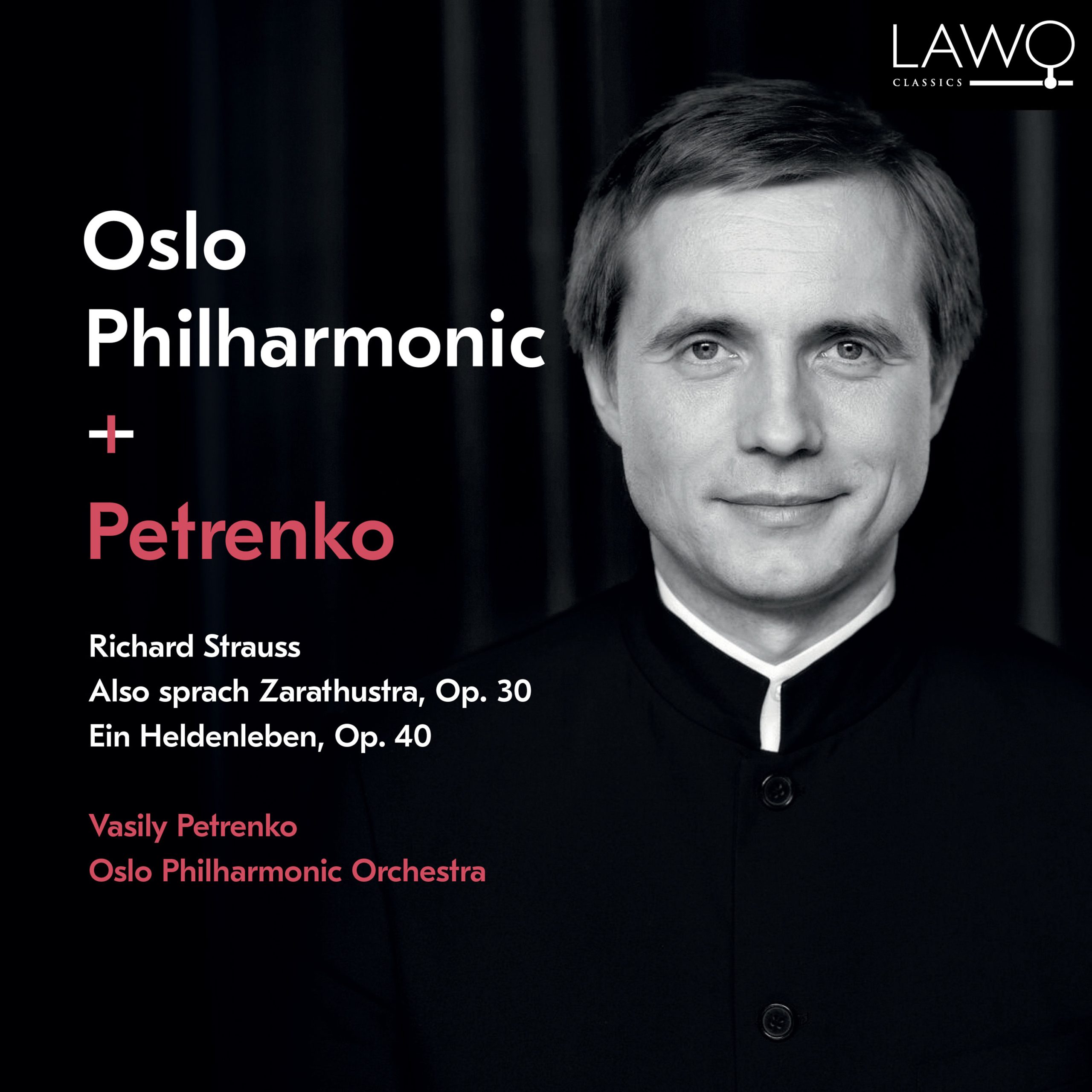
Richard Strauss – Also sprach Zarathustra, Op. 30 – Ein Heldenleben, Op. 40
Oslo Philharmonic Orchestra (Symphony orchestra) | Vasily Petrenko (Conductor)
Stream & download
Tracks
Richard Strauss (1864–1949)
Reviews
For their first recording project since their critically-acclaimed Scriabin cycle, Petrenko and his Norwegian orchestra embark on a new Strauss series on LAWO with two great…
Show more Show less
For their first recording project since their critically-acclaimed Scriabin cycle, Petrenko and his Norwegian orchestra embark on a new Strauss series on LAWO with two great tone-poems from the 1890s; reviewing a live performance of Also sprach in 2016, BachTrack observed that ‘Nietzsche may have proclaimed that God is dead, but he reckoned without Petrenko. All of creation seemed to emanate from the man as he summoned vast worlds into being.
 Presto Classical | 19.04.2019
As Petrenko’s tenure in Oslo begins to wind down, he revels in the standards of orchestral virtuosity he has attained with this excellent band in two Strauss tone poems that challenge all instrumental...
 Sunday Times | 21.04.2019
Spectacular music from the Oslo Philharmonic: Petrenko will bring his tenure as chief conductor in Oslo to a close by recording works by Richard Strauss.…
Show more Show less
Spectacular music from the Oslo Philharmonic: Petrenko will bring his tenure as chief conductor in Oslo to a close by recording works by Richard Strauss. It is by no means a bad idea, as the orchestral works of this German composer are a perfect fit for a sonically rich orchestra such as the Oslo Philharmonic. [...] The Oslo Philharmonic is, sonically speaking, a magnificent orchestra, and they make full use of this in these two works. Orchestral music at its most colourful and captivating!Show original
Spektakulær musikk fra Oslo-filharmonien: Petrenko vil avslutte sin tid som sjefsdirigent i Oslo med å spille inn verk av Richard Strauss. Det er ingen dum tanke for orkesterverkene til denne tyske komponisten passer et klanglig rikt orkester som Oslo-filharmonien som hånd i hanske. [...] Oslo-filharmonien er klanglg et flott orkester og dette benytter de seg av i disse to verkene. Orkestermusikk på det mest fargerike og besnærende!

[...] an expansive account that is detailed and questing, lyrically spacious in slower music, played sensitively and rapturously, while dramatic episodes enjoy thrill and sweep.
 Classical Source | April 2019
Read at Classical Source →
The opportunity to hear Petrenko conducting Richard Strauss is certainly a mouthwatering prospect.…
Show more Show less
The opportunity to hear Petrenko conducting Richard Strauss is certainly a mouthwatering prospect. [...] Strauss requires a massive orchestra with extended wind and brass sections and Petrenko bonds everything together with unwavering assurance, accompanying the imaginary hero on his adventures very convincingly. In such a vibrantly colourful score, crammed with incident, Petrenko reveals a surprising amount of often indiscernible orchestral detail. Particularly impressive is the performance of the third section, Des Helden Gefährtin (The Hero’s Companion), a love portrait of Strauss’s wife, Pauline de Ahna, effectively depicted by the solo violin of leader Elise Båtnes. [...] Certainly, the Oslo Philharmonic Orchestra plays beautifully under Vasily Petrenko, ...
 Musicweb International | April 2019
Read at Musicweb International →
Show all 13 reviews
The orchestra and Maestro Petrenko certainly live up to expectations.…
Show more Show less
The orchestra and Maestro Petrenko certainly live up to expectations. The Oslo Philharmonic now possesses an intensity and a finesse reminiscent of the Jansons era. And when two of Strauss’s undisputedly greatest works are being recorded – ‘Also Sprach Zarathustra’ and ‘Ein Heldenleben’ – expectations are set sky-high. To my ears, this is absolutely brilliant – indeed, I struggle to find other recordings that match the Oslo Philharmonic’s performance. [...] The mood is set – and what follows are 80 minutes of brilliant immersion and experience. [...] The balance in the recording is perfect, and when the musicians and conductor are as well-rehearsed as they are on this album, it is a delight for us listeners to experience such a vivid musical result. It must have been great fun recording this album!Show original
Orkester og maestro Petrenko innfrir så til de grader. Oslo-filharmonien har nå en intensitet og et finspill som minner om Jansons-æraen. Og når det er to av Strauss' desidert største verk som er lydfestet - «Also Sprach Zarathustra» og «Ein Heldenleben», så spennes forventningenes bue høyt. Dette er i mine ører fantastisk bra - ja jeg sliter med å finne andre innspillinger som matcher Oslo-filharmoniens spilleri. [...] Stemningen er satt - og det blir 80 minutter med strålende innlevelse og opplevelse. [...] Balansen i opptaket er perfekt og når musikere og dirigent er så godt samspilte som de er på denne platen er det en fryd for oss lyttere å få oppleve et særdeles levende musikalsk resultat. Det må ha vært gøy å spille inn denne plata!

This first release features two great tone poems ‘Also sprach Zarathustra’ and ‘Ein Heldenleben’ both works the Oslo Philharmonic has a long history of performing at home and abroad.…
Show more Show less
This first release features two great tone poems ‘Also sprach Zarathustra’ and ‘Ein Heldenleben’ both works the Oslo Philharmonic has a long history of performing at home and abroad. Vasily Petrenko, chief conductor of the Oslo Philharmonic since 2013, exploits the special intensity of the orchestra’s string sound and its magnificent wind and brass sections to full effect in this highly virtuosic music.
 My Classical Notes | 28.04.2019
Read at My Classical Notes →
Vasily Petrenko’s Also sprach Zarathustra is partly very sensitive, partly very dramatic.…
Show more Show less
Vasily Petrenko’s Also sprach Zarathustra is partly very sensitive, partly very dramatic. He is structuring the work excitingly and emphasizes the metaphysical side of the music. Ein Heldenleben is well coloured, powerful, but also lyrical, in a quite transparent and spacious sound. Thus the music acquires a great freshness, and anything that could sound pathetic is avoided.
 pizzicato | 01.05.2019
Read at pizzicato →
But the Oslo Philharmonic has always been proactive when it comes to the late Romantic and early modern repertoire.…
Show more Show less
But the Oslo Philharmonic has always been proactive when it comes to the late Romantic and early modern repertoire. Here, in Strauss, under Petrenko, they possess the necessary gravitas and tonal sensitivity required for Strauss. The fact that they dare to tackle *Das Heldenleben* – a work one cannot help but associate with a self-absorbed composer – works well because the orchestra and conductor do not approach the piece cautiously, but rather seem to turn it inside out. The exaggerations can thus be interpreted both as excessively autobiographical music and as a lesson in irony.Show original
Men Oslo-filharmonien har alltid vært på offensiven når det gjelder senromantisk og tidligmoderne repertoar. Her i Strauss, under Petrenko, har de den nødvendige tyngde og klangsensibilitet som skal til hos Strauss. At de våger seg ut på Das Heldenleben, som man ikke kan unngå å assosiere med en selvopptatt komponist, står seg godt fordi orkester og dirigent ikke angriper stykket på en forsiktig måte, men liksom vrenger innsiden. Overdrivelsene kan dermed tolkes både som en overdreven selvbiografisk musikk og som et lærestykke i ironi.
 Stavanger Aftenblad | 27.06.2019
Norwegian
We will pay close attention to the next production of this Strauss program, which only lacks few things to convince completely.
 Res Musica | 04.08.2019
Read at Res Musica →
The drama and thrilling orchestral writing of Strauss’s tone poems seem second nature to Vasily Petrenko on superb form.
 Gramophone Magazine | August 2019
Editor's Choice
The famous opening of Zarathustra is done in tempo, without milking the timpani or the trumpet fanfare, leading immediately into the essence of this performance, which consists of…
Show more Show less
The famous opening of Zarathustra is done in tempo, without milking the timpani or the trumpet fanfare, leading immediately into the essence of this performance, which consists of detailed phrase-shaping that brings out the musical values in an overly familiar score. [...] Petrenko’s reading should especially win over listeners who know the score well, because he is so imaginative in the intricacies of Strauss’s scoring in between the big moments. [...] Petrenko has hit a peak of excellence few can match right now. This thrilling Strauss album demonstrates what a gifted conductor can do to transcend familiarity and make old music new again.
 Fanfare Magazine | October 2019
A remarkable achievement. And the camaraderie amongst the musicians?…
Show more Show less
A remarkable achievement. And the camaraderie amongst the musicians? – *Ein Heldenleben* is, in every sense, a showpiece that pushes the orchestra to its limits; if it passes this test with flying colours (the right word), then it is a true orchestra. The Oslo Philharmonic did just that, of course – a great achievement and, for that matter, a great interpretation, when it is indeed one. And so too is the recording of *Ein Heldenleben*, which is already available on CD (LAWO 1166). And I must say, on behalf of many others – Elise Båtnes’s ‘wondering’ and beautiful solo passages were well worth the 40 minutes. Though that’s nonsense, of course; you’ll be listening anyway once *Ein Heldenleben* starts playing.Show original
En bragd. Og kjærligheten blant musikere? – Ein Heldenleben er på alle vis et show-stykke, som utfordrer alle orkestrets utfordringer, står det prøven med glans (riktig ord) er det et virkelig orkester. Det gjorde Oslo-filharmonikerne, selvfølgelig – en stor bragd og for så vidt tolkning, når den først er det. Og det er også innspillingen av Ein Heldenleben, som allerede er ute på Cd (LAWO 1166). Og så må jeg si, på vegne av atskillig flere – Elise Båtnes «undrende» vakre soloinnslag var verd de 40 minuttene. Skjønt det er tull, man hører jo på, når Ein Heldenleben først spilles.
 Vårt Land | 18.01.2020
Norwegian
Credits
- Conductor
- Vasily Petrenko
- Performer
- Elise Båtnes (Violin)
- Symphony orchestra
- Oslo Philharmonic Orchestra
- Composer
- Richard Strauss
- Producer
- John Fraser
- Engineer
- Arne Akselberg
- Mastering
- Thomas Wolden
- English translation
- Jim Skurdall
- Executive producer
- Vegard Landaas
- Booklet editor
- Hege Wolleng
- PR
- Camilla Momkvist-Skau
- Cover photo
- Anna-Julia Granberg
- Artist photo
- Oslo Philharmonic Orchestra by CF Wesenberg
- Design
- Anna-Julia Granberg | Blunderbuss
- Recording location
- Oslo Concert Hall
- Recording country
- Norway
- Recording year
- 2016
- Recording dates
- 01.11.2016 | 02.11.2016 | 03.11.2016 | 04.11.2016 | 05.11.2016 | 06.11.2016 | 07.11.2016 | 08.11.2016
- Original source
- DXD (352.8 kHz, 24 bit)
- Discs / tracks
- 1 disc | 2 tracks
- Release year
- 2019
- Label
- LAWO Classics
- Duration
- 1:19:55
- EAN
- 7090020181882
- ISRC
- NOEHX1820010/20
Booklet text
Long before Richard Strauss came to maturity as a composer, European theorists had been pitting the contrasting ideologies of 'pure music' and 'programme music' against one another. As a talented young man, Strauss was instructed by his horn-playing father to avoid programme music at all costs – music, in other words, which recounted some sort of narrative without recourse to words or dance. Strauss's father went so far as to forbid him from reading any scores other than those of the pure classicists and their successors (in other words, Mozart, Beethoven and Brahms).
When Strauss junior eventually discovered Wagner, Liszt and Berlioz, it proved a revelation. Before he focused his attentions resolutely on opera from 1900 onwards, Strauss created a string of magnificent orchestral tone poems that heralded a new age of orchestral virtuosity and owed a clear debt to all three composers. But Strauss cited Beethoven too, specifically his music for Goethe's play Egmont, in trying to persuade his father and others that the path was a legitimate one.
In the early 1890s, Strauss was at work on his opera Guntram, immersing himself in the writings of the philosopher Friedrich Nietzsche. The composer had been drawn to Nietzsche's criticisms of organized religion given their implications for his title character, who sought inspiration and meaning from a higher plane of spirituality. Nietzsche's concept of the 'superman' – a being who would transcend traditional thought and determine the parameters of his own existence – lingered in Strauss's mind long after Guntram was finished.
Strauss saw the difficulties in setting such philosophical concepts to operatic music, which is one reason Guntram failed. That led the composer to ponder the creation of a large orchestral tone poem based on Nietzsche's Thus Spake Zarathustra, a poetic vision of the Persian prophet Zoroaster who descends from a mountaintop to share his insights with the world.
In February 1896, Strauss started to sketch his score. The aim was to reflect on Nietzsche's proposed divisions between man and nature. The composer subtitled his work 'Freely after Nietzsche', probably because it focused on just eight of the 80 subsections in the philosopher's original poem. The finished piece was first performed the following November in Frankfurt.
Strauss asserted more than once that it wasn't necessary to know the narrative behind the work to understand it. 'The poetic programme is nothing more than the initial cause…in which I then give expression to my feelings', he wrote. 'For the listener an analytical programme should be no more than a guide. Whoever really understands how to listen to music probably has no need of it,' he continued. Still, Strauss's gift for describing events and concepts in music was second to none.
In addition, Also Sprach Zarathustra contains some of the composer's most voluptuous music: rich, malleable, unpredictable, wickedly exciting, touchingly tender and intensely dramatic, all of it wrapped up in the composer's own brand of orchestral display. Some contemporaries derided such music as 'too loud' and 'too full of notes'. But Claude Debussy immediately recognized its power and significance, comparing Strauss's music to the burgeoning art of cinematography.
Debussy's observation was prescient; in the following century the film industry famously borrowed Also Sprach Zarathustra's opening bars. But rather than the black expanses of nothingness seen in Stanley Kubrick's 2001: A Space Odyssey, in Strauss's work those bars herald Zoroaster's emergence from a mountainous peak after years of solitude. 'The sun rises', explained Strauss, 'the individual enters the world, or the world enters the individual.'
The music introduces a rising, heraldic figure in the key of C. Throughout the piece, that figure tussles with the key of B major, heard most frequently in subsequent up-down broken chords. Here we have a philosophical battle proposed via a simple contrast of keys: C for the superman who can tame nature, B (major and minor) for foolish, mistaken mankind. We then hear four short sections followed by four longer ones, in which Zoroaster wrestles with religious dogma and more.
The first four work themselves up before winding down again. We hear of the 'backworldsmen', the simple beings drawn to the superstition of religion (for Nietzsche), characterized by a devotional theme initiated by a cello. Of the Great Longing and Of Joys and Passions are both interrupted by the nature motif; the latter's portrait of man's sensuality is also brought to order by prudish trombones. In Funeral Song, man once again tries but fails to look beyond his primitive existence.
In the first of the four longer episodes, Of Science, Strauss uses the nature motif as the basis for a fugue: the motif is introduced and discussed in detail at staggered intervals and at different pitches, starting on quiet, low strings. That music is constantly pulled downwards by the weight of its own intellect, until it bursts hysterically outwards in The Convalescent, where Strauss's two opening motifs battle once more, accompanied by cackling quotes from another of his tone poems, Till Eulenspiegel's Merry Pranks.
In Dance Song, Zoroaster glimpses the wonder of the superman; his joy spawns a rollicking waltz introduced by a solo violin that toys with many of the themes already heard. Finally, in The Song of the Night Wanderer, the low Cs of nature prove beyond the realms of man's bright B major chords. The two worlds appear to slip away from one another as the orchestral texture becomes eerily sparse.
So where does this leave our 'superman' and, by implication, Strauss himself? This is where the composer strays from Nietzsche's script and onto his own. According to the musicologist Bryan Gilliam, the score's final pages suggest that man is destined for a life of the 'eternal convalescence' heard in the passage before the waltz; man may glimpse visions of the next world, but is unable to transcend, 'frustrated by self-doubt'.
Strauss followed Also Sprach Zarathustra with a tone poem for cello, viola and orchestra after Cervantes's legend of Don Quixote – the fifth orchestral work from his pen to be inspired by a larger-than-life figure from literature or folklore. When he came to follow that piece in 1898, the 34-year-old composer turned to a character that fascinated him 'as much as Napoleon or Alexander': it was none other than Strauss himself. His new work Ein Heldenleben ('A Hero's Life') was to be an orchestral autobiography. That was the suggestion, at least.
The very idea might sound like an act of tremendous immodesty, even before we consider the bombastic brilliance with which the composer introduces The Hero's qualities of ambition, resilience, bravery and intellect in Ein Heldenleben's opening pages. Strauss protested in a letter to his father that The Hero was 'not in fact a single figure' but in retrospect those words look like an act of pleading. Strauss would depict himself and his life in music throughout his career, but we can assume that as a composer of some wit, he did so with his tongue planted firmly in his cheek.
That introduction is a case in point. It gives us the 'Hero' via a broad theme that straddles three octaves, spans 16 bars and births a tone poem that feels hugely ambitious and all-encompassing even after the excesses of Also Sprach Zarathustra – way beyond the egotistical realms of a Bavarian composer who was actually possessed of rare self-awareness. In this imposing score the composer extends his already impressive and fully integrated toolbox of orchestral techniques, and can do so precisely because of the narrative's range of expression: we meet not just the central Hero, but a confection of souls with whom he fraternized and fought.
Strauss fought, of course, with critics. After Ein Heldenleben's premiere in Frankfurt in 1899, one review spoke of the 'mocking creations of an overheated, sick imagination.' Not only had the writer apparently missed the fertile rhythmic and textural innovations in the passage he described from 'The Hero's Battlefield', his words also reinforced the composer's own view of such criticism as depicted in 'The Hero's Adversaries'.
This, the second of Strauss's six sections, is a caricature of critics but also a representation of more abstract doubts and barriers. For Strauss, there were four types of critic: carpers (heard on the flute), vituperators (oboe), whiners (cor anglais), and hair-splitters (tuba). The tuba's theme is said to explicitly outline the name of Strauss's nemesis in the Munich press, a certain Doctor Dehring (think of the theme against the syllables Doc-tor DEH-ring). Although The Hero appears to dispatch these cynics with ease, critical specters continue to haunt the piece as it proceeds.
Strauss used the tenderness of a solo violin to depict his love for his wife Pauline in a whole raft of works, which would appear to undermine his denial of Ein Heldenleben's autobiographical qualities further as a violin sings out a series of increasingly demanding cadenzas in 'The Hero's Companion'. The composer's wife Pauline was capricious and tricky but Strauss delighted in her strength of personality and couldn't live without her. The section ends with a rapturous love scene, gate-crashed at the last by the sniping critics of the previous portrait.
Three off-stage trumpets herald 'The Hero's Battlefield', which contains the work's most turbulent, cinematic and magnificent music. The horn, the instrument of Strauss's almost-celebrity father, also held special personal significance for the composer. The battle is arduous and brutal, but when it ends all eight of the orchestra's horns proclaim victory in unison.
In 'The Hero's Works of Peace', Strauss makes his most overt autobiographical gestures, quoting from nine of his previous compositions including Guntram and six of the tone poems. Most obviously, we hear the impish main theme of Till Eulenspiegel's Merry Pranks (on a clarinet) and the louche posturing of Don Juan (on woodwinds and a solo cello), but most of the themes are integrated so seamlessly that they are easy to miss. Listen hard, and you may hear the 'nature' motif from Also Sprach Zarathustra cropping up around a minute in to the movement on a trumpet. Not so elusive is the seemingly irrepressible tuba of Doctor Dehring.
Strauss's final chapter describes 'The Hero's Retirement from the World and the Fulfillment of his Life'. As the composer went on to write 14 operas, this movement is canny in its distancing of the piece from any parallel in the composer's life beyond those imagined. After one last internal struggle, the cor anglais recalls a pastoral theme from the tone poem Don Quixote and the music moves from bravado to serenity – from confidence to disarming love. There are final utterances from a solo horn and violin; pictures of Strauss and his wife, perhaps, having transcended their troubles.
— Andrew Mellor