
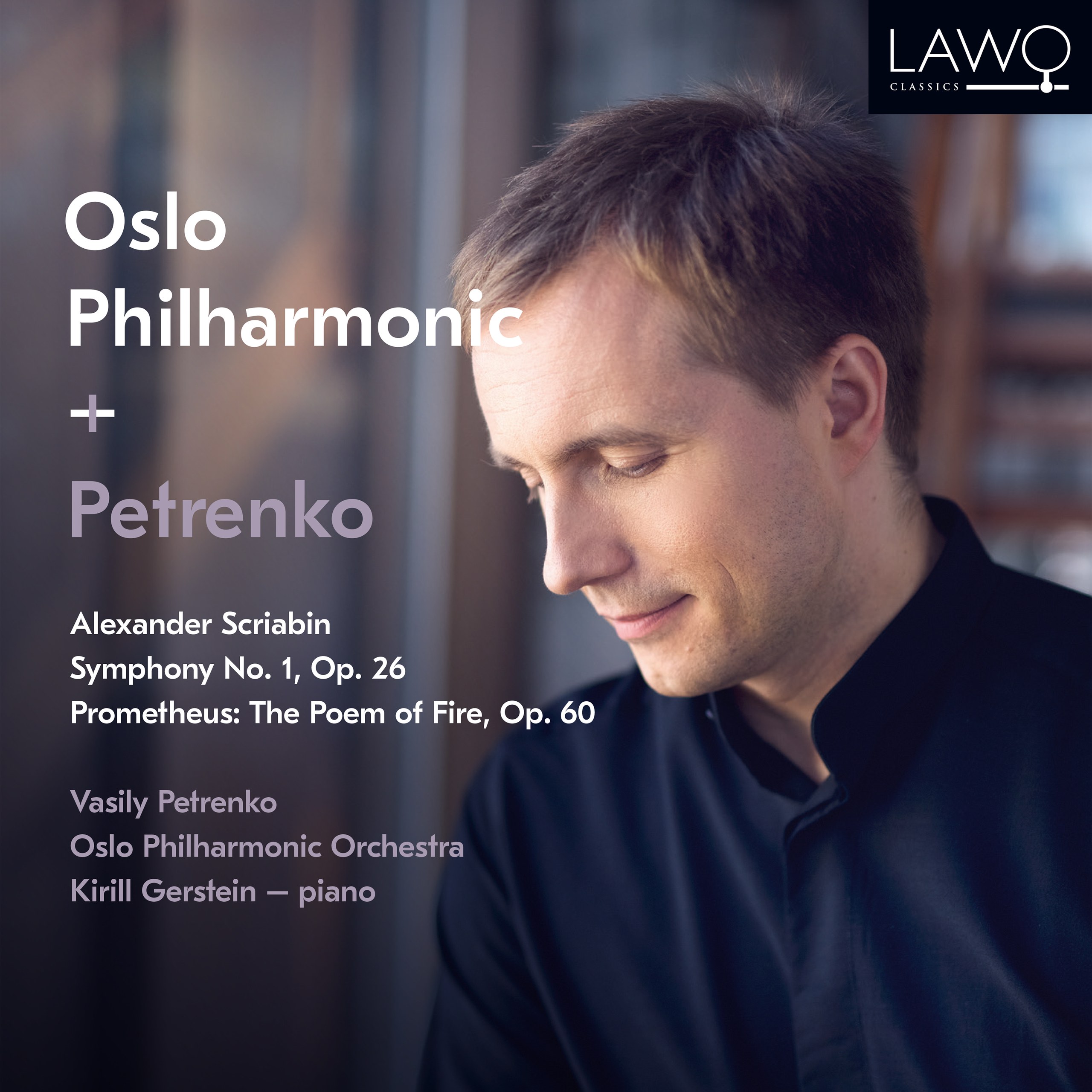
Alexander Scriabin
Scriabin Symphony No. 1 – Prometheus: The Poem of Fire
Kirill Gerstein (Piano) | Oslo Philharmonic Orchestra (Symphony orchestra) | Vasily Petrenko (Conductor)
Stream & download
Tracks
Alexander Scriabin (1872–1915)
Symphony No. 1, Op. 26
Symphony No. 5, Op. 60
Vasily Petrenko (conductor) | Oslo Philharmonic Orchestra | Kirill Gerstein
Reviews
This Petrenko account is first class and can stand confidently alongside the finest accounts.…
Show more Show less
This Petrenko account is first class and can stand confidently alongside the finest accounts. […] The imposing Oslo Philharmonic Choir combines with the soloists to remarkable effect, resulting in a conclusion with a tumultuous outburst of passion. […] Gerstein produces the elevated level of performance to which I have become accustomed.
 Musicweb International | September 2018
Read at Musicweb International →
It’s their performance of Prometheus, one of Scriabin’s greatest achievements, that stands out.
 The Guardian, October 25 | 2018
There is a great deal of emotion in Scriabin’s music.…
Show more Show less
There is a great deal of emotion in Scriabin’s music. Emotions that Petrenko and his orchestra convey brilliantly. The music and the musicians merge to become, in effect, a living organism that is impossible not to be moved by. The performance is powerful; the orchestra’s instrumentalists impress both in their solo passages and as a unified musical ensemble. Such a performance also demands a top-class conductor, something Petrenko once again demonstrates.Show original
Det er mye følelser i Skrjabins musikk. Følelser som Petrenko og orkesteret hans formidler på en glimrende måte. Musikken og musikerne smelter sammen til faktisk å bli en levende organisme som det er umulig å ikke bli grepet av. Musiseringen er sterk, instrumentalistene i orkesteret imponerer både i de solistiske innslagene, samt som en musikalsk enhet. Slikt fordrer også en dirigent i toppklasse, noe Petrenko igjen viser.

We listened with great pleasure to the first recordings by Vasily Petrenko with the Oslo Philharmonic.
 Sonograma Magazine | 29.11.2018
Read at Sonograma Magazine →
Petrenko shapes such details with great finesse and equally digs out instrumental niceties from the heady perfumed tumult of Prometheus.…
Show more Show less
Petrenko shapes such details with great finesse and equally digs out instrumental niceties from the heady perfumed tumult of Prometheus. Precision, transparency, and, when it's warranted, sweltering heat.
Show all 8 reviews
Very strong moments of orchestra and the great form of Petrenko.
[...] Petrenko makes the music sound beautiful and poetic from bar to bar, which is about all anyone can do in the amorphous luxuriance of Lymphony No.…
Show more Show less
[...] Petrenko makes the music sound beautiful and poetic from bar to bar, which is about all anyone can do in the amorphous luxuriance of Lymphony No. 1. [...] The woodwind solos are delicately handled, and the Oslo Philharmonic Choir, extravagantly called upon only in the last four minues of the symphony, is excellent and recorded with clarity.
 Fanfare Magazine | April 2019
[...], Petrenko seems to have an instinct for where the music wants to go , and he takes it there unerringly and without mannerisms.…
Show more Show less
[...], Petrenko seems to have an instinct for where the music wants to go , and he takes it there unerringly and without mannerisms. His reading is not only well thought out and executed; it breathes in a way that makes it seem as if the score is playing itself. [...] The chorus is good, and the Russian tone of both soloists fits perfectly. I had the same response to it that Don O'Connor did reviewing Petrenko's Scriabin Third and Fourth when he called the orchestra a "delightful surprise, responding to every nuance of Petrenko's vision of the msic. This expecially emerges in some brass parts, which often sound blatty, but here sound noble.
 American Record Guide | 2019-03
Credits
- Conductor
- Vasily Petrenko
- Performer
- Alisa Kolosova (Mezzo-soprano) | Alexey Dolgov (Tenor) | Kirill Gerstein (Piano)
- Symphony orchestra
- Oslo Philharmonic Orchestra
- Composer
- Alexander Scriabin
- Producer
- Andrew Walton
- Engineer
- Thomas Wolden | Vegard Landaas
- Mastering
- Thomas Wolden
- English translation
- Jim Skurdall
- Executive producer
- Vegard Landaas
- Booklet editor
- Hege Wolleng
- PR
- Camilla Momkvist-Skau
- Cover photo
- Anna-Julia Granberg
- Artist photo
- Kirill Gerstein by CF Wesenberg | Kirill Gerstein by Marco Borggreve
- Session photo
- Fred-Olav Vatne
- Design
- Anna-Julia Granberg | Blunderbuss
- Recording location
- Oslo Concert Hall
- Recording country
- Norway
- Recording year
- 2017
- Recording dates
- 08.05.2017 | 09.05.2017 | 10.05.2017 | 11.05.2017 | 12.05.2017 | 04.09.2017 | 05.09.2017 | 06.09.2017 | 07.09.2017 | 08.09.2017
- Original source
- DXD (352.8 kHz, 24 bit)
- Discs / tracks
- 1 disc | 7 tracks
- Release year
- 2018
- Label
- LAWO Classics
- Duration
- 69:38
- EAN
- 7090020181820
- ISRC
- NOEHX1814010/70
Video
Booklet text
Come, all peoples of the world, / Let us sing the praises of Art! / Glory to Art, Glory forever!
(Excerpt of the words in the final movement of Alexander Scriabin's Symphony No. 1)
There was no doubting the young Russian composer Alexander Scriabin's (1872-1915) high ambitions when he presented his first symphony to the public. With its six-movement, hour-length duration, incorporating a grandiose choral finale, complex chromatic harmonic language and self-composed text paying tribute to the universal greatness of art, Scriabin made a grand entrance on the international symphonic stage. Beethoven's ninth might well have served as a model, but the symphony's harmonic language owes more to Tchaikovsky, Strauss, and above all, Wagner. For Scriabin, this grand symphonic project was the start of an even greater artistic plan. His ambitions reached far beyond the traditional boundaries of music and into the realm of philosophy and existentialism.
Russian composer, philosopher and mystic Alexander Scriabin was one of the most eccentric and mystic figures of the age of modernism. His innovative sounds and utopian ideas challenged not only performers and audiences of the time, but also the boundaries of our thinking, the categories of history, and the limitations of art. His apparently egocentric view of the world, his megalomania and delusions have been psychoanalyzed, ridiculed and dismissed. He genuinely believed that art in general, and his own music in particular, could change the world and raise humankind to a higher level of awareness. His plan was that his musical oeuvre would culminate with Mysterium, a work that was to be performed at the foot of the Himalayas, in which all art forms came together, time and space dissolved and all present participated in a spectacular transcendence.
One of the first steps towards this utopian moment was the Symphony No. 1 which Scriabin began drafting in 1899 and completed in 1900. By that time, he had discovered two of his most important conceptual bases. The first of these was Russian symbolism, especially the symbolism associated with the ideas of Alexander Soloviov in which art plays a defining role as a builder of bridges between extreme contrasts in life and the world, taking on almost religious functions. In many ways, Symphony No. 1 gives voice to Soloviov's 'theurgical' understanding of art — implicitly in the first five movements and explicitly in the final movement's verbal tribute to the unfathomable greatness of art. Although the words are not Soloviov's own, Scriabin has captured a similar spirit and world of ideas.
Scriabin's second conceptual basis was the music and ideas of Richard Wagner. In Wagner's concept of the 'Gesamtkunstwerk' Scriabin found a cautious variant of what he himself so strongly believed in. Of perhaps greater relevance in this context was the fact that Wagner's harmonic language provided a decisive point of departure for Scriabin around 1900. He was one of few Russian composers who took Wagner seriously, incorporating chromaticism and extended traditional harmony within his own musical style, eventually taking both to their very extremes. Scriabin was so deeply engrossed in Wagner's ideas that between 1900 and 1903 he planned a grandiose, philosophical opera based on the myth of Eros and Psyche, the inspiration for which undoubtedly lies in Wagner's Tristan und Isolde. Scriabin eventually abandoned the project but carried Wagnerian compositional techniques and stylistic elements forward into his first two symphonies.
It is particularly in the two Allegro movements, and in parts of the final choral movement, that certain harmonic and melodic elements point towards Tristan and other Wagner operas as possible influences. Scriabin operates within a similar late romantic, expressive idiom with extensive use of chromaticism and chord progressions on the very brink of conventional tonality. The symphony also offers lyrical passages in the spirit of Tchaikovsky, such as in the introductory Lento movement which more or less serves as a prelude. The concluding choral movement is perhaps the most special and gripping moment for many, particularly at the point where art is extolled in words and music in a complex fugal section preceding the mighty finale. In this final movement the orchestra is extended with soloists and a choir; the reference to Beethoven's ninth is as obvious as it is bold. By ending his first symphony in this way, Scriabin indicated his intention to take up competition with the musical giants of the past, and that his approach to art was both profound and ambitious to the extreme.
Contrary to Scriabin's wish, the final movement was omitted at the symphony's first performance in 1900, the publishers claiming that the choral part was 'impossible to sing'. In 1901, however, the work was performed complete under the leadership of Vasily Safonov in Moscow. It never became part of the standard repertoire, but has gained renewed interest in recent years, parallel to Scriabin's growing international popularity. For Scriabin, the work was without a doubt a major step along the road to the Himalayas and the great mystery he envisioned for the future. He never made it that far, however, and when he died of blood poisoning at the age of 43, he left the world and humanity more or less unchanged. His output is nonetheless regarded one of the most fascinating in the history of western music; in the absence of the great Mysterium, it is Prometheus - The Poem of Fire, his last symphonic work and often referred to as his fifth symphony, that remains Scriabin's greatest mystic legacy.
It is quite incredible to contemplate the stylistic development that Scriabin's music underwent between the first symphony and The Poem of Fire. Only a decade separates the two works, yet they appear to inhabit two entirely different musical worlds. Not only have all traces of Wagner and Soloviov vanished from the harmonic language in Prometheus; Scriabin has set aside the entire tonal fundament and diatonic key system. Instead, he uses octatonic and whole-tone scales and avoids the sensation of major and minor. From the very first chord, it is clear that we are in new and unfamiliar terrain. The distinctive, dissonant chord is Scriabin's musical signature and consists of the notes A, D-sharp, G, C-sharp, F-sharp, B, a chord Scriabin used in several works and which became known as the 'mystic chord'. A large portion of the work is built around the chord and its constituent notes in various forms and constellations.
The mystic chord and all that came with it was not, however, the only innovation that Scriabin introduced in Prometheus. Scriabin was blessed — or perhaps cursed — with a condition called synesthesia in which stimulation of one sense is experienced by a different sensory area of the brain — such as, in Scriabin's case, seeing colour when hearing music. In Prometheus Scriabin took this multi-modality out of the orchestra to create an independent part for Luce — a 'colour organ' or 'chromola'. Despite the title, Scriabin's work is only loosely based on the myth in which Prometheus steals fire from the gods and gives it to humans. Scriabin envisaged a colour organ in which two 'colour parts' were to be performed with the orchestra. One of the parts follows the chords, illustrating Scriabin's synesthetic linking of specific chords with specific colours; the other colour part has a slower rhythm. Even though the colour organ can only be experienced in the listener's imagination on this recording, it is testimony to Scriabin's innovative and original ideas.
There can be little doubt that the audience found the music modern and unfamiliar when Serge Koussevitzky conducted it for the first time in Moscow in 1911. Scriabin's mystic harmonic universe is so distinctive that it still jogs listeners out of their comfort zone into uncharted waters. And even if a state of transcendence is not achieved, Scriabin never came closer to sublimity than he did at the conclusion of Prometheus - The Poem of Fire. Choir and orchestra, sound, light, and colour all come together as the mystic chord finally resolves into a powerful and consonant major triad — a hint of the grand transformation that Scriabin had planned for us all, from the primeval dark of mysticism to the ecstatic enlightenment of a greater awareness.
— Notes: Thomas Erma Møller · English translation: Andrew Smith