
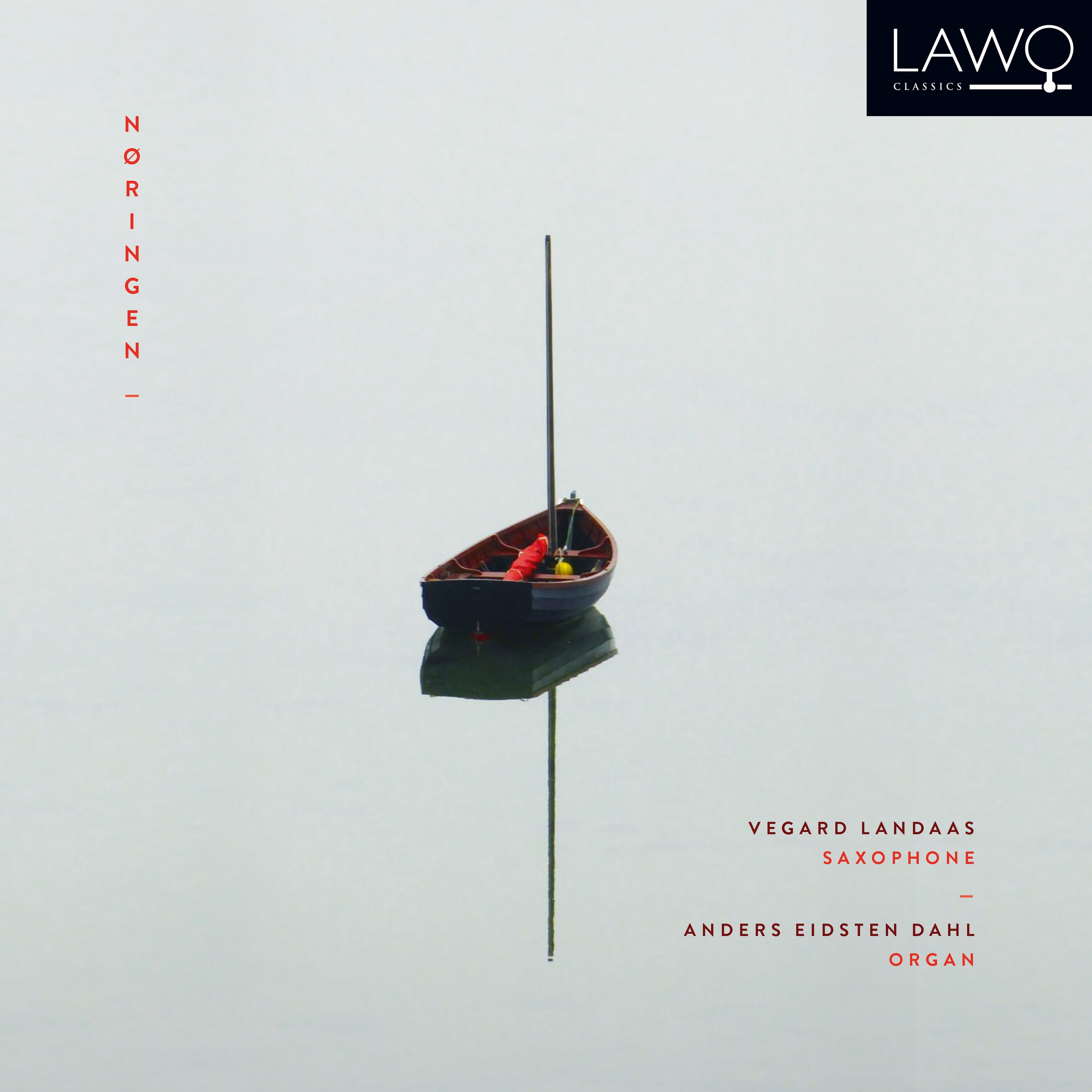
Nøringen
Vegard Landaas (Saxophone) | Anders Eidsten Dahl (Organ)
Stream & download
Tracks
Traditional
Maria Theresia Paradis (1759–1824)
Johann Sebastian Bach (1685–1750)
Sonata in E-flat major, BWV 1031
Traditional
Erik Satie (1866–1925)
Gabriel Fauré (1845–1924)
Nils Lindberg (1933–2022)
Serge Rachmaninoff (1873–1943)
Traditional
Johann Sebastian Bach (1685–1750)
Traditional
Reviews
Solid performers. Landaas has a beautiful and expressive tone, which he manages to vary in a restrained manner, depending on the repertoire.…
Show more Show less
Solid performers. Landaas has a beautiful and expressive tone, which he manages to vary in a restrained manner, depending on the repertoire. Classical music is given the calm and gravitas it deserves, whilst folk music possesses the spontaneity we expect, with appropriate ornamentation and musical freedom. Eidsten Dahl is a responsive accompanist who brings richness and variety of expression to the music.Show original
Solide utøvere. Landaas har en vakker og uttrykksfull tone, som han klarer å variere på en behersket måte, alt etter repertoaret. Den klassiske musikken får den ro og tyngde den skal ha, samtidig som folkemusikken har den spontanitet vi forventer, med adekvate ornamenter og musikalsk frihet. Eidsten Dahl er en lydhør medspiller som tilfører musikken rikdom og variasjon i uttrykket.

Saxophone and organ: a combination we're not used to seeing perform Norwegian folk tunes and Baroque.…
Show more Show less
Saxophone and organ: a combination we're not used to seeing perform Norwegian folk tunes and Baroque. Surprisingly beautiful and rich in tone.
 BBC Music Magazine | November 2018
The album *Nøringen* offers a varied and well-composed programme, in which classical gems and folk-inspired arrangements alternate.…
Show more Show less
The album *Nøringen* offers a varied and well-composed programme, in which classical gems and folk-inspired arrangements alternate. [...] This album must be a great source of inspiration for both organists and saxophonistsShow original
Med albumet Nøringen får vi et variert og godt komponert program, der klassiske perler/svisker og folketone-arrangementer avløser hverandre. [...] Dette albumet må være en stor inspirasjon for både organister og saksofonister
 Orgelspeilet | 2018
Norwegian
The sound combinations are very good, both musicians fully reveal the mastery of their instruments and highlight this wonderful alliance between the language of tradition and the language of classics.…
Show more Show less
The sound combinations are very good, both musicians fully reveal the mastery of their instruments and highlight this wonderful alliance between the language of tradition and the language of classics. Vegard Landaas and Anders Eidsten Dahl express concepts and images, surpassing purely sound limits. A sound poem.
 Sonograma Magazine | 29.12.2018
Read at Sonograma Magazine →
On this album you’ll find classic gems and exciting folk music arrangements – all performed to the highest standard.…
Show more Show less
On this album you’ll find classic gems and exciting folk music arrangements – all performed to the highest standard. Vegard Landaas once again showcases his superb saxophone playing, with a tone that is particularly irresistible. And when the accompanist plays the organ at Strømsø Church in Drammen in the manner heard here, the hour simply flies by. Here you’ll be treated to music by Johann Sebastian Bach. Gabriel Fauré, Maria Theresia Paradis, Erik Satie, Nils Lindberg and Sergei Rachmaninoff. As well as a number of folk tunes. A great album!Show original
På denne platen finner du klassiske perler og spennende folkemusikkarrangementer - alt gjort på forbilledlig vis. Vegard Landaas viser igjen frem et meget godt saxofonspill, der spesielt klangen er uimotståelig. Og når den musikalske medmusikeren trakterer orgelet i Strømsø kirke i Drammen på slik måte som det er gjort her, fyker timen av gårde. Her får du servert musikk av Johann Sebastian Bach. Gabriel Fauré, Maria Theresia Paradis, Erik Satie, Nils Lindberg og Sergej Rakhmaninov. Samt en rekke folketoner. God plate!
Credits
- Performer
- Vegard Landaas (Saxophone) | Anders Eidsten Dahl (Organ)
- Composer
- Maria Theresia Paradis | Johann Sebastian Bach | Erik Satie | Gabriel Fauré | Nils Lindberg | Serge Rachmaninoff | Bjørn Luksengård | Kåre Nordstoga | Henning Sommerro
- Producer
- Vegard Landaas
- Engineer
- Thomas Wolden
- Editing
- Vegard Landaas
- Mastering
- Thomas Wolden
- Liner notes
- Anders Eidsten Dahl
- English translation
- Jim Skurdall
- Executive producer
- Vegard Landaas
- Booklet editor
- Hege Wolleng
- PR
- Camilla Momkvist-Skau
- Cover photo
- Pexels.com CC licence
- Artist photo
- Vegard Landaas by Anna-Julia Granberg | Anders Eidsten Dahl by Elin Eike Worren
- Design
- Anette L’orange | Blunderbuss
- Recording location
- Strømsø Church, Drammen
- Recording country
- Norway
- Recording year
- 2017
- Recording dates
- 09.08.2017 | 10.08.2017
- Original source
- DXD (352.8 kHz, 24 bit)
- Discs / tracks
- 1 disc | 15 tracks
- Produced with support from
- Orgelbau Mühleisen GmbH | Strømsø Congregation
- Release year
- 2018
- Label
- LAWO Classics
- Duration
- 59:11
- EAN
- 7090020181813
- ISRC
- NOEHX1813010/150
Booklet text
Saxophone and organ sound good together and complement each other well, yet little music has been written for this instrumental combination. For this reason, we are always looking for music that works well and often it is music written for instruments other than our own. Part of the effort of finding good music involves getting accomplished composers and arrangers to write for us.
This recording is the concrete result of a concert tour we undertook in Slovakia during some hectic days in the summer of 2017. It features a broad range of music, and the quality, we feel, merits being presented on this album. In addition to the rehearsed repertoire, Bjørn Luksengård (b. 1956), church organist in Sande, Vestfold, sent us his arrangements and compositions during the tour. To some extent we developed the repertoire between the concerts and also tried out some of the music in concert situations. Not long after returning to Norway, we met for several intense days of recording in Strømsø Church in Drammen. It is one of Norway's largest wooden churches and acquired its Mühleisen organ with 31 stops in 2011. The melodious organ and the church's good acoustics gave us the conditions we were looking for.
A common theme on this recording is traditional music, and we begin in Telemark with an arrangement by Kåre Nordstoga (b. 1954) of "Gammel-Sjugurmarsjen." In addition to being cathedral organist in Oslo and a concert organist of international stature, Nordstoga, himself from Telemark, performs and is an expert on Norwegian traditional music. The arrangement played here was written for the wedding of Crown Prince Haakon and Crown Princess Mette-Marit in Oslo Cathedral in 2001.
Track 2 features one of Bjørn Luksengård's traditional music arrangements written especially for us. In "Kom hjerte, sjung en aftensang" the events of the day are sorted out before the night's repose.
Maria Theresia Paradis's (1759–1824) best known composition is "Sicilienne in E-flat major" for violin and piano. Indeed, there are numerous indications that the "discoverer" of the piece, violinist Samuel Dushkin (1891–1976), is the actual composer. No matter what its origin, the piece is a little gem that deserves the attention posterity has paid it. A sicilienne is a quiet piece of music of pastorale character and dotted rhythms. Paradis's "Sicilienne" follows this pattern and is superbly suited to our instrumental combination, though written for violin and piano.
The immense life work of Johann Sebastian Bach (1685–1750) also includes chamber music for the instrumentations of the day. His music for flute was written between 1720 and 1741, a time when the recorder gradually was being replaced with the forerunner of the modern transverse flute. Here, too, there are some doubts regarding the origin of the piece. Two independent sources, Bach's own son, Carl Philipp Emanuel (1714–1788), and Johann Sebastian's last pupil, Christian Friedrich Penzel (1737–1801), have both named Johann Sebastian Bach as composer. But the resemblances between this sonata and the flute sonata in E-flat major by Johann Joachim Quantz (1697–1773) are striking and give rise to speculation whether Bach's sonata is simply a variant and something of a musical paraphrase of the Quantz sonata.
In "Nøringen" we encounter again the musical expression of arranger Bjørn Luksengård, with a folk tune that conveys feelings of longing. The text and the pensive melody communicate ill-fated love: "I see you, I see you, yet cannot come to you. But had I oars and a sturdy boat, so would I hasten thither."
In recent years, "Brureslått fra Øre" has become a favourite bridal march in church wedding ceremonies, and most of those who attend church weddings in Norway will become acquainted with it at one time or another. The version we play, arranged by Henning Sommerro (b. 1952), works well for most solo instruments with organ accompaniment.
Erik Satie (1866–1925) has a special place in music history. He saw himself as breaking with the romantic ideals of his time. Phonometrician was a term he used in reference to himself and his work as an artist. The word can mean "someone who measures sound." Among the ca. 200 piano works he wrote, we find three "Gymnopédies," written in 1888. The word gymnopaedia appears in a poem from the same time and describes a dance from ancient Greece.
French composer, pianist and organist Gabriel Fauré (1845–1924) is regarded as one of the most important composers in France in the period between romanticism and modernism. "Sicilienne," written in 1893, was originally an orchestral work composed for a theatre production. Fauré arranged the piece a few years later for cello and piano. Alongside his "Requiem," "Sicilienne" is one of Fauré's most performed works. Though there is hardly an instrumental combination for which this piece has not been arranged, we think saxophone and organ work extremely well for this music.
The works of Nils Lindberg (b. 1933), who comes from a musical family in Dalarna, bear the influence of the traditional music of his home district. Lindberg is also known for compositions inspired by jazz, and it is indeed the combination jazz and traditional music that we find in his "Visa efter Torn Erik." Originally written for saxophone (clarinet) and organ, the piece vividly confirms that music in itself is genre-crossing. This is Swedish traditional music with a classical and jazz-inspired tonal language, written for a Belgian wind instrument, and the main church instrument.
Sergei Rachmaninoff (1873–1943) grew up in a musical family and exhibited his extraordinary gifts as pianist and composer at an early age. He was not only a celebrated composer, but known as well throughout the world as a brilliant pianist. He wrote "Vocalise" for soprano Antonina Nezhdanova in 1915, and it was published in a collection of 14 songs. A vocalise is a melody sung on one or more vowels. It has no words, no text. A glance at the list of published arrangements of Rachmaninoff's "Vocalise" reveals that it sounds good with a large number of instrumental combinations.
Luksengård's arrangement of the melody "Noël Nouvelet" provides us with a total of six different encounters with the fifteenth-century French folk tune. This arrangement is originally for solo organ, but Luksengård revised it for us in connection with our recording. The melody, based on the Dorian church mode, has inspired a number of composers over the years. In the Norwegian Hymnal from 2013 we find it under the title "Kornet har sin vila." In Luksengård's own words: "'Kornet har sin vila' is a homage to life and to the processes of life — from the seed that is laid in the earth and then dies germinating new life, to all life processes, large and small, which are milled by this life cycle. When all is said and done, this is a homage to the Man from Nazareth — Jesus."
Johann Sebastian Bach's "Air" is possibly his most performed single piece. We find it in the Orchestral Suite No. 3, and there the movement is for string players only. Today we can hear "Air" on many occasions, performed by every imaginable instrument and instrumental combination. Neither does one have to search very long to find references to the piece in pop music. Most often it is the bass line that has inspired musicians of different genres to create their own musical expression based on "Air."
We end the album with yet another of Bjørn Luksengård's arrangements, this time a springar from Hallingdal, "Sjugurd i peise." A springar is a traditional Norwegian couple dance in triple metre. Something entirely new is created here by letting the springar merge with a flute melody from Southern Rhodesia. The give-and-take relationship that results enhances both. We experience a musical symbiosis possibly never before heard in a church setting.
— Notes: Anders Eidsten Dahl · English translation: Jim Skurdall