
Gustav Mahler
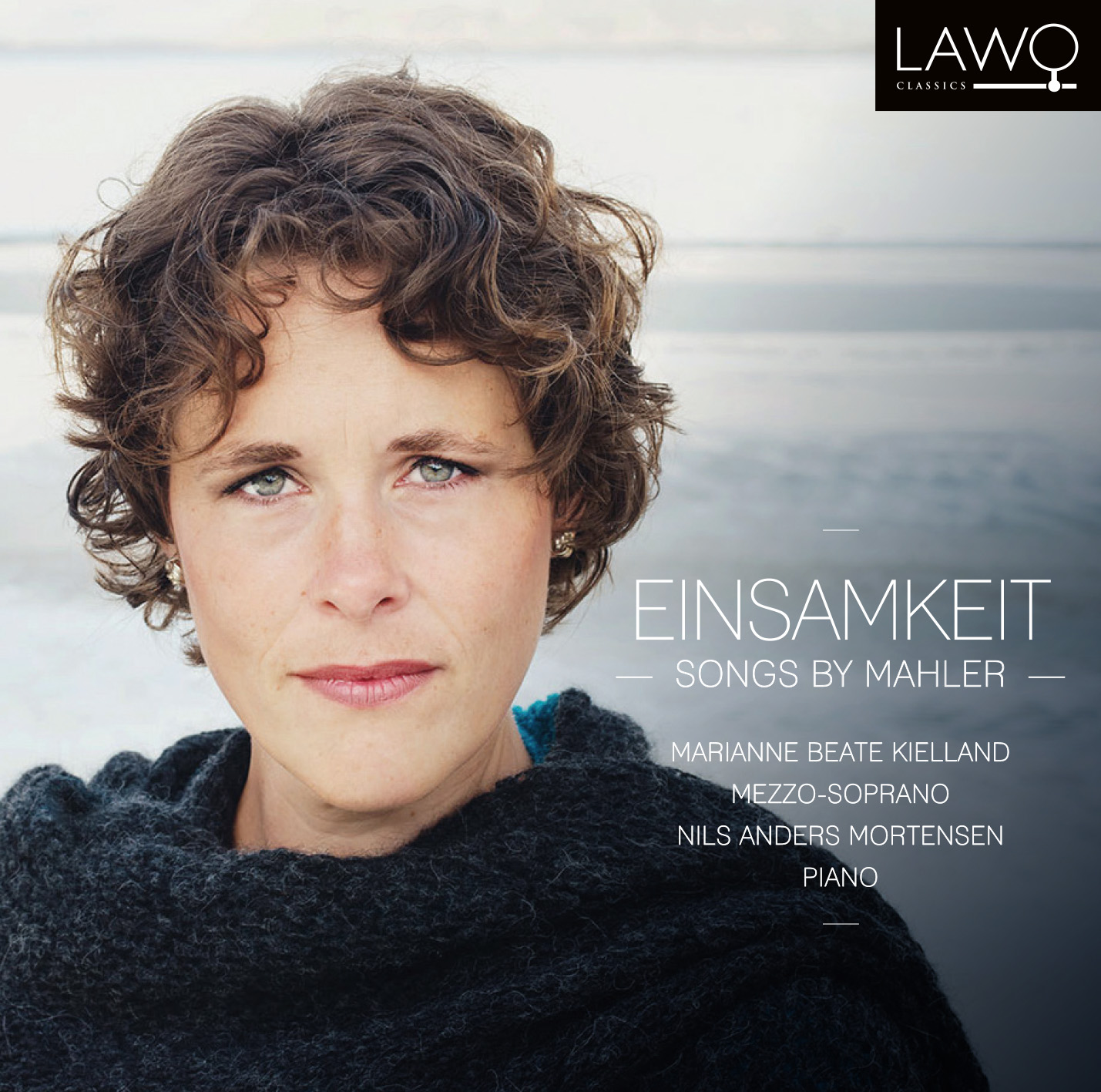
Einsamkeit – Songs by Mahler
Marianne Beate Kielland (Mezzo-soprano) | Nils Anders Mortensen (Piano)
Stream & download
Tracks
Gustav Mahler (1860–1911)
Rückert-Lieder
Kindertotenlieder
Lieder eines fahrenden Gesellen
Credits
- Performer
- Marianne Beate Kielland (Mezzo-soprano) | Nils Anders Mortensen (Piano)
- Composer
- Gustav Mahler
- Producer
- Vegard Landaas
- Engineer
- Thomas Wolden
- Editing
- Vegard Landaas
- Mastering
- Thomas Wolden
- Liner notes
- Marianne Beate Kielland
- English translation
- Jim Skurdall
- Executive producer
- Vegard Landaas
- Booklet editor
- Hege Wolleng
- PR
- Camilla Momkvist-Skau
- Cover photo
- Lena Lahti
- Artist photo
- Marianne Beate Kielland by Trym Ivar Bergsmo | Marianne Beate Kielland by Lena Lahti
- Design
- Anna-Julia Granberg | Blunderbuss
- Recording location
- Sofienberg Church, Oslo
- Recording country
- Norway
- Recording year
- 2016
- Recording dates
- 04.01.2016 | 05.01.2016 | 06.01.2016
- Original source
- DXD (352.8 kHz, 24 bit)
- Discs / tracks
- 1 disc | 14 tracks
- Release year
- 2018
- Label
- LAWO Classics
- Duration
- 55:29
- EAN
- 7090020181790
- ISRC
- NOEHX1811010/140
Video
Booklet text
The songs of Gustav Mahler have haunted me for 20 years. These are songs that you begin to take in, hum along to, and listen to early in your studies. See them lie far yonder, like a glimpse of the Grail. To sing these songs – nay, to dare sing them – is indeed a challenge.
But the day came, at least for me, when Mahler's songs suddenly were part of the repertoire. And the more I perform them, the more they grow into me. They feel as they are a part of me now, and I hope that I shall continue to sing this wonderful repertoire for a long, long time.
Why is this record titled Einsamkeit? Mahler has not chosen the lightest lyrics for his music, which must partially reflect his own situation. How lonely it must be not to find a life partner, or to lose your own children! And even if the Rückert songs contain some bright and beautiful moments, there is still much existentialism in Ich bin der Welt and Um Mitternacht.
Enjoy! I hope you will come to love these songs as much as I do.
— Marianne Beate Kielland
MAHLER — For any lover of classical music, the name itself is evocative of orchestral colour, broad, sweeping symphonic brushstrokes and the culmination of the romantic symphony. However, Mahler wrote with equal mastery in another genre: his oeuvre is remarkable in that he virtually wrote in two genres alone, namely symphony and song. What is more, there were few composers for whom the two genres were so closely connected: Mahler would often reuse material from songs in symphonies, and some claim that these self-quotations are keys to secret programmes in the symphonies. Most important of all is the fact that all of his mature songs were written both with orchestral accompaniment and as songs for piano and voice. In one of his final masterpieces, Das Lied von der Erde (the Song of the Earth) he combined the two into a symphonic song cycle.
Where does this leave the piano version? Are these 'mere' piano reductions? One might ascribe commercial reasons for their creation: in Mahler's own time, a reduced arrangement was the only way the works could be heard outside of the concert hall, and a piano reduction would be the easiest to sell. This, however, would give far too little credit to the pieces. In fact, the attention to detail given in them shows that they were written to be performed as equals in either form. After all, since it would be in this form that most people would have the opportunity to hear them, it was important that these versions were as strong as they could possibly be.
This cannot be achieved automatically. Whereas one often speaks of Brahms as a composer who orchestrated works that seemed conceived for the piano, the process may have been the opposite for Mahler. As one of Vienna's leading conductors, the orchestra was his part and parcel, and he had mastered it as fully as any composer. A reduction for piano will have to simplify many details in the full score, in particular those that are available only at closer study, and the many possibilities for combinations of timbre the orchestra offers have to be done without. That Mahler's songs never give the impression of being lacking in the pianistic form is high praise that can be afforded to few composers. Mahler obviously had both versions in mind and made sure that the result would be attractive in either form. In fact, beyond their qualities as songs, the interested listener can benefit immensely from comparing the orchestral and piano versions to gain an appreciation of the skill and thought that went into the latter.
In his songs, Mahler primarily took his texts from two sources. On the one hand, he was greatly influenced by German folk literature, and did in particular use the collection Des Knaben Wunderhorn (The Boy's Magic Horn) as a source of texts in his career. He later worked intensely with the texts of the romantic poet Friedrich Rückert (1788–1866) – an old-fashioned choice for a hypermodern composer. In both of these cases, Mahler followed in the footsteps of the great song composers of the nineteenth century: gold was mined from the same sources in the works of Schubert, Schumann and Brahms. Rückert was a well-known poet at the time and would reach the peak at the end of the century. He was, however, never considered one of the truly great German authors, and Mahler considered him perfect for this very reason: for him, setting a poem that was perfect in itself to music was 'as if a sculptor chiselled a statue from marble and a painter came along and coloured it'; it was already known, but largely ignored, that the sculptures of Greek and Roman antiquity bore bright – and, in the eyes of many, gaudy – colours.
For the four songs that make up Lieder eines fahrendes Geselle (Songs of an Apprentice), Mahler chose not to go to Des Knaben Wunderhorn for texts, but rather to make his own text in the same style. The songs do not tell a conventional story, but rather depict the aftermath of an unrequited love, where the protagonist moves from despair to acceptance and eventually to inner peace. This approach to setting texts that were psychological, rather than driven by a proper story, would become characteristic of many of Mahler's songs. The texts were partly autobiographical, both in the sense that he considered himself to be an apprentice in his field, and as a reflection of an unhappy love affair with the soprano Johanna Richter.
The first song also highlights how pianistically conceived these works could be. The song mixes the festive Czech folk music of the beloved's wedding with the despairing moods of the protagonist. In a setting that was meant to be purely orchestral, these could be mixed together, since they could be separated through orchestral colour. Mahler, however, chose rather to juxtapose and alternate between the two, and in this way the differences in musical style are as clear on the piano as in the orchestra. A closer blend of the two in the orchestral version would have been impossible to replicate on the piano; their separation and juxtaposition suggests that Mahler had the piano version in mind while composing.
Kindertotenlieder (Songs on the Death of Children) was Mahler's last song cycle, and arguably his most famous one. The four poems Mahler ended up using is a minute selection of the 428 poems (!) Rückert wrote on the topic in the years 1833–1834, following the death of two of his children. For Mahler, too, the topic could be said to have personal meaning in several ways. Six of his thirteen siblings died in infancy, and thus he was always acquainted with the death of the young. Simultaneously, he began work on the first songs as a childless bachelor of 40, whose chances of having progeny were getting slim. Whilst he would in time be blessed with both a wife and two daughters, the songs could be said to be eerily prescient, as his elder daughter, Maria Anna, died in 1907 – just before he learned of his own heart condition that was to take his life four years later. As in the Apprentice songs, Mahler chose not to give any real narrative through the texts, but rather to depict the changing states of mind of the protagonist, from despair towards acceptance.
Simultaneously with the Kindertotenlieder, Mahler worked on a set of independent Rückert songs. These songs did not attempt to create any sort of continual narrative, but rather allowed Mahler to explore different aspects of Rückert's poetry and how it could be set to music. In this collection, Mahler explored wide-ranging topics that include the poet's study, the nineteenth century's fascination by the oriental, triumph over adversity, and love – Liebst du um Schönheit is his only proper love song. These songs may be heard less often than the proper cycles, but they are as masterful as anything Mahler wrote.
— Halvor K. Hosar
Notes: Marianne Beate Kielland (foreword) · Halvor K. Hosar (essay) · English translation: Halvor K. Hosar