
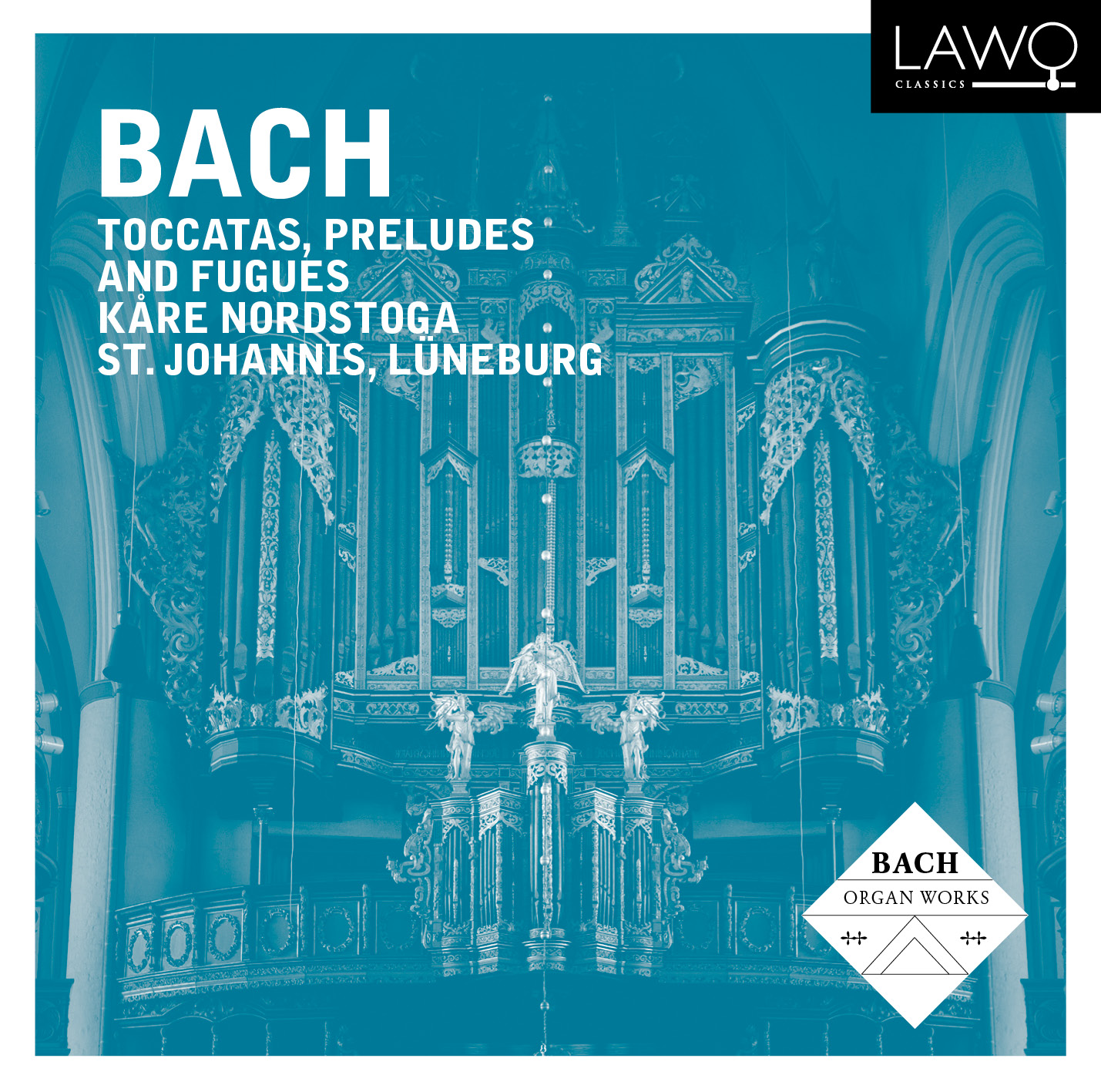
Bach: Toccatas, Preludes and Fugues – St. Johannis Lüneburg
Kåre Nordstoga (Organ)
Listen
Tracks
Disc 1
Johann Sebastian Bach (1685–1750)
Prelude and Fugue in C major, BWV 545
O Gott, du frommer Gott, BWV 767
Prelude and Fugue in F minor, BWV 534
Prelude and Fugue in C minor, BWV 546
Disc 2
Prelude and Fugue in D major, BWV 532
Toccata and Fugue in F major, BWV 540
Christ, der du bist der helle Tag, BWV 766
Prelude and Fugue in A major, BWV 536
Prelude and Fugue in A minor, BWV 543
Prelude and Fugue in B minor, BWV 544
Credits
- Performer
- Kåre Nordstoga (Organ)
- Composer
- Johann Sebastian Bach
- Producer
- Vegard Landaas
- Engineer
- Thomas Wolden
- Editing
- Vegard Landaas
- Mastering
- Thomas Wolden
- English translation
- Jim Skurdall
- Executive producer
- Vegard Landaas
- Booklet editor
- Hege Wolleng
- Cover photo
- Anna-Julia Granberg
- Artist photo
- Kåre Nordstoga by Anna-Julia Granberg
- Design
- Anna-Julia Granberg | Blunderbuss
- Recording location
- St. Johanniskirche, Lüneburg
- Recording country
- Germany
- Recording year
- 2017
- Recording dates
- 09.10.2017 | 10.10.2017 | 11.10.2017
- Original source
- DXD (352.8 kHz, 24 bit)
- Series
- Bach Organ Works
- Discs / tracks
- 2 discs | 36 tracks
- Produced with support from
- Arts and Culture Norway | The Audio and Visual Fund
- Release year
- 2018
- Label
- LAWO Classics
- Duration
- 138:49
- EAN
- 7090020181752
- ISRC
- NOEHX1807010/360
Video
Played from YouTube. When you play it, YouTube may set cookies.
Booklet text
NORDSTOGA'S NINTH
In his ninth and tenth of a total of fourteen releases of Bach's collected organ works, Kåre Nordstoga pulls together much of what was not collected from the composer's side — preludes and fugues.
The double form prelude (or toccata) and fugue has been an established form of composition since the 1600s. The North Germans Dietrich Buxtehude and Georg Böhm made a powerful contribution to this contrastive style in which the freer first part and the more rigorous second part are united in a dynamic whole. The young Johann Sebastian harvested significant impressions from these two composers during his time in Lübeck and Lüneburg, and this album was recorded in Lüneburg.
Bach organized his chorale-based organ works in collections such as Orgelbüchlein and Clavier-Übung. But non-chorale-based works are not collected in a similar manner. These were composed over a longer period of time, from his youthful years in Arnstadt via Mühlhausen and Weimar to Leipzig. (In Köthen there was a focus on other instruments.) They were written for irregularly occurring occasions such as when Bach was consulted as expert in the inspection of a new organ, or when he auditioned for a new job.
He would sometimes pull up an older work and polish it into a new version that might be used to teach pupils in organ and composition in Leipzig. One point could be precisely the difference between the first rendering and an improved version. As Bach biographer Forkel wrote in 1802 regarding Bach's revisions: "Nothing can be as instructive as a comparison, for both an expert and an ardent student."
As for Bach's desire to constantly improve what he had written, Forkel wrote that he did it "to correct errors, to make what was good even better, and to make what was best the very best". The revisions can be more advanced than the first version, as, for example, the Fugue in D Major in BWV 532.
With respect to content and style, the preludes, toccatas and fugues cover a wide range, from the North German inspiration of Buxtehude to the Italian inspiration of Vivaldi's concertos, yet it is the inimitable musical expression of a Johann Sebastian Bach that holds them all together.
BWV 578 The Little Fugue in G minor and BWV 579 Fugue on a Theme by Corelli were written in Bach's youth. The Fugue in G minor is presumed to have originated during Bach's tenure as court organist in Weimar, where the organ was situated on the fourth(!) floor of the palace chapel in a heavenly realm high above the noble parishioners.
The Fugue on a Theme by Corelli is also from Weimar, composed when Bach was around twenty years old. The Corelli theme is from a trio sonata included by the Italian master in his opus 3 (1689).
Both fugues have two themes and show how the young Bach worked to become proficient in the art of the fugue, which he continued to develop to the very end of his life. His son, Carl Philipp Emanuel, wrote of his father that "even in his youth he became a strong and genuine fugue enthusiast (Fugist)".
Toccata and Fugue in D minor BWV 565 is for a large number of listeners the Bach work above all others. It is more improvisational in form than presumably any of the master's other organ works. Some have wondered whether it may have been written for solo violin. Others have voiced the opinion that because it is unlike anything else Bach composed, it was perhaps not written by him!
In the novel The Glass Bead Game (1943), Hermann Hesse inserted this Bach inspiration, a poetic vision of the power in this thunderous work from Bach's youth. (Bantam Books, translated by Alex Page, excerpt).
To a Toccata by Bach
Frozen silence.… Darkness prevails on darkness. One shaft of light breaks through the jagged clouds Coming from nothingness to penetrate the depths, Compound the night with day, build length and breadth, Prefigure peak and ridge, declivities, redoubts, A loose blue atmosphere, earth's deep dense fullness.
That brilliant shaft dissevers teeming generation into both deed and war, and in a frenzy of creation ignites a gleaming terrified new world. All changes where the seeds of light descend, Order arises, magnificence is heard In praise of life, of victory to light's great end.
Chorale Music from Weimar
The two partitas BWV 766 Christ, der du bist der helle Tag and BWV 767 O Gott, du frommer Gott presumably originate from the first years as court organist in Weimar, where Bach arrived in 1708. They are, compared with the later partita BWV 768 Sei gegrüsset, Jesu gütig, simpler and less organ-like, arising from a piano tradition without pedal. Thus they are also performed today on harpsichord.
The variations bear the legacy of Georg Böhm and Johann Pachelbel in their two-voiced pianistic elaboration with ornamentation, but they reveal a new boldness as regards the tradition. Both follow the text in the hymns from verse to verse with a rich spectrum of expression. Bach also wrote other organ arrangements based on these two chorales.
BWV 766 is a text by the 16th-century poet Erasmus Alber: Christus, der du bist der helle Tag, Von dir die Nacht nicht bleiben mag, Du leuchtest uns vom Vater her und bist des Lichtes Prediger.
The hymn in BWV 767 was written by Johann Heermann in 1730: O Gott, du frommer Gott, du Brunnquell guter Gaben, ohn den nichts ist, was ist von dem wir alles haben; gesunden Leib gib mir und dass in solchem Leib ein unverletzte Seel und rein Gewissen bleib.
— Torkil Baden · English translation: Jim Skurdall
Biographies
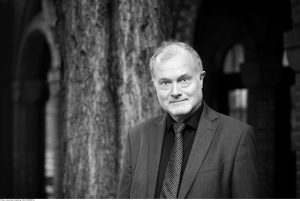
Kåre Nordstoga
Kåre Nordstoga (b. 1954) studied at the Norwegian Academy of Music under Søren Gangfløt, Bjørn Boysen and Kaare Ørnung, among others. Following his debut concert in 1978, he continued his studies under David Sanger in London, and was for a time organist at Ullern Church before coming to Oslo Cathedral in 1984. He has also been associated with the Norwegian Academy of Music, where he was appointed professor in 1994.
As cathedral organist at Oslo Cathedral, Nordstoga frequently performs a large repertoire, which has included two popular concert series with Bach's complete organ works. His recordings include the organ music of Bach, Brahms, Franck, Widor and Liszt, all of Bach's violin sonatas recorded on the cathedral's chancel organ in collaboration with violinist Geir Inge Lotsberg, as well as several recordings of Norwegian organ music. Nordstoga is an active concert organist.
In recent years he has been soloist with the symphony orchestras of Oslo, Bergen and Trondheim, and he has been invited to organ festivals abroad, including Aarhus, Notre Dame in Paris, and the Musashino Cultural Center in Tokyo. In 2006 he was awarded the Lindeman Prize for his active contribution to musical life.
Johann Sebastian Bach
Johann Sebastian Bach was born on 21 March 1685 in Eisenach into an extensive family of musicians. Orphaned by the age of ten, he was raised by his elder brother Johann Christoph in Ohrdruf before receiving a scholarship to the Michaelisschule in Lüneburg in 1700. His first appointment, in 1703, was as a court violinist to Duke Johann Ernst of Saxe-Weimar, but within months he became organist at the Neue Kirche in Arnstadt, composing his first significant organ works and, in 1705, travelling to Lübeck to study with Dietrich Buxtehude. In 1707 he became organist of St Blasius's Church in Mühlhausen and married his cousin Maria Barbara; the following year he entered the service of Duke Wilhelm Ernst in Weimar as court organist, rising to concertmaster in 1714 and building a reputation as an organ virtuoso.
In 1717 Prince Leopold of Anhalt-Köthen appointed him Hofkapellmeister, a productive period that yielded much of his instrumental output, including violin concertos and orchestral suites, though it was also marked by the death of his wife in 1720; he remarried the following year to Anna Magdalena Wilcke. In 1723 Bach was elected Thomaskantor in Leipzig, a post he held for the rest of his life, composing there his great vocal works, including the St John and St Matthew Passions and over two hundred cantatas, until his death on 28 July 1750.