
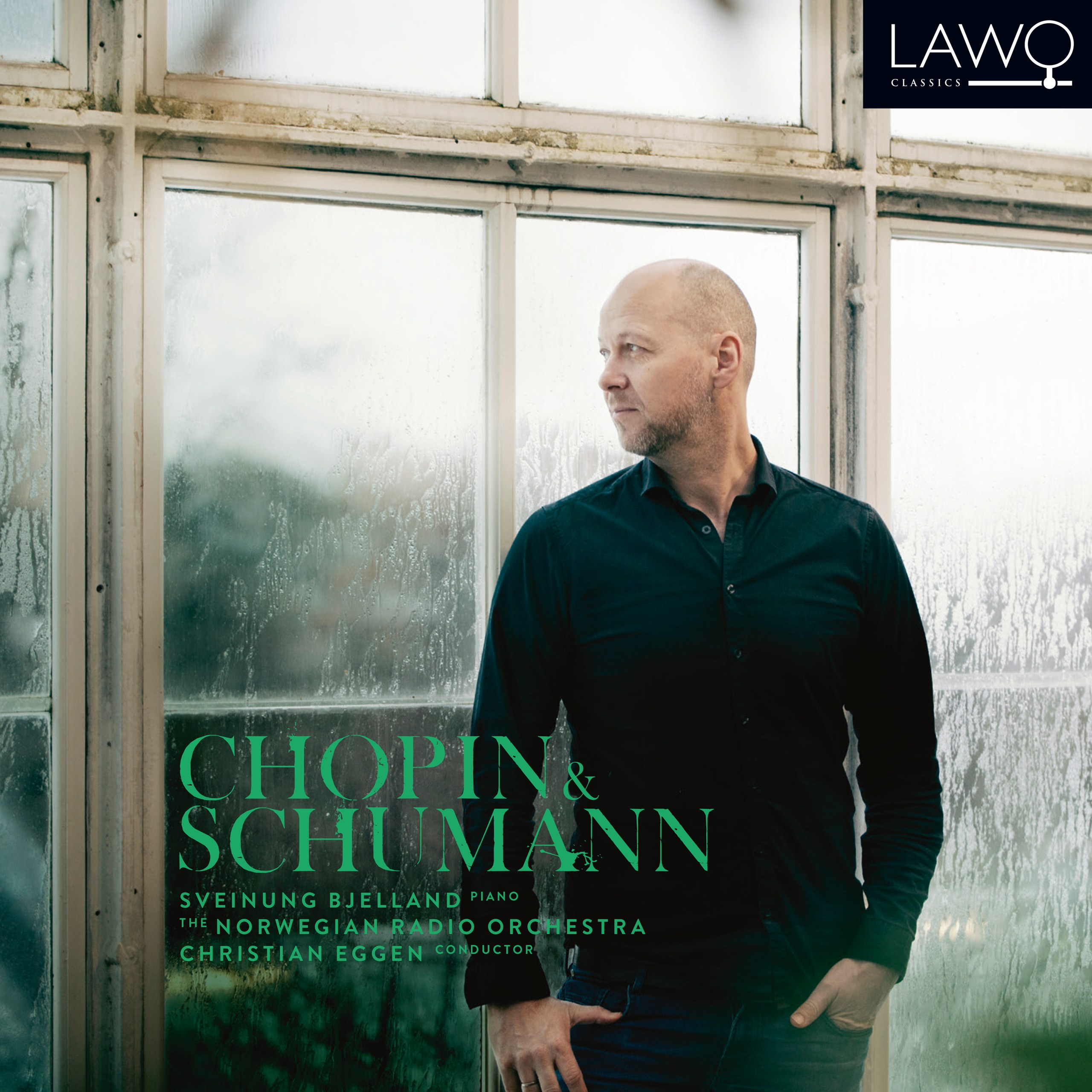
Frédéric Chopin | Robert Schumann
Chopin – Schumann Piano Concertos
Sveinung Bjelland (Piano) | Norwegian Radio Orchestra (Orchestra) | Christian Eggen (Conductor)
Stream & download
Tracks
Robert Schumann (1810–1856)
Frédéric Chopin (1810–1849)
Piano Concerto No. 1, Op. 11
Reviews
Here we find a pianist and an orchestra in perfect harmony, playing beautifully.…
Show more Show less
Here we find a pianist and an orchestra in perfect harmony, playing beautifully. The performance is marvellous – and, to my ears, the interplay between the pianist and the orchestra is among the finest I have ever heard in this piece.Show original
Her møter vi en pianist og et orkester i perfekt harmoni og nydelig spillemodus. Formidlingen er herlig - og samspillet mellom pianist og orkester er i mine ører noe av det beste jeg har hørt når det gjelder dette verket.

It is a delight to hear Schumann played as romantically as Bjelland does [...] The challenge in this concert lies in the refined timbre, which Bjelland demonstrates through his subtle touch and keen sense of nuance.…
Show more Show less
It is a delight to hear Schumann played as romantically as Bjelland does [...] The challenge in this concert lies in the refined timbre, which Bjelland demonstrates through his subtle touch and keen sense of nuance. [...] We look forward to more recordings with Bjelland!Show original
Det er herlig å høre Schumann spilt så romantisk som det Bjelland gjør [...] Utfordringen i denne konserten ligger i det klanglig raffinerte, som Bjelland demonstrerer med forfinet behandling og sans for nyanser. [...] Vi gleder oss til flere innspillinger med Bjelland!
 Stavanger aftenblad | 03.05.18
Norwegian
There’s always room for a reading as considered and thoughtful as this one, too: to my mind, Sveinung Bjelland is one of Norway’s most mature musicians, and he brings both clarity…
Show more Show less
There’s always room for a reading as considered and thoughtful as this one, too: to my mind, Sveinung Bjelland is one of Norway’s most mature musicians, and he brings both clarity and energy to the piece, with like support from Christian Eggen and the players of the Kringkastningsorkestret.
 klassiskmusikk.com | 20.07.18
Read at klassiskmusikk.com →
Sveinung Bjelland, a new pianist to me, plays this minor masterpiece with great sensitivity and aplomb.
 Musical Opinion, juli | 2018
Bjelland’s tone is both rich and tender; his touch is soft, yet his character remains firm, and there is never any doubt that we are dealing with a musician who has the early Romantic style at his fingertips.…
Show more Show less
Bjelland’s tone is both rich and tender; his touch is soft, yet his character remains firm, and there is never any doubt that we are dealing with a musician who has the early Romantic style at his fingertips. [...] What makes this recording particularly inspiring, however, is precisely how Bjelland manages to vary his expression and bring out the more rhetorical subtleties through brilliant and delicate runs and details, without his approach ever seeming contrived or laboriously correct.Show original
Bjellands klang er både rik og øm, anslaget mykt, men karakteren samtidig fast, og det er aldri noen tvil om at vi har å gjøre med en musiker som har det tidligromantiske uttrykket i fingrene. [...] Det som imidlertid gjør innspillingen særlig inspirerende, er hvordan Bjelland nettopp makter å variere uttrykket og spille ut de mer retoriske finessene gjennom briljante og delikate løp og detaljer, uten at tilnærmingen virker påtatt eller anstrengende korrekt.
 Morgenbladet | 21.09.18
Norwegian
Show all 7 reviews
What makes this recording particularly inspirational is how Bjelland precisely varies the expression and reveals the more finely rhetorical essence of the music through brilliant…
Show more Show less
What makes this recording particularly inspirational is how Bjelland precisely varies the expression and reveals the more finely rhetorical essence of the music through brilliant and delicate runs and details, without the approach seeming to be laboured or mere straining after effect. Sveinung Bjelland knows the modern piano’s possibilities of colour and caprice.
Morgenbladet | 21.09.18
[...] The Norwegian Radio Orchestra conducted by Christian Eggen, with the presence of the pianist Sveinung Bjelland.…
Show more Show less
[...] The Norwegian Radio Orchestra conducted by Christian Eggen, with the presence of the pianist Sveinung Bjelland. These artists offer us a clean and intense reading and performance of the scores of two great contemporary composers. [...] Equally romantic the executive intent of the introduction and Allegro appassionato op. 92 by Schumann where the balance between the piano and the instruments of the orchestra is always controlled in the wake of the expressive timbre and melodic elegance that characterize the piece.
 Amadeus | 2018
Credits
- Conductor
- Christian Eggen
- Performer
- Sveinung Bjelland (Piano)
- Orchestra (unspecified)
- Norwegian Radio Orchestra
- Composer
- Frédéric Chopin | Robert Schumann
- Producer
- Vegard Landaas
- Engineer
- Thomas Wolden
- Editing
- Vegard Landaas
- Mastering
- Thomas Wolden
- Liner notes
- Sveinung Bjelland
- English translation
- Jim Skurdall
- Executive producer
- Vegard Landaas
- Booklet editor
- Hege Wolleng
- Cover photo
- Anna-Julia Granberg
- Artist photo
- Sveinung Bjelland by Marius Arnesen | Sveinung Bjelland by Anna-Julia Granberg
- Session photo
- Thomas Wolden
- Design
- Anette L’orange | Blunderbuss
- Recording location
- NRK Radio Concert Hall, Oslo
- Recording country
- Norway
- Recording year
- 2015–2017
- Recording dates
- 10.11.2015 | 11.11.2015 | 12.11.2015 | 13.11.2015 | 04.12.2017 | 05.12.2017
- Original source
- DXD (352.8 kHz, 24 bit)
- Discs / tracks
- 1 disc | 4 tracks
- Produced with support from
- Creo – The Union for Arts and Culture | Fund for Performing Artists
- Release year
- 2018
- Label
- LAWO Classics
- Duration
- 58:18
- EAN
- 7090020181714
- ISRC
- NOEHX1802010/40
Video
Booklet text
'Hut ab, ihr Herren, ein Genie' – ['Hats off, gentlemen; a genius'] – this simple phrase, published in the Allgemeine Musikalische Zeitung in Leipzig on December 7 1831, marked the first appreciation in German of the music of young Polish composer and pianist Frédéric Chopin to reach a wide audience.
It was written by the 21-year-old Robert Schumann, who had been born in Zwickau, Saxony, in June 1810, the son of a bookseller. His birth followed just three months after that of Chopin, sixteen months before Liszt and eighteen months after that of Mendelssohn. All four master-composers of piano music therefore arrived at their early maturity at approximately the same time: a time that was, in musical terms, dominated by several factors, not least consequent upon the respective deaths in Vienna, in 1827 and 1828, of Beethoven (at the age of 56) and Schubert (aged 31).
The work about which Schumann was writing was the publication of Chopin's Opus 2 – Variations for piano and orchestra on the duet by Zerlina and Leporello, 'Là ci darem la mano', from Mozart's Don Giovanni. Chopin's work dates from 1827, when he was 17 and had, by that time, been composing for ten years – his first Polonaises were written when he was just seven years old – and it may be felt that, even at that age, they constitute some of the very earliest examples of the coincidentally-emergent nationalism in music.
Chopin's Opus 2 had received its German premiere by Julius Knorr at the Leipzig Gewandhaus six weeks before Schumann's review appeared. Schumann – at that time, considering twin careers as a writer and concert pianist – acquired the music and practised the work in some detail, which in turn led his then teacher Friedrich Wieck (whose young daughter Clara was to become Schumann's wife) to publish an enthusiastic review of the Variations in the rival German periodical Caecilia.
Chopin's reactions to Schumann's and Wieck's reviews were not entirely those of gratification – reading of Wieck attempting to equate the variations with Zerlina and Leporello's stage actions reduced Chopin to amused incomprehension. His natural modesty, whilst not causing embarrassment, did not wholly permit him to reciprocate such acclaim, yet there is no doubt that Schumann admired Chopin more than Chopin admired the German.
It is known that Schumann wrote to Chopin on several occasions, but no replies apparently survived; in 1834–35, Schumann composed his piano suite Carnaval Opus 9, wherein one movement (No 12) is simply entitled 'Chopin'; the following year, he composed a set of Variations on a Theme of Chopin and dedicated his Kreisleriana Opus 16 to Chopin; this was around the period of the only two occasions they met. In return, Chopin dedicated his Second Ballade Opus 38 (completed in 1839) to Schumann, and although Schumann appeared to be less enamoured of that work than he had been of Chopin's earlier works, he and Clara retained admiration for Chopin's music for the rest of their lives.
As well they might, for although Chopin's companion (and, in fact) earlier F minor Concerto was the last such work Clara Schumann played in public, both Concertos have existed within a critical climate that took superficial aspects – the relative youth of the composer, his apparent relegation of the orchestra to a subsidiary role, the absence of a virtuoso cadenza – as reasons for criticism.
It was to Schumann's eternal credit that he was able to see the original genius which infuses Chopin's music from the beginning. Chopin might have been only 19 when the E minor Concerto appeared, but he had been composing music for a dozen years, and his original genius was by then fully formed.
Notwithstanding Friedrich Wieck's attempt at relating Chopin's Opus 2 to the drama of the opera from which the theme comes, in the far greater E minor Concerto of 1829–30 many were confused by the work's profound originality. The Concerto had been first performed on October 12, 1830, in Warsaw, just before Chopin left Poland. The public premiere, by Chopin himself with the orchestra conducted by Carlo Evasio Soliva, was a complete success. Not long afterwards, in Paris, Chopin played the concerto at the Salle Pleyel, where it was also received with equal enthusiasm.
The E minor was the first of his two piano concertos to be published, and – although the F minor Concerto had been written beforehand – was therefore termed No. 1; the F minor was published not long afterwards as No 2. The orchestra of the E minor comprises two each of flutes, oboes, clarinets, and bassoons, 4 horns, 2 trumpets, tenor trombone, timpani and strings.
What must have seemed remarkable to Schumann and Wieck is that there is no sentimentality in Chopin's music, in which the richness and ardour of the composer's mind is revealed. Even today, Chopin's concertos are written off without due consideration of the composer's youth or that the young genius's aims in these works are very different from those of, say, Mozart or Beethoven. A detailed consideration will reveal the astonishing depth of these works and of Chopin's originality in terms of design. His orchestration may not always be entirely successful, but of which young composer in his first orchestral works can that not be said? As with Schumann's orchestration, it is invariably suitable for his expression, no matter how 'different' it may appear – it is the conductor's task to gauge the internal balance of the orchestra; when that is given due consideration the result demonstrates Chopin's unique genius. A further little-appreciated aspect of Chopin's approach is that in this work the piano does not invariably play to the end of each movement: it is often the orchestra alone which brings the music to a close.
Quite apart from the consistently spacious and dignified expression of the work – civilised in the best sense – Chopin's readiness to abjure the standard concerto construction of the era was something of which he himself was well aware. The Concerto is dedicated to Friedrich Kalkbrenner, who encouraged Chopin on his arrival in Paris. Whilst composing the Concerto, Chopin was fully aware of his original approach to the task, writing to his patron Tytus Woyciechowski: 'You will no doubt observe my tendency to do wrong against my will', though whether this refers to his failure to adhere to accepted compositional procedures or to other matters is unclear, yet it remains a standing reproach that his musical originality was so little appreciated by generations after his death.
As a few examples, this remains the first great concerto in the repertoire wherein both first and second subjects of the opening movement share the same tonality, maintained throughout all three movements (the Romance and Finale are also both in E major). Chopin's astonishingly original characteristic of seeming to repeat a phrase, yet – by changing as little as just one note – the expressive nature of the music is altered. This is a consistent trait of his, the subtlety of which would have earned the admiration of Mozart and Beethoven – as well as it obviously did of Schumann, who began to adopt strikingly similar procedures in his own music from around 1836 onwards.
The Concertos in E minor and F minor were not the only works for piano and orchestra that occupied Chopin around this time; late in 1831 he composed a Grande Polonaise Brillante for piano and orchestra – the Polonaise doubtless as a tribute to his homeland. In 1834, he added an introductory Andante, originally for piano solo. The idea of a concert work, a brilliant Allegro piece preceded by a slow introduction, may not have been Chopin's original conception, but there is no doubt he was among the first composer-pianists to employ it as a stylisation of the folk-like slow-fast dances of central Europe, soon to be taken up in concert works by Liszt in his Hungarian Rhapsodies, ostensibly based upon lassú-friss (slow-fast) folk dances.
The conception, therefore, of a slow Introduction succeeded by an Allegro took hold as a concert piece as the 19th century evolved but has largely disappeared from today's programmes – a pity, as there are several outstanding works in this form by great composers which are never heard, by Mendelssohn, Chopin and Liszt in particular. Yet it is perhaps the two works by Schumann which lead the works in that genre.
His Introduction and Allegro appassionato, Op. 92, was sketched in just two days in September 1849, the full score being completed within the following week – just one month before the death of Chopin in Paris at the age of 39.
The work remains arguably Schumann's most unjustly neglected masterpiece; it contains some of his finest and most original themes and most brilliant piano writing, and further demonstrates that the piano remained central to Schumann's creativity, notwithstanding his significant contributions to orchestral and chamber music and to the German lied. His first 23 consecutive Opus numbers were all for solo piano, yet it was not solely the piano that consumed his interest, for in 1832 he drafted a Symphony in G minor, of which he conducted the first movement in Zwickau. The 'symphonic' nature of Schumann's music at that time is demonstrated more fully in his Études symphoniques for piano, which he revised several times, finally in 1852, almost 20 years after the original appeared.
In the case of the Introduction and Allegro appassionato, the premiere by Clara in February 1850 was not well received, but the second performance in Düsseldorf the following month, with Schumann himself conducting, was a notable success. It has been convincingly argued that the work may well have had a literary inspiration – particularly Byron's Manfred, with which Schumann at the time was greatly preoccupied – but as he left no clue, the work has to be considered on its purely musical aspects, which are considerable.
The Introduction at once transports the listener into a world of reverie; occasionally emotionally uncertain, despite the underlying mood, whose troubling aspects finally burst out in the extended Allegro appassionato; here the polarity alternates this way and that in a fully-developed conjoined movement that is driven by considerable inner momentum – here, one may appreciate the mind of the one composer who comprehensively represents the Romantic spirit in music.
The piano writing is magnificent, and the orchestration completely disabuses those who – as with Chopin – maintain that Schumann was uncertain in that aspect. The tonal oscillations may suggest a troubled outlook – not of the composer himself, but of the (undisclosed) subject he is essaying: and here, surely, is Manfred himself – more than glimpsed, a convincing representation in music of a character fighting within its own uncertainties.
Schumann's Opus 92 is a masterpiece of coherent musical composition, demonstrating the composer's genius at capturing the mood and inner life of that which he wishes to express, leaving the listener in no doubt as to the composer's aims, profoundly moved by the success of such essential human feelings which the sympathetic listener will instinctively recognise.
Chopin's E minor Concerto and Schumann's Opus 92 remain as two of the finest of all works for piano and orchestra by composers from the early part of the Romantic era – the universal human spirit of these compositions being equally relevant in the early decades of the 21st century as they were when they first appeared.
— Notes: Robert Matthew-Walker · Norwegian translation: Tor Tveite