
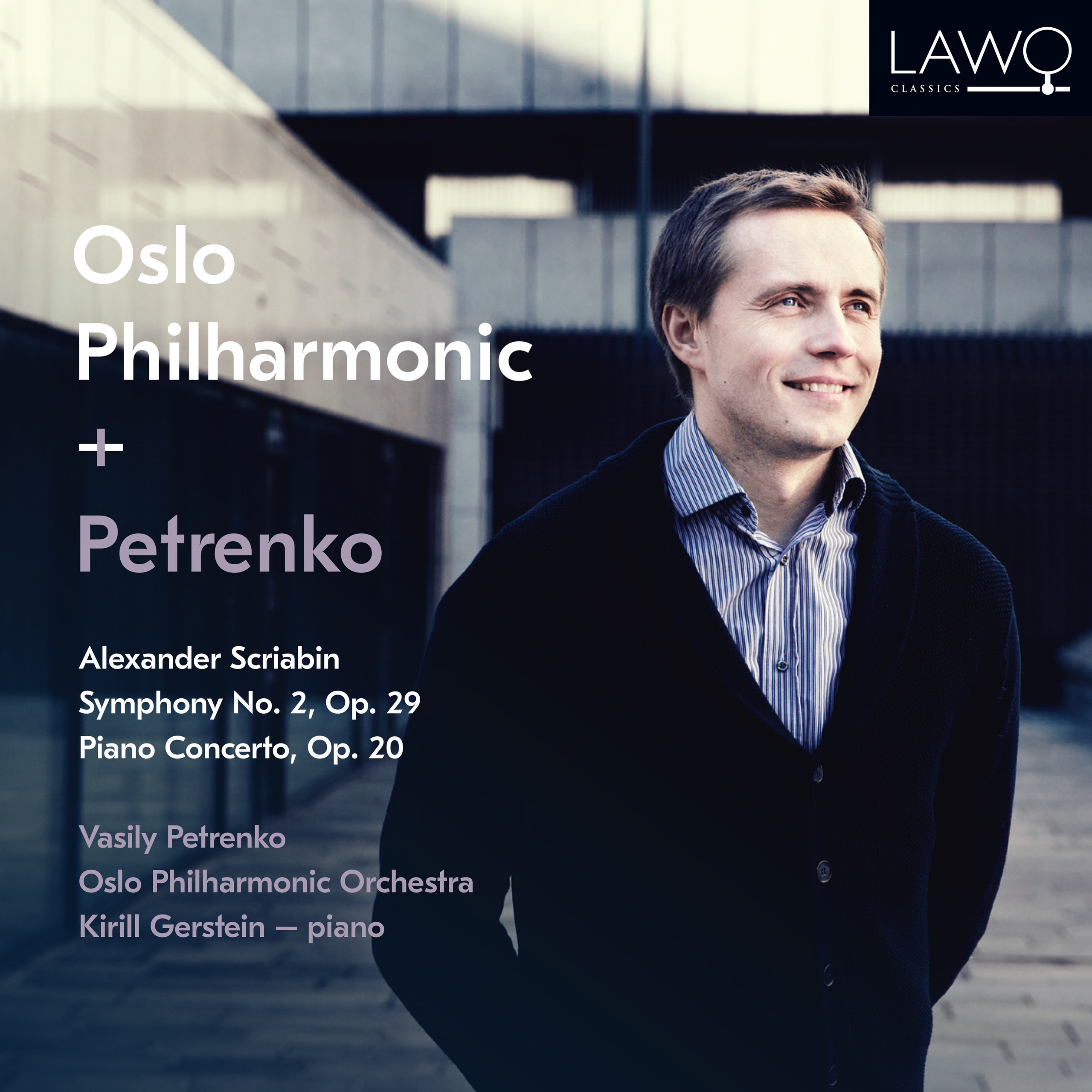
Alexander Scriabin
Scriabin Symphony No. 2, Op. 29 & Piano Concerto, Op. 20
Kirill Gerstein (Piano) | Oslo Philharmonic Orchestra | Vasily Petrenko (Conductor)
Stream & download
Tracks
Alexander Scriabin (1872–1915)
Symphony No. 2, Op. 29
Vasily Petrenko (conductor) | Oslo Philharmonic Orchestra
Piano Concerto, Op. 20
Vasily Petrenko (conductor) | Kirill Gerstein | Oslo Philharmonic Orchestra
Reviews
The Oslo Philharmonic – under Vasily Petrenko’s skilful baton – makes full use of the musical resources at its disposal in its performance of the five-movement symphony.…
Show more Show less
The Oslo Philharmonic – under Vasily Petrenko’s skilful baton – makes full use of the musical resources at its disposal in its performance of the five-movement symphony. And it is done well – so well that the composer’s Wagnerian passion sparkles from the speakers. High praise is also due to the solo passages amongst the wind section – truly splendid playing across the board. [...] The concert has great qualities – it is catchy, with dazzlingly lyrical passages. [...] The duo of Gerstein and Petrenko gives the performance a structure that works perfectly.Show original
Oslo-filharmonien - under Vasily Petrenkos dyktige ledelse - bruker de musikalske virkemidlene for det det er verd i formidlingen av den fem-satsige symfonien. Og det gjøres godt - så godt at komponistens wagnerske forelskelse gnistrer ut av høyttalerne. En stor blomst går også til de solistiske innslagene blant blåserne - ganske så herlig spill over hele linjen. [...] Konserten har store kvaliteter - den er iørefallende, med blendende lyriske partier. [...] Duoen Gerstein og Petrenko gir fremførelsen en form som fungerer optimalt.

The Oslo Philharmonic and Petrenko have so far given us many treasures featuring Scriabin on CD – and this is far from the last!…
Show more Show less
The Oslo Philharmonic and Petrenko have so far given us many treasures featuring Scriabin on CD – and this is far from the last! This is a marvellous recording. We are still delighted and look forward to what is to come.Show original
Oslo-filharmonien og Petrenko har til nå gitt oss mange skatter med Scrjabin på CD – og dette er langt fra den siste! Dette er en herlig innspilling. Vi gleder oss fortsatt og ser fram mot det som kommer.

[...] the succeeding andante has one of the most memorable tunes in any piano concerto, as compelling as the big themes of Rachmaninov’s second and third.…
Show more Show less
[...] the succeeding andante has one of the most memorable tunes in any piano concerto, as compelling as the big themes of Rachmaninov’s second and third. The pianist here is the un-Trumpian Kirill Gerstein and his performance is utterly winning, full of depth, dazzle and delight. [...] Oslo are lucky to have Vasily Petrenko, who maintains a deft balance between genius and madness. [...] The orchestra sound sensational.
The Oslo Philharmonic’s playing is polished, detailed, and intelligently structured.…
Show more Show less
The Oslo Philharmonic’s playing is polished, detailed, and intelligently structured. Kirill Gerstein’s piano playing is vivid and soulful.
 Pizzicato | 13.10.17
Read at Pizzicato →
[...] the symphony and the piano concerto, of which the Oslo Philharmonic Orchestra now offers us a truly superb recording: Symphony No.…
Show more Show less
[...] the symphony and the piano concerto, of which the Oslo Philharmonic Orchestra now offers us a truly superb recording: Symphony No. 2, Op. 29, shows that the Russian composer not only shared much of Wagner’s artistic and philosophical megalomania, but was also thoroughly familiar with his musical language. [...] Chief Conductor Vasily Petrenko conducts with absolute control over the finest details.Show original
[...] symfonien og klaverkonserten som Oslo Filharmoniske Orkester no gjev oss ei makelaus god innspeling av: Symfoni nr. 2, op. 29, syner at russaren ikkje berre hadde mykje av den kunstfilosofiske megalomanien til Wagner, men òg kjende godt til tonespråket hans. [...] sjefdirigent Vasily Petrenko styrer med absolutt kontroll over dei minste detaljane.
 Dag og tid | 13.10.17
Norwegian
Show all 24 reviews
[...] it would take a heart of stone not to be moved by the exquisite artistry and sensitivity that Petrenko and Gerstein achieve in the Andante, the middle movement of the piano concerto.…
Show more Show less
[...] it would take a heart of stone not to be moved by the exquisite artistry and sensitivity that Petrenko and Gerstein achieve in the Andante, the middle movement of the piano concerto. The essence of an outstanding performance is that it can persuade you to set aside all preconceptions and listen to the music anew. The recording of both works did just that for me.Show original
[...] det er et hardt hjerte som ikke smelter av den utsøkte holdningen og fintfølelsen som Petrenko og Gerstein oppnår i Andante, midtsatsen i klaverkonserten. Kjernen i en fremragende fremførelse er at den kan overtale deg til å glemme all forutinntatthet og lytte til musikken på nytt. Innspillingen av begge verk gjorde det for meg.
Gerstein, Petrenko and the Norwegian top orchestra encounter the mystical-romantically charged sound magic with lucidity, coloristic difference, overview and a certain affinity to focus and objectification.
Here is a new recording for your consideration: [...] On this recording the Symphony No.2 is coupled with his Piano Concerto op.20, performed by the excellent pianist Kirill Gerstein.…
Show more Show less
Here is a new recording for your consideration: [...] On this recording the Symphony No.2 is coupled with his Piano Concerto op.20, performed by the excellent pianist Kirill Gerstein. [...] Vasily Petrenko is an acclaimed classical recording artis, and he has won numerous awards for his recordings of Russian repertoire, including two Gramophone awards.
 My Classical Notes | 17.10.17
Read at My Classical Notes →
This is a terrific performance; Vasily Petrenko's Oslo Philharmonic Orchestra play as if possessed, the sonorities suitably dark but never too thick.…
Show more Show less
This is a terrific performance; Vasily Petrenko's Oslo Philharmonic Orchestra play as if possessed, the sonorities suitably dark but never too thick. They're joined by pianist Kirill Gerstein in Scriabin's Piano Concerto. This really should be a repertoire piece: it's as accessible as anything by Tchaikovsky or Rachmaninov.
 The Arts Desk | 21.10.17
Read at The Arts Desk →
In many respects, Vasily Petrenko is the ideal interpreter for this ripe overheated music [...] The Oslo Philharmonic responds with brilliantly incisive ensemble in the tricky…
Show more Show less
In many respects, Vasily Petrenko is the ideal interpreter for this ripe overheated music [...] The Oslo Philharmonic responds with brilliantly incisive ensemble in the tricky part-writing [...] I was particularly enthralled by the degree of menace projected in the fourth movement [...]
 BBC Music Magazine | des. 2017
To sum up the performances: the concerto is memorable, the symphony is indispensable.
 Gramophone | des. 2017
Scriabin's orchestration is always rich and inventive, and Petrenko ensures that we hear every hand-stopped horn entry and quietly ominous timpani pronouncement.…
Show more Show less
Scriabin's orchestration is always rich and inventive, and Petrenko ensures that we hear every hand-stopped horn entry and quietly ominous timpani pronouncement. The first two movements are replete with clarinet solos, and the Oslo Philharmonic’s principal player produces a wonderful range of colours [...]
 Presto Classical | 8.12.17
Read at Presto Classical →
Scriabin's Piano Concerto is a work that really should be heard more often in concert – it's a language, rich and melodic, that sometimes reminds me of Rachmaninov with its sweep…
Show more Show less
Scriabin's Piano Concerto is a work that really should be heard more often in concert – it's a language, rich and melodic, that sometimes reminds me of Rachmaninov with its sweep and ambition, and harmonically it's got some surprises. Kyrill Gerstein is just the sort of 'thinking pianist' to take it on and he does a terrific job, and Vasily Petrenko and the Oslo Phil are highly sympathetic partners.
The Oslo Philharmonic Orchestra provides a formidable support to the soloist Kirill Gerstein, which offers an exceptional interpretation, in terms of power and brilliance, of the Piano Concert by Alexander Scriabin.
 Sonograma Magazine | 29.10.17
Read at Sonograma Magazine →
Skrjabin's Piano Concerto was much less confusing and had much more success, perhaps also because Rachmaninov liked to put it on his program.…
Show more Show less
Skrjabin's Piano Concerto was much less confusing and had much more success, perhaps also because Rachmaninov liked to put it on his program. Here the solo part is played by Kirill Gerstein: colorful and with a sense of Skrjabins vibrant fantasy.
This is highly recommendable version of the concerto, poetic when required – the theme and first variation in the slow movement are exquisite – and listening to it, one can only…
Show more Show less
This is highly recommendable version of the concerto, poetic when required – the theme and first variation in the slow movement are exquisite – and listening to it, one can only wonder at the immense change in Scriabin’s musical vocabulary that occurred in the following few years.
 MusicWeb International | feb. 2018
Read at MusicWeb International →
Everything is beautifully balanced, and the tempos seem just right for each movement (and mood).…
Show more Show less
Everything is beautifully balanced, and the tempos seem just right for each movement (and mood). [...] This recording [...] may very well be the best ever of this symphony.
 American Record Guide, februar | 2018
The fragrant harmonies alongside the achingly Romantic melodies propel the first movemeng inexorably; the central Andante takes us to a place of great beauty, while holding a most intriguing digression.…
Show more Show less
The fragrant harmonies alongside the achingly Romantic melodies propel the first movemeng inexorably; the central Andante takes us to a place of great beauty, while holding a most intriguing digression. [...] An excellent disc.
 International Piano, jan/ | feb 2018
Kirill Gerstein could hardly be better in the solo part [...] For pianophiles, this is sure to be one of the top concerto releases of the year.…
Show more Show less
Kirill Gerstein could hardly be better in the solo part [...] For pianophiles, this is sure to be one of the top concerto releases of the year. [...] This conductor was at his best in the complete Prokofiev Romeo and Juliet from Oslo, and now that this new release is an equal triumph, they seem to have made a musical marriage that promises special things for the future. Warmly recommended as a must-listen for anyone attracted to both works.
 Fanfare Magazine, mar/ | apr 2018
If you find Petrenko’s 18-minute suspended animation reading of the Andante as spellbinding as I do, I would venture that this performance of Scriabin’s Symphony No.…
Show more Show less
If you find Petrenko’s 18-minute suspended animation reading of the Andante as spellbinding as I do, I would venture that this performance of Scriabin’s Symphony No. 2 with the Oslo Philharmonic may be your best bet for a recording of the work. [...] The Oslo Philharmonic has really bloomed under Petrenko into one of the world’s top-flight orchestras, Gerstein is dazzling in the concerto, and this new LAWO CD is sonically superior [...] You won’t go wrong with this one.
Fanfare magazine, mai/juni | 2018
I take back all the bad things I’ve said, or at least thought, about Scriabin’s Piano Concerto.…
Show more Show less
I take back all the bad things I’ve said, or at least thought, about Scriabin’s Piano Concerto. [...] Gerstein and Petrenko have charmed me so much that I have revised my opinion about this work. [...] I’m setting this CD aside for my Want List.
Fanfare Magazine, mai/ | jun 2018
This is a great performance of it, captured in sonic splendour, engineered by Arne Akselberg.
 Classicalsource.com review_LWC1139_classicalsource | Jan 2018
A perfect second volume in this complete collection of Scriabin’s symphonies, which has me eagerly looking forward to hearing the final one: just think, the First Symphony and…
Show more Show less
A perfect second volume in this complete collection of Scriabin’s symphonies, which has me eagerly looking forward to hearing the final one: just think, the First Symphony and *Prometheus* – where I hope to hear Kirill Gerstein again.Show original
Second volume parfait d’une intégrale du Scriabine symphoniste qui me rend impatient d’entendre l’ultime : pensez un peu, la Première Symphonie et Prométhée, où j’espère retrouver Kirill Gerstein.
 Artamag | 03.01.2018
French
Vasily Petrenko directs a taut and noble performance of Scriabin’s second symphony, recorded in beautiful sound in the Oslo Concert Hall.…
Show more Show less
Vasily Petrenko directs a taut and noble performance of Scriabin’s second symphony, recorded in beautiful sound in the Oslo Concert Hall. An excellent disc.
Credits
- Conductor
- Vasily Petrenko
- Performer
- Kirill Gerstein (Piano)
- Composer
- Alexander Scriabin
- Producer
- John Fraser
- Engineer
- Arne Akselberg
- Mastering
- Thomas Wolden
- English translation
- Jim Skurdall
- Executive producer
- Vegard Landaas
- Booklet editor
- Hege Wolleng
- Cover photo
- Anna-Julia Granberg
- Artist photo
- Kirill Gerstein by CF Wesenberg | Kirill Gerstein by Marco Borggreve | Kirill Gerstein by Anna-Julia Granberg
- Design
- Anna-Julia Granberg | Blunderbuss
- Recording location
- Oslo Concert Hall
- Recording country
- Norway
- Recording year
- 2016
- Recording dates
- 23.05.2016 | 24.05.2016 | 25.05.2016 | 26.05.2016 | 27.05.2016 | 30.05.2016 | 31.05.2016 | 01.06.2016 | 02.06.2016 | 03.06.2016
- Original source
- 96 kHz, 24 bit
- Discs / tracks
- 1 disc | 8 tracks
- Release year
- 2017
- Label
- LAWO Classics
- Duration
- 76:35
- EAN
- 7090020181615
- ISRC
- NOEHX1721010/80
Booklet text
Alexander Scriabin — Symphony No. 2, Op. 29 / Piano Concerto, Op. 20
"Second Cacophony" and Small Pianist Hands
Among the diverse figures of musical modernism in early 20th-century Europe, Alexander Scriabin (1872–1915) was by far one of the most eccentric and most mystical. With innovative sounds and utopian ideas, the Russian composer, philosopher and mystic challenged not only performers and listeners of his time, but also frameworks of thought, categories of history, and limits of art. Scriabin's seemingly egocentric outlook, megalomania and delusions have been psychoanalysed, ridiculed and brushed aside. Nonetheless, he sincerely believed himself that art in general, and his own music especially, could change the world and elevate humanity to a new and higher level of consciousness. The plan was that his musical production and activity would culminate with Mysterium, a work that was to be performed in the foothills of the Himalayas and in which all art forms would be synthesized, time and place suspended, and all those present would be participants in a grand transcendence. Long before he reached that point — and he never actually did, although he was working on the sketches when he died in 1915 — he composed his only and often underrated Piano Concerto (1896) and his ineffable but likewise unpredictable and much berated Symphony No. 2 (1901). It goes without saying that Scriabin in his twenties was an unusual young man and that these works have their enigmas, albeit more down-to-earth this time.
If we shift the perspective away from Scriabin's own person to some extent, there are two concepts that stand out as important for him. The one was Russian Symbolism, especially as it related to the thoughts and ideas of Vladimir Solovyov, for whom art had a decisive role as bridge builder between extreme opposites in life and the world and took on almost a religious function. Scriabin's Symphony No. 1 (1900) is a 'hymn to art' and a resounding expression of Solovyov's 'theurgic' understanding of art. The other was Richard Wagner's music and philosophy. In Wagner's 'Gesamtkunstwerk' Scriabin believed he had found a variant of what he so strongly believed in. More directly relevant in this context is the fact that Wagner's tonal language was an important point of departure for Scriabin around 1900. He was one of few Russian composers who took Wagner absolutely seriously, who incorporated chromaticism and the limits of functional harmony into his own musical style, and who in the end accepted the utmost consequences of this technique and way of thinking. Scriabin was so deeply immersed in the Wagnerian fog that between 1900 and 1903 he planned a grand-scale philosophical opera based on the myth of Eros and Psyche. Here Wagner's Tristan und Isolde indeed lurked in the background. He eventually abandoned the project, but integrated Wagnerian compositional appeal and stylistic elements into Symphony No. 2.
The outer framework for the chromaticism that distinguishes this symphony's tonal language is surprisingly traditional. The symphony is, to be sure, divided into five movements, but the first two are played 'attacca' and constitute together a sonata form with slow introduction — hence a typical opening movement in a four-movement Classical-Romantic symphony. The first movement presents the symphony's most important thematic material, including the dark opening theme by the clarinet, which returns in different forms throughout the work and in the end is transformed into the triumphal march in the finale. The theme is one of the few in Scriabin's symphonic production that many would characterize as 'Russian', and it is here too that we feel Tchaikovsky's presence: the clarinet's somber opening theme that returns in triumphal major mode in the last movement is, after all, the exact same dramaturgical idea we find in Tchaikovsky's Symphony No. 5. His expressive emotionality also harks back to the esteemed master, although the chromaticism is much more far-reaching in Scriabin's musical universe.
Following the slow introduction, the tempo and rhythmic intensity increases in the second movement, and Scriabin serves up one sweeping 'Wagner surge' after the other in a dramatic and weighty symphonic movement which also has traces of the distinctive melodic and harmonic qualities of the composer's later works. Yet the symphony's first real musical surprise comes in the opening of the third movement. Suddenly, like lightning from a clear sky, birds begin to twitter, a pastoral calm descends, and a natural landscape opens for the listeners. Soon however the lyrical and delectably orchestrated musical landscape must again yield to more passionate and fully chromatic orchestral swells, and these contrasts distinguish the slow movement from the first to the last note. The nature idyll and pathos of the third movement is followed by a stormy and turbulent scherzo, which, after a more tranquil middle section, builds up to the triumphal finale.
And here awaits yet another surprise, or perhaps rather an enigma. The passion, natural landscape and intensity of this symphony lead in fact to a stately, rather pompous, and in the eyes of many — the composer's own included — banal march. "Instead of the light I needed, I was left sitting with a military parade … The last part is banal!" exclaimed the composer some years later, and, for that matter, where the symphony is brimming with complexity, ambiguity and ambivalent emotionality, the finale is more likely to conjure up the image of Tsar Nicolas II riding into the sunset in gleaming uniform on his newly groomed horse. It is cavalry and caviar, and seemingly little that is reminiscent of philosophical depth, higher states of consciousness or world-redeeming art. Can the finale be seen perhaps as a first link in the preparations for the ecstasy in the famous Le Poème de l'extase (1908), and in the last instance as the mystical transcendence at the foot of the Himalayas? No matter what, the character, expression and image of the finale are unquestionably a surprise.
The symphony was premiered in Saint Petersburg in 1902 under conductor Anatoly Lyadov, in a concert that turned into a disaster par excellence, not due mainly to the finale, but rather because the audience and critics regarded the tonal language as much too chromatic, dissonant and difficult. Booing broke out in the hall along with other expressions of disapproval, and composer Anton Arensky ruthlessly declared: "It was, in my opinion, a mistake to list the work in the programme as Scriabin's 'Second Symphony'. It should have been called his 'Second Cacophony' … One dissonance follows the other with no thought behind any of it." The fiasco was repeated in Moscow the following year, and Scriabin was wounded by the scathing criticism. Since then, criticism of the last movement has led to the work being ignored and dismissed as his least successful symphony. And although conductor Vassily Safonov probably exaggerated when he once waved the score at his orchestra musicians in the early 1900s saying "Gentlemen, this is the new Bible", the overall picture is more nuanced than the history of its reception and pronouncements of the composer would seem to indicate. Beyond the complex melodic and harmonic elements that later paved the way for astonishing innovation, Scriabin's extraordinary tonal imagination allows him constantly to emerge from the Wagner fog in this very distinctive symphony.
Glancing a little further back in Scriabin's production to his Piano Concerto, the image of this peculiar man and radical modernist becomes even more nuanced. The work has strong ties to the nineteenth century's great European piano concertos and often sounds like Chopin, sometimes like Liszt or Schumann, and then at other times like Rachmaninoff, yet with a flow, rhythmic freedom and unpredictability of musical expression that distinguishes it from most of its predecessors. The first movement is an intense and emotional affair with strong contrasts in mood, expression and character — and some exceedingly virtuosic whirlwinds. The second movement however is lyrical, lovely and sweetly sentimental, before Scriabin pours his passionate expressivity and untamed pathos into the last movement, which ends in ecstatic climax.
The Piano Concerto also reveals Scriabin's ability to write idiomatically for the piano. He was a distinguished concert pianist himself, despite the fact that nature had not provided him with the best prerequisites for success. He was said to have especially small hands for a pianist. Rachmaninoff, by comparison, could stretch his hand an interval that was eight half-tones larger. In addition, Scriabin injured a hand in the early 1890s while practicing a Liszt piece, and this jeopardized his entire career. There are scholars who believe that both the size of his hands and this injury may have influenced the development of some distinct figures, melodies and chord structures in Scriabin's piano works. This is a matter of detail, however, as the concerto is not essentially different from the Romantic piano concerto tradition, though the details are doubtless Scriabin's own. The Piano Concerto became a favourite of the large-handed Rachmaninoff, who conducted a performance with Scriabin as soloist in 1911 and performed the concerto himself in connection with Scriabin's death in 1915. The Piano Concerto was premiered in Odessa in 1897 with the composer as soloist and Safonov as conductor. Since then it has had a more favourable reception and performance history than Symphony No. 2, but has never become an audience favourite alongside the great piano concertos of Tchaikovsky, Rachmaninoff, Prokofiev and Shostakovich.
In spite of small pianist hands and symphonic opposition, Scriabin continued to compose music both for orchestra and for piano, music which few have fully understood and which none have managed to copy. Even in his early works — such as the Piano Concerto and Symphony No. 2 — he was about to break with tradition and create his own style and musical expression. And perhaps at the same time he was taking important steps on the road toward the great Mystery that awaited him at the foot of the Himalayas, though only he can provide an answer. Meanwhile, listeners can appreciate music of a composer who undeniably throughout his career dared to think outside the box.
— Thomas Erma Møller · English translation: Jim Skurdall