
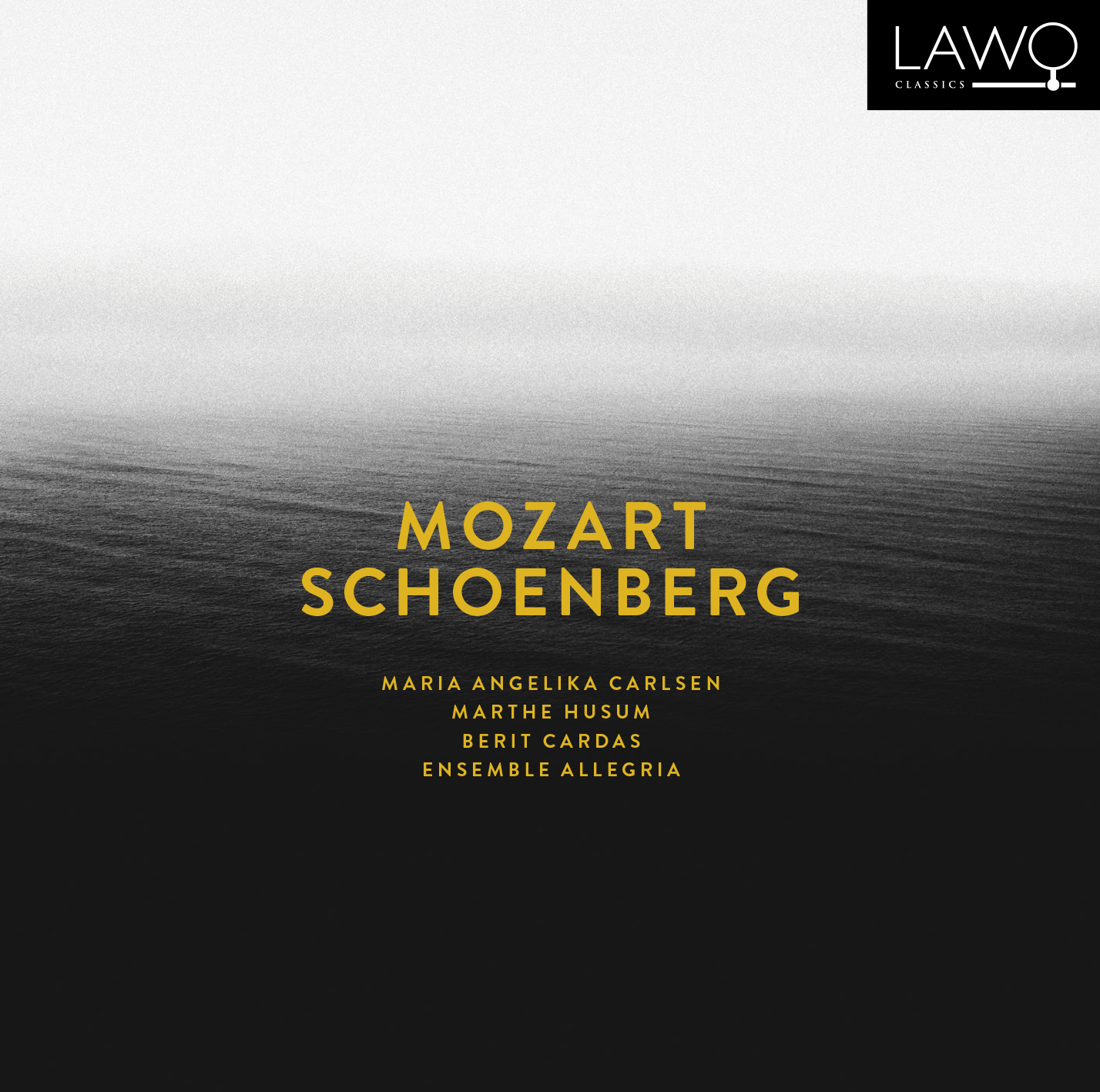
Wolfgang Amadeus Mozart | Arnold Schönberg
Mozart – Schoenberg
Maria Angelika Carlsen (Violin) | Marthe Husum (Viola) | Ensemble Allegria (String orchestra) | Berit Cardas (Violin)
Stream & download
Tracks
Wolfgang Amadeus Mozart (1756–1791)
Sinfonia Concertante in E-flat major, K. 364/320d
Ensemble Allegria | Maria Angelika Carlsen | Marthe Husum
Arnold Schönberg (1874–1951)
Reviews
One of the special things about this recording by the young Allegria ensemble is that here we experience a subdued ensemble, not a 100-piece orchestra with all its clamour and din.…
Show more Show less
One of the special things about this recording by the young Allegria ensemble is that here we experience a subdued ensemble, not a 100-piece orchestra with all its clamour and din. The music feels closer and more intimate this way. [...] In any case, this is an enjoyable encounter with the young ensemble. Things are really taking root in the Norwegian music scene today!Show original
Noe av det spesielle med denne innspillingen med det unge Allegria-ensemblet er at her opplever vi et nedtonet ensemble, ikke et 100 manns orkester med dets bulder og brak. Musikken kommer tettere og nærmere oss på denne måten. [...] Uansett er dette et sympatisk møte med det unge ensemblet. Det gror i norsk musikkliv i dag!

The soloists of the Norwegian Ensemble Allegria perform this opening track on their album with verve and precision [...] Ensemble Allegria give an outstanding performance here…
Show more Show less
The soloists of the Norwegian Ensemble Allegria perform this opening track on their album with verve and precision [...] Ensemble Allegria give an outstanding performance here, particularly towards the end, where they achieve a wonderfully transparent orchestral sound – a hint of something fresh and sombre that is now on the horizon.Show original
Solistane til det norske Ensemble Allegria spelar dette fyrste verket på plata si livfullt og presist [...] Ensemble Allegria spelar her ypparleg, særleg mot slutten, der dei får til ein vedunderleg transparent orkesterklang – ein dåm av noko doggfriskt somberbodomeinatnydag er i emning.
 Dag og tid | 08.12.17
Norwegian
Verklärte Nacht (with Berit Cardas as guest conductor) stands up to such a full-throttle approach, and this intense and fiery interpretation is utterly convincing.…
Show more Show less
Verklärte Nacht (with Berit Cardas as guest conductor) stands up to such a full-throttle approach, and this intense and fiery interpretation is utterly convincing. These are young musicians, and Schoenberg was a young man of 25 when he wrote the work.Show original
Verklärte Nacht (gjestedirigent her er Berit Cardas) tåler en sånn full guffe-tilnærmelse, og denne intense og ildfulle tolkningen er helt og holdent overbevisende. Det er unge musikere her, og Schönberg var en ung mann på 25 da han skrev verket.
With a vivid and quite fast, yet very coherent performance of Mozart’s Sinfonia concertante and a lean and intense one of Schönberg’s Transfigured Night, the Olso-based Allegria…
Show more Show less
With a vivid and quite fast, yet very coherent performance of Mozart’s Sinfonia concertante and a lean and intense one of Schönberg’s Transfigured Night, the Olso-based Allegria Ensemble and its soloists present an attractive account of both works.
 Pizzicato | 28.02.18
Read at Pizzicato →
Listening and feeling the passion and experimentation of the Ensemble Allegria chamber ensemble is an encouraging exercise for all of us who want music to beat everywhere in our lives.
 Sonograma magazine | 29.03.18
Read at Sonograma magazine →
Show all 8 reviews
The performance is absolutely brilliant; the same goes for Allegria, which also has the depth to convey subtle details, both in terms of tone and phrasing.
Show original
Uttrykket er feiende flott, det gjelder også for Allegria, som dessuten har overskudd til subtile detaljer, både klanglig og i fraseringen.
 Morgenbladet, 13. | april 2018
Norwegian
Winning performances in both works, too.
 BBC Magazine
ICMA
[…] The pairing of this work with Wolfgang Amadeus Mozart’s (1756–1791) ‘Sinfonia Concertante in E flat major’, K.…
Show more Show less
[…] The pairing of this work with Wolfgang Amadeus Mozart’s (1756–1791) ‘Sinfonia Concertante in E flat major’, K. 364/320d, is an excellent choice. It gives the ensemble the opportunity to truly shine, whilst also allowing them to showcase their musical versatility as an ensemble. Mozart’s piece features three brilliant soloists: Maria Angelika Carlsen (violin), Marthe Husum (viola) and Berit Cardas (violin). The album is exceptionally good. Ensemble Allgeria plays with confident playfulness and has an irresistible sound. Highly recommended.Show original
[…] Kombinasjonen med dette verket og «Sinfonia Concertante i Ess-dur» K364/320d av Wolfgang Amadeus Mozart (1756-1791) er et særdeles godt grep. Det gir ensemblet mulighet til virkelig å skinne, samt at de får vist sitt musikalske mangfold som ensemble. Mozarts stykke er med tre strålende solister; Maria Angelika Carlsen (fiolin), Marthe Husum (bratsj) og Berit Cardas (fiolin). Platen er sjeldent god. Ensemble Allgeria spiller med overbevisnede lekenhet og har en uimotståelig klangbehandling. Anbefales på sterkeste.

Credits
- Soloist
- Maria Angelika Carlsen (Violin) | Marthe Husum (Viola)
- Performer
- Berit Cardas (Violin)
- String orchestra
- Ensemble Allegria
- Ensemble members
Ensemble Allegria on this recording
- Berit Cardas (Violin)
- Maria Angelika Carlsen (Violin)
- Sunniva Carmen Fossum (Violin)
- Oda Gihle Hilde (Violin)
- Miriam Bergset-Gibbs (Violin)
- Ragnhild Kyvik Bauge (Violin)
- Eva Camilla Eikaas Stalheim (Violin)
- Theodor Thornhill (Violin)
- Nora Myrset Asheim (Violin)
- Vilde Sandve Alnæs (Violin)
- Andreas Haug (Violin)
- Emilie Benedicte Haagenrud (Violin)
- Hugo Hilde (Violin)
- Maria Eikefet (Violin)
- Ingvild Finset Spilling (Viola)
- Einar Kyvik Bauge (Viola)
- Marthe Husum (Viola)
- Torunn Johanna Uglem Falnes (Viola)
- Ole Rasmus Bjerke (Viola)
- Emilie Heldal Lidsheim (Viola)
- Frida Fredrikke Waaler Wærvågen (Cello)
- Benedicte Alstveit Årsland (Cello)
- Jan-Øyvind Grung Sture (Cello)
- Sverre Kyvik Bauge (Cello)
- Ulrikke Henninen (Cello)
- Mathias Sunde Valseth (Bass)
- Inga Margrete Aas (Bass)
- Marianne Svenning (Oboe)
- Christine Lorentzen (Oboe)
- Benedicte Elnes (Horn)
- Ingvild Sandstad (Horn)
- Composer
- Wolfgang Amadeus Mozart | Arnold Schönberg
- Producer
- Vegard Landaas
- Engineer
- Thomas Wolden
- Editing
- Vegard Landaas
- Mastering
- Thomas Wolden
- Liner notes
- Maria Angelika Carlsen
- English translation
- Jim Skurdall
- Executive producer
- Vegard Landaas
- Booklet editor
- Hege Wolleng
- Cover photo
- Wikimedia Commons / Pexels.com CC licence
- Artist photo
- Maria Angelika Carlsen by Ingrid Pop | Maria Angelika Carlsen by Rune Kongsro | Maria Angelika Carlsen by Anna-Julia Granberg
- Design
- Anette L’orange | Blunderbuss
- Recording location
- Ris Church, Oslo | Solsiden Church, Fredrikstad
- Recording country
- Norway
- Recording year
- 2015
- Recording dates
- 09.04.2015 | 10.04.2015 | 17.04.2015 | 18.04.2015
- Original source
- DXD (352.8 kHz, 24 bit)
- Discs / tracks
- 1 disc | 4 tracks
- Release year
- 2017
- Label
- LAWO Classics
- Duration
- 58:21
- EAN
- 7090020181608
- ISRC
- NOEHX1720010/40
Booklet text
Viennese Contrasts
Two young composers from what today is Austria are featured on this recording. The works, separated in time by 120 years, are contrasting in many respects — in form, mood and artistic aim. In music history we speak of several Viennese "schools", and here the differences between them are obvious. They are similar only in wealth of imagination and quality.
Wolfgang Amadeus Mozart: Sinfonia Concertante in E-flat, KV 364
Mozart was 23 years old when, in 1779, he wrote this work for the somewhat unusual instrumentation of violin and viola and an orchestra consisting of strings, two oboes and two horns. This instrumentation was quite common then, except for the division of the viola section into two parts, just like the violins. The solo viola part is, however, notated in D-major, meaning that all four strings are tuned a semitone sharper, presumably so that the darker-sounding solo instrument might be better heard. This is seldom done today, nor was it done on this recording.
Mozart wrote the "Concertante", as it is usually known among musicians, in Salzburg under the impression of his mother's death and their stay in Paris. He had tried in vain to find a permanent engagement there and had despaired of the conditions in the metropolis and the treatment he was subjected to. Then came the death of his mother, who no doubt was along to support and keep an eye on him. Some see the second movement — a dignified, striding andante in C-minor — as an expression of his grief, but this is conjecture only. With Mozart, it is virtually impossible to read his state of mind from the music he wrote.
The first movement seems rather to suggest something more concrete, since it has been given the tempo marking allegro maestoso and proceeds in the traditionally majestic key of E-major. The Magic Flute also opens with solemn E-flat chords, and Beethoven wrote his Piano Concerto No. 5, the Emperor Concerto, in the same key. Mozart was, however, probably after a musical mood and not thinking of a particular occasion with pomp and ceremony. This movement can otherwise leave analysts with a certain sense of despair, as it really has no main theme, but rather a collection of fragmented motifs.
The last movement — a rondo with the tempo marking presto — wants little more than to put us in a good mood. The musicians get to frolic, and the soloists end by ascending the fingerboard from the lowest range to extraordinary heights. It is, for that matter, not inconceivable that Mozart wrote the solo viola part for himself; he was a virtuosic performer both as pianist and violinist. For a good violinist, the viola is easy to master. Mozart's own instrument is on exhibit in Salzburg, in the house in which he was born. The fingerboard is just long enough to be able to play the highest note.
Mozart had to endure life in Salzburg under the archbishop's yoke yet another two years before liberating himself and settling in behind the high walls of the imperial city of Vienna.
Arnold Schoenberg: Verklärte Nacht, Op. 4, Version for String Orchestra
Mozart was a child of the Enlightenment; Schoenberg was born in Vienna in 1874, in the age of industrialisation and an economic phase known as the "Gründerzeit". "Ringstrasse" was built with the opera, the imperial palace, the "Musikverein", and the other magnificent edifices where city walls had once surrounded the historic city centre. Young poets, composers and other artists and philosophers soon understood the hollowness in this grandiose architectonic expression. Behind it they saw a hierarchical and hypocritical society in which the nobility continued to set the tone. They had to oppose it, and there were many of them, for right at this time the imperial city was teeming with young talent. Schoenberg and his somewhat younger pupils, Alban Berg and Anton Webern, frequented the same cafés as the poets Stefan Zweig and Hugo von Hofmannsthal and the social satirist Karl Kraus. Gustav Klimt and his circle were supported by the wealthy industrialist Wittgenstein family, whose youngest son Ludwig would become a renewer in the field of philosophy.
First, however, one must know that which one wishes to renew. Such was the case with Schoenberg, who in his earlier works followed in the footsteps of Brahms and Wagner. It was not until after 1900 that he sought out entirely new — and, for his wider audience, scandalous — paths as a composer.
Verklärte Nacht was first written for two violins, two violas and two cellos in 1899. The remarkable and at times grandiloquent late romantic work was inspired by a poem of the same name by the German poet Richard Dehmel (1863-1920). Schoenberg had already set a number of his poems to music.
The poem consists of two monologues — the woman's and the man's — framed by three shorter verses. Schoenberg closely follows the structure of the poem, and from the poem alone it is natural to speak of a rondo form — with a basic theme that is repeated as it alternates with new secondary themes. As is often the case with musical analysis, however, this is not particularly helpful in understanding the composition's — or the poem's — inner life and development. We are at the same time dealing here with programme music, since the music is based on a text — and it is striking, the extent to which the musical tones illustrate the poem. Yet the music is independent and needs no text to be understood.
The tonal language encompasses everything from simpler hymnic parts to jarring expressionistic passages in the tonal borderland. This was a challenge for the audience in Vienna, when the work was premiered by the Vienna Philharmonic Orchestra led by legendary concertmaster Arnold Rosé. Audience reaction was, mildly put, divided. Many reacted to the poem's "indecent" content. There was still a long road ahead for Schoenberg and his like-minded admirers …
After finding his later atonal style and constructing his theory of composition, Schoenberg did not turn his back on tonality completely. And he returned to Verklärte Nacht on two occasions: in 1917 he arranged the piece for string orchestra, adding double bass and alternating soloistic and orchestral parts. He revised this version in the USA in 1943, and it is the revised version we hear on this recording. He liked this work of his early years, played here by a youthfully energetic orchestra.
— Notes: Morten Carlsen, Norwegian Academy of Music · English translation: Jim Skurdall