
Stream & download
Tracks
Alf Hurum (1882–1972)
Hurum
Hjalmar Borgstrøm (1864–1925)
Borgstrøm
Knut Håkanson (1887–1929)
Håkanson
Franz Liszt (1811–1886)
Liszt/Wagner
Øistein Sommerfeldt (1919–1994)
Sommerfeldt
Arne Dørumsgaard (1921–2006)
Dørumsgaard
Sigurd Lie (1871–1904)
Lie
Sverre Jordan (1889–1972)
Jordan
Reviews
I have to say that this is a success, as I could sense there’s a real atmosphere in these songs – and not least in the way they’re performed.…
Show more Show less
I have to say that this is a success, as I could sense there’s a real atmosphere in these songs – and not least in the way they’re performed. From Alf Hurum’s very first songs, I was swept away by a joy of singing that transported me into a world I’m more than happy to revel in. Absolutely!Show original
Jeg må si at dette er vellykket all den stund jeg merket at det er atmosfære i disse sangene og ikke minst i hvordan de blir framført. Fra de første sangene til Alf Hurum ble jeg båret av gårde på en sangglede som lot meg bringe inn i en verden jeg mer enn gjerne frydes ved. Så absolutt!

What Gericke herself cannot say is that any soprano following in Flagstad’s footsteps in this repertoire must herself possess an equally unpretentious voice – one so natural that…
Show more Show less
What Gericke herself cannot say is that any soprano following in Flagstad’s footsteps in this repertoire must herself possess an equally unpretentious voice – one so natural that it never occurs to you that this lack of affectation might conceal a phenomenal vocal technique. Gericke is precisely that sort of singer. One is filled with wonder at how innocent her voice seems and how directly it addresses the listener, as if a favourite aunt were sitting down to tell you a fairy tale.Show original
Det Gericke ikke selv kan si er at enhver sopran som følger Flagstads fotspor i dette territoriet, selv må ha en like ukunstlet stemme, en som er så naturlig at det aldri faller deg inn at ukunstletheten kanskje skjuler en fenomenal vokalteknikk. Gericke er nettopp en sånn sanger. Man fylles av undring over hvor uskyldig den virker og hvor direkte den henvender seg til tilhøreren, som om en favoritt-tante setter seg ned for å fortelle deg et eventyr.
[...] this music is too appealing to ignore.…
Show more Show less
[...] this music is too appealing to ignore. [...] Gericke has a warm, sensuous voice, even from top to bottom, and she interprets these songs with great love and passion.
 American Record Guide | april 2018
With this album, soprano Isa Katharina Gericke pays tribute to one of our greatest singers of all time – Kirsten Flagstad.…
Show more Show less
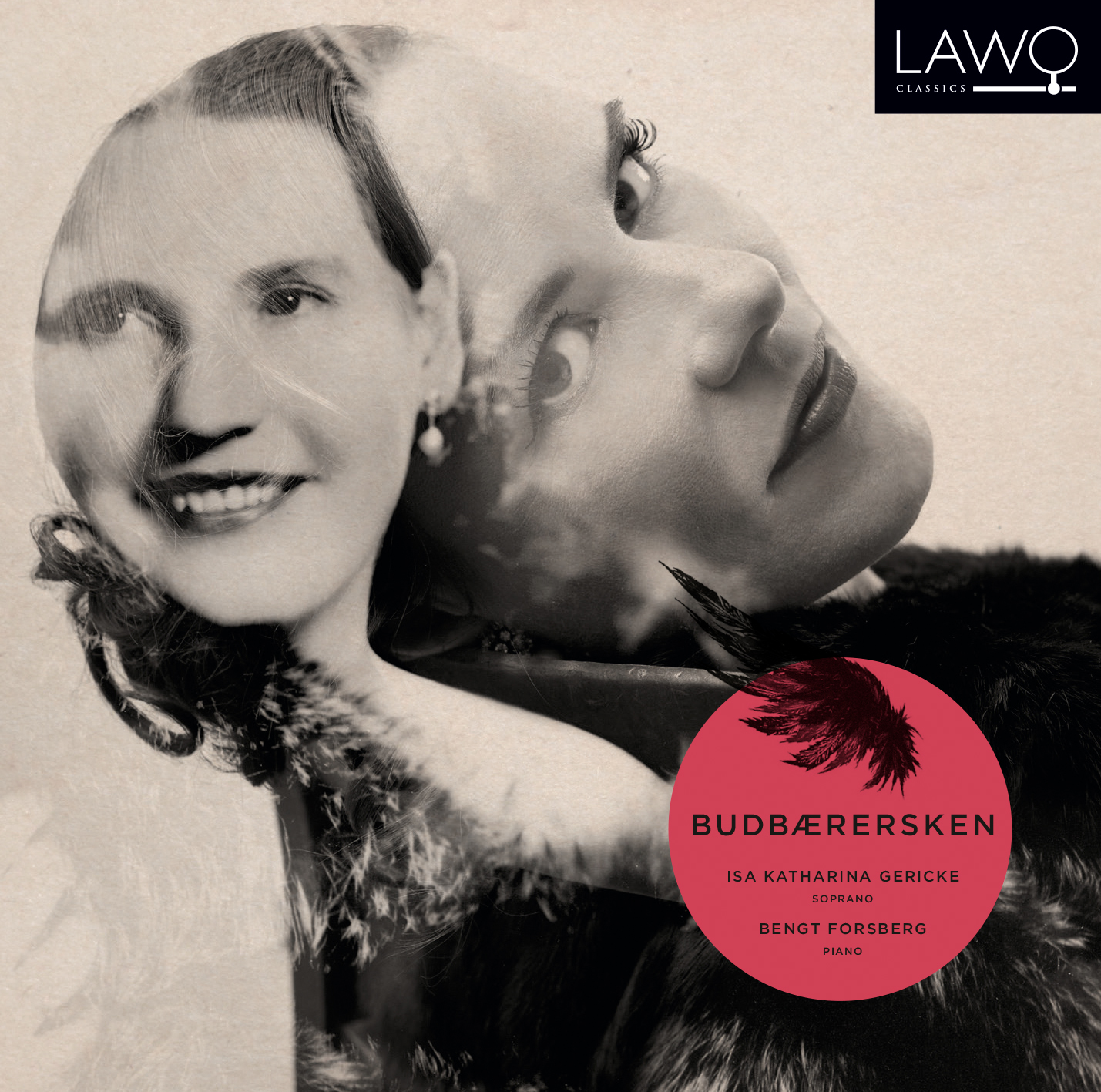
With this album, soprano Isa Katharina Gericke pays tribute to one of our greatest singers of all time – Kirsten Flagstad. She is joined by the Swedish singer Bengt Forsberg in presenting this collection of Nordic songs. If you enjoy delving into the Nordic repertoire, you simply must give this recording a listen. It’s absolutely lovely!Show original
Sopranen Isa Katharina Gericke gir med denne platen sin hyllest til en av våre aller største sangerinner - Kirsten Flagstad. Medspiller i sangskatten som presenteres er svenske Bengt Forsberg. Liker du å dykke ned i den nordiske sangskatten - er det bare å låne øret til denne innspillingen. Den er meget fin!

Credits
- Performer
- Isa Katharina Gericke (Soprano) | Bengt Forsberg (Piano)
- Composer
- Alf Hurum | Hjalmar Borgstrøm | Knut Håkanson | Franz Liszt | Øistein Sommerfeldt | Arne Dørumsgaard | Sigurd Lie | Sverre Jordan
- Producer
- Vegard Landaas
- Engineer
- Thomas Wolden
- Editing
- Vegard Landaas
- Mastering
- Thomas Wolden
- Liner notes
- Isa Katharina Gericke
- English translation
- Jim Skurdall
- Executive producer
- Vegard Landaas
- Booklet editor
- Hege Wolleng
- Artist photo
- Isa Katharina Gericke by Jan Erik Fillan | Isa Katharina Gericke by Romulo Correa
- Design
- Anna-Julia Granberg | Blunderbuss
- Recording location
- Sofienberg Church, Oslo
- Recording country
- Norway
- Recording year
- 2014
- Recording dates
- 25.05.2014 | 26.05.2014 | 27.05.2014 | 28.05.2014 | 29.05.2014
- Original source
- 44.1 kHz, 16 bit
- Discs / tracks
- 1 disc | 24 tracks
- Produced with support from
- Arts and Culture Norway
- Release year
- 2016
- Label
- LAWO Classics
- Duration
- 57:37
- EAN
- 7090020181325
- ISRC
- NOEHX1702010/240
Booklet text
Kirsten Flagstad was born in Hamar, Norway, in 1895, into a life filled with music; both her parents were professional theatre musicians in Norway's capital.
Throughout her childhood years at Vinderen in Oslo, music was a part of her life from morning until evening. Via her parents' acquaintances, Kirsten was introduced to a broad repertoire; she would accompany herself at the piano in Schubert Lieder, revue songs by Vilhelm Dybwad, operettas by Franz Lehár and Emmerich Kálmán, as well as in the arias of Puccini and Wagner. Her début as an opera singer took place at the National Theatre in Oslo, in December 1913, where she sang the part of Nuri in Eugen d'Albert's Tiefland, under the baton of Johan Halvorsen.
After having considered a career as a doctor or piano teacher, Kirsten and her family realized that she should focus on a singing career. From then on, her course was set for vocal studies in Stockholm, and opera and operetta roles in Sweden and Norway. During the 1933-34 season she had an engagement at Wagner's opera house in Bayreuth prior to her international breakthrough in the spring of 1935 when she sang all of Wagner's major soprano roles at the Metropolitan Opera in New York. She finished the season as superstar, and the centre of attention of the world press. In America, a Flagstad fever raged — no Norwegian since Ole Bull had managed to cause such a sensation in the USA as Kirsten Flagstad's voice did. Following the complicated war years, during which she had fallen into disfavour with her audience due to her husband's political leanings, Flagstad resumed her career and once again rose to glory.
In 1958, Kirsten Flagstad was appointed Norway's very first Opera Director. Plagued by ill health, she died in 1962 and was buried according to her own wish in an unmarked grave at the Vestre gravlund cemetery in Oslo.
It might seem something of a risky venture, setting out to perform songs sung by Kirsten Flagstad — who even while she lived was referred to as the 'voice of the century'. To me, Kirsten Flagstad was for a long time a myth, an unapproachable legend, with countless merits and recordings to her name. Her capacity for work was phenomenal, and her courage and stoic calm had an aura of the supernatural about it. My first encounter with Kirsten Flagstad happened when, as a young girl, I heard her on the radio in a recording of the Norwegian hymn Alltid freidig når du går, accompanied by Sigvart Fotland. The combination of Flagstad's rich, beautiful voice interpreting the almost childish naivety of the words was a genuine and personal experience for me.
In 2013, when Norway and the opera world celebrated the centenary of Kirsten Flagstad's début, I had the opportunity to become more closely acquainted with her life and work in conjunction with a concert production I took part in together with actress Minken Fosheim and pianist Trygve Brøske. Kristen Grødem wrote and directed the performance. As our preparations led us to read through biographies and other material on our subject, an understanding of the person behind the public image began to form. She was shy and stubborn at the same time, wise and courageous in her choice of repertoire; she sang for thousands nearly every day, but was happiest in her own company with playing cards or a pair of knitting needles. Apparent simplicity, yet possessing a voice with an entire symphony of colours.
Kirsten Flagstad received the accolade 'voice of the century' primarily for her remarkable interpretations of Wagner's soprano roles. Her impressive embodiment of the characters, her voice and her stamina were as if made for the repertoire; few singers are up to the challenge — as she was — of singing five different Wagner roles in two months.
Despite the fact that Kirsten Flagstad is remembered as a singer mainly of large-scale works, with a voice that was suited to the largest venues, she had a particular love of Lieder and art songs. From her teens and throughout her career her repertoire included a significant number of German and Nordic songs. It is perhaps this very diversity and versatility in Kirsten Flagstad that fascinated me most as I grew more familiar with her life and art.
Her distinctive voice and ability made Kirsten Flagstad a source of inspiration to composers all over the world. Many wrote music for her, claiming that their music was so demanding that only Kirsten would be able to perform it. She had a predilection for Norwegian music and as often as not a recital programme would contain songs by Arne Dørumsgaard, Sverre Jordan, Øistein Sommerfeldt, Sigurd Lie, or Hjalmar Borgstrøm. Flagstad's short, intense friendship with the Swedish composer Knut Håkanson inspired a special collection of songs that she kept in her repertoire all her life.
My intention with this recording is to shed light on new facets of Kirsten Flagstad as an interpreter of art song. The songs recorded here were written by composers, some of whom were her accompanists at one time or another, or they were young, talented individuals whom she helped into the limelight; a few of them became lifelong, close friends. The songs are of such a high standard that they deserve the attention of new performances, and thus each one of them pays tribute to one of the greatest singers of the twentieth century.
— Isa Katharina Gericke
About the Composers
ARNE DØRUMSGAARD (1921-2006) was born in Fredrikstad and showed an early interest in music and poetry. At the age of 10 or 11, he heard a recording of Kirsten Flagstad for the first time, which was to prove decisive for his further development: 'When I was fifteen, I had composed more than one hundred songs, most of them for soprano, with the voice of Kirsten in mind. I tailored them so closely to her voice that many other singers, as I later found out, had great problems doing what Kirsten so effortlessly accomplished when she sang them.'
Dørumsgaard did not only compose songs and piano pieces, however, he also wrote poetry. In October 1939, he made a booklet of 15 of his poems, the first of which dealt with the meaninglessness of a war that he saw approaching. The 17-year-old composer was bold enough to send some of his songs to Kirsten Flagstad, who sent him a pleasant and encouraging reply. On this recording, we hear four of the early songs that Kirsten Flagstad sang. Natt Op. 4, No. 1 is a setting of a word-painting poem by Ragnvald Vaage. En hustavle Op. 5, No. 1 and Søvnen Op. 6, No. 1 are settings of poems by Arnulf Øverland whom Dørumsgaard knew via his mother. Regn is a poem by Sigbjørn Obstfelder, a writer Dørumsgaard developed a strong interest in.
During the years that followed, Dørumsgaard's songs would often feature on Kirsten Flagstad's recital programmes. Flagstad was not the first to sing Dørumsgaard's songs, however; several of them were premiered by Egil Nordsjø in the Norwegian Society of Composers' concert series in 1941. The songs have attractive melodic lines and a characteristic piano part showing Dørumsgaard's distinctive style and his talent for allowing words and music to merge into an artistic unity.
During the war years, Dørumsgaard taught theory at the Barratt Due Institute of Music and took part as pianist and accompanist in the Institute's concerts.
Dørumsgaard reacted strongly to the way in which certain Norwegian artists were treated after the war, not least Kirsten Flagstad. In 1951 he emigrated to France where he began the task of collecting what amounted to some 2000 folk songs from all over the world. He arranged several hundred of them for voice and piano or orchestra. At around the same time he embarked on a project to translate poetry from the Far East. He earned his living as an accompanist, singer, and producer and instructor for recording sessions.
In 1968, Dørumsgaard moved to Marzio in northern Italy where he continued his translation project and collecting a music library that was to become the foundation of Norsk Lydinstitutt — The Norwegian Institute of Recorded Sound — in Stavanger.
KNUT HÅKANSON (1887-1929) was born in Sjuhäradsbygden, Sweden. After having studied in Uppsala and Dresden he worked for a brief period as a composer in Stockholm, writing chamber music, songs, and works for piano, orchestra and choir. In 1916 he returned to his hometown where he became conductor of the Borås Orchestra Society and founded the Borås Institute of Music. He was also active at the time as a ground-breaking music critic in Gothenburg, and it was in that connection he came to Oslo on 13th of January 1929 to review Kirsten Flagstad's two concerts with the Philharmonic in the University Aula. '...she infuses her song with energy, a mighty hymn to light and life…' wrote Håkanson in Gothenburg's Handels- och Sjöfartstidning. He was so delighted with Flagstad's performance that he invited her to sing at his composer's soirée in Gothenburg on 15th of November the same year, with himself at the piano. 'It was quite astonishing the way in which she engaged with these songs, which are so captivating and became even more so thanks to her animated performance,' wrote one Gothenburg newspaper about Kirsten Flagstad after the concert. Håkanson died on 13th of December, barely a month after the recital had taken place. Kirsten Flagstad continued to programme Håkanson's songs, which are characterized by the New Objectivity movement that was beginning to gain a foothold in Scandinavia at the time. The songs have such depth and musical expressivity that they deserve to be better known outside Sweden.
ALF HURUM (1882-1972) was born in Kristiania (Oslo). He developed an early interest in architecture, art and music. After having studied piano and composition in Berlin he moved on to Paris where Debussy's music provided a crucial impulse. Most of Hurum's works were composed between 1910 and 1930. Stylistically they range from the neo-romantic with elements of folklorism and modality, to typically impressionistic.
Following a period as a piano teacher and orchestra director in Honolulu, Hawaii, Hurum spent the remainder of his life as an artist (painting on silk) with annual exhibitions in his new home country. Kirsten Flagstad visited him there once in connection with a major tour of Australia; Hurum's songs frequently appeared on her recital programmes.
HJALMAR BORGSTRØM (1864-1925) was born in Kristiania. After having studied music in his hometown, he moved to Germany to continue his studies. He returned to Norway after 16 years abroad and with the performance of his five symphonic poems became a notable representative of so-called programme music. Borgstrøm composed music in a wide variety of genres, and during the first half of the 20th century was a feared yet respected music critic. His music was widely performed up until World War II; the many singers who débuted during that time rarely neglected to include his songs on their programmes. Unlike many of his colleagues, Borgstrøm was not particularly interested in national tendencies — his music is characterized first and foremost by European models such as Richard Wagner and Richard Strauss.
SVERRE JORDAN (1889-1972) was born in Bergen. He studied piano and composition in Berlin. During his first years as a professional musician, he worked as a pianist and accompanist for Kirsten Flagstad, among others. Later he dedicated his career to Bergen's music life as an administrator, writer, critic and Kapellmeister at Den Nationale Scene. He composed music in most genres, but it is nonetheless his over 200 songs in late romantic idiom that are at the core of his output. These songs were inspired in particular by his collaboration with Kirsten Flagstad and other Norwegian singers.
SIGURD LIE (1871-1904) was born in Drammen, but grew up in Kristiansand. Like Rikard Nordraak, his was a musical talent that never had the chance to fully blossom before being caught up by death. Lie's Symphony in A minor, premiered the year before he died, gives us an idea of what Norway lost with the composer's premature passing away. Many of Sigurd Lie's songs are miniature gems; one of these is Sne, a setting of words by Helge Rode.
ØISTEIN SOMMERFELDT (1919-94) was born in Oslo and began studying at the Music Conservatory during World War II. Following further studies in Vienna and Paris Sommerfeldt attracted attention with his first two songs, Bånsull and Fattig er mitt liv. Upon discovering them, Kirsten Flagstad programmed them for her farewell recital at Carnegie Hall in New York in 1954. Like Grieg, Sommerfeldt was a master at creating songs and piano miniatures; these, with a solid foundation in neoclassicism and Norwegian folk music, gained widespread popularity.
— Harald Herresthal
English translations: Andrew Smith