
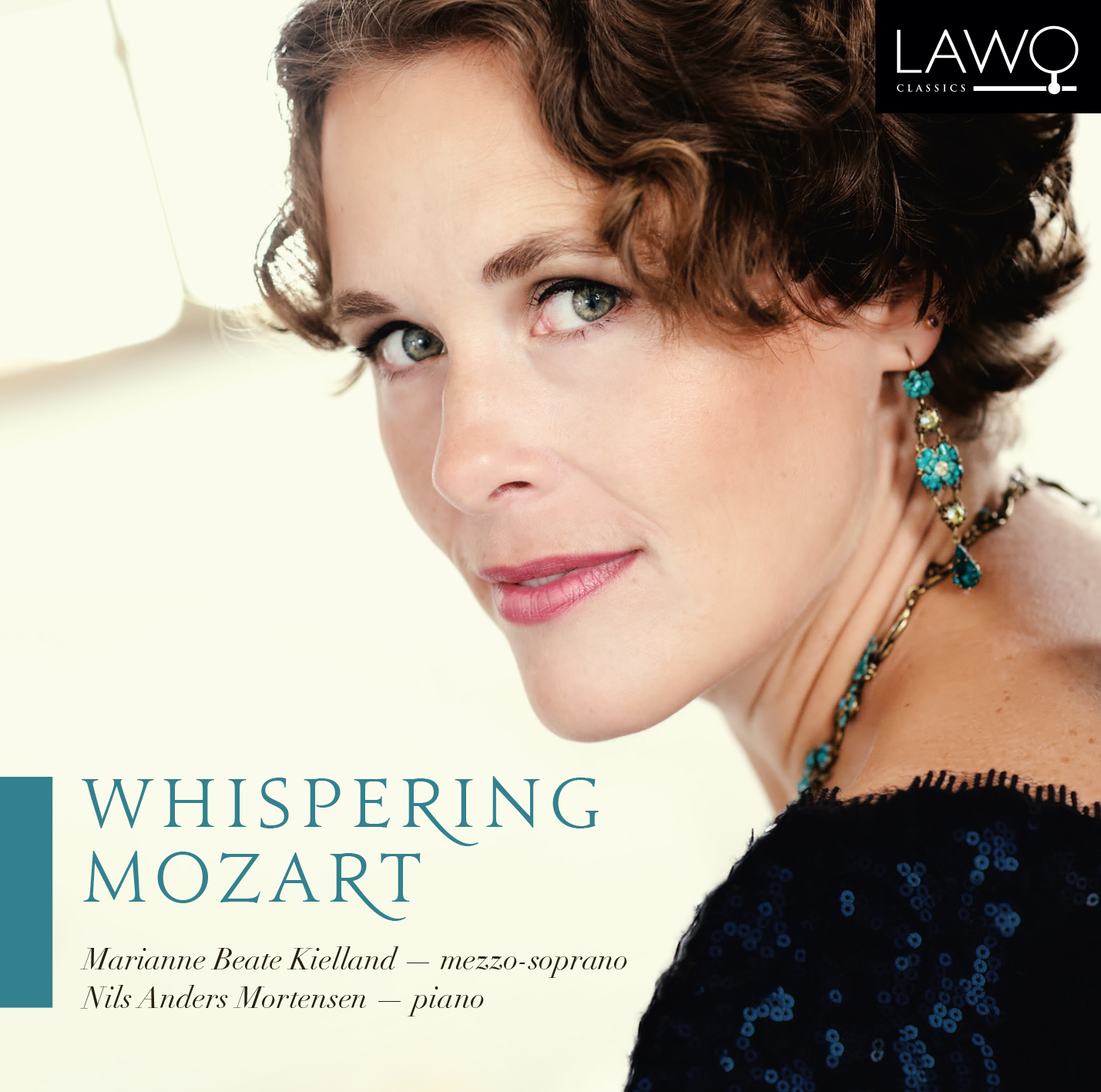
Whispering Mozart
Marianne Beate Kielland (Mezzo-soprano) | Nils Anders Mortensen (Piano)
Stream & download
Tracks
Wolfgang Amadeus Mozart (1756–1791)
Eine kleine deutsche Kantate
Zaide, K. 344
Credits
- Performer
- Marianne Beate Kielland (Mezzo-soprano) | Nils Anders Mortensen (Piano)
- Composer
- Wolfgang Amadeus Mozart
- Producer
- Vegard Landaas
- Engineer
- Thomas Wolden
- Editing
- Vegard Landaas
- Mastering
- Thomas Wolden
- Liner notes
- Marianne Beate Kielland
- English translation
- Jim Skurdall
- Executive producer
- Vegard Landaas
- Booklet editor
- Hege Wolleng
- Cover photo
- Christian Palm
- Artist photo
- Marianne Beate Kielland by Espen Mortensen | Marianne Beate Kielland by Christian Palm
- Design
- Anna-Julia Granberg | Blunderbuss
- Recording location
- Vågan Church, Lofoten
- Recording country
- Norway
- Recording year
- 2014
- Recording dates
- 08.03.2014 | 09.03.2014 | 10.03.2014 | 11.03.2014
- Original source
- DXD (352.8 kHz, 24 bit)
- Discs / tracks
- 1 disc | 21 tracks
- Produced with support from
- Scene Finnmark
- Release year
- 2016
- Label
- LAWO Classics
- Duration
- 65:16
- EAN
- 7090020181233
- ISRC
- NOEHX1616010/210
Booklet text
We who can look back on centuries of music history, and listen to the development of music over the same period of time, do not regard Mozart as the ultimate source of music. He was, to be sure, one of the greatest musical geniuses the world has ever known; yet he was, at the same time, but one of a number of musicians and composers whose impact over the course of history has made music what it is today.
When we consider the development of classical song as an art form, however, Mozart must be seen as one of the pioneers. It was he who elevated the song from domestic and traditional music to the realm of serious music. And with Mozart we have the entire spectrum of what a song can be. Many are in simple verse form — such as the very familiar “Im Frühlingsanfang” — and can be sung by just about anyone. But Mozart developed the song into something larger and more complex, with greater technical challenges and more innovative musical progression. “Abendempfindung” and, especially, “Eine kleine deutsche Kantate” represent the apex of Mozart’s achievement in this regard.
To do the songs of Mozart is indeed something of a challenge, precisely because they are so simple. Excessive pathos or outpouring of feeling is unsuitable. Emotion is to be expressed, of course, but it must be confined to the delicate and simpler limits that Mozart has established. I have chosen, therefore, to call the album “Whispering Mozart”, for that is how it feels to sing this material: as though you are whispering the words and melodies to the few who have gathered in your living room to listen …
— Marianne Beate Kielland
With Mozart in Vienna's Salons
The guests sat crowded together in the elegant salon of Minister Franz Bernhard von Keess. A Concert was about to begin, with everyone’s favourite, Wolfgang Amadeus Mozart, presenting his new song, and the minister’s wife herself performing it.
But no Mozart appeared, and servants were sent to town to look for him. When the composer was finally found in an alehouse, he was told that everyone eagerly awaited hearing his new song. It was then Mozart recalled he had forgotten to compose it. He asked for paper, wrote down the song, and returned with the servants to the party.
Mozart was given a warm welcome, after being gently reproached by the host for his late arrival. At last he seated himself at the piano, and the minister’s wife was given the music. With trembling voice, she sang the brand-new song to enthusiastic applause. (From the reminiscences of Adalbert Gyrowetz)
We do not know to which song this anecdote refers. Among suggestions by Mozart experts is Das Traumbild (K 530), composed in Prague in 1787.
The episode confirms that house concerts and performances at social gatherings by the hosts and other amateurs were an important part of musical life. Minister von Keess hosted his Gesellschafts-Concerte twice a week, and chamber music and symphonies were performed as well.
Following Mozart’s death in 1791, many of his songs lived on as household music and were printed. His name was also associated with a number of songs he had not composed. Sometimes the opposite was true: others took credit for Mozart’s songs, and if it was a friend, he did not object (for example, Als Luise die Briefe ihres Ungetreuen Liebhabers verbrannte K 520, 1787).
In 1800 Mozart’s widow Constanze published 30 Gesänge mit Begleitung des Pianoforte, and the collection remains the basis for this part of the Mozartian universe.
In verse form
Most of Mozart’s songs are in verse form, with the same melody used for all the verses. This is true for the first of the songs of which we know, An die Freude (K 53, 1768). It is the twelve-year-old composer’s fanfare-like tribute to the elation felt after recovering from an illness, composed the same year as Waisenhaus-Messe, the opera La finta semplice and the Singspiel Bastien und Bastienne.
In Das Traumbild Mozart combines the verses two by two, creating four rather than eight units, with each unit embellished by a piano interlude.
He uses this technique as well, for example, in Die Zufriedenheit (K 473, 1785). The text was written in Leipzig by Christian Felix Weisse, an intellectual kinsman of our own Henrik Wergeland. Weisse also published the children’s magazine Der Kinderfreund.
In Komm, liebe Zither (K 351, 1781) Mozart was indeed thinking of a zither accompaniment. The very first performance was by Martin Lang, who normally played horn in the orchestra in Munich, where Mozart’s opera Idomeneo was premiered at the Hoftheater in January 1781. Proud papa Leopold and sister Nannerl travelled from Salzburg for the occasion.
As for Wolfgang, he was in Munich on over-extended leave. Might we imagine a lively late-evening soirée of singing and zither playing where Wolfgang has his share of worries? He dreams of freedom from the dictatorial Archbishop Colloredo. At the same time, his beloved Aloysia Weber has just married another. Thus it is to his zither that he confides his delight and his anguish. A few months later he resigned his position in Salzburg and moved to Vienna.
Brüder, lasst uns lustig sein is the opening song in the Singspiel Zaide (K 344, 1780), which takes place at the court of the Turkish sultan Suleiman.
Among other songs in verse form are Daphne (K 52), the Masonic song from Salzburg, An die Freundschaft (K 148, 1772), Geheime Liebe (K 150), Ich würd’ auf meinem Pfad (K 390, ca. 1780), An die Einsamkeit (K 391, ca. 1780), An die Bescheidenheit (K 392, ca. 1780), Der Zauberer (K 472, 1785), and Die betrogene Welt (K 474, 1785).
Mozart’s best-known song, Sehnsucht nach dem Frühlinge/Komm lieber Mai (K 596, 1791), was one of the very last written in 1791, the year he died. The naturally joyful triadic melody is in a simple folk tune style. No wonder the Norwegian version, Kom mai, du skjønne milde, is thought by many to be a folk song. The piano postlude is itself a short refrain and its more ornamented style creates a lovely contrast.
Komm lieber Mai is the first in a collection of drei teutsche Lieder, dated 14 January 1791, at the beginning of the year of Mozart’s death. He died on December 5th. There is a touch of melancholy in his selection of Im Frühlingsanfang (K 597, 1791) as the second of his three last songs. In the midst of the Viennese winter, the composer chooses a tribute to spring and to nature’s rebirth.
Poet Christian Adolph Overbeck was mayor of Lübeck, and Komm Lieber Mai is from the collection Fritzchens Lieder from 1781.
Larger forms
An Chloë (K 524, 1787) has a more complicated form, in which the beginning is used as a sort of rondo theme and certain parts of the text are emphasized by means of repetition and pauses on important words.
In Abendempfindung (K 523, 1787) from the same year, Mozart strays even further from verse form. The meditation on the setting sun in nature and in life leaves room for a melody that strains against a text of measured verses. The piano interludes provide something of a foothold, while the voice leads us steadily along in the drama of life and death, sorrow and remembrance.
Das Lied der Trennung (K 519, 1787) is a sad story in F minor of angels who weep over broken love.
It begins in verse form, then gradually proceeds to break new ground.
Mozart does not have many songs in a fully elaborate style, but this, his only setting of a Goethe text, is one of them. The image used in Das Veilchen (K 476, 1785), Goethe’s story of the violet and the maiden, is similar to that in Heidenröslein, which Schubert set to music. Heidenröslein was written in 1771 and portrays a lad who picks a rose. Several years later Goethe created a reverse image. Here the flower, the violet, is a man’s heart crushed by the shepherdess.
Mozart dramatizes the text as he would a short opera aria — The Marriage of Figaro, which is filled with broken hearts, was composed the same year — and he fashions a new ending to round off the story of the unfortunate violet. (This Goethe-Mozart example is a forerunner of the coming Romanticism’s infinite longing for the Blue Flower, in which love, death and religious feeling merge into a single spiritual mood.)
Equally operatic is the melodramatic monologue Als Luise die Briefe ihres Ungetreuen Liebhabers verbrannte (K 520, 1787). The composer himself noted that on the 26th of May 1787 he was sitting composing at the home of his friend Emilian Gottfried von Jacquin (who took credit for the composition). The text, written by Gabriele von Baumberg a year earlier, tells of a woman who in her disappointment burns the love letters from a faithless lover.
What Mozart called Eine kleine teutsche Cantate (K 619, 1791) begins with Die ihr des unermeßlichen Weltalls Schöpfer ehrt — a homage to God, who has many names.
In the summer of 1791, Mozart was working on both Titus and The Magic Flute. Constanze was staying in Baden near Vienna, and in gratitude to the city organist for his help in finding lodging for her, Mozart composed Ave verum corpus for the church choir in Baden. Amidst all this, a commission arrived from Franz Heinrich Ziegenhagen, a businessman in Hamburg who was more preoccupied with religious ideas than his business. A Freemason, he wrote books about the universe, God’s creation and the divine. Mozart’s head was filled with such ideas while working with the Masonic ideas in The Magic Flute. The cantata’s call to overcome ignorance and the bonds of discord evokes the triumphant style of the Schiller-Beethoven message of brotherhood and Freude in the Ninth Symphony.
— Torkil Baden