
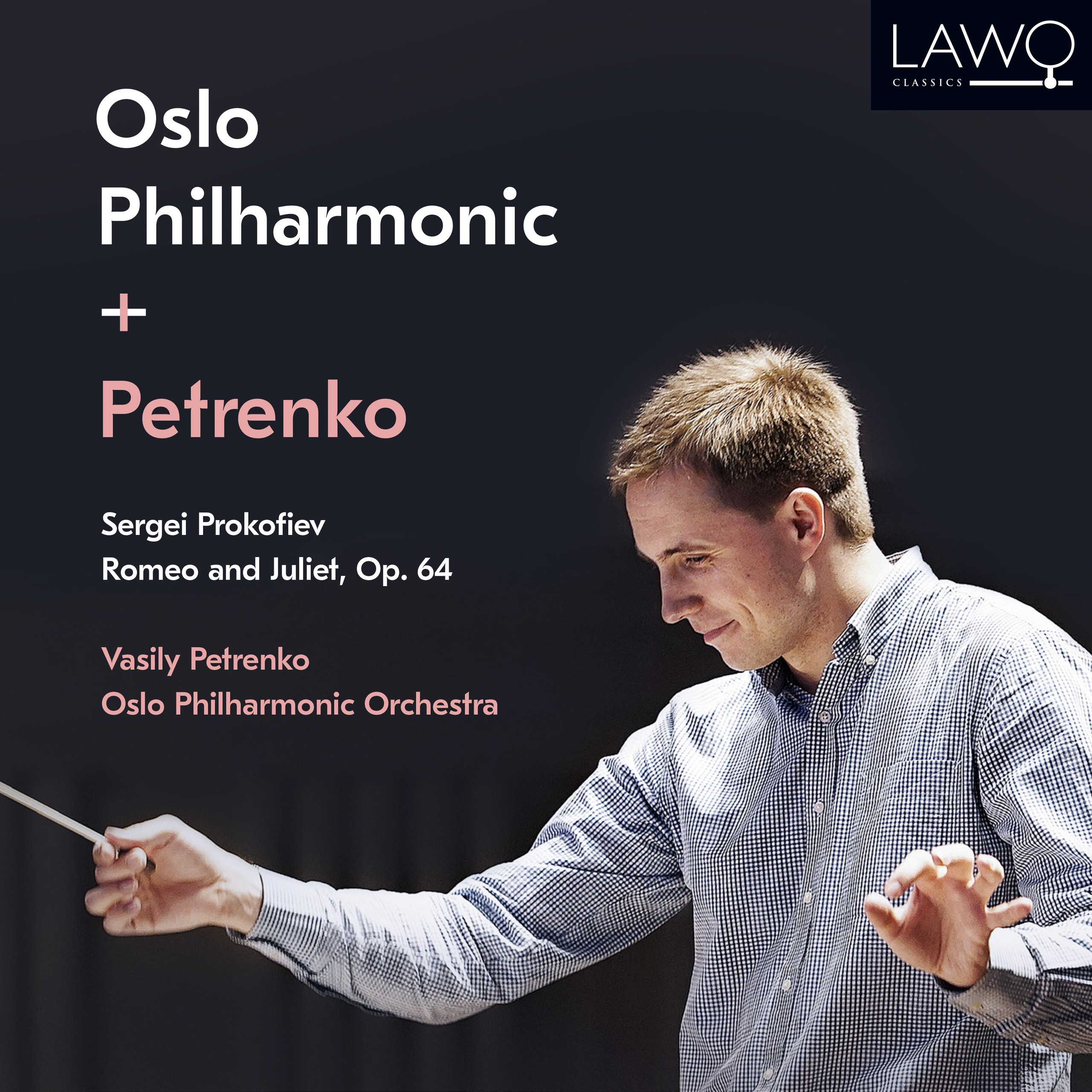
Prokofiev Romeo and Juliet Op. 64
Oslo Philharmonic Orchestra (Symphony orchestra) | Vasily Petrenko (Conductor)
Stream & download
Tracks
Disc 1
Sergey Prokofiev (1891–1953)
Romeo and Juliet, Op. 64, Act I
Romeo and Juliet, Op. 64, Act II
Disc 2
Romeo and Juliet, Op. 64, Act III
Act 3
Reviews
Sergei Prokofiev’s *Romeo and Juliet* contains so much fine music that the Oslo Philharmonic’s excellent recording is well worth a listen.…
Show more Show less
Sergei Prokofiev’s *Romeo and Juliet* contains so much fine music that the Oslo Philharmonic’s excellent recording is well worth a listen. […] The orchestra’s dynamics are exceptional and the chamber music sections work perfectly. Vasily Petrenko, together with his fellow musicians, turns this into a real experience.Show original
Sergej Prokofievs «Romeo og Juliet» inneholder så mye god musikk, at Oslo-filharmoniens meget fine innspilling er vel verd å låne øret til. […] Orkesterets dynamikk er eksepsjonell og de kammermusikalske delene fungerer optimalt. Vasily Petrenko gjør dette til en opplevelse sammen med sine medspillere.

To put it bluntly: this recording is a goldmine that stands as an example of some of the very best work Petrenko has achieved with his Oslo orchestra.…
Show more Show less
To put it bluntly: this recording is a goldmine that stands as an example of some of the very best work Petrenko has achieved with his Oslo orchestra. […] This is great music, and it is performed magnificently. Hats off to the Oslo Philharmonic and Petrenko!Show original
For å si det rett fram: denne innspillingen er en gullgruve som kan stå som uttrykk for noe av det aller beste som Petrenko har fått til med sitt Oslo-orkester. […] Dette er stor musikk og den er framført på en stor måte. Blomster til Oslo-filharmonien og Petrenko!

The partnership between the Oslo Philharmonic and its chief conductor, Vasily Petrenko, is now an absolutely superb one.…
Show more Show less
The partnership between the Oslo Philharmonic and its chief conductor, Vasily Petrenko, is now an absolutely superb one. Ever since he arrived here, Petrenko’s grasp of Prokofiev’s scores has been absolutely exquisite. He combines a robust grasp of the music with the very finest nuances, whenever the composer calls for them. This release is no exception; the conductor and orchestra give it their all right to the very end.Show original
Nå er koblingen mellom Oslo-Filharmonien og sjefdirigent Vasily Petrenko en aldeles utmerket kobling. Fra han kom hit har Petrenkos grep om Prokofjevs partiturer vært aldeles utsøkt. Han forener et robust grep om musikken med de aller fineste nyanser, når komponisten vender den siden til. Så også på denne utgivelsen, dirigent og orkester står løpet helt ut.
 Dagbladet
Norwegian
His interpretation of his compatriot Sergei Prokofiev’s longest and best-known ballet score, *Romeo and Juliet* (1938), is refreshingly unsentimental, and at times even humorous.…
Show more Show less
His interpretation of his compatriot Sergei Prokofiev’s longest and best-known ballet score, *Romeo and Juliet* (1938), is refreshingly unsentimental, and at times even humorous. The numerous changes in tempo and expression – the ballet comprises no fewer than 52 movements – work flawlessly. Particularly impressive is the orchestral clarity, where the sound of the strings and woodwinds blend perfectly.Show original
Tolkinga hans av landsmannen Sergej Prokofjevs lengste og mest kjente ballettmusikk Romeo og Julie (1938), er forfriskande usentimental, stundom jamvel humoristisk. Dei mange overgangane i tempo og uttrykk – balletten har heile 52 satsar – fungerer lytefritt. Særleg imponerande er den klanglege klåren i orkesteret, der lyden av strykarar og treblåsarar blandar seg perfekt.
 Dag og tid | 26.05.17
Norwegian
Petrenko’s Norwegian band yield nothing in virtuosity — the strings are staggering in the fight — to Russian peers.…
Show more Show less
Petrenko’s Norwegian band yield nothing in virtuosity — the strings are staggering in the fight — to Russian peers. The dramatic episodes sizzle, but there is poignancy in the balcony scene and Juliet’s death. One listens with refreshed ears.
 The Sunday Times
Show all 19 reviews
The delicate numbers, for example the «Dance of the Girls with Lilies», are genuinely touching, and the virtuoso ones prove that the Oslo Philharmonic has what it takes to play this hugely taxing score.
He has a light touch with both the orchestra and the piece, and makes it sound really balletic throughout [...]
Vasily Petrenko’s recording represents a very fine achievement.…
Show more Show less
Vasily Petrenko’s recording represents a very fine achievement. [...] The Oslo Philharmonic plays extremely well for him and both the conductor and players have got right under the skin of Prokofiev’s music. The Lawo recording is very successful. The sound is natural and clear with good left-to-right and front-to-back perspectives. [...] I enjoyed this new version of Romeo and Juliet very much. I wonder if Petrenko might consider setting down the Cinderella ballet as well.
 MusicWeb International | Nov 2016
Read at MusicWeb International →
The playing is precise and sharp-edged, exactly right for this vivid, exuberant score.…
Show more Show less
The playing is precise and sharp-edged, exactly right for this vivid, exuberant score. When tenderness is required, as in Act 3 Scene 10 (Romeo Bids Juliet Farewell), the Oslo players are full of heart and warmth. Lovely playing all round, with beautiful solos (woodwind particularly) and clean ensemble.
 The Guardian
Read at The Guardian →
Vasily Petrenko’s new studio version is a stunner, tidier than Gergiev’s entertaining LSO Live recording and as taut as Lorin Maazel’s famous 1970s Cleveland account.…
Show more Show less
Vasily Petrenko’s new studio version is a stunner, tidier than Gergiev’s entertaining LSO Live recording and as taut as Lorin Maazel’s famous 1970s Cleveland account. [...] There are details in this performance I’ve never heard before, Petrenko reminding us that Prokofiev hadn’t forgotten his early years as an enfant terrible. [...] Prokofiev’s big romantic numbers are spectacular, the Oslo string playing lacking nothing in terms of weight and security [...] Magnificent, in other words, brilliantly recorded and easily among the best versions of this miraculous score yet recorded. Can we have a Cinderella from the same forces, please?
 the artsdesk.com | 03.12.2016
Read at the artsdesk.com →
[...] our colleagues from Oslo are in a class of their own, and their Russian chief conductor phrases this music – which is both rugged and expressive – with a chirping insistence on lightness at the end of each phrase.
Show original
[...] kollegaerne fra Oslo har klasse, og deres russiske chefdirigent fraserer den både barske og udtryksstærke musik med en tjirpende insisteren på lethed i fraseafslutningerne.
The first impression is very positive: the Introduction – warmly expressive, flexible and exuding interpretative confidence – promises and outstanding performance.…
Show more Show less
The first impression is very positive: the Introduction – warmly expressive, flexible and exuding interpretative confidence – promises and outstanding performance. [...] the first and final acts as great as any available.
 Gramophone | des. 2016
[...] the harmony between conductor and orchestra seems to be perfect: and this recording of the complete Romeo and Juliet is a proof [after Janson] the orchestra gets back to…
Show more Show less
[...] the harmony between conductor and orchestra seems to be perfect: and this recording of the complete Romeo and Juliet is a proof [after Janson] the orchestra gets back to Prokofiev in seventh heaven with a conductor who is full of energy and artistically clear-minded, perfectly able to move in the most different emotional atmospheres created by the Russian composer. And in order to fully appreciate this recording [...] this set offers an exciting sound projection and richness.
 Amadeus | 2017
[...] which would seem to make this the most completely satisfying Romeo and Juliet on the market today.…
Show more Show less
[...] which would seem to make this the most completely satisfying Romeo and Juliet on the market today. [...] What it offers is playing of such point and character that the music leaps off the page: from the droll humor of Masks, the brutality of the Dance of the Knights, to the chaste ardor of the Balcony Scene and Love Dance. [...] If under Mariss Jansons the Oslo Philharmonic began its transformation into one of Europe’s finest orchestras, then that transformation is now unmistakably complete, while the recorded sound is warm, detailed, and perfectly natural. No matter how many R& Js you might have crowding the shelves, make room for this one.
 Fanfare Magazine | april 2017
Petrenko clearly relishes every bar of this rich score, in an exciting reading full of both energy and detail.
 Classical Music | 25.11.2016
Some readers might remember the series of very exciting recordings this orchestra made with Mariss Jansons in the late 1980s and early 90s for Chandos and EMI.…
Show more Show less
Some readers might remember the series of very exciting recordings this orchestra made with Mariss Jansons in the late 1980s and early 90s for Chandos and EMI. Those records were notable for superb sound, excellent playing, and thrilling, if not always particularly deep, interpretations. The good news is that all those virtues are on display here under Petrenko, the Oslo Philharmonic’s current chief conductor. [...] Petrenko ticks all the boxes in the big dramatic moments, so there’s plenty of bite to the death of Tybalt and a lot of unrepressed youthful energy to the scene leading up to it.
 American Record Guide, juli | 2017
This complete recording of Prokofiev’s *Romeo and Juliet* – the first available release – confirms the vigour, passion and eloquence of Petrenko’s conducting.
Show original
Cette intégrale de Roméo et Juliette de Prokofiev, la première parution disponible, confirme la vivacité, l’ardeur et l’éloquence de la baguette de Petrenko.
Petrenko is a conductor who believes in the musicians of the Oslo Philharmonic; it shows.…
Show more Show less
Petrenko is a conductor who believes in the musicians of the Oslo Philharmonic; it shows. He is on their side and guides them through every sonic chamber that Prokofiev created for Romeo and Juliet: drama, timbral richness, sonic balance and powerful expressiveness. Some say that the relationship between Vasily Petrenko and the Oslo Philharmonic was love at first sight…Show original
Petrenko és un director que creu en els músics de la Oslo-Filharmonien, se li nota; està per ells i els acompanya per totes les estances sonores que Prokofjev va crear per a Romeo i Julieta: dramatisme, riquesa tímbrica, equilibri sonor i una contundent expressivitat. Alguns diuen que la relació entre Vasily Petrenko i la Oslo-Filharmonien va ser un amor a primera vista…
 Sonograma magazine | 29.10.2016
Norwegian
A magnificent CD featuring the complete ballet score, where – for once – you don’t miss the dancing at all, because the music is conveyed with such extraordinary expressiveness and tension.…
Show more Show less
A magnificent CD featuring the complete ballet score, where – for once – you don’t miss the dancing at all, because the music is conveyed with such extraordinary expressiveness and tension. A CD that is an absolute must-listen.Show original
Eine grandiose CD mit der kompletten Ballettmusik, bei der man ausnahmsweise einmal den Tanz überhaupt nicht vermisst, weil die Musik über alle Maßen ausdrucksstark und spannungsgeladen vermittelt wird. Eine CD, die man unbedingt gehört haben sollte.
Credits
- Conductor
- Vasily Petrenko
- Performer
- Oslo Philharmonic Orchestra
- Symphony orchestra
- Oslo Philharmonic Orchestra
- Composer
- Sergey Prokofiev
- Producer
- John Fraser
- Engineer
- Arne Akselberg
- Mastering
- Thomas Wolden
- English translation
- Jim Skurdall
- Executive producer
- Vegard Landaas
- Booklet editor
- Hege Wolleng
- Design
- Anna-Julia Granberg | Blunderbuss
- Recording location
- Oslo Concert Hall
- Recording country
- Norway
- Original source
- DXD (352.8 kHz, 24 bit)
- Discs / tracks
- 2 discs | 52 tracks
- Release year
- 2016
- Label
- LAWO Classics
- Duration
- 144:48
- EAN
- 7090020181172
- ISRC
- NOEHX1610010/520
Booklet text
On the balcony. Neither graceful dance nor William Shakespeare's immortal words have been necessary to experience the excitement and beauty of the young love playing out on the balcony, since Sergei Prokofiev (1891−1953) set to music one of the most famous love scenes of all time. The nocturnal magic is established immediately with the sound of flutes, clarinets, harps and muted strings ("but soft") and, subsequently, with the unusual organ solo ("what light"). Yet it is not until the three horns introduce their plaintive accompaniment, and cellos, violas and violins announce the central love theme ("O Romeo, Romeo") that the music begins to seethe with colour and feeling. Its greatest miracle is nonetheless the composer's facility for shunning suffocating sentimentality and achieving genuine emotional expression with his tonal and melodic distinctiveness and constant surprises.
In his familiar style, Prokofiev has flavoured the ballet music to Romeo and Juliet with unexpected melodic turns, chords, rhythms and timbres. Neoclassical play with conventions often has a dryly humorous effect. Gavotte (no. 18), originally from Symphony No. 1, smiles slyly and shrewdly behind the classical façade. There is also an abundance of agreeable humour in the matchless Masks (no. 12), and just listen to the plucking, tooting and laughter in Dance With Mandolins (no. 25)! On the other hand, the iconic Dance of the Knights (no. 13) is fierce, almost diabolic, with its distorted melodies, rhythmic accentuations and grating harmonies. Here we find mild aftershocks from the composer's youth as the 'enfant terrible' of Russian musical life, and the intensity in some of his early piano works such as Toccata, Op. 11, or Suggestion diabolique, Op. 4.
At the same time, there are few composers with the gift of Prokofiev's musical lyricism — Peter Tchaikovsky, perhaps, who with his great ballets was one of the most important intellectual forebears of Prokofiev's works. Yet Prokofiev's lyrical music never sounds like Tchaikovsky's. Moreover, the overall contours and memorable melodies are distinguished by Prokofiev's continuous surprises and omissions, which are not always meant to create comical effects or diabolical drama. In Love Dance (no. 21), and especially in Balcony Scene (no. 19), the composer's clear fingerprint makes the music sincere and ardent, but also unsentimental and filled with the unexpected. The same can be said of the music accompanying the couple to their final repose, Juliet's Funeral (no. 51) and Death of Juliet (no. 52). The love theme prevails, but in timbre and form it never leaves any doubt about the outcome.
One of the most striking qualities of Prokofiev's ballet music is the richly coloured and imaginative orchestration. Prokofiev's orchestra arsenal in Romeo and Juliet includes tenor saxophone, four mandolins, cornet, celesta, organ, piano and a number of percussion instruments, providing him with an unusually abundant selection of timbral combinations. Even more important, however, is how the composer uses his resources, and there can be little doubt that he is a child of the Nikolai Rimsky-Korsakov (1844-1908) school of orchestration. Prokofiev regretted that he had only studied briefly with the master; nonetheless, he picked up many of Rimsky-Korsakov's most important principles — such as the ability to let each individual timbre sound freely on its own, allowing the overall sound at the same time to become transparent and elaborately coloured; to experiment with new combinations of instruments; to write idiomatically for each individual instrument; and to find timbres and textures that illustrate an action or portray a character in an especially vivid manner.
The boundless variation and rare inventiveness of expression, character and sound have made Prokofiev's Romeo and Juliet world-famous. They are probably also the reason that the music has become best known through the orchestral suites, and not through the ballet as a whole. Prokofiev collected twenty of the numbers from the ballet into three suites that do not follow the storyline of the ballet, but rather form three new musical wholes, each with its own structure and logic. The suites work well for concert organisers with limited resources and limitations on the programme. At least an equally important factor is that for many listeners the special moments rather than the work as a whole are the most appealing aspect of Prokofiev's scintillating ballet music.
Of course the many moments also constitute a coherent whole — a dimension not experienced in the suites. Prokofiev was not only an expert in capturing the moment, but also a full-blooded composer of symphonies and a serious musical dramatist who produced seven symphonies, seven operas, eight ballets, five piano concertos and many other works of large cyclic form. Despite great contrasts, Romeo and Juliet is unified musically, and there is no mistaking the musically dramatic plot. A central and unifying musical element in this respect is the love theme that recurs over and over and ultimately unites love and death when transformed in the final numbers. Amazingly, Prokofiev briefly considered giving the ballet a happy end (!), but ultimately rejected the idea, presumably to be true to Shakespeare's drama.
The genesis and performance history of Romeo and Juliet was elaborate and complex. Producer Sergei Radlov commissioned Prokofiev to write the music for a project at the Mariinsky Theatre in Leningrad in 1934, however, due to a change of directorship at the theatre, Radlov fell into disfavour and the project was abandoned. Instead, Prokofiev signed a new agreement with the Bolshoi Theatre in Moscow. He composed the music in 1935-36, just as he was establishing himself in the Soviet Union after having resided elsewhere for several years, mainly in the USA and Paris. While living abroad, Prokofiev had been free to explore a dissonant and modern tonal language, but back in the Soviet Union the situation was different, and 1936 was an especially difficult year for Soviet artists and the cultural elite in the aftermath of highly critical Pravda editorials and "the great purge" that followed. One of those attacked, arrested and eventually killed was dramaturge Adrian Piotrovsky, who had suggested the subject of Romeo and Juliet for a ballet. Thus, after his return, Prokofiev, like Dmitri Shostakovich and many other composers and artists, had to balance musical innovation with loyalty to the political leadership. Many have speculated whether this could have contributed to the postponement of the ballet's premiere, but the official reason given was that prominent persons at the Bolshoi Theatre believed the ballet was too "difficult" and the music "impossible to dance to".
The ballet finally premiered in Brno, Czechoslovakia in 1938, far from both Leningrad and Moscow. Prokofiev had already been able to have parts of the music performed in the form of the first two suites. It was not until 1940 that the ballet was staged at the Mariinsky Theatre, renamed the Kirov Theatre, in a heavily revised version. There are many indications that Prokofiev was pressured into making changes against his will, either by the political leadership or by the choreographer, Leonid Lavrovsky. In any case, it is in this version that Romeo and Juliet became one of the twentieth century's most often recorded and performed ballets. With Tchaikovsky's glittering ballet tradition on the one shoulder, Rimsky-Korsakov's opulent instrumentation on the other, and angry Stalinists close on his heels, Prokofiev managed to create musical expression both personal and modern for the most famous love story of all time, and secure for himself a place in the history books.
It can seem like a long way from Shakespeare's seventeenth-century Verona and Prokofiev's Soviet Union of the 1930s to Oslo in the year 2016. Yet Russian music, from Tchaikovsky's symphonies to this very work, Prokofiev's Romeo and Juliet, has occupied an ever more prominent position in the Oslo Philharmonic's repertoire all the way back to the orchestra's recordings and concerts with legendary conductor Mariss Jansons in the 1980s and 1990s. On this recording it is led by its new Chief Conductor, Vasily Petrenko, who has astonished listeners with his stirring recordings of the Russian repertoire, from Scriabin to Shostakovich. Petrenko belongs to a new generation of East European conductors who have carried on the legacy of Jansons and others, but who also have brought new elements into their interpretations of the Russian core repertoire. In many ways, Petrenko's approach, both in Liverpool and Oslo, is a synthesis of Russian tradition and modern West or North European ideals of orchestral sound and interpretation. For both the Oslo Philharmonic and Petrenko, this is the first recording of the complete ballet music of 'Romeo and Juliet'. The orchestra recorded Suites No. 1 and 2 with Jansons in 1989.
— Notes: Thomas Erma Møller · English translation: Jim Skurdall