
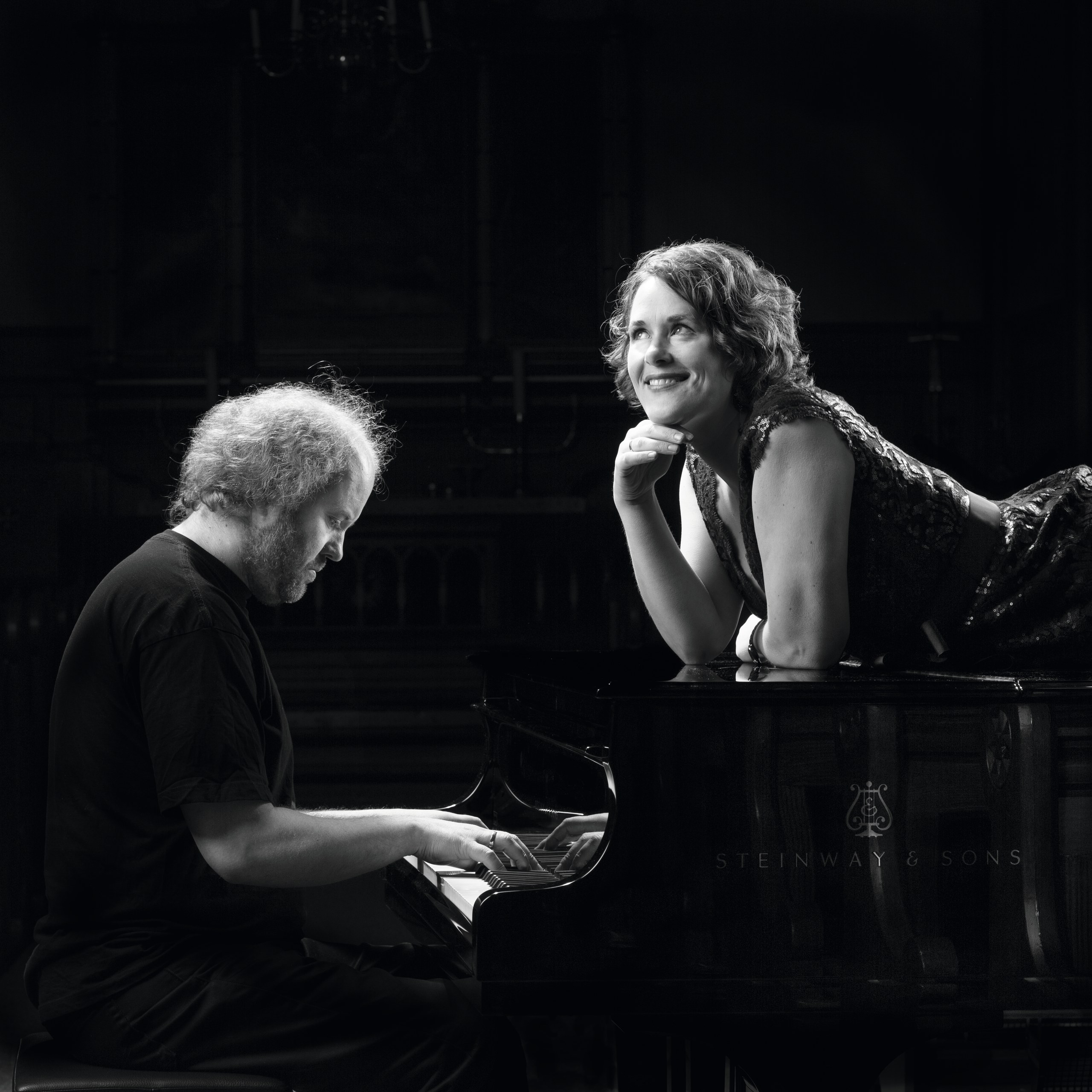
The New Song
Marianne Beate Kielland (Mezzo-soprano) | Nils Anders Mortensen (Piano)
Stream & download
Tracks
Helge Iberg (*1954)
LiebesKleineLieder
Henrik Hellstenius (*1963)
Håvard Lund (*1971)
Brahmanische Erzählungen
Edvard Hagerup Bull (1922–2012)
Gruk pour Soprane et Piano, Op. 53B
Credits
- Performer
- Marianne Beate Kielland (Mezzo-soprano) | Nils Anders Mortensen (Piano)
- Composer
- Helge Iberg | Henrik Hellstenius | Håvard Lund | Edvard Hagerup Bull
- Producer
- Vegard Landaas
- Engineer
- Thomas Wolden
- Editing
- Vegard Landaas
- Mastering
- Thomas Wolden
- Liner notes
- Marianne Beate Kielland
- English translation
- Jim Skurdall
- Executive producer
- Vegard Landaas
- Booklet editor
- Hege Wolleng
- Cover photo
- Espen Mortensen
- Artist photo
- Marianne Beate Kielland by Espen Mortensen
- Session photo
- Espen Mortensen
- Design
- Anna-Julia Granberg | Blunderbuss
- Recording location
- Vågan Church, Lofoten
- Recording country
- Norway
- Recording year
- 2014
- Recording dates
- 08.03.2014 | 09.03.2014 | 10.03.2014 | 11.03.2014
- Original source
- 44.1 kHz, 16 bit
- Discs / tracks
- 1 disc | 14 tracks
- Produced with support from
- Arts and Culture Norway | Fund for Performing Artists | Scene Finnmark
- Release year
- 2016
- Label
- LAWO Classics
- Duration
- 53:27
- EAN
- 7090020181097
- ISRC
- NOEHX1602010/140
Booklet text
We know many of them — the German Lied, the French chanson, the Scandinavian song — works for voice and piano. Countless such musical pieces have been written throughout history, mainly from Mozart's time on. But after a couple of hundred years, this form of composition fell "out of fashion", and composers often used other ways to accompany singers.
How do we think of classical song today? I challenged three composers to each write his "Lied", a piece of music for voice and piano, and received three remarkably different results. Two hundred years ago, the format was predictable; today, boundaries have dissolved, and the composer turns out whatever the heart desires. What these composers write about their own works appears later on.
In addition, we wished to include five wonderfully distinctive songs of Edvard Hagerup Bull — a composer of our own time, but one who was and remained controversial, and, as such, was essentially deprived of recognition and fame in Norway. Edvard Hagerup Bull was a grandnephew of Edvard Grieg, he studied with Messiaen and Milhaud, among others, and he lived a large part of his life in Paris.
Many are familiar with the short aphoristic poems of Piet Hein known as "grooks" — artful, thought-provoking texts with their unconventional way of looking at life. Coupled with Hagerup Bull's playful, humoristic music, they become musical gems deserving of attention and performance. We are pleased to have these songs on the recording! To be on the safe side, I wish to point out that the "grooks" are written in Danish, but I have chosen to sing the texts with Norwegian pronunciation.
— Marianne Beate Kielland
HELGE IBERG on LiebesKleineLieder
Erich Fried's poetry is not straightforwardly "musical". It is fashioned from concise and simple prose, like many poems in the modernist tradition. Yet the love poems have, naturally enough, a romantic touch that leaves room for musical intervention and adaptation. I have tried to maintain the unpretentiousness and lightness by using a simple tonality that continually leads and dissolves into abstract phrases, yet remains recognizable nonetheless. In the poem Was es ist (Fried's most familiar poem), I have availed myself of the musical cabaret tradition in order to underscore the burlesque-unceremonious wisdom in the poem. My word construction LiebesKleineLieder is meant concretely, but suggests at the same time that intense emotions are concealed in small things: Wenn ein schwerer Tropfen fällt/bebt das ganze Blatt./So bebt jedes Mal mein Herz/wenn dein Name auf es fällt.
HENRIK HELLSTENIUS on ...As the Last Blow Falls...
This work is dedicated to the memory of a friend who died much too early, and is inspired by the poem Schliesse mir die Augen beide by Theodor Storm, twice set to music by the composer Alban Berg.
The piece unfolds in one long and two shorter arcs. The piano propels the music forward in insistent, repetitive rhythmic and harmonic patterns, while the song flows rather slowly and, at times, lifelessly. The text to the piece is a synthesis of the original German and an English translation. The words themselves have such power that even though the line of the text is continually broken by the weaving together of the German and the English, the basic Romantic character of the text is more than well understood. The collision between the static musical lines and the frenetic fluctuation between languages is meant to create an imaginary extension lasting fourteen minutes of what could have been a few short seconds of a mental state.
HÅVARD LUND on Brahmin Stories (Brahmanische Erzählungen)
Writing music for someone offers great possibilities and the chance to investigate new areas and subjects. Marianne gave me the challenge to compose some Eastern-inspired pieces for the duo with Nils Mortensen in 2013.
My work speeded up when I found that the great German poet Friedrich Rückert had translated Persian texts into German (I guess feelings of self-importance deemed it a good thing to have my own Rückert lieder).
Persian mysticism and wisdom are far from my own north Norwegian background — which I tend to describe as outspoken, raw and unrefined — the opposite of what I have learned from Persian fine art and poetry.
These two short stories translated by Rückert in his Brahmanische Erzählungen (Brahmin Stories, 1839) presented wisdom in a way that fascinated me, and finding the key to the meaning of the texts took an unexpected length of time. I like to think that these Persian lines, wrapped in music by an impatient north Norwegian composer and performed by some of my favourite musicians, will entice some of you.
— English translation: Jim Skurdall