
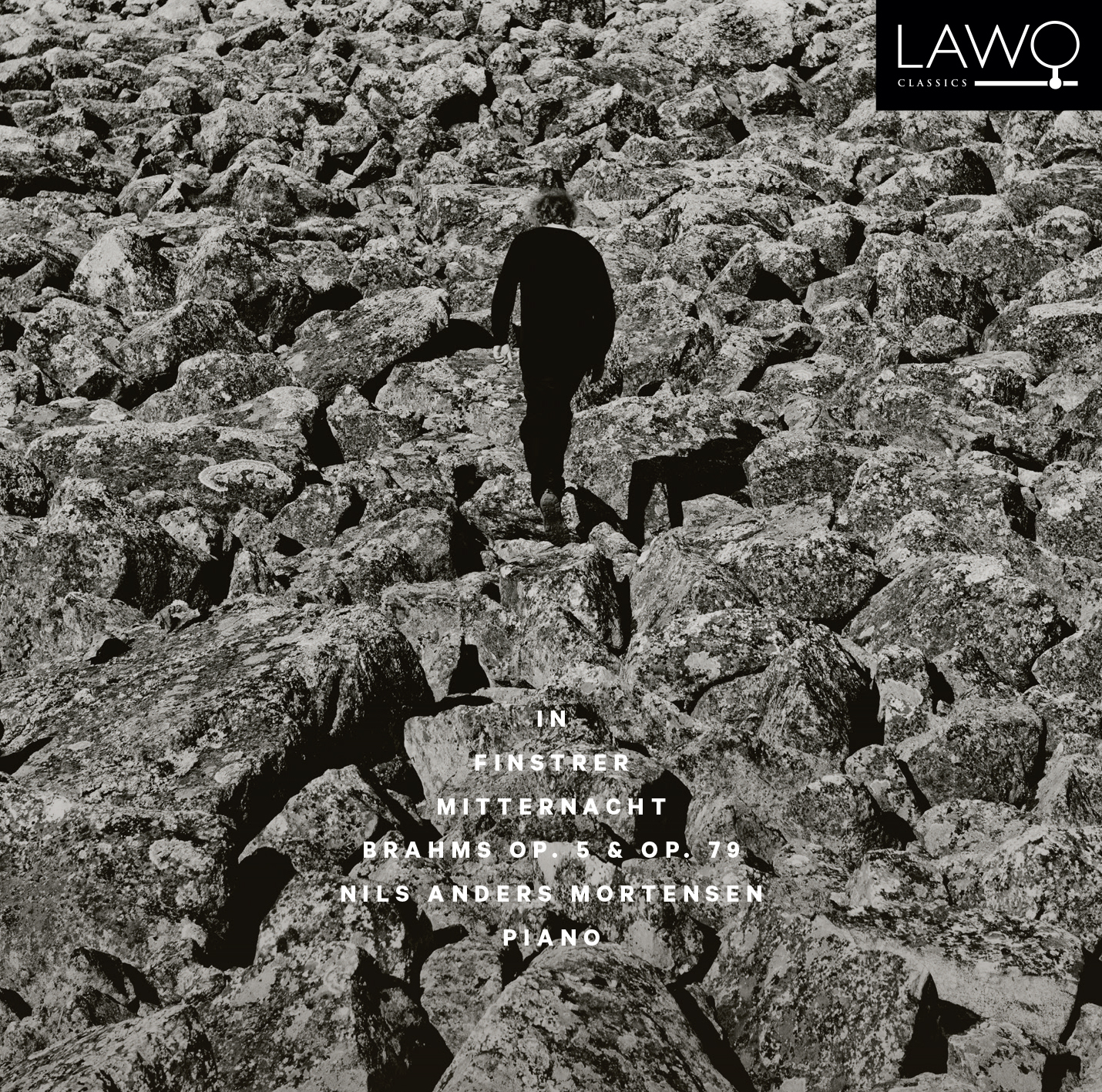
In finstrer Mitternacht Brahms op. 5 & o p . 7 9
Nils Anders Mortensen (Piano)
Stream & download
Tracks
Johannes Brahms (1833–1897)
Zwei Rhapsodien, Op. 79
Sonate Nr. 3, Op. 5
Ballade, Op. 10
Credits
- Performer
- Nils Anders Mortensen (Piano)
- Composer
- Johannes Brahms
- Producer
- Vegard Landaas
- Engineer
- Thomas Wolden
- Editing
- Vegard Landaas
- Mastering
- Thomas Wolden
- Liner notes
- Nils Anders Mortensen
- English translation
- Jim Skurdall
- Executive producer
- Vegard Landaas
- Booklet editor
- Hege Wolleng
- Cover photo
- Trym Ivar Bergsmo
- Artist photo
- Nils Anders Mortensen by Trym Ivar Bergsmo
- Session photo
- Trym Ivar Bergsmo
- Design
- Anna-Julia Granberg | Blunderbuss
- Recording location
- Jar Church, Bærum
- Recording country
- Norway
- Recording year
- 2013
- Recording dates
- 09.05.2013 | 10.05.2013 | 11.05.2013 | 12.05.2013 | 13.05.2013
- Original source
- DXD (352.8 kHz, 24 bit)
- Discs / tracks
- 1 disc | 8 tracks
- Release year
- 2015
- Label
- LAWO Classics
- Duration
- 58:24
- EAN
- 7090020180960
- ISRC
- NOEHX1508010/80
Video
Booklet text
Johannes Brahms' Sonata no. 3 for piano, opus 5, bears impressive testament to the young composer's formidable gift as a composer and pianist.
In the spring of 1853 the twenty-year-old Johannes Brahms embarked on a concert tour of his native Germany with the Hungarian violinist Eduard Reményi. During their travels Brahms met the renowned violin virtuoso Joseph Joachim, whom he had heard five years earlier in a performance of Beethoven's violin concerto. The two took to each other immediately, and Joachim was deeply impressed by what he heard of the young Brahms: '…and his compositions display such meaningfulness as I have never before seen in such a young artist,' he is reported to have commented. The following summer Joachim and Brahms spent several weeks together and laid the foundation of a friendship that was to last almost half a century. On the strength of his reputation as a renowned and respected performer, Joachim wrote a number of introductory letters on behalf of Brahms, including one to Robert and Clara Schumann. And in September of that same year Brahms met the Schumanns for the first time.
Brahms stayed in Düsseldorf for a month and met Robert and Clara Schumann almost daily for music making, conversation, studying and leisure. Brahms' talent aroused the Schumanns' enthusiasm and that autumn he was hailed as the new Beethoven by Robert Schumann in the Zeitschrift für neue Musik. It was during this period that Brahms composed his opus 5. 'In its heroic scale, unconventional layout, and high quality of thought it was one of the most impressive sonatas since those of Beethoven and Schubert,' writes music critic Calum MacDonald, who further suggests that Brahms wrote his sonata as a response to Liszt's B minor sonata, which Brahms had heard Liszt play in the summer of 1853. The sonata opus 5 was the last work for solo piano in the genre that Brahms would write.
In addition to echoes of Brahms' leading example Beethoven (epitomised by, among other things, several references to the famous fate motif in Beethoven's fifth) there are many qualities — rhythmic, melodic, harmonic — that the listener will recognise as typical of Brahms, such as his predilection for plagal cadences — at the end of movements two and four, for example — that give the music a darker colour and a modal flavour which in turn may reflect Brahms' interest in older music and folk music.
The Sonata no. 3, op. 5 consists of five movements: Allegro maestoso, Andante, Scherzo, Intermezzo, Finale. The formal construction of the work and the use of classical formal techniques might lead one to imagine that this is absolute or 'pure' music without any programmatic content. There are, however, many layers of extra-musical meaning in the work that contribute to its unique character. Motifs from well-known Lieder and poetic quotations, which constitute the work's basic material, strongly suggest romantic qualities. And, as pointed out by musicologist George Bozarth, the Andante movement (and its counterparts in the two preceding sonatas opp. 1 and 2) could be described as being 'Brahms' Lieder ohne Worte'. It is interesting to note that Brahms composed the Andante movements of his sonatas first; thus these poetically inspired 'songs without words' constitute a thematic point of departure and point of focus for the entire work. The American musicologist Walter Frisch referred to this as writing 'whole sonatas…from the inside out.' Perhaps this is a key to understanding how Brahms manages to maintain such lyrical, expressive qualities throughout the work.
At the beginning of the second movement Brahms inscribed his manuscript with the following three lines from a poem by C.O. Sternau (pseudonym of Otto Inkermann, 1823–62):
Der Abend dämmert, das Mondlicht scheint / Da sind zwei Herzen in Liebe vereint / Und halten sich selig umfangen
The poem continues: Es weht und rauschet durch die Luft, / Als brächten die Rosen all ihren Duft, / Als kämen die Englein gegangen. // Ich küsse dich zum ersten Mal, / Ich küsse dich viel tausend Mal. / Ich küsse dich immer wieder; / Auf Deine Wange lange Zeit / Rollt manche Träne der Seligkeit / Wie eine Perle nieder. // Die Stunde verrauscht, der Morgen scheint, / Wir sind noch wieder in Liebe vereint / Und halten uns selig umfangen. / Es weht und rauschet durch die Luft, / Als brächten die Rosen all ihren Duft, / Als kämen die Englein gegangen.
The evening falls, the moon shines, two hearts united in love hold each other in fond embrace. There is movement and rustling in the air as if the roses were bringing all their scent, as if angels were coming. I kiss you once, I kiss you a thousand times. I kiss you yet more; tears of joy roll endlessly down your cheeks like pearls. The moment fades and morning dawns, we are still united in love holding each other in fond embrace. There is movement and rustling in the air as if the roses were bringing all their scent, as if angels were coming.
Frisch describes the second movement as programme music, a love scene between two lovers in the moonlight. After the lovers have bidden each other farewell, it is as if the one remains, humming part of the folk song Schildwachtlied (I stand in the darkest midnight) by Friedrich Silcher (words ascribed to Wilhelm Hauff, 1802–27). The lovers part; love is discernible in the distance symbolised by the appearance of the song in the subdominant key of D flat in which the movement comes to an end. The writer John Rink refers to this movement as 'instrumental commentary on the love scene'. In the light of this there can be little doubt of the sonata's programmatic content. George Bozarth also likened the sonata to a 'Bildungsroman' in which the main character learns of life's harsh realities through experience.
Steh ich in finstrer Mitternacht / So einsam auf der stillen Wacht, / So denk ich an mein fernes Lieb, / Ob mir's auch treu und hold verblieb. // Als ich zur Fahne fort gemüßt, / Hat sie so herzlich mich geküßt, / Mit Bändern meinen Hut geschmückt / Und weinend mich ans Herz gedrückt. // Sie liebt mich noch, sie ist mir gut, / Drum bin ich froh und wohlgemut. / Mein Herz schlägt warm in kalter Nacht, / Wenn es ans treue Lieb gedacht. // Jetzt bei der Lampe mildem Schein / Gehst du wohl in dein Kämmerlein, / Und schickst dein Nachtgebet zum Herrn / Auch für den Liebsten in der Fern. // Doch wenn du traurig bist und weinst, / Mich von Gefahr umrungen meinst, / Sei ruhig, bin in Gottes Hut, / Er liebt ein treu Soldatenblut. // Die Glocke schlägt, bald naht die Rund / Und löst mich ab zu dieser Stund. / Schlaf wohl im stillen Kämmerlein / Und denk in deinen Träumen mein.
I stand in the darkest midnight alone on my watch, thinking of my distant love, if she too is good and faithful. When I departed under the flag she kissed me with such passion, adorned my hat with ribbons, and, crying, held me to her heart. She loves me still and is good to me, therefore I am happy and at ease. My heart beats warm in the cold night as I think on my true love. And now, by the soft glow of the lamp, you enter your chamber and say an evening prayer to the Lord for your loved one far away. But when you are sad and weep and fear that I am in danger, be calm; I am under God's wing, he loves a faithful soldier. The bell sounds, the company approaches to relieve me from my watch. Sleep well in your little chamber and think on me in your dreams.
The ensuing Scherzo, with its structurally balancing central trio section, is highly expressive and forms a strong contrast to the two surrounding Andante movements. The fourth movement, Intermezzo, marked Andante molto, is subtitled 'Rückblick' and looks back on the second movement both thematically and emotionally. This movement can possibly be linked to another Sternau poem Bitte that was discovered in the notebooks of Brahms by his friend and biographer Max Kalbeck.
The sonata's symmetrical structure is brought to completion by the two outer movements, both of which are composed according to classical formal principles. The opening movement is a variant of sonata form in which the different themes are really just transformations of the original, main theme. The expressive contrast between these variations of the main theme creates a tension and dialogue reminiscent of the musical discourse of conventional sonata form. Returning to the idea of a compositional model 'from the inside out' we might consider the first movement as an introduction to the second, an overture to the love scene. The final movement, with its changeable, extrovert character, is composed in rondo form and concludes with a brilliant, virtuosic coda in the parallel key of F major. In the B section of this movement we encounter the F-A-E motif, which is associated with Brahms' above-mentioned close friend Joseph Joachim. Joachim, who was unmarried, described himself as 'free but lonely' — 'frei aber einsam' — hence F-A-E. Perhaps the inclusion of this motif is a reflection on the two hearts that part in the second movement, and might therefore be considered a motto for the emotional character of the sonata: free but lonely. And perhaps at this time Brahms had already begun to entertain deeper feelings for Clara Schumann.
The two Rhapsodies op. 79 were composed in 1879 when Brahms was in his mid-forties and at the peak of his career. These two compositions are the largest free-standing single-movement piano pieces Brahms had written since the Scherzo, op. 4. 'Rhapsody' is perhaps most often associated with single-movement works in free form; opus 79, however, consists of two pieces with very clear formal structures: no. 1 in B minor has a ternary form, while no. 2 in G minor is in sonata form. The Rhapsodies are dedicated to Elizabet von Herzogenberg, Brahms' student and lover.
For the Ballad op. 10, no. 1, Brahms was inspired by the Scottish ballad Edward (which he later set for vocal duet in his opus 75):
'Why does your sword so drip with blood, Edward, Edward? Why does your sword so drip with blood? And why are ye so sad, O?' 'O, I have killed my hawk so good, Mother, Mother, O, I have killed my hawk so good, And I had no other but he, O.'
'Your hawk's blood was never so red, Edward, Edward, Your hawk's blood was never so red, My dear son, I tell thee, O.' 'O, I have killed my red-roan steed, Mother, Mother, O, I have killed my red-roan steed, That was so fair and free, O.'
'Your steed was old, and ye've got more, Edward, Edward, Your steed was old and ye've got more, Some other grief ye bear, O.' 'O, I have killed my father dear, Mother, Mother, O, I have killed my father dear, Ala, and woe is me, O.'
'And what penance will ye pay for that, Edward, Edward? And what penance will ye pay for that? My dear son now tell me, O.' 'I'll set my feet in yonder boat, Mother, Mother, I'll set my feet in yonder boat, And I'll sail o'er the sea, O.'
'And what will ye do with your towers and your hall, Edward, Edward, And what will ye do with your towers and your hall, That were so fair to see, O?' 'I'll let them stand till they fall down, Mother, Mother, I'll let them stand till they fall down, For here never more I'll be, O.'
'And what will ye leave to your children and your wife, Edward, Edward? And what will ye leave to your children and your wife? When ye sail o'er the sea, O?' 'The whole wide world, let them beg through life, Mother, Mother, The whole wide world, let them beg through life, For them never more will I see, O.'
'And what will ye leave to your own Mother dear, Edward, Edward? And what will ye leave to your own Mother dear? My dear son, now tell me, O.' 'The curse of Hell from me shall ye bear, Mother, Mother, The curse of Hell from me shall ye bear, Since counsel ye gave to me, O.'
— Andrew Smith