
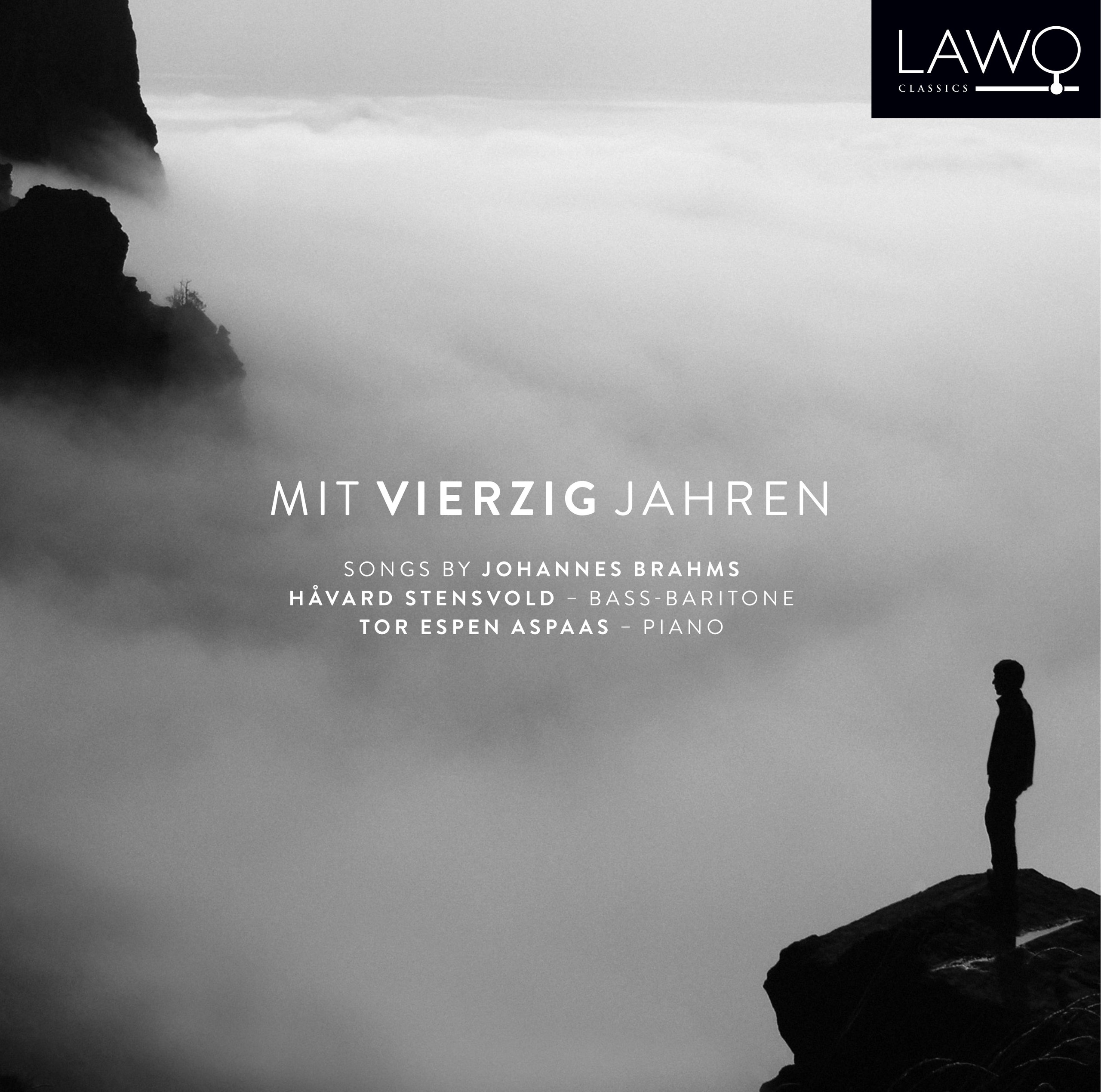
Mit vierzig Jahren – Songs by Johannes Brahms
Håvard Stensvold (Baritone) | Tor Espen Aspaas (Piano)
TURNING-FORTY CRISIS À LA BRAHMS
Following the success of “Vinterreise”(LWC1013), featuring a Norwegian version of Schubert’s song cycle, Håvard Stensvold and Tor Espen Aspaas have now released their second album on the LAWO Classics label — “Mit vierzig Jahren”. This time we are offered up the songs of Johannes Brahms with their original German texts. The album title is taken from one of the songs, which gives rise to the turning-forty crisis. “At age forty you are standing on the mountain top, and, before you know it, your life is over.”
Stensvold (43) and Aspaas (43) have both made it through this juncture, and on this recording they have collected some of Brahms’s finest, from the wonderful narrative songs to the more intimate and tender. A favourite is “Mondnacht”, which has a more famous half brother in Schumann’s version.
Bass-baritone Håvard Stensvold is a trained opera singer. In addition to having sung numerous roles on Scandinavian stages, Stensvold has appeared with most of the major Scandinavian symphony orchestras. His recording releases include the aforementioned “Vinterreise”, which features his own free adaptations of the original texts.
Pianist Tor Espen Aspaas is professor at the Norwegian Academy of Music. He is one of the most distinguished pianists of his generation with a number of critically acclaimed recordings to his name. He is also one of the founders of the Røros Winter Chamber Music Festival.
Stream & download
Tracks
Johannes Brahms (1833–1897)
Credits
- Performer
- Håvard Stensvold (Baritone) | Tor Espen Aspaas (Piano)
- Composer
- Johannes Brahms
- Producer
- Vegard Landaas
- Engineer
- Thomas Wolden
- Editing
- Vegard Landaas
- Mastering
- Thomas Wolden
- Liner notes
- Håvard Stensvold | Tor Espen Aspaas
- English translation
- Jim Skurdall
- Executive producer
- Vegard Landaas
- Booklet editor
- Hege Wolleng
- Cover photo
- Blunderbuss / Anette l'Orange
- Artist photo
- Håvard Stensvold by Tevje Akerø
- Design
- Anette L’orange | Blunderbuss
- Recording location
- Sofienberg Church, Oslo
- Recording country
- Norway
- Original source
- 96 kHz, 24 bit
- Discs / tracks
- 1 disc | 19 tracks
- Release year
- 2015
- Label
- LAWO Classics
- Duration
- 46:13
- EAN
- 7090020180915
- ISRC
- NOEHX1503010/190
Booklet text
When leaving to perform at Drottningholm Palace Theatre outside of Stockholm in the summer of 2010, I tucked all four albums of Brahms lieder into my luggage. In the warm summer weather, between rehearsals for Don Giovanni, I painstakingly went through all the songs in search of the very best ones. There is usually a reason why certain songs are better known than others, which makes it all the more enjoyable to discover songs that are both unknown — to me at least — and totally fantastic. Such was the case with «Mondnacht», with a text by Joseph Freiherr von Eichendorff.
Robert Schumann had established the standard in 1840, when he set the poem to music in his Liederkreis op. 39. In 1850 the seventeen-year-old Johannes is said to have sent Robert some of his compositions, which reportedly were returned, unopened. Brahms is known to have declared that he scarcely had any knowledge of Schumann whatsoever until the late summer of 1853. Brahms's «Mondnacht», which lacks an opus number, is probably from the same year. It is thus very likely that Brahms did not have any knowledge of Schumann's song, which may explain why he would have set the same poem to music. Schumann's rendition is brilliant, but I believe the Brahms version deserves greater attention. It has suffered, unjustifiably so, from having a more famous half brother.
Of course there were some songs I had decided on before I began. I am partial to wonderful narrative songs like «Wie rafft' ich mich» and, especially, «Von ewiger Liebe». Both have a number of Brahmsian lines that a singer cannot help but love. Then I found a song in somewhat the same category, a riveting narrative about a man who conceals himself outside his own house to finally obtain proof of his wife's infidelity — thus the title «Verrat» («Betrayal»). He hears his wife say: «Come back tomorrow, and don't keep me waiting, for my husband is far away». But the man kills his wife's lover, who is found dead the following day. I came across several different recordings, including one by the incomparable Dietrich Fischer-Dieskau, known for having recorded every imaginable song by all the well-known German composers of lieder. However, in the fast and furious middle section I noticed that he did not sing the discordant tone that is called for, and he was not alone in this respect. Thinking this must be an error in my notation, I consulted with Dr. Michael Struck of the Research Centre, Johannes Brahms Gesamtausgabe, in Kiel. He gave many good reasons for believing that the notation was correct, observing in particular that «the dissonance on the word 'Kuss' ('kiss') is more suitable as an image of the man's anguish and disappointment over his wife's betrayal». I have thus attempted to make the most of precisely that tone, well aware that I can at least surpass the late, great Herr Dieskau in something.
As I dug deeper into Brahms's lieder, I observed that approximately every other song had something about a nightingale. What was it about this bird that fascinated nineteenth-century poets? In Romanticism, of course, the nightingale was used as a symbol of art, both that of the singer and the poet, usually as an image of unrequited love, «the sobbing nightingales». In truth, however, the nightingale only sings when it feels safe, so there is nothing whatsoever plaintive about its song, even though it may sound that way. I decided to steer clear of all nightingale songs, and I believe I succeeded. It is difficult, on the other hand, to avoid unhappy love songs when you are working with lieder from this period. But I have tried to find texts that are not one-sided and that illustrate various aspects of this feeling that we all have known — everything from the maiden in «Treue Liebe» waiting for her beloved who never returns home from the sea, and who in the end chooses to drown herself in order to «be reunited with him», to the bitterness of the man in «Schön war, das ich dir weihte», and the debilitating hopelessness in «Nicht mehr zu dir zu gehen». And then, in contrast to this, the playfulness in «Vergebliches Ständchen», «Spannung», and «In den Beeren».
Toward the very end of the fourth album there was a song that caught my attention because of the title, «Mit vierzig Jahren.» My outstanding pianist, Tor Espen, and I were both perilously close to turning forty at the time, and I thought, «This is right on the mark» — until I had a closer look at the text, which can be summarized in this manner: «At age forty you are standing on the mountain top, and, before you know it, your life is over.» It seemed an odd text, and I was uncertain whether there was hidden irony to be found in it. Yet it was clear that Brahms, who was fifty when he composed the song, had taken the text seriously, and so gradually I understood that I must do the same. You stand on top of the mountain and realize with a sense of resignation that you have lived a good portion of your life, one half of it if you are lucky. Of course life expectancy was shorter in Brahms's time, and in most cases walking down a mountain takes less time than walking up! So even though you who read this may have passed forty by a good margin, don't despair. Delight in the descent as a fantastic nature experience. Life is glorious.
Enjoy!
— Håvard Stensvold · English translation: Jim Skurdall